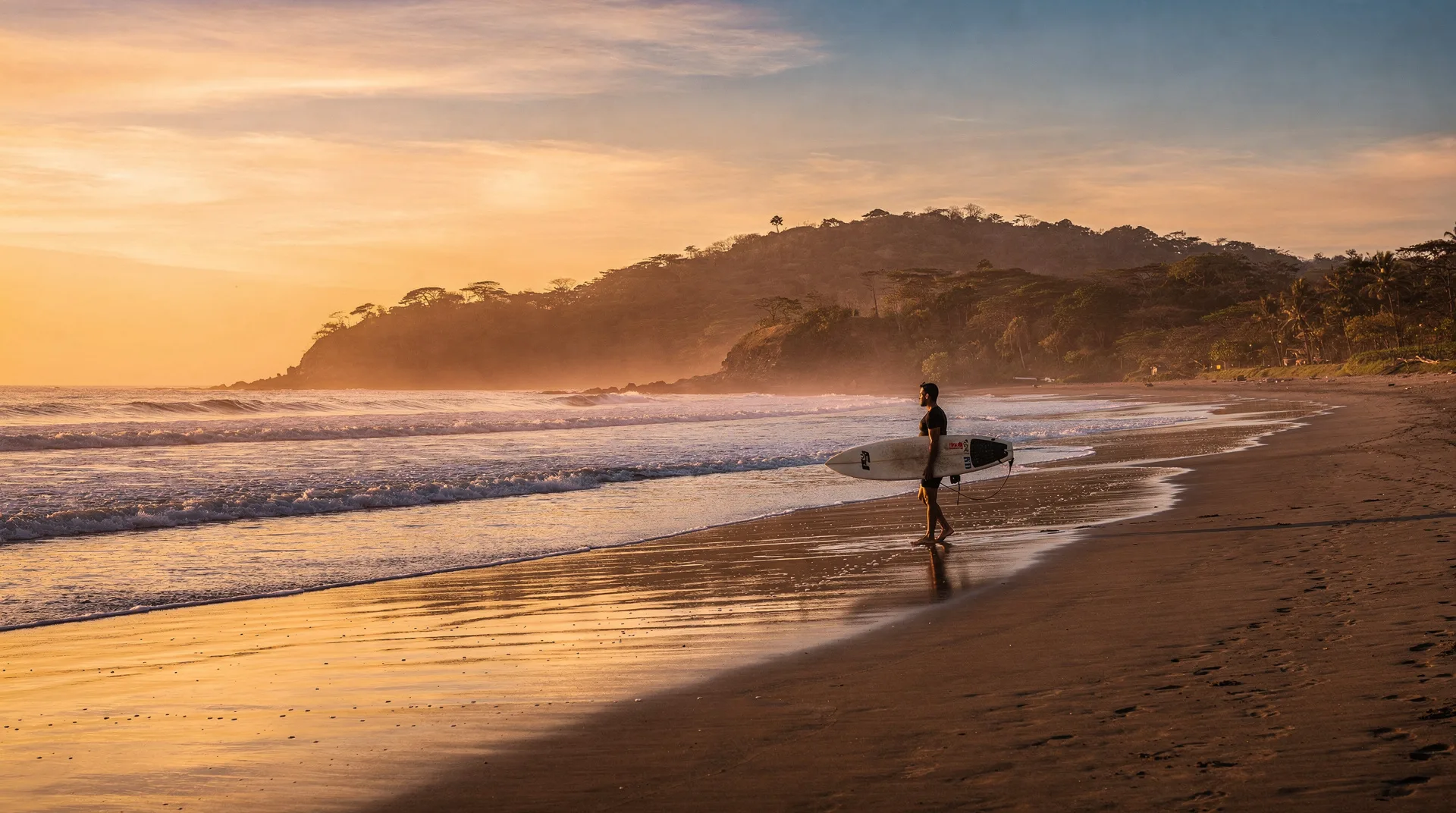
Nosara — the Nicoya Peninsula's yoga and surf sanctuary
Plan your Nosara trip: yoga retreats, surf at Playa Guiones, sunset catamarans, turtle tours, and cooking classes. Nicoya Peninsula's eco-conscious gem.
Top experiences nearby
Quick facts
- Best time to visit
- November to April (dry season and best surf windows)
- Days needed
- 4 to 5 days
- Getting there
- 2.5 hours from Liberia airport; 5.5 hours from San José via Nicoya Peninsula
- Budget per day
- USD 80–120 budget · USD 160–280 mid-range · USD 400+ retreat
Costa Rica’s most self-consciously green beach community
Nosara is what happens when a community decides — deliberately, consistently, over decades — to limit development, ban large hotel chains, restrict building heights, protect the forested estuary, and orient everything around surf, yoga, and the natural environment. The result is one of the most distinctive beach towns in Central America: a place where a dirt-road grid through dense vegetation connects boutique yoga retreats to world-class surf breaks without a single fast-food chain or neon sign in sight.
The community is made up of three parts: the original Tico village of Nosara (inland, slightly rough around the edges), the beach area of Playa Guiones (where the surf schools and yoga studios cluster), and the estuary zone connecting them. For visitors, the beach area is the destination.
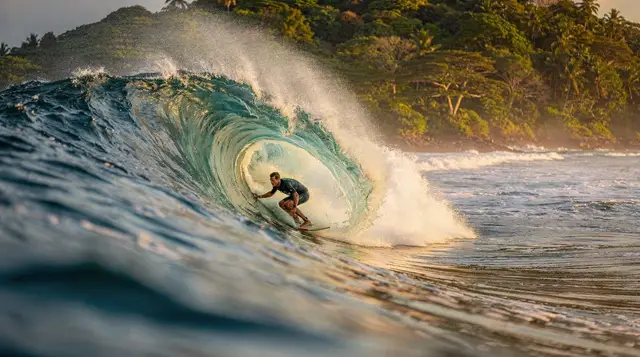
Playa Guiones is a 7-kilometre crescent of consistent beach break that produces waves 300 days a year. It is widely considered one of the top intermediate-to-advanced surf spots in Central America. The consistent groundswell, the long rideable sections, and the lack of crowds (by Costa Rican beach standards) attract dedicated surf travellers who have been coming back for years.
The yoga scene is equally serious: Bodhi Tree Yoga Resort is one of the most respected yoga retreat centres in the Americas, drawing international teachers for residencies and intensives. The Nosara Yoga Institute has been operating since the 1990s. Even hotels without a yoga affiliation typically offer morning classes.
Surfing at Playa Guiones
Playa Guiones is an intermediate-to-advanced beach break. Unlike Tamarindo’s beginner-friendly softer conditions, Guiones produces waves with more power and faster sections. The offshore wind (most consistent November–March) creates clean conditions; the swell tends to be more organised than Jacó or Tamarindo, with longer sets and more defined peaks.
Surf schools in Nosara are of generally high quality — the community’s standards have historically been higher than beach towns more focused on volume. Safari Surf School, Corky Carroll’s Surf School, and Jungle Surf have strong reputations for experienced instruction. Group lessons run $80–$100; private $120–$150. Board rental is $20–$25 per day.
For beginners, Guiones is manageable in the small summer swell months (May–July), but the dry season swell (November–March) is better approached with prior experience. Our dedicated Nosara surf guide breaks down the different peaks along the 7-kilometre beach, tide preferences, and which sections suit which skill level.
surf lessons at Tamarindo — transferable format — from $50 — if you are working your way north on the Nicoya Peninsula, getting your foundational surf lessons at Tamarindo before arriving in Nosara to practise on better waves makes practical sense. The technique is identical; the waves at Nosara reward more developed skills.
Yoga and wellness
Nosara’s yoga infrastructure is serious. Unlike beach towns where a yoga class is an afterthought added to the spa menu, here the retreat centres built the place.
Bodhi Tree Yoga Resort: A dedicated yoga and wellness property with multiple studios, a saltwater pool, in-house spa, restaurant, and a year-round programme of intensives and teacher trainings. Day passes for drop-in classes run $25. The lunch menu is outstanding — fresh and plant-forward without being preachy.
Nosara Yoga Institute: The oldest yoga centre in the area, offering drop-in classes ($20) and longer programmes. More grassroots in atmosphere than Bodhi Tree.
Harmony Hotel: Famous in the international yoga community for its retreat packages. The beach-facing property has its own spring-fed saltwater pool and a full spa.
Blue Spirit Retreat Center: A dedicated residential retreat centre hosting international teachers. Not for drop-in day visitors but worth booking for longer stays (5–7 day programmes from $2,000 all-inclusive).
The wellness infrastructure extends beyond yoga: surf therapy programmes, equine-assisted therapy, holistic nutrition consultations, and sound healing are all available in Nosara — the kind of offering that would seem affected in other places but feels organic here. For anyone weighing a retreat against a teacher-training programme, our Nosara yoga retreats guide compares the main centres by price, style, and length of stay.
Nosara for digital nomads and longer stays
Nosara has quietly become one of Costa Rica’s most established digital-nomad bases, alongside Santa Teresa and Tamarindo — a function of reliable fibre internet in the Guiones area, a critical mass of co-working spaces (Nosara Coworking and WeWork-style desks inside several cafés), and a community used to long-stay visitors rather than one-week tourists. Monthly furnished rentals near Guiones run $1,200–$2,500 depending on proximity to the beach and pool access; further inland toward the village, $700–$1,000 is realistic.
Most long-stayers combine remote work with daily surf or yoga rather than treating it as a pure holiday, which is part of why the town’s rhythm feels calmer than more transient beach destinations. Anyone planning a stay beyond the 90-day tourist entry should read our digital nomad visa guide before committing to a lease.
Nosara vs Santa Teresa vs Tamarindo
All three are Nicoya Peninsula beach towns with strong surf and wellness identities, but they suit different travellers:
| Nosara | Santa Teresa | Tamarindo | |
|---|---|---|---|
| Surf level | Intermediate–advanced | Beginner–advanced (mixed breaks) | Beginner-friendly |
| Nightlife | Minimal, early nights | Moderate, beach bars | Most developed |
| Development control | Strict (no chains, low-rise) | Looser, growing fast | Most built-up |
| Access | Hardest (dirt roads, flights) | Hard (ferry + dirt road) | Easiest (paved, closest to LIR) |
| Best for | Yoga, wellness, serious surf | Younger surf/nomad crowd | Families, first-timers |
Santa Teresa sits across the peninsula’s southern tip and shares Nosara’s wellness culture with a livelier bar scene; Tamarindo is the easiest introduction to this coast for anyone unwilling to tackle dirt roads.
Cooking class and cultural connection
Nosara traditional Costa Rican cooking class and meal — from $95 — $95 for 3 hours, learning to prepare gallo pinto, ceviche, arroz con pollo, and fresh tortillas with a local host. One of the better ways to understand Tico food culture in a region where most restaurants cater to international visitor tastes. The $95 includes the meal and drinks.
Sunset catamaran
The Nosara coast at sunset, with Guiones and the estuary spreading south and the Pacific stretching west, is one of the more photogenic moments available on this coast.
Nosara catamaran sunset charter — from $135 — $135 for 3 hours, departing around 15:30 for a coastal sail with drinks. The catamaran is based from the beach south of Guiones. Spinner dolphins and flying fish are common; occasionally whale sightings in season. A relaxed, uncrowded experience suited to the Nosara atmosphere.
Turtle watching at Playa Ostional
Playa Ostional, 10 km north of Nosara, is one of the most important Olive Ridley sea turtle nesting sites in the world. The arrival events (called “arribadas”) involve thousands — occasionally hundreds of thousands — of turtles coming ashore simultaneously to nest, typically during the dark phase of the moon between August and December. The sight of the beach covered in turtles is extraordinary; it is one of the great mass-wildlife events on earth.
Tours from Nosara to Ostional run $95 during nesting season. The timing depends on the lunar cycle and local turtle activity — operators will advise on the best night. Entry to the beach is regulated by ADIO (the Ostional Development Association) rather than SINAC; this community-based management model is a good practice case study and revenues directly support local conservation. Our Ostional arribada guide explains how the arribada cycle works and how to time a visit around it.
Tamarindo turtle nesting tour — similar format — from $95 — if Ostional tours are not available on your dates, the leatherback turtle tours from Tamarindo (1.5 hours north) operate October–March and provide an equivalent experience with a different species.
The Nosara estuary
The estuary at the south end of Playa Guiones connects the beach to the inland river system and provides excellent wildlife watching — crocodiles, caimans, waterbirds, and occasional ocelots at dusk. Kayaking or paddleboarding through the estuary channels is one of the quieter activities in Nosara and one of the most likely to produce an intimate wildlife encounter. Most surf camps and yoga resorts can arrange estuary tours ($45–$65 for 2 hours).
Wildlife around Nosara
Beyond the estuary crocodiles and caimans, the forest between the village and Guiones shelters howler and white-faced capuchin monkeys, agoutis, and coatis, most active at dawn and dusk. Our monkey species guide helps identify what you are seeing, and the sloth-spotting guide covers where sightings are most reliable if the estuary tour doesn’t turn one up — sloths are less common in Nosara’s drier forest than in the wetter Caribbean or southern Pacific zones.
Where to eat
La Luna Restaurant (Playa Pelada): The best-positioned restaurant in Nosara — a sunset terrace over Playa Pelada, excellent ceviche, fresh tuna, and good cocktails. $25–$45 per person. Go at 16:00 for the light.
Café de Paris (Guiones area): A French-run bakery and café with the best breakfasts in Nosara — real croissants, granola, fresh smoothies, and strong coffee. Under $15.
L’Angolo (Guiones): Italian restaurant with good pasta and wood-fired pizza. Popular with the resident expat community. $20–$35.
Robin’s Smoothies (Guiones strip): Cold-pressed juices, açaí bowls, and healthy snacks. Under $12. The quintessential Nosara breakfast stop.
Olga’s (near Ostional road): The most honest local soda — rice, beans, fresh fish, gallo pinto, and a $8 casado. Worth the 10-minute drive from the main beach area.
Where to stay
Luxury ($300+/night): Harmony Hotel is the standard reference — an adults-only eco-resort with saltwater pool, yoga programme, and beach location. Expensive but genuinely good. Lagarta Lodge has spectacular views over the Nosara estuary and the coast from its hillside position.
Mid-range ($120–$250/night): Cafe Playa Negra offers well-designed rooms in a quiet location. The Nosara Beach House is a boutique property with a small pool and strong reviews. Giardino Tropicale is excellent value for a proper hotel experience with pool.
Budget ($50–$100/night): The Nosara hostel scene is more limited than in Tamarindo or Puerto Viejo — Nosara’s brand has discouraged large party-hostel development. Surf camp packages (dorm + lessons + board) running $90–$120 per night all-in are the best budget formula here.
Getting there
Nosara is the most logistically challenging of the major Guanacaste destinations. From Liberia airport (LIR), the drive takes 2.5 hours — including a stretch of dirt road (10–15 km) that requires a 4WD or at minimum high-clearance vehicle. In dry season, a regular car can sometimes manage; in green season, 4WD is essential.
From San José, the route goes via Nicoya (5–5.5 hours). Alternatively, take the Puntarenas ferry to the Nicoya Peninsula (1h20 crossing) and drive north — about 4.5 hours total from San José.
Sansa and Aerobell operate small-aircraft flights from San José to the Nosara airstrip ($120–$150 one way, 45 minutes). For travellers who want to skip the dirt road entirely, this is the most reliable option, particularly in green season.
Shared shuttles from Liberia and San José do run to Nosara but the roads require 4WD-equipped vehicles; check your operator’s vehicle type before booking.
Frequently asked questions about Nosara
Is Nosara good for beginner surfers?
Manageable but not ideal for complete beginners. Guiones produces waves with more power than typical beginner-friendly breaks. If you have zero experience, Tamarindo or Jacó offer a gentler learning environment. Come to Nosara after 2–3 lessons elsewhere.
Do I need a 4WD to get to Nosara?
For the approach roads, yes — particularly in green season (May–November). The dirt sections between Nicoya and the coast are steep and often muddy during rainy months. In dry season (December–April) a high-clearance vehicle can manage, but a 4WD is always the safer choice. Some visitors fly in to avoid the road entirely.
Is Nosara expensive compared to other Guanacaste beaches?
Yes. The deliberate restriction on development and the wellness-resort brand positioning have pushed prices above Tamarindo or Playas del Coco. Budget travellers do exist in Nosara but options are fewer. Expect to pay 20–40% more for equivalent accommodation compared to Tamarindo.
What is the Nosara estuary like to kayak?
Excellent. The mangrove channels are calm enough for beginners, long enough (3–5 km) for a proper excursion, and richly inhabited by wildlife that is easier to approach quietly by kayak than by motorised boat. Best in early morning (06:30–09:00) when caiman activity is highest and the light is good.
How to fit Nosara into your itinerary
Nosara works best as a 4–5 night destination on a Nicoya Peninsula circuit: Liberia (arrival) → Tamarindo (2 nights) → Nosara (4 nights) → Santa Teresa (3 nights) → Montezuma/ferry → Pacific coast. The 7-day Nicoya Peninsula itinerary covers this route.
Alternatively, Nosara as a standalone 5-night retreat — fly in from San José, surf or yoga daily, fly out — is increasingly common for visitors who have done the main circuit before. Travellers who find Nosara’s development restrictions and higher prices off-putting sometimes prefer the quieter, less-developed Sámara 40 minutes south, which shares the calmer, family-friendlier end of the surf spectrum.