Free hot springs near Arenal: the Río Chollín guide
Are there free hot springs near Arenal?
Yes — Río Chollín flows under a bridge on highway 142, about 14 km from La Fortuna. Volcanic water mixes with a cool stream in a natural pool that's free to access. Safety caveats: flash flood risk in green season and no facilities. Best in dry season, mornings only.
The appeal of free hot springs — and why you should read the safety section first
Soaking in volcanic thermal water a few metres from a multi-million dollar luxury resort, for free, is one of those genuinely satisfying travel experiences that Costa Rica makes possible. Río Chollín near Tabacón is exactly that situation: a natural thermal river accessible from a public roadside point on highway 142, with the same volcanic water source that Tabacón charges $110 to soak in flowing under a bridge metres away.
This guide is honest about both the appeal and the risks. The risks are real — not exaggerated for legal reasons, but actual physical hazards that vary significantly by season. Read the safety section before planning your visit.
| Where | Highway 142, ~14 km west of La Fortuna, near Tabacón |
| Cost | Free |
| Best time | Dry season, mornings before noon |
| Bring | Water shoes, towel, dry bag, no valuables |
| Avoid | Green season afternoons, visiting alone |
Where Río Chollín is and how to find it
Río Chollín is located approximately 13-14 km west of La Fortuna on highway 142, very close to the Tabacón resort entrance. The access point is a roadside pull-off (unofficial — no signage) near the bridge where the thermal water crosses under the road.
Navigation: If you’re driving west from La Fortuna, watch for the Tabacón entrance on your right. Approximately 200-300 m past Tabacón (or 500 m before it, depending on your approach direction), the road crosses a small bridge. The thermal river is visible from the bridge. A pull-off exists on the side of the road where locals and budget travellers park.
By taxi: Tell the driver “Río Chollín, cerca de Tabacón” — the free hot spring by the bridge near Tabacón. Most local taxi drivers know it, though some may express mild reluctance since the drop-off is on a highway rather than a proper car park.
By rental car: The most practical option. There’s a gravel shoulder where several vehicles can park. Never leave valuables visible in the car — highway 142 does have occasional vehicle break-ins near tourist activity areas.
What the thermal river experience is actually like
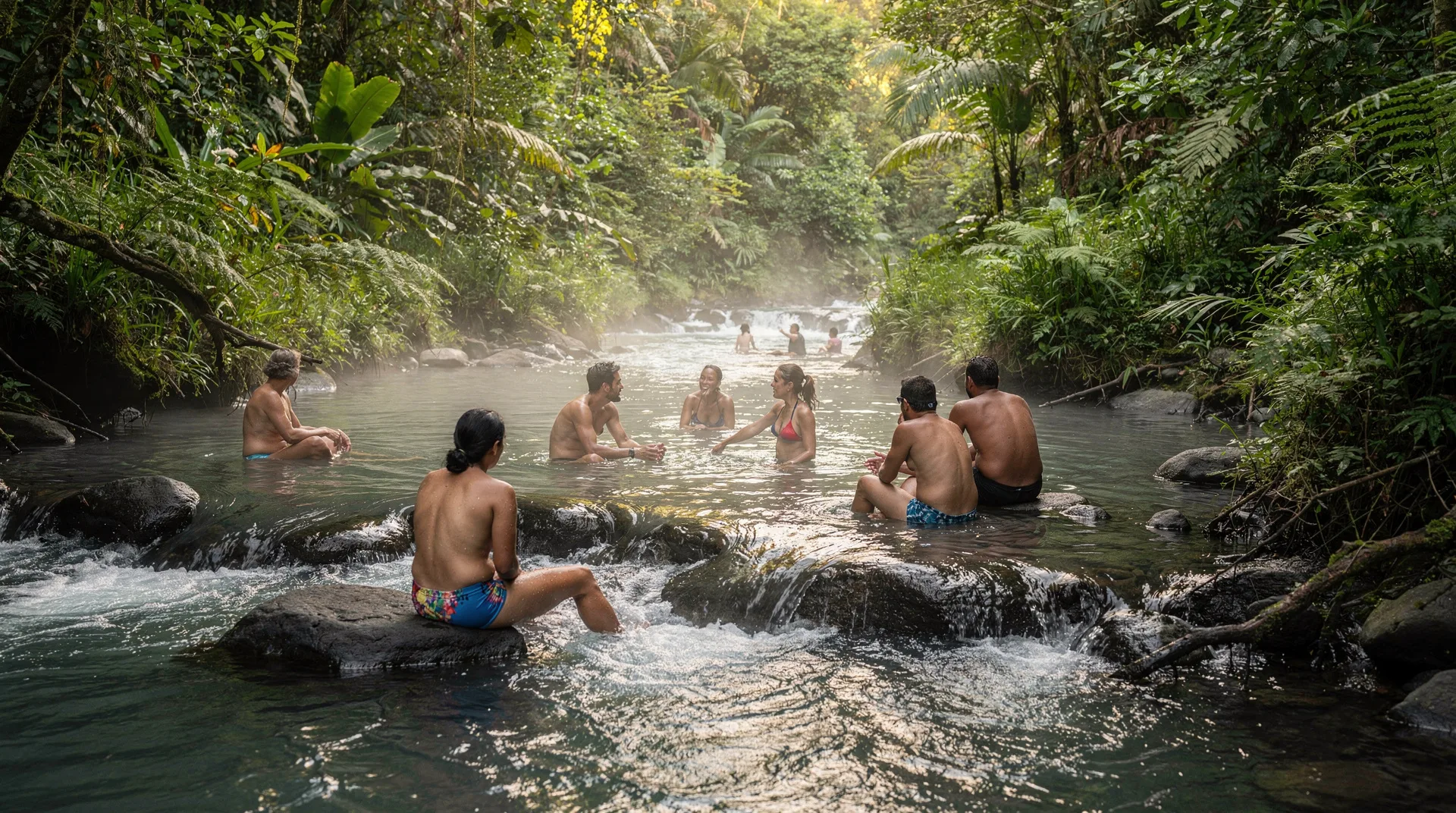
The Río Chollín is a small river that emerges from volcanic-heated underground sources and flows through open terrain before meeting the cooler La Palma stream near the bridge. Where the two waters meet, there are naturally formed pools and eddies of mixed temperature water.
Temperature and feel
In the pool areas directly at the mixing point, water temperatures typically range from 30°C to 38°C depending on the season and recent rainfall. After dry periods, when the cool stream is at its lowest, the thermal contribution dominates and temperatures run hotter (35-40°C). After heavy rain, the cool stream overwhelms the thermal source and the temperature drops significantly (25-30°C).
The water is slightly sulphurous — the classic volcanic hot spring smell that some people find atmospheric and others find immediately off-putting. It fades quickly once you’re accustomed to it.
The riverbed is composed of rounded volcanic rocks, many of which are slippery. Footwear — rubber sandals or water shoes — is essential for getting in and out of the pools safely.
The pools and seating areas
The main pool area is immediately downstream of the bridge, where natural eddies and rock formations create pools of varying depth (knee to chest-high on most adults). There’s no constructed infrastructure — no steps, no railings, no changing areas.
Some visitors find rocks or natural ledges to sit on while soaking. The setting is genuinely pleasant in dry conditions: open sky, the sound of flowing water, dense tropical vegetation along the river banks.
The safety situation: read this before visiting
Flash flood risk — the serious concern
The La Palma stream that mixes with Río Chollín is a mountain river in a volcanic watershed. It can flash flood rapidly and with little warning following heavy rainfall upstream — which can be occurring kilometres away in the mountains while the sky above you looks clear.
Flash floods in Costa Rica’s volcanic rivers are not gradual rises in water level. They arrive as a surge — sometimes a 1-2 m wall of turbid water moving at speed. The time between a storm in the mountains and a flood surge reaching the lower river can be as little as 15-30 minutes.
The primary risk period is the green season (May-November). During this period, afternoon electrical storms are common in the mountains feeding the Chollín watershed. If you visit during the green season, observe these rules:
- Mornings only (before noon) in green season — electrical storms typically build in the afternoon
- Check the weather forecast for the mountains east of La Fortuna, not just the local La Fortuna forecast
- If the sky darkens, water becomes visibly turbid, or you hear thunder in any direction — exit the river immediately and move to higher ground
- Never visit after sustained rainfall — even if it has stopped raining locally
In the dry season (December-April), the flash flood risk decreases substantially as both rainfall and upstream storm activity are minimal. Morning visits in dry season have a meaningfully lower risk profile.
The lone swimmer problem
Never visit Río Chollín alone. This is not an overcautious recommendation — it’s basic water safety in an unpatrolled river environment. If someone is swept off their feet or becomes trapped in the current, there must be someone else present who can help or summon help.
Minimum group size: two adults.
No lifeguard, no emergency infrastructure
Río Chollín has no lifeguard, no emergency communication system, no rescue equipment, and no organised response capability. In the event of an incident, the nearest help is the Tabacón resort (approximately 300 m) or passing vehicles on highway 142.
If you’re visiting as part of a group of experienced travellers who understand river environments and are visiting in dry season during morning hours, the free hot spring is a legitimate option. If you’re uncertain about any of these factors, the commercial resorts provide the same volcanic water with proper infrastructure.
What to bring to Río Chollín
Unlike the commercial resorts, there are no amenities whatsoever at Río Chollín. Prepare accordingly:
- Water shoes or rubber sandals (the rocky riverbed is mandatory footwear territory)
- Towel (there’s nowhere to rent one)
- Dry bag or waterproof case for your phone
- Change of clothes and dry bag for your wet clothes
- Water bottle (bring your own — there’s no food or drink vendor)
- Sunscreen (no poolside shade — you’re in an open river environment)
- Insect repellent (particularly at dawn and dusk)
Leave: expensive cameras, significant cash, or anything you’d be devastated to lose. Vehicle break-ins do occur at unattended highway parking spots.
The honest comparison: free vs paying
The volcanic water at Río Chollín is from the same hydrothermal system that supplies Tabacón. The chemical composition is essentially the same. The therapeutic experience of hot volcanic minerals is identical.
What you’re paying for at Tabacón ($110) or even Paradise ($40) is not the water — it’s the infrastructure, safety, atmosphere, and facilities. The commercial resorts have:
- Secure car parks with attendants
- Changing rooms and lockers
- Towel rental
- On-site restaurants
- First aid facilities
- Lifeguards or monitoring staff
- Guaranteed safe pool conditions year-round
Whether these are worth $40-110 to you depends on your priorities and budget. For backpackers doing Costa Rica on $40-65 per day, spending that budget on a hot spring admission means forgoing a night’s accommodation. Río Chollín is genuinely the right choice for this traveller profile, with appropriate precautions.
For travellers on a mid-range or luxury budget ($90-150 per day), the commercial resorts offer proportionately better value — the setting, safety, and amenity gap between Río Chollín and Eco Termales ($55) is substantial.
Other informal hot spring spots near La Fortuna
Beyond Río Chollín, there are several other spots where thermal water reaches the surface in the Arenal valley — road drainage ditches near the Tabacón area occasionally run warm during the dry season (this is thermal leakage, not a recreational option), and local knowledge of smaller river pools exists among La Fortuna’s fishing and farming community.
We do not list specific unverified locations because conditions change and unverified information about hot spring access points can put travellers in genuinely dangerous situations. If you want to find lesser-known spots beyond Río Chollín, ask at your hostel in La Fortuna — the staff who live locally will know what’s safe in the current season.
La Fortuna: Arenal Volcano rainforest night tour — from $60Visiting Río Chollín: the best-case scenario
The ideal visit looks like this: dry season, Tuesday to Thursday (fewest weekend tourists), arrive by 8:30-9:00 am, spend 60-90 minutes in the pools, leave before noon, drive back to La Fortuna for a late breakfast.
This combination delivers the free hot spring experience at its safest and most pleasant. No queues (because there’s no commercial structure to create queues), good temperature (thermal source is dominant in dry season mornings), manageable UV exposure, and low flash flood risk.
Many travellers who do this sequence describe it as one of the most memorable experiences of their Costa Rica trip — precisely because of its informality and authenticity.
Making a morning at the river part of a bigger day
Because the best window at Río Chollín is early, the rest of your day stays wide open. A soak first thing leaves the afternoon free for something that does not depend on river conditions. If you want to understand what the area is built on, the Arenal Volcano National Park guide explains the trails and lava fields, and understanding Costa Rica volcanic activity puts the thermal water you just soaked in into context.
Travellers who like an active day often follow the pools with something wetter and more structured. A guided session such as canyoning down a series of waterfalls — from $120 is run by operators who handle safety themselves, which makes a useful contrast with the unsupervised river. Our canyoning in Arenal guide and the zip-lining vs canyoning vs bridges comparison help you choose, and Arenal ziplines covers the canopy option.
If you would rather spend the afternoon on a slower plan, a paid spring is the natural second soak, and Tabacón vs Baldí vs Eco Termales shows how they differ. For a night in the valley, the guide to seeing Arenal eruptions and volcano photography tips are worth a read before dusk.
Planning around the weather and the season
The single biggest variable for this visit is timing, so build the trip around it rather than the other way round. Our dry season pros and cons and green season pros and cons guides explain what each half of the year feels like across the country, and microclimates explained shows why the Arenal side can be wet when other regions are clear. Keep a spare plan for any morning that dawns grey: a paid spring or an indoor stop costs little compared with a rushed exit from a rising river.
Getting there and back is the other piece. If you are deciding whether to hire a vehicle for the highway pull-off, read rent a car or not and driving in Costa Rica, and keep safety in Costa Rica in mind for parking and valuables.
Frequently asked questions about free hot springs near Arenal
Is Río Chollín dangerous?
The flash flood risk is real and should be taken seriously, particularly during the green season (May-November). In dry season with appropriate morning timing, the risk is substantially lower. The river is appropriate for experienced travellers who understand river safety; it is not appropriate for young children, solo swimmers, or anyone visiting in the afternoon during green season.
How do I know if there’s a flash flood risk?
Check weather forecasts for the Monteverde and northern Alajuela mountain areas (the watersheds feeding rivers that flow toward La Fortuna). If there’s been heavy overnight rain, if the sky looks threatening, or if the river water appears turbid or discoloured when you arrive, do not enter the water.
Can I visit Río Chollín with children?
With significant caveats: children under 12 in the river represent a higher risk profile due to their lower body mass and strength in any current. If you visit with children, stay in the shallowest pool areas, maintain direct physical contact, and be prepared to leave instantly if conditions change.
What time does the free hot spring get crowded?
There’s no entry control, so “crowded” is relative. Weekends from 10:00 am onward can bring 20-40 people to the main pool area. Weekday mornings may have 5-15 people. The spot is popular among La Fortuna hostel guests.
Are there other free hot spring options in Costa Rica?
Yes — similar informal thermal river access exists at several points along Costa Rica’s volcanic spine. Rincón de la Vieja has informal thermal sites, and some river points near Turrialba run warm. All share the same caveats: no facilities, flash flood potential, seasonal variation. See our hot springs day pass guide for context on the broader hot spring landscape.
Is it illegal to use Río Chollín?
The river is a public waterway and access from a public road is not prohibited. There are no signs restricting access, and local police do not patrol the area with enforcement intent. However, the area is not actively managed, which is part of the risk — there’s no authority verifying conditions are safe.
How does Río Chollín compare to a paid resort like Tabacón at night?
At night, the comparison shifts further toward the paid resorts. Río Chollín has no lighting, no path markers, and the flash flood and slip risks that exist by day are worse in darkness. Tabacón and similar resorts run evening sessions with lit pools, staff on site, and proper walkways. If your visit is planned for after dark, a paid resort is the only sensible option — see our Arenal volcano night tour coverage and the Arenal hot springs overview for evening-friendly picks.
Related guides
If the safety considerations make the free option less appealing, the next most affordable commercial option is Paradise Hot Springs at $40. Our Arenal hot springs overview covers all six commercial resorts with pricing and honest assessments.
For a detailed comparison of the three most popular options (Tabacón, Baldí, Eco Termales), see our comparison guide. And for pricing context across Costa Rica’s entire hot springs landscape — including Guanacaste’s Hacienda Guachipelín experience — see our hot springs day pass guide.
Planning a broader Arenal visit? The La Fortuna destination guide covers how to structure your time across ziplines, hiking, hot springs, and the waterfall.