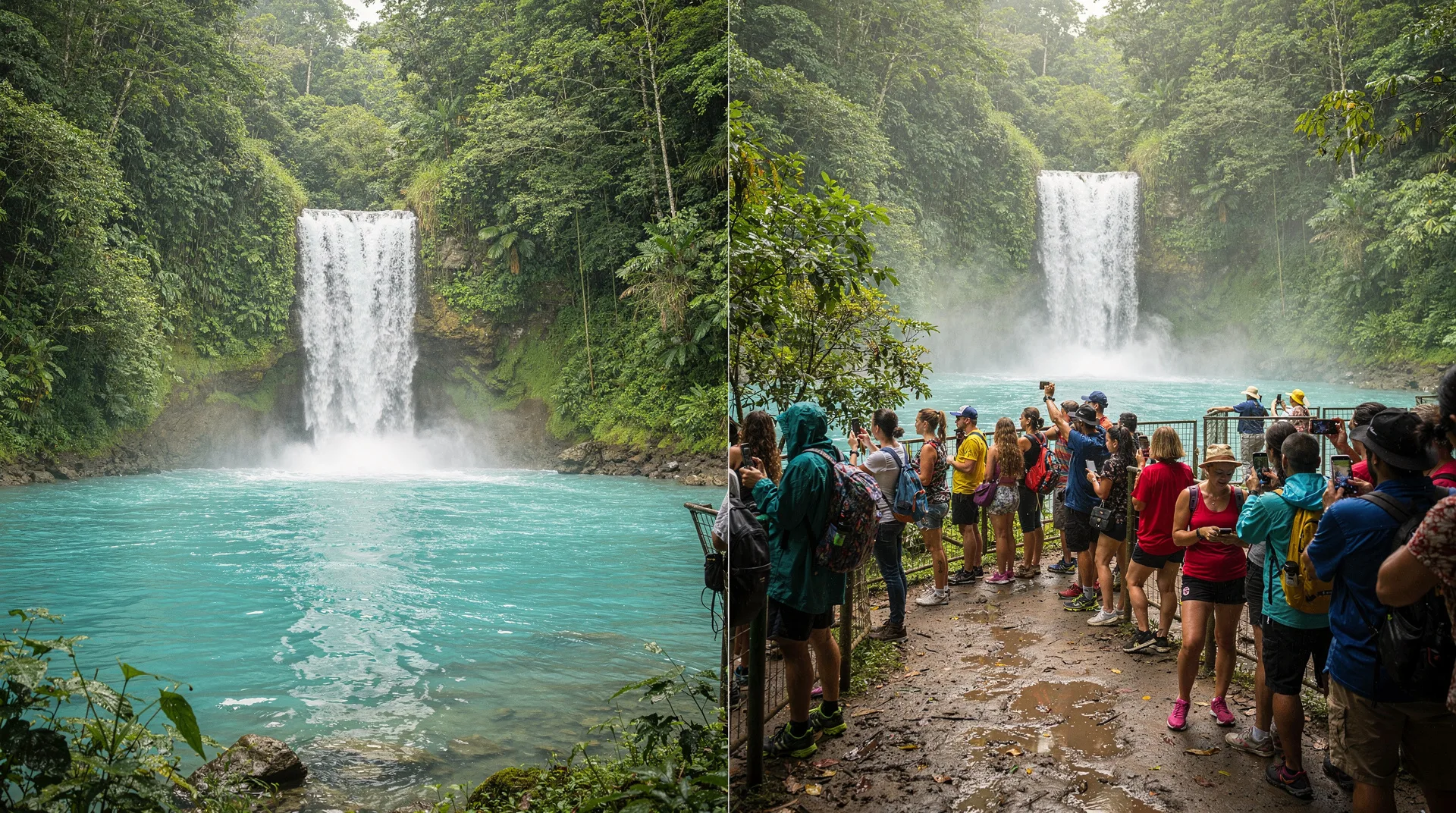
Costa Rica: Instagram vs reality
The version of Costa Rica you have already seen
Before you visit Costa Rica for the first time, you have almost certainly already seen hundreds of images of it. The waterfall with a single swimmer suspended in emerald water. The hanging bridge with cloud forest disappearing into mist. The sloth hanging from a tree directly above a sun-dappled trail. The sea turtle emerging from glowing water on a moonlit beach. The sunset over Arenal, perfectly unobscured by cloud, with hot springs steaming in the foreground.
These photographs are real. All of those things exist in Costa Rica and have been photographed. The question is what surrounds them in actual experience — the parts of the frame that the feed crops out.
We think this matters not because Instagram photography is dishonest, but because the gap between the curated version and the reality shapes expectations in ways that determine whether travelers have a good time or a frustrating one. Travelers who arrive expecting the feed often feel that the country failed to deliver. Travelers who arrive knowing the reality tend to find more than they expected.
| What’s real | Waterfalls, wildlife density, Río Celeste’s blue, Pura Vida |
| What’s cropped out | Crowds, road conditions, small-lens wildlife views |
| Fix | Arrive early, hire a guide, adjust camera expectations |
| Best photogenic-without-crowds window | Weekday mornings, green season |
What the waterfall photographs don’t show
The waterfall images that perform best on social media share a consistent set of characteristics: the shot is taken in the early morning at low tourist volume, from a specific angle that excludes the people standing five meters to the left and right, with the subject either alone in the water or cropped to appear alone.
The reality of La Fortuna Waterfall, which appears in probably more Costa Rica social media photographs than any other single attraction, in January at 10am on a Saturday: there are between 50 and 120 people in the swimming area at any given time. The path down to the falls (a well-maintained staircase of approximately 500 steep steps) is busy in both directions simultaneously. The swimming pool at the base is beautiful — genuinely beautiful — but it is a busy swimming pool in a beautiful setting, not a private encounter with a wild waterfall.
This is not a criticism of the waterfall. It is a description. If you want to be the only person in frame, you need to arrive at opening time (usually 8am) on a weekday in green season.
The same principle applies to Río Celeste — the extraordinary blue river in Tenorio Volcano National Park that generates some of Costa Rica’s most recognizable images. The blue is real and it is remarkable. The Los Teñideros viewpoint where the turquoise and white rivers meet to produce the color effect is, in peak season, a viewing platform with a queue. The photograph on your phone will look like the photograph you saw on Instagram. The experience around it will not.
Río Celeste National Park hike — from $95If you are building a trip around these two places, our guides to Arenal Volcano National Park and Tenorio National Park and Río Celeste explain what each visit involves, and the La Fortuna destination page shows how they fit together as a base.
The road conditions that the car photographs skip
Travel content about Costa Rica loves the shot of a 4WD on a dirt road, usually with jungle on either side and mountains visible ahead, sometimes with a ford crossing. It looks adventurous and photogenic.
What the photographs understandably skip: the one-hour stretch of deeply rutted road before the photogenic ford. The part where you misjudge a puddle’s depth and the front right wheel drops into something that requires rocking the vehicle free while your passengers sit in anxious silence. The moment, after three hours on secondary roads, when you check the fuel gauge and realize you passed the last gas station forty kilometers back.
Costa Rica’s roads are genuinely part of the adventure. This is not irony — we mean it sincerely. The sense of arrival that comes after a challenging approach to a remote destination is real, and it is partly what makes those places feel remote rather than just distant.
We think this is one of the more underrated parts of a Costa Rica trip precisely because it does not photograph well. A river ford successfully crossed produces a genuine, physical sense of accomplishment that a smooth paved arrival never does — but that feeling lives in memory, not in a feed, so it gets systematically underweighted by anyone forming expectations from social media alone. Knowing this in advance changes how you experience a rough final stretch of road: as part of the destination rather than an obstacle standing between you and it.
But the social media version of Costa Rica roads suggests that the adventure is always photogenic, the challenges always resolved easily, and the outcomes always positive. The reality includes flat tires, overheating vehicles on steep grades, and map applications that confidently route you through roads that are not navigable in the vehicle you are driving.
The actual practical guidance: rent the right vehicle (full-size 4WD for any itinerary with secondary roads), get full coverage insurance, download offline maps before you go, and ask your lodging about current road conditions before every day of driving.
For the longer version of that advice, read our guides to driving in Costa Rica, road conditions by region and whether to rent a car at all. If the idea of a rough ford puts you off, shuttles are a perfectly reasonable alternative, covered in our shuttle services overview.
The wildlife photography vs the wildlife encounter
The wildlife images from Costa Rica that circulate most widely share another set of common characteristics: the animal is large, clearly visible, close to the camera, and framed against a clean background. The toucan perched with sufficient light and separation to show every feather detail. The sloth’s face at portraiture distance, expression rendered thoughtful. The humpback breach frozen at the exact moment of maximum airtime.
These photographs are real. They are also the product of exactly the right conditions, sometimes after hours of waiting, often achieved by professional photographers with telephoto equipment and either exceptional patience or exceptional luck.
The wildlife encounter that most travelers have is different. The howler monkey visible through 40 meters of canopy, moving constantly, producing excellent photographs on a professional lens and blurry shapes on a phone camera. The sloth that your guide spotted in a cecropia tree and is pointing at, and which took you three minutes to locate despite it being, apparently, directly in front of you. The sea turtle, observed under red-light torchlight at the approved distance on a turtle tour, for the three minutes it was on the beach before returning to water.
These are not inferior experiences. They are, in many ways, more honest wildlife encounters than the edited feed version — you are in proximity to wild animals, observing them under appropriate conditions, without disturbing their behavior. But they do not look like the Instagram version, and visitors who arrive expecting to photograph toucans with their phone at portrait quality are going to be frustrated.
Our advice: adjust your camera expectations and expand your experience expectations. Bring binoculars. Hire a guide. Look at what the guide is looking at rather than at your phone. If you want to actually improve your own photos rather than just accept blurry shapes, our wildlife photography tips guide covers the gear and technique gap between a phone snapshot and the images you see online. And if sloths specifically are the draw, our where to see sloths in Costa Rica guide is more useful than any single Instagram geotag.
The towns that the beach photographs erase
Tamarindo is photographed extensively as a beach. The beach is good. The photographs of it are accurate.
What the beach photographs do not show: the main road behind the beach, which has the traffic, the noise level, and the visual character of a tourist strip that has been developing at maximum speed for twenty years. The parking situation on a January Saturday. The bar strip at midnight, which is a specific and accurate version of Tamarindo that serves some travelers well and is very much not everyone’s vision of a beach town.
Manuel Antonio is photographed as a national park with pristine beach and sloths in the trees. This is accurate. The town of Manuel Antonio — the road from Quepos to the park entrance — is a dense strip of hotels, souvenir shops, and tour operators that exists for the purpose of serving park visitors. It is not the photogenic element in any photograph.
None of this is a reason to avoid these places. It is information about what surrounds the photogenic moments. Knowing this in advance tends to produce better itinerary decisions — staying in Quepos rather than on the Manuel Antonio strip, for example, where the town has actual character alongside reasonable prices.
Best sunset yacht charter Flamingo/Tamarindo — from $140If you want the full picture of each town before you commit, we have written up Tamarindo and Manuel Antonio as destinations, along with a Tamarindo surf guide for anyone heading there for the waves rather than the bar strip.
The prices that the luxury feed implies
This is a specific gap worth naming. The Instagram version of Costa Rica features a lot of infinity pools and over-water platforms and rooms with floor-to-ceiling jungle views. This version of Costa Rica exists, is real, and is available to travelers with the appropriate budget.
It is not, as the feed might imply, representative of typical Costa Rica travel. The luxury eco-lodge properties — Nayara Springs, Tabacón, Lapa Rios, Pacuare Lodge — are genuine, excellent, and expensive. They cost $400-900+ per night per person in high season, often including meals and some activities.
The mid-range reality that most travelers experience — the clean but unremarkable mid-range hotel, the restaurant with good food and plastic chairs, the shared shuttle with the stop that takes forty minutes longer than estimated — is not photographed and posted. It does not generate engagement. But it is what most Costa Rica trips actually look like most of the time.
This is fine. The mid-range experience in Costa Rica is genuinely good — comfortable, interesting, sufficient. The gap between the Instagram luxury version and the reality of what most people are buying is worth knowing so that your budget expectations are accurate. Our money and currency guide and adventure tour pricing guide go into what things tend to cost once you leave the feed behind.
What the feed gets right
This is not a polemic against Instagram or travel photography. The feed gets things right too.
The wildlife density is real. Costa Rica genuinely has howler monkeys in the canopy, sloths in cecropia trees, toucans on fences, and sea turtles on moonlit beaches. These encounters happen to real travelers without professional photography equipment. We have seen all of them, multiple times, and they are as extraordinary as represented.
We would add one more thing the feed gets right that skeptics of travel photography sometimes miss: the color. The particular saturated green of a cloud forest canopy after rain, the turquoise of Río Celeste, the specific blue-black of a Pacific sunset with volcanic silhouette — these are not filtered into existence. Costa Rica’s light and landscape genuinely produce colors that look edited even when they are not, and that is one area where the honest and the curated versions of the country agree completely.
The natural landscape is as dramatic as it appears. Arenal in early morning before the clouds close in is a genuinely astonishing sight. The cloud forest of Monteverde in low mist is exactly as atmospheric as the photographs suggest. The Caño Island snorkel visibility — 20+ meters of clear Caribbean water with reef fish, reef sharks, and the occasional sea turtle — produces exactly the kind of photographs you see online because the reality is exactly that good.
Pura Vida is real. Not as a slogan, but as an orientation. The warmth of the people, the ease of social interaction, the genuine pleasure that Ticos take in showing travelers what their country contains — this is not marketed and it is not performed. It is the thing that makes returning travelers keep returning. It shows up in small, unphotographed ways more than in the grand gestures: a shuttle driver who waits an extra five minutes for a late passenger without complaint, a soda owner who walks you through the menu in patient broken English, a stranger on a beach who offers unsolicited but genuinely useful advice about the next day’s surf conditions.
Manuel Antonio NP: guided tour with entrance fee included — from $60The recommendation that follows from all of this
Go. Go with accurate expectations. Know that the waterfall will have other people at it and that the drive will have challenging sections and that the wildlife encounters will require a guide and patience and will not look like portrait photography on your phone and will still be extraordinary.
If you are still deciding when to go, our best time to visit guide and the comparison of green season pros and cons will help you pick the conditions that suit the photographs you hope to take. A sample route that balances the famous stops with quieter ones is the 7 days Arenal and Manuel Antonio itinerary.
The country is worth it. It is worth it in the edited version and it is worth it in the unedited version, which is the one you will actually experience.
The feeds show you why you want to go. We try to tell you what actually being there is like. Both are useful. Neither is complete without the other.
For more on the specific realities of planning a Costa Rica trip — prices, logistics, what the parks actually require — read our 2026 pricing update and our honest look at tourist traps.
Pura Vida — and we mean that in the non-marketing, actually-real sense that we wrote about in that post.