An honest look at Costa Rica's tourist traps
This is the post we always meant to write
One of the founding commitments of this site was to be honest about Costa Rica in ways that travel writing typically is not. We praise this country — we genuinely love it — but that praise is useful only if it comes alongside an accurate account of the things that regularly catch visitors off guard, cost them money they did not intend to spend, or deliver experiences that are not what they were sold.
This is that account. It is specific, it is based on years of experience and reader reports, and it is deliberately named with the word “traps” because that is what these are.
| Worst offenders | Manuel Antonio gate guides, airport currency exchange |
| Biggest money leak | Rental car insurance escalation ($40–60/day extra) |
| Where to book instead | Reputable operator, SINAC portal, your lodge’s direct recommendation |
| Applies to | Every major tourist zone, not one region |
| Overall risk level | Low compared to most destinations — mostly money, not safety |
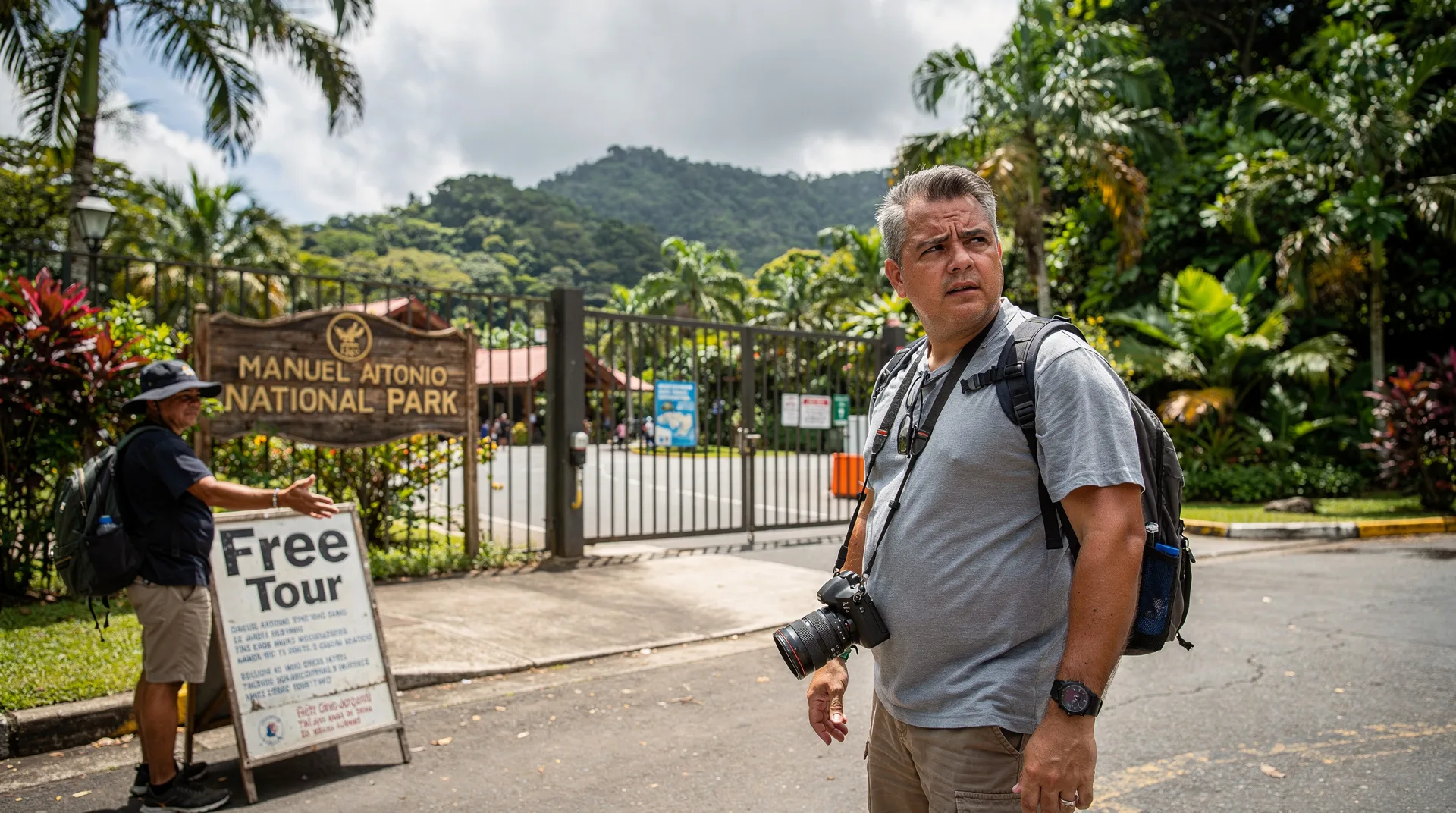
The fake park guide at Manuel Antonio
This is the most reliably documented trap in Costa Rica and the one we hear about most consistently from readers.
The setup: visitors arriving at Manuel Antonio National Park’s main entrance on the road from Quepos encounter individuals positioned outside the park gates, wearing khaki clothing or carrying naturalist equipment, who approach and offer guide services. They describe themselves as “certified park guides” and present materials suggesting they are ICT-approved. They charge $25-40 per person for a guide service that will begin at the park gate.
The problem: entry to Manuel Antonio National Park does not require — and never has required — a guide. The entrance fee covers solo access to all public trails. The guides outside the gate are not necessarily certified by the ICT, and they are not park staff. Some are legitimate freelance guides (who should present verified ICT certification cards and should be hired before you arrive, not approached cold at the gate). Others are not guides at all.
How to avoid: if you want a certified naturalist guide for Manuel Antonio — which we genuinely recommend, because guides find sloths in seconds while unguided visitors walk past them — book in advance through a reputable operator, not through an approach at the entrance. Ask for ICT certification documentation.
Manuel Antonio Park: guided walking tour with a naturalist — from $65If you are still choosing where to base yourself, our pages on Manuel Antonio and nearby Quepos explain what the area offers, and the Manuel Antonio National Park guide walks through how a visit works so that nobody at the gate can sell you a story about it.
The “guaranteed cheapest” tour operator
In Tamarindo, La Fortuna, Monteverde, and most major tourist areas, there are tour desks and street-level operators who advertise “best price guaranteed” for national park tickets, zip-line passes, and activity tours. Some of these are legitimate. Some are not.
The specific issue: some operators sell tickets or “reservations” for parks and activities at prices that appear to be discounts but are actually above the standard price, with no actual booking made until you show up — at which point they inform you that the “discount” is not available and the standard rate applies. Or the booking does not exist and you are turned away at the attraction.
For national parks, book directly through the SINAC portal (sinac.go.cr). For tours, book through operators with verifiable reviews on TripAdvisor, GetYourGuide, or Viator, or through your hotel’s recommendation with a specific named operator. The legitimate operators are easy to find; the trap is in accepting an unverified recommendation from someone approaching you cold on the street.
Ziplines are a good example of an activity where price and safety are linked, so it helps to read our zip line safety and pricing guide before you hand money to anyone. The same goes for the wider picture in adventure tour pricing: knowing what a normal price looks like is the best defence against a fake discount.
The rental car insurance escalation
Most international travelers arrive in Costa Rica with some understanding that rental car insurance is mandatory. What surprises many is the pressure to purchase additional insurance products at the counter that are not mandatory but are presented as if they are.
The minimum legal requirement in Costa Rica: the base liability insurance (Seguro Obligatorio de Vehículos) that is included in every rental or available as a daily add-on. Everything above that — CDW (Collision Damage Waiver), theft protection, tire and windshield coverage — is optional.
The trap: rental counter staff routinely present the optional coverages in language that implies they are required or that your credit card coverage is “not valid in Costa Rica” (which may or may not be true depending on your card). The full optional package can add $40-60 per day to your rental cost.
The honest advice: check your credit card’s rental car coverage before you travel. Many premium cards offer CDW coverage that is valid internationally. If your card covers CDW, you can decline it at the counter. Read the policy carefully — exclusions for unpaved roads (relevant in Costa Rica) sometimes apply. And whatever you decide about optional coverage, the base liability insurance is genuinely mandatory and not negotiable.
Before you commit to a car at all, our guide on whether to rent a car or not is worth a read, since many itineraries work well with shuttles instead. If you do drive, driving in Costa Rica covers what to expect on the road, and travel insurance is a separate question from the rental counter’s add-ons.
The “free” beach activity that becomes expensive
At several major beaches — Tamarindo, Jacó, Manuel Antonio — there are vendors who offer seemingly free or very low-cost activity introductions (short surf lesson, paddleboard “try,” horse ride on the beach) and then present a larger bill when the activity ends, citing duration or equipment that was not clearly disclosed upfront.
This is not specific to Costa Rica — it exists at tourist beaches globally. The Costa Rica version tends to involve clearly inflated post-activity pricing rather than outright theft. The prevention is simple: agree on the total price and duration explicitly, in writing if possible, before beginning any activity initiated by a beach approach.
The “all-inclusive Caribbean” hotel that is not in Costa Rica
This is a marketing confusion rather than a direct scam, but it catches enough travelers that it warrants inclusion.
Several large resort aggregators and package travel operators market “all-inclusive Costa Rica Caribbean” packages that, when examined closely, are in the Dominican Republic or Mexico, not Costa Rica. Costa Rica’s Caribbean coast — Puerto Viejo, Cahuita, Tortuguero — does not have large all-inclusive resort infrastructure. The Caribbean coast of Costa Rica is characterized by small guesthouses, eco-lodges, and locally-owned properties, none of which are “all-inclusive” in the resort sense.
If you are booking a Caribbean beach all-inclusive package and it sounds like a large resort, check the specific location. Punta Cana is not Puerto Viejo.
The exchange desk at the airport
The currency exchange desks at Juan Santamaría Airport (Banco de Costa Rica, Banco Nacional) are licensed and safe — they are not scams. But the exchange rate they offer is consistently 8-10% worse than the rate available at ATMs in the destination.
For a $1,000 cash exchange at the airport, you lose approximately $80-100 compared to using a BAC or Promerica ATM at your destination. Over a two-week trip with significant cash use, this accumulates.
Use the airport exchange for small amounts only if you need cash for the immediate taxi or shuttle. Plan to use BAC or Promerica ATMs for the main cash withdrawal within 24 hours of arrival. Our ATM and cash tips and money and currency guides go into the practical details, and the story behind the exchange rate is told in why the colón fell against the dollar.
Hot springs without safety infrastructure
Around La Fortuna, there are several natural hot spring streams — fed by the volcanic thermal activity — that are accessible without paying a resort fee. The most commonly visited is a stream under a bridge on the road near Tabacón.
This is legal. The experience can be good. The issue is the absence of any safety monitoring, which matters because natural thermal streams can have temperature gradients and current variations that are not visible until you are in them. There have been incidents at unmonitored natural hot spring sites.
We are not saying avoid natural thermal experiences. We are saying use common sense: check temperature before entering fully, avoid currents after rain when water flow increases unpredictably, and do not take children into unmarked natural thermal sources without testing conditions first.
La Fortuna: Arenal Volcano, lunch & hot springs morning tour — from $120For the full picture, see our guides to free hot springs near Arenal and the hot springs day pass guide, and the base town of La Fortuna if you are planning the trip around it.
The photography “attraction” that exploits animals
A consistent and problematic category: roadside vendors or informal attractions that offer photos with wild animals — sloths, monkeys, macaws — for a fee. The animals in these setups are typically drugged, improperly cared for, and removed from their natural habitats in ways that are often illegal under Costa Rican wildlife protection law.
The test: if a wild animal allows humans to hold it without any sign of stress or resistance, something is wrong. Healthy wild sloths, monkeys, and birds have normal startle and escape responses.
Do not pay for photographs with animals that are being held by humans in a non-sanctuary context. Legitimate wildlife encounters in Costa Rica happen at ICT-certified rescue sanctuaries (Sloth Sanctuary near Limón, Toucan Rescue Ranch near San José, Jaguar Rescue Center in Puerto Viejo) or in the wild with certified naturalist guides.
If seeing animals responsibly matters to you, start with our pages on wildlife watching ethics and where to see sloths, which show how to find them without paying for a staged photo.
The overconfident driving GPS route
GPS applications, including Google Maps and Waze, occasionally route drivers through roads in Costa Rica that are technically connected on the map but are not passable with a standard vehicle in wet season, or require local knowledge to navigate safely.
The specific trap: Google Maps has been known to route drivers through the “shortest path” on secondary roads that are seasonal, flooded, or require river crossings that are only safe in dry conditions. The fact that a road appears on the map does not mean it is passable.
Always cross-reference GPS routes with local knowledge (ask at your hotel), especially for routes to remote destinations in wet season. For routes into the Osa Peninsula, northern Nicoya, or secondary roads in the Caribbean zone, local advice trumps app routing.
Legitimate versus trap: a quick comparison
| Situation | Legitimate | Trap |
|---|---|---|
| Park guide | Booked in advance, shows ICT card unprompted | Approaches you cold at the gate |
| Tour “discount” | Confirmed booking reference before you pay | ”Reservation” that evaporates on arrival |
| Rental insurance | Base liability only, clearly itemized | Bundled “required” add-ons at the counter |
| Animal encounter | Wild, at a distance, or ICT-certified sanctuary | Drugged animal held for photos |
| Currency exchange | ATM in town (BAC, Promerica) | Airport exchange desk for large sums |
What we’d add if this were a new destination for us
Most of these traps share a single underlying mechanism: they exploit the gap between what a first-time visitor assumes is standard (a guide is required, insurance is mandatory, a “reservation” means something) and what is actually true. That gap closes fast once you’ve made one trip — which is why repeat visitors report far fewer of these issues than first-timers, and why we keep writing posts like this one for people planning their first trip.
If you are short on planning time and want a single practical hedge against most of the list above, book your higher-stakes activities — Manuel Antonio, Arenal hot springs, anything involving wildlife — through an operator with public, verifiable reviews rather than an approach on the street. It costs the same or less than the “discount,” and it removes the entire category of risk.
The honest bottom line
None of these traps are unique to Costa Rica. They are the standard set of tourist-destination issues that appear wherever there is significant visitor demand and economic asymmetry between visitors and local operators. Costa Rica’s overall safety record and its genuine commitment to quality tourism mean that the trap-to-legitimate-experience ratio is lower here than in many competing destinations.
But being forewarned is worth something. Most of the issues above are avoidable with basic preparation: book in advance through verifiable operators, check documentation before accepting any service, and apply the same skepticism to too-good deals in Costa Rica that you would apply anywhere else.
For more on the realities of visiting versus the Instagram version, read our companion post on Costa Rica Instagram vs reality. For broader safety context beyond scams and overcharges, see our Costa Rica safety guide, and for what national park visits actually cost now, see our 2024 park fees breakdown.