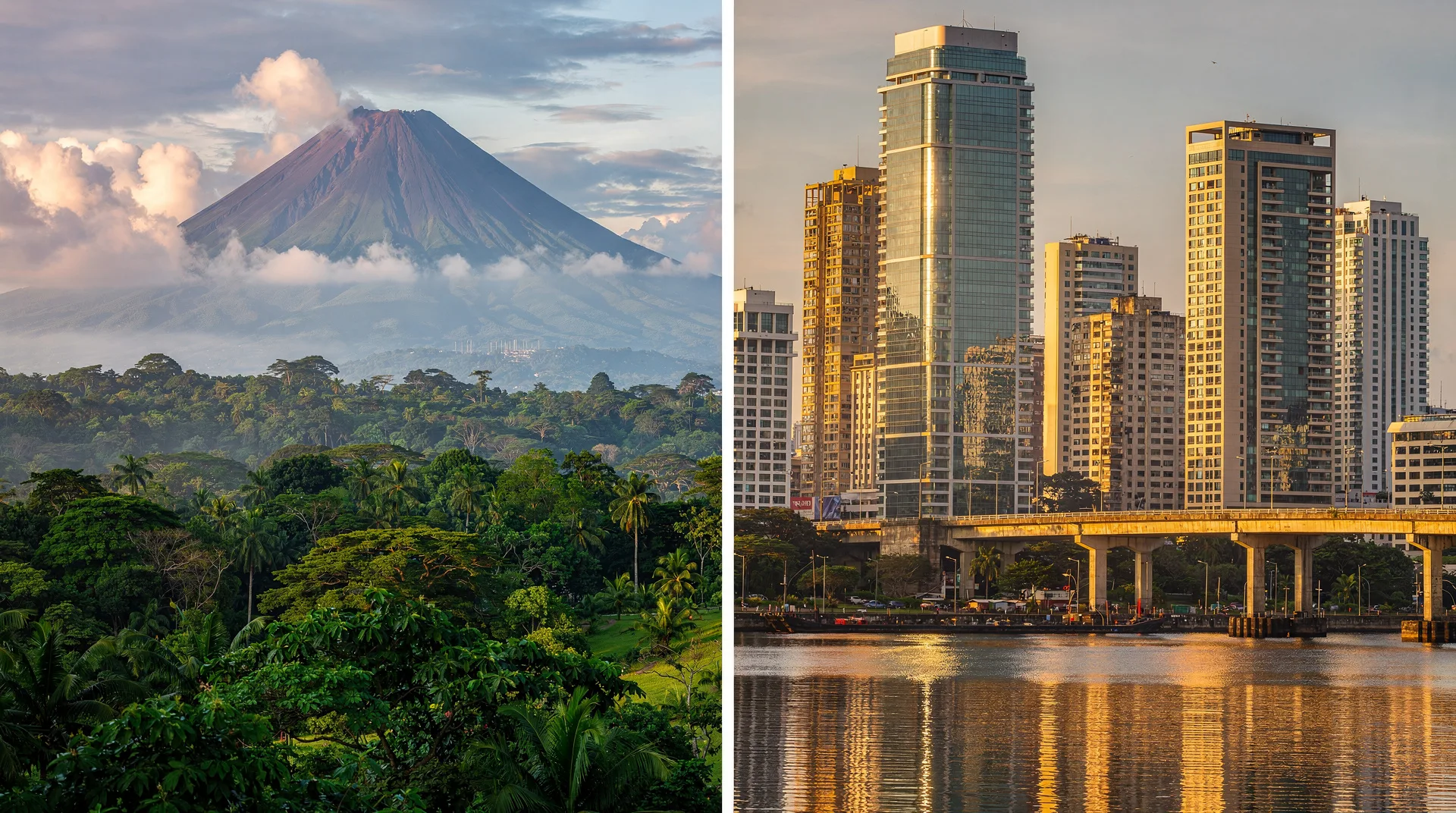
Costa Rica vs Panama: which to pick
The question we get from the research-minded traveler
It usually arrives from someone who has been doing their homework. They have read about both countries, they know they want some combination of wildlife, beaches, and probably a city stop, and they have two weeks. “Can you just tell us: Costa Rica or Panama?”
We have spent serious time in both countries. We can give you an honest answer — which is that neither is universally better, but each is clearly better for specific traveler types. Here is the comparison that we have found most useful.
| Costa Rica | Panama | |
|---|---|---|
| Best for | Predictable infrastructure, accessible wildlife | Budget, a great city stop, expedition birding |
| Wildlife access | Corcovado, independent-friendly with a guide | Darién, remote and expedition-level |
| Costs | Higher across the board | Cheaper for hotels, food, tours |
| City stop | San José, functional but not a destination | Panama City, genuinely excellent |
| Currency | Colón, exchange rate to track | Dollarized since 1904, no exchange risk |
The wildlife comparison: Corcovado vs Darién
Costa Rica is often described as having 5% of the world’s biodiversity in 0.03% of the land area. Panama’s numbers are comparable — it is positioned as the land bridge between continents, meaning it has species from both North and South America that do not appear further north or south respectively. The Darién region alone is one of the most biodiverse areas in the Western Hemisphere.
The practical difference is access. Corcovado in Costa Rica, while logistically demanding (mandatory guides, advance booking, the journey to Drake Bay or Puerto Jiménez), is accessible to independent travelers with a week of planning. The Darién in Panama is genuinely remote and requires either an organized expedition or a very high tolerance for complex logistics in areas with limited infrastructure and, in border zones, security considerations.
For the traveler who wants maximum wildlife with minimum expedition complexity, Costa Rica wins. The guide system, the park infrastructure, the reliable boat services to places like Drake Bay — these represent a public investment in accessible conservation that Panama’s equivalents have not matched. Our Corcovado National Park guide covers exactly what that access looks like in practice, guide requirement included.
If the choice inside Costa Rica is what worries you, our Manuel Antonio vs Corcovado comparison helps you pick the right level of effort, and the Costa Rica wildlife overview shows what you can realistically expect to see. Wildlife is also not limited to the south: Tortuguero offers a very different, canal-based way to watch animals, and our nocturnal wildlife guide explains why an after-dark walk is often where the best sightings happen.
If you are a serious birder or expedition wildlife traveler with more time and higher risk tolerance, Panama’s diversity is extraordinary and the Canal Zone’s Pipeline Road alone can generate 100-species days.
Drake Bay: Corcovado NP and Sirena Station tour — from $135Infrastructure: the real difference
This is where the comparison is most lopsided, and where we see the most misleading travel writing that undersells the gap.
Costa Rica has a highway system that, while imperfect, connects all major destinations with paved roads. The rental car fleet is large, the shuttle network is extensive, the airport choices (SJO and LIR) give good coverage of the country’s regions. Hotels at every price point have been competing for quality-conscious travelers for decades. The guide certification system means a baseline of professionalism in the tourism sector.
Panama City is excellent — one of the best cities in Central America, with the canal, a fantastic ceviche culture, Casco Viejo, and an international airport that connects to more global destinations than San José. Outside Panama City, the infrastructure drops off more steeply than in Costa Rica.
The Pacific beaches — Bocas del Toro on the Caribbean, the Azuero Peninsula on the Pacific — are reached by domestic flights with smaller aircraft and less frequency than Costa Rica’s equivalent domestic network. Roads outside the Interamerican Highway corridor are rougher. The tourist infrastructure in places like Bocas del Toro is more rustic and less reliably calibrated to the quality expectations of travelers who have been reading international travel publications.
On the Costa Rica side, getting around is a choice you can plan rather than a gamble. Our guide on whether to rent a car and our notes on driving in Costa Rica cover the self-drive option, the shuttle services overview covers the no-car option, and the domestic flights guide explains when flying saves a long day on the road.
This is not a criticism of Panama — it is a factual comparison of development stage. For a traveler who wants to know exactly what they are getting in advance, Costa Rica is more predictable. For a traveler who enjoys a degree of improvisation and is comfortable with variability, Panama can surprise you positively in ways that Costa Rica, with its now-established tourist circuit, rarely does.
Cost: Panama’s genuine advantage
Panama is cheaper than Costa Rica for most categories of travel in 2025. This has been true for several years and reflects both the different levels of tourism development and the different cost structures.
Hotel comparison: a clean mid-range hotel in David (Panama’s second city, gateway to Boquete and the highland coffee country) costs $50-75 per night. A comparable hotel in La Fortuna or Monteverde in Costa Rica costs $100-150. Bocas del Toro budget guesthouses run $20-40 per night. Costa Rica’s equivalent budget tier runs $35-65.
Food: the traditional Panamanian sancocho or ropa vieja at a local lunch counter costs $4-6. Costa Rica’s equivalent soda lunch runs $6-9 in 2025. Restaurant meals in Panama City can rival San José prices in the upscale zones, but middle-market eating is cheaper.
Tours: Panama’s guide and tour market is less mature and less standardized, which produces both lower prices and more variable quality. A guided Bocas snorkel trip might run $25-40 per person compared to $60-90 in Costa Rica’s comparable market.
If you want to see how Costa Rica’s own prices have moved, our pricing update and the earlier piece on whether Costa Rica is still affordable give the context behind the gap. To keep your own costs down on the Costa Rica side, eating at the best local sodas is the single easiest habit, and our money and currency guide explains how the colón works in practice.
The dollar advantage is structural: Panama officially dollarized its economy in 1904, so there is no exchange rate risk or currency management complexity for dollar-carrying travelers.
The canal: Panama’s irreplaceable asset
The Panama Canal is the specific thing that Panama has and Costa Rica definitively does not. If you are traveling with people for whom the engineering and history of the canal is a genuine interest — watching Panamax ships lift through the Miraflores Locks, understanding the logistics of the world’s most important artificial waterway — that is an experience with no equivalent in Costa Rica.
Panama City’s combination of the canal visit, Casco Viejo (UNESCO World Heritage old quarter), the Biomuseo (a Frank Gehry building with an excellent biodiversity exhibition), and the quality of the restaurant scene makes it one of the best city travel experiences in the Americas for the length of stay required. A three-day Panama City stop is remarkably efficient at delivering genuinely distinct experiences.
Costa Rica’s equivalent urban stop — San José — is functional and interesting but not in the same category as a city experience. San José is better understood as a logistics hub than a destination in itself.
The hybrid trip argument
The question “Costa Rica or Panama” sometimes has a third answer: both. The overland crossing at Paso Canoas connects Costa Rica’s Pacific coast to Panama’s Chiriquí province. In a 14-day trip, you could spend 10 days in Costa Rica’s southern Pacific (Uvita, Drake Bay, Puerto Jiménez) and cross to spend 4 days in Boquete (Panama’s highland coffee and hiking destination) and David, before flying home from Tocumen or returning to Costa Rica.
This combination works logistically and gives you both the depth of the Osa Peninsula and the different-but-complementary highland landscape of the Chiriquí highlands. Boquete, set in the Barú Volcano foothills, is genuinely beautiful — cooler, cloud-forest-adjacent, with excellent coffee and a well-developed expat hiking community, not unlike Monteverde on the Costa Rica side if you want a point of comparison before deciding whether the crossing is worth it.
The land crossing adds roughly half a day of logistics. If you are organized about it (arrange transport in advance, have your documents sorted), it is not a significant obstacle.
We would flag one practical detail that trips up travelers attempting this route without planning: Costa Rica and Panama both require proof of onward travel at the border in some circumstances, and a one-way overland crossing does not always satisfy that requirement cleanly on either side. Confirm current rules for your nationality before you commit to the hybrid itinerary, rather than discovering the requirement at the checkpoint.
Whale & dolphin watching in Uvita — from $75Our honest recommendation
For most travelers who are asking this question — first-time visitors to Central America, people with 10-14 days, an interest in wildlife and beaches and some cultural experience — Costa Rica is the better choice. The infrastructure removes friction, the guide quality is higher on average, the wildlife access (Corcovado, Tortuguero, Monteverde) is exceptional without requiring expedition-level planning, and the country delivers reliably against the expectations that its reputation creates.
Panama is the better choice if: you are on a tight budget; you are a serious birder with expedition tolerance; you want to spend meaningful time in a great city (Panama City); or you are a repeat Costa Rica visitor looking for something different.
For travelers who fall into the “both” category — and many do — the hybrid southern Pacific trip is genuinely worth considering. The countries complement each other in ways that spending a two-week trip in only one misses.
Whichever way you lean, a few practical pages are worth reading before you book: the visa and entry requirements, our advice on travel insurance, and the safety guide. If the hybrid route appeals, the 12-day south Pacific itinerary is a good base to adapt.
For comparative analysis of specific Costa Rica regions, read our Guanacaste vs southern Pacific comparison, and for the season that makes either country work best, our best time to visit Costa Rica guide.