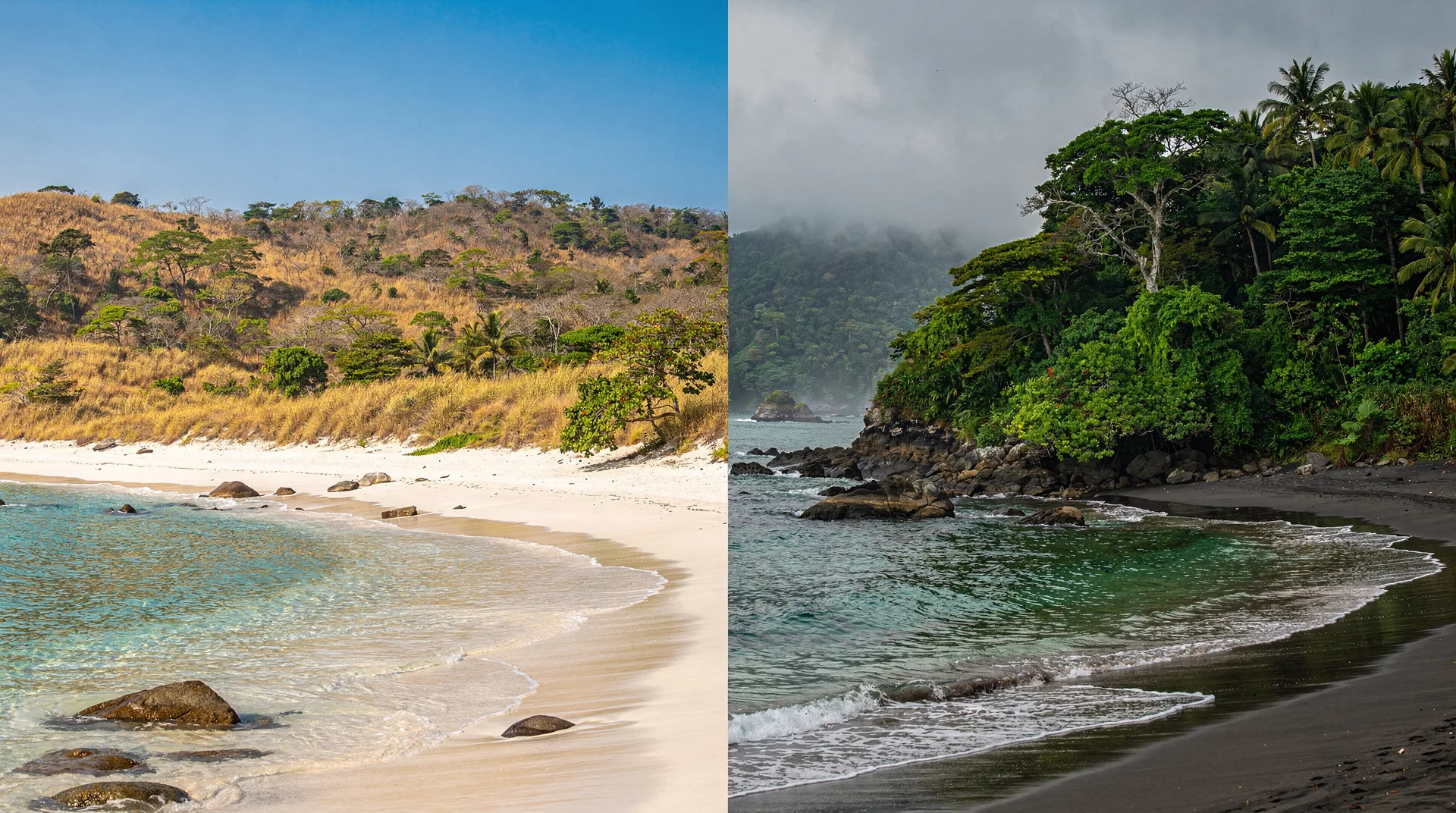
Guanacaste vs southern Pacific Costa Rica: which coast fits your trip?
Guanacaste or southern Pacific?
Guanacaste is ideal for sunny resort holidays, surf, and easy logistics. The southern Pacific — Uvita, Dominical, Drake Bay, Osa — rewards travelers who want wildlife, remote beaches, and genuine wilderness.
Two very different versions of Pacific Costa Rica
The Pacific coast of Costa Rica stretches from the Nicaraguan border in the northwest to the Panamanian border in the southeast — roughly 1,000 km of coastline that splits into two worlds at the Nicoya Peninsula. To the north: Guanacaste, sunny, dry, resort-heavy, and easy to access. To the south: the central and southern Pacific — Uvita, Dominical, Matapalo, Drake Bay, and the Osa Peninsula — lush, wild, and remote.
These are not variations on the same theme. They are fundamentally different experiences in terms of landscape, ecology, infrastructure, visitor profile, and what you will spend each day doing. Picking the wrong one for your trip profile is one of the most common planning mistakes among first-time visitors to Costa Rica.
This guide gives you an honest comparison across every factor that matters.
| Guanacaste | Sunny, dry, resorts, easy access via Liberia |
| Southern Pacific | Lush, wild, wildlife-rich, remote |
| Minimum time (south) | 4+ nights for Uvita and Drake Bay |
| Airport access | Guanacaste: direct LIR; South: via San José |
| Best combined trip | 10–14 days with a domestic flight leg |
The landscape difference: sun vs jungle
The contrast begins with climate and vegetation, and it is striking even from the air.
Guanacaste sits in the rain shadow of the Cordillera de Guanacaste. During the dry season (December through April), the landscape dries to a gold-and-brown savanna. Acacia trees lose their leaves. The sky stays cloudless for weeks at a time. The beaches — Tamarindo, Playa Conchal, Playa Flamingo, Playa Hermosa, Nosara — are sun-drenched, the water warm and gentle. It looks and feels like a tropical resort destination, because that is largely what it has become.
The southern Pacific is different in almost every respect. Driven by the trade winds and Pacific weather systems, this coast receives year-round rainfall — more of it, and more reliably, than Guanacaste. The landscape stays green through the dry season. The Osa Peninsula receives up to 5,000 mm of rain per year in some areas — among the highest rainfall totals in Central America — making it a true lowland tropical rainforest rather than the dry tropical forest of Guanacaste. Corcovado National Park, at the tip of the Osa, has been called “the most biologically intense place on Earth” by National Geographic, a description that is not exaggerated.
Beach character
| Feature | Guanacaste | Southern Pacific |
|---|---|---|
| Beach season | Dec–Apr reliably sunny; May–Nov mixed | Year-round but wetter May–Nov |
| Water conditions | Calm bays, good swimming | More exposed, stronger waves |
| Snorkelling from shore | Limited | Limited — boat trips to Caño Island |
| Beach infrastructure | Extensive (loungers, restaurants, bars) | Minimal to none at wilder beaches |
| Sunset quality | Spectacular (faces west) | Also faces west — equally good |
| Typical sand | White to pale gold (Conchal: crushed shell) | Grey volcanic to golden, often backed by jungle |
| Crowds | Moderate to high at major beaches | Low to moderate; some beaches nearly empty |
Guanacaste’s beaches win for ease and reliability of good weather. The southern Pacific’s beaches win for drama and the experience of having near-wilderness to yourself.
If your priority is a classic beach holiday — flat water, warm sun, cold drink in hand — Guanacaste is the answer. If you want to walk to a beach with no other tourists present and watch scarlet macaws fly overhead, book the south.
Wildlife: no contest for serious nature travelers
This is where the comparison becomes definitive.
Guanacaste has wildlife. The national parks — Rincón de la Vieja, Santa Rosa, Palo Verde — protect significant dry forest ecosystems and wetlands. Howler monkeys, coatis, iguanas, and white-faced capuchins are common around resort areas. The Río Tempisque wetlands support extraordinary concentrations of birds in the dry season. Sea turtle nesting at Playa Grande (Las Baulas National Park) and Ostional (olive ridley arribadas) are world-class experiences. The Diamante Adventure Park wildlife sanctuary provides animal encounters in a structured setting.
The southern Pacific, and particularly the Osa Peninsula, operates at an entirely different scale of biodiversity. Corcovado National Park contains all four of Costa Rica’s monkey species (howler, spider, capuchin, squirrel) in the same place — a rarity. It has healthy tapir, puma, jaguar, and ocelot populations, though sightings of large cats require extended stays and significant luck. Scarlet macaws are common and spectacular. All four species of sea turtle nest on Osa beaches. Whale shark, humpback whale, bottlenose dolphin, and spotted dolphin are reliably seen offshore.
For the Uvita whale watching season specifically, Marino Ballena National Park near Uvita is one of the premier humpback whale sites in Central America — two distinct populations visit (August through October from southern oceans, December through April from northern oceans). This experience is not available in Guanacaste.
Whale & dolphin watching in Uvita — from $75Logistics and accessibility
Guanacaste wins decisively on logistics.
Guanacaste: Liberia International Airport (LIR) receives direct flights from most major US and Canadian gateways year-round. From the airport to Tamarindo is 1 hour by transfer; to Playa Flamingo or Nosara, 1-2 hours. Most major beaches have paved or good-quality roads. The infrastructure for accommodation, dining, and tours is mature.
Southern Pacific: There is no international airport. All visitors arrive via San José (SJO). From San José to Uvita is 3 hours by car; to Drake Bay, 4 hours by car plus a boat crossing or 50 minutes by domestic flight with Sansa; to Puerto Jiménez (Osa gateway), 6 hours or 55 minutes by Sansa flight. The road to Drake Bay is challenging in the wet season. Parts of the Osa Peninsula require 4WD essential.
Costa Rica: beach hopping & snorkelling private charter — from $650 Playa Matapalo: scenic horseback riding adventure — from $75This is not a minor difference. If you are on a tight schedule, flying into Liberia and spending 5-7 days at Guanacaste resorts is far simpler than navigating the southern Pacific. Conversely, if you have 10-14 days and are prepared for longer drives or domestic flights, the southern Pacific opens up itineraries that Guanacaste cannot match.
Accommodation range
Guanacaste has the widest accommodation range in Costa Rica, from $20/night surf hostels in Tamarindo to the Four Seasons at Papagayo ($800+/night), Andaz Papagayo, and Westin Las Catalinas at the luxury end. The mid-range ($90-200/night) is extremely well-served: comfortable boutique hotels, surfcamp-style properties, and all-inclusive resorts are abundant.
Southern Pacific leans toward the extremes. Budget options exist in Uvita, Dominical, and Puerto Jiménez (dormitories and basic guesthouses from $20-40/night). The luxury end is extraordinary: Lapa Rios Ecolodge on the Osa is among the finest wilderness lodges in Central America, with a $600-900/night price tag. Pacuare Lodge-equivalent properties exist around Drake Bay and Corcovado. The mid-range is thinner.
Activities comparison
| Activity | Guanacaste | Southern Pacific |
|---|---|---|
| Surf | Excellent (Tamarindo, Nosara) | Excellent (Dominical, Pavones) |
| Ziplines | Excellent (Diamante Park, many operators) | Limited |
| ATV tours | Good | Limited |
| Rafting | Distant (need to transfer) | Distant |
| Snorkelling by boat | Catalinas Islands, Tortuga Island | Caño Island (world-class) |
| Whale watching | No comparable season | Yes (Marino Ballena, Aug–Oct + Dec–Apr) |
| Birdwatching | Good (Palo Verde, Santa Rosa) | Outstanding (Corcovado has 400+ species) |
| National park hiking | Rincón de la Vieja, Santa Rosa | Corcovado (mandatory guides), Marino Ballena |
| Yoga/wellness | Strong (Nosara, Santa Teresa region) | Limited |
| Night tours | Moderate | Excellent (Corcovado, Osa) |
Who should go to Guanacaste?
- First-time visitors to Costa Rica who want a reliable, easy beach experience.
- Families with young children who need calm swimming beaches and good infrastructure.
- Couples who want yoga retreats, surf lessons, and resort amenities (Nosara, Santa Teresa).
- Anyone flying into Liberia without plans to travel widely.
- Visitors with 5-7 days who cannot afford to spend two full days in transit.
- Anyone visiting in the dry season (December-April) who wants guaranteed sunshine.
Who should go to the southern Pacific?
- Wildlife enthusiasts for whom Corcovado, Caño Island, and humpback whales are the primary motivations.
- Travelers with 10+ days who have time to reach remote areas and explore them properly.
- Visitors who want wilderness without other tourists — the southern Pacific has far fewer visitors than Guanacaste.
- Couples seeking eco-luxury wilderness lodges (Lapa Rios, Drake Bay lodges).
- Experienced travelers who are comfortable with limited infrastructure and remote conditions.
- Anyone visiting in the dry season who wants to combine beach time with genuine tropical rainforest.
Can you do both in one trip?
Yes, and it is one of the best Costa Rica itineraries available. The most logical approach:
- Fly into San José (SJO) → drive or shuttle to La Fortuna (Arenal) for 3 nights → travel south to Uvita for 2 nights → continue to Drake Bay or Osa for 3 nights → domestic flight back to San José or shuttle north → 2 nights in Guanacaste before flying home from Liberia (LIR).
This requires 10-14 days minimum and a domestic flight or two. It works well for the 12-day southern Pacific deep dive itinerary, which includes the Osa Peninsula in depth.
Alternatively, a trip that combines Guanacaste (fly in LIR) with a southern add-on of Uvita and whale watching is feasible in 10 days with a domestic transfer.
Seasonal considerations
Both coasts share the same broad season structure:
- Dry season (December–April): Best overall weather on both coasts. Pacific is reliably sunny.
- Green season (May–November): Afternoon rain, lower prices, lush scenery.
However, the southern Pacific receives significantly more rain in the green season than Guanacaste. Corcovado and the Osa can be challenging to access during the wettest months (September–October). Some Corcovado accommodation (particularly the Sirena ranger station area) operates with restrictions during heavy rain periods.
Guanacaste in the dry season is near-perfect beach weather. The southern Pacific in the dry season is equally good in terms of sun, but remaining green and lush rather than golden-dry.
For whale watching at Marino Ballena, August-October (southern hemisphere population) and December-April (northern hemisphere population) are the peak windows. This gives southern Pacific visitors a specific seasonal incentive that Guanacaste cannot replicate.
Cost comparison
| Item | Guanacaste | Southern Pacific |
|---|---|---|
| Budget accommodation | $25-50/night | $20-45/night |
| Mid-range hotel | $90-180/night | $80-150/night |
| Luxury | $300-800+/night | $400-900+/night |
| Restaurant meal (mid) | $15-30 | $10-20 |
| National park entry | $20-30 | $20 (Marino Ballena), $20 (Corcovado) |
| Typical tour (half day) | $60-120 | $80-180 (boat tours longer) |
The southern Pacific is not dramatically cheaper than Guanacaste, but the remote nature of many locations means you spend less on incidentals and more on meaningful experiences. The Osa can be expensive if you are staying at Lapa Rios or similar — but it is also possible to do it on a mid-range budget using Puerto Jiménez as a base.
Frequently asked questions about Guanacaste vs southern Pacific
Is Guanacaste more touristy than the southern Pacific?
Yes, decisively. Tamarindo in particular is a fully internationalised tourist town with chain restaurants, surf schools, and real estate offices aimed at foreign buyers. The southern Pacific — particularly beyond Uvita — has far fewer foreign visitors and far more local character. Puerto Jiménez is a small, working Tico town. Drake Bay has almost no tourist infrastructure outside the lodges.
Which has better surf?
Both regions have excellent surf for different levels. Guanacaste’s Tamarindo and Nosara are among the best learn-to-surf destinations in Costa Rica. The southern Pacific’s Dominical (heavier, intermediate to advanced) and Pavones (one of the longest left-hand breaks in the world, advanced only) serve more experienced surfers. See our best surf beaches guide.
Which is better for snorkelling?
The southern Pacific wins for its best single site: Caño Island, accessible by boat from Drake Bay or Uvita, is the best snorkel and dive site on the Pacific coast with extraordinary visibility and marine life. Guanacaste’s Catalinas Islands are also excellent for diving. Neither coast offers good shore snorkelling compared to the Caribbean.
Can I see monkeys in Guanacaste?
Yes — howler and white-faced capuchin monkeys are common in hotel gardens and park zones throughout Guanacaste. But to see all four Costa Rican monkey species in one place, you need Corcovado on the Osa Peninsula.
How long do I need for the southern Pacific?
A minimum of 4 nights for Uvita plus Drake Bay to feel worthwhile. For a proper Corcovado experience, 6-7 nights is more appropriate — Corcovado itself requires a guided day tour or overnight stay (the Sirena ranger station is the base), and the journey to and from Drake Bay or Puerto Jiménez adds half a day on each end.
Is one coast noticeably safer than the other?
Both are safe by regional standards, but the risk profile differs. Guanacaste’s risks are the standard tourist-town ones — vehicle break-ins, ocean rip currents at popular beaches. The southern Pacific’s risks are more about remoteness — limited cell signal, distance from medical facilities, and river crossings on some hiking routes. Neither coast has meaningful crime risk targeting tourists compared to the country’s Central Valley cities.
Which coast is better for a honeymoon?
It depends on the mood you want. Guanacaste suits couples who want polished resorts, sunset cocktails, and minimal logistics — Papagayo and Las Catalinas are the standout picks via the Guanacaste beach guide. The southern Pacific suits couples who want genuine wilderness immersion — a private plunge pool at a Drake Bay eco-lodge with jungle sounds at night is a different kind of romantic than a beachfront resort bar.
Transport and driving: what to expect on each coast
Understanding road conditions on each coast changes the logistics calculation significantly.
Guanacaste is well-served by paved roads between the airport and the major beaches. The Liberia-Tamarindo road (Route 21, then 155) is fully paved and in good condition. Nosara is accessible via a partly unpaved road that requires a 4WD or high-clearance vehicle — but the condition has improved. Playa Conchal, Flamingo, and Hermosa are on paved roads. Getting around Guanacaste with a regular car is possible for most itineraries.
The southern Pacific requires a 4WD for most of its itinerary. The road from Dominical to Uvita is paved and fast. South of Uvita, the road to Palmar Norte and then to Puerto Jiménez is largely paved but with sections in poor condition in wet season. The road to Drake Bay is infamous — a rough, unpaved track subject to flooding during heavy rain that is only reliably passable in dry season in any vehicle, and year-round only in a 4WD. Many visitors choose to fly into Drake Bay (Sansa domestic flights, ~50 minutes from San José) rather than drive, saving 5 hours of road and 2 hours of boat combined.
Comparing signature experiences
| Signature experience | Guanacaste | Southern Pacific |
|---|---|---|
| Watching the sunset over the Pacific | Yes (from Tamarindo, Playa Flamingo, Nosara) | Yes (from Uvita, Dominical, Corcovado coast) |
| Swimming with whale sharks | Occasional (Catalinas area) | Regular (Caño Island, Drake Bay) |
| Walking a deserted beach | Possible (some outer beaches) | Easy (Drake Bay, Matapalo, Osa coast) |
| All-inclusive resort | Yes (Papagayo, Andaz, Westin) | No comparable option |
| Guided night walk in primary forest | Limited | Excellent (Corcovado, Osa lodges) |
| Soaking in volcanic hot springs | Rincón de la Vieja (1.5h from Liberia) | No |
| Watching scarlet macaws in flight | Yes (Curú, Santa Rosa, Carara nearby) | Outstanding (Corcovado, Osa) |
| Sea kayaking in mangroves | Tamarindo estuary (limited) | Osa mangroves (extensive) |
Choosing a base on each coast
Once you have picked a coast, the next decision is where to sleep. On the Guanacaste side, Tamarindo is the busiest and most social base, Nosara leans toward yoga and a quieter pace, and Liberia is the practical gateway town close to the airport. If a short, easy stay is the goal, the 5-day Guanacaste resort itinerary shows how to pace it without overplanning.
In the south, Uvita is the natural first stop for whales and beaches, Drake Bay is the door to the Corcovado side of the Osa, and Puerto Jiménez is the town-based alternative with a more local feel. Because the gaps between these places are real, a domestic hop can be worth considering; our guide to internal flights with Sansa and Aerobell explains how that option works.
Matching the coast to your interests
Surfers can read more before deciding: the Tamarindo surf guide and Nosara surf guide cover the beginner-friendly north, while Dominical and southern Pacific surf and the Pavones longest left page cover the more demanding south.
Underwater, the Caño Island snorkelling guide is the reason many divers and snorkellers head south, while the Catalinas Islands diving guide covers the northern alternative. For a volcanic landscape and forest hiking without leaving Guanacaste, the Rincón de la Vieja National Park guide is the one to start with, and sloth hunters should compare both coasts in where to see sloths in Costa Rica.
Timing also shapes the choice. Our best time to visit Costa Rica guide helps you decide which months suit each coast before you lock in flights.
Making your decision
If you have one week, uncertain logistics tolerance, or young children who need calm beaches and easy days: Guanacaste. Fly into Liberia, pick your beach, and enjoy it.
If you have 10+ days, want the most biodiverse national park in Central America, are excited by humpback whales and scarlet macaws rather than cocktails and resort pools, and are willing to drive longer roads to feel genuinely remote: southern Pacific.
Start your planning with our Guanacaste beach guide for the north, or the Marino Ballena National Park guide and Corcovado National Park guide for the south. For transport logistics on either coast, see our guide to driving in Costa Rica and road conditions by region.