Corcovado National Park: the complete guide to visiting the Osa Peninsula
Can I visit Corcovado without a guide?
No. Since 2014, a certified guide is mandatory for all visitors entering Corcovado National Park. Access is ranger-controlled and you will be turned away without a licensed guide. Entry is from Drake Bay or Puerto Jiménez only — no self-guided wandering permitted.
Corcovado rewards travellers who plan ahead and punishes those who don’t — there is no walk-up entry, no shop if you forget something, and no shortcut around the mandatory guide rule. This guide covers exactly what a first-time visit requires: how to choose an entry point, what it actually costs, when to go, and how to fit it into a wider Osa Peninsula trip.
| Where | Osa Peninsula, southern Pacific coast |
| Cost | Around $200–250/person for a Drake Bay day trip (guide + boat + entrance + lunch) |
| Time needed | Full day minimum; 2–3 nights nearby is far better |
| Getting there | Boat from Drake Bay, or overland/hike from Puerto Jiménez |
| Best time | January–April (dry season) for easiest access |
The last great wilderness of Central America
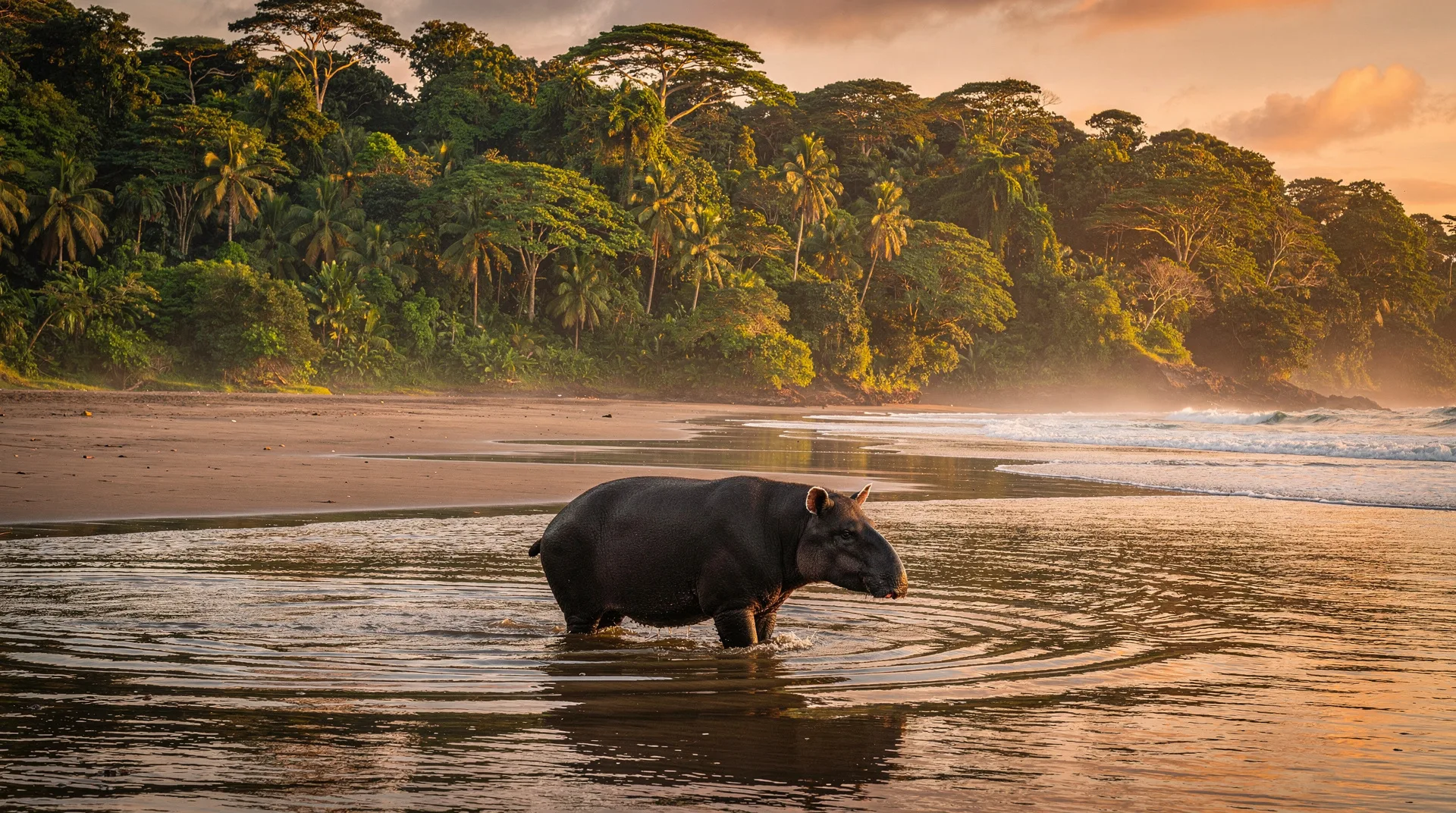
National Geographic once called Corcovado “the most biologically intense place on Earth.” It is not hyperbole. The park protects 41,788 hectares of primary lowland rainforest on the Osa Peninsula — the last significant patch of Pacific coastal rainforest in Central America. It is the only place in Costa Rica where all four native monkey species coexist: white-faced capuchin, mantled howler, spider monkey, and the critically endangered squirrel monkey. Tapirs wander the riverbanks at Sirena Station, scarlet macaws wheel overhead in flocks rarely seen elsewhere on the Pacific coast, and jaguars — though elusive — leave prints in the wet sand along forest streams.
Corcovado is the park that serious wildlife travellers come to Costa Rica for. It is remote, genuinely wild, and not a place for casual day-trippers without preparation. The logistics require more planning than any other park in the country, but the payoff is unlike anything else in the region.
The mandatory guide rule explained
In 2014, following years of illegal gold mining, poaching, and visitor pressure that degraded key habitats, the Costa Rican government made certified guides mandatory for all Corcovado visitors. The rule is enforced at the ranger stations — arrive without a licensed guide and you will not enter.
A certified Corcovado guide must have passed a specific course accredited by ICT (Instituto Costarricense de Turismo) covering species identification, first aid, navigation, and environmental impact minimisation. Ask to see the guide’s certification card before booking. Licensed guides are registered with SINAC (Sistema Nacional de Áreas de Conservación) and can be verified.
This rule has a secondary benefit beyond conservation: the guide quality at Corcovado tends to be excellent. These are specialists who can identify birds by call, track tapir prints, and know exactly which strangler fig is currently fruiting and attracting toucans. The mandatory guide rule has, despite initial pushback, produced a more rewarding experience for most visitors.
Drake Bay: Corcovado NP and Sirena Station tour — from $135Two entry points: Drake Bay vs Puerto Jiménez
There is no road to the main Sirena Ranger Station — the park’s wildlife epicentre. You reach Sirena either by boat from Drake Bay (the most common approach) or by a 16km jungle trek from La Leona station near Puerto Jiménez.
Drake Bay approach: Drake Bay is a small village on the north side of the Osa Peninsula, accessed by a 1-hour boat from Sierpe or a 50-minute domestic flight from San José (Sansa, around $100 one-way). From Drake Bay, speedboats take about 45 minutes to reach the Sirena Station landing. Most Drake Bay lodges — Aguila de Osa, Casa Corcovado, La Paloma Lodge — include Corcovado day trips in their packages. This is the most common and logistically streamlined approach.
Puerto Jiménez approach: Puerto Jiménez is a small town on the eastern side of the Osa Peninsula, reachable by a 6-hour drive from San José or a 50-minute flight. From here, the classic entrance is through La Leona station (accessed via a 45-minute taxi-boat along the coast), then a 16km hike along the beach and jungle to Sirena. This multi-day overland approach is for serious trekkers and requires camping gear or pre-booked lodges.
Which is better? For a first visit or a day trip, Drake Bay is easier and gives you the most time at Sirena. Puerto Jiménez is the gateway for multi-day expeditions and overnight stays at Sirena Station, which must be booked months in advance through SINAC.
Both towns have their own personality worth factoring in. Drake Bay is quieter, more remote, and geared almost entirely around lodges and wildlife tours — there is little to do beyond the forest and the boat trips. Puerto Jiménez is a working town with a genuine local feel, better independent dining options, and easier access if you are also planning a trip further along the peninsula or a stop at the Caño Island snorkelling grounds, which lie roughly equidistant from both entry points by boat.
2 days 1 night in Corcovado Sirena from Drake Bay — from $425Entry fees and costs
Park entrance fee: $15–20 per person per day (fee may increase — verify with SINAC before travel). A separate fee applies for overnight stays at Sirena Station.
Guide fee: A certified guide typically costs $80–120 per person for a day tour from Drake Bay, inclusive of the boat transfer. This is non-negotiable and pays for their livelihood in a community where alternative employment is limited.
Overnight at Sirena Station: Dormitory beds and meals must be booked directly with SINAC, often 6 months in advance. This is one of the most coveted wildlife experiences in Central America and fills up fast.
Total realistic budget for a day trip from Drake Bay: $200–250 per person including boat, guide, entrance fee, and lunch. Multi-day expeditions from Puerto Jiménez vary widely based on operator and accommodation.
Wildlife highlights at Corcovado
Tapirs: Baird’s tapir, the largest native land mammal in Central America, is regularly seen drinking at the Río Sirena near the station, especially at dawn. Guides know the best observation spots and the hours when tapir activity peaks.
Jaguars and pumas: You probably will not see them, but they are there. Corcovado has one of the healthiest jaguar populations in Central America — guides occasionally find fresh tracks, and lucky visitors spot them at dawn near the beach sections of trail. The best chances are on multi-day stays with very early morning walks.
Scarlet macaws: Corcovado holds one of Costa Rica’s largest scarlet macaw populations. Unlike the small groups at Carara, flocks of 20 to 40 birds are common here — a spectacular sight as they fly over the canopy at dawn.
Four monkey species: A single morning walk from Sirena Station often produces all four monkey species. Spider monkeys swing above, howlers grumble in the distance, white-faced capuchins investigate the trail edges, and with luck, you may hear the tiny squirrel monkeys chattering in the lower canopy.
Reptiles: Both American and spectacled caimans inhabit the rivers. Fer-de-lances (one of the most venomous snakes in Central America) are present — this is one reason guides are genuinely useful beyond wildlife spotting.
Birds: Corcovado is a Tier 1 birding destination. Harpy eagles have been recorded here. More reliably, you will see scarlet macaws, chestnut-mandibled toucans, fiery-billed aracaris, boat-billed herons, and dozens of antbird species along the forest floor.
Corcovado NP: Sirena day tour Drake Bay-Corcovado — from $145Best time to visit Corcovado
January to April (dry season): The most popular and logistically easiest months. Trails are drier, boat crossings calmer, and wildlife more concentrated around water sources. The forest is stunning in morning light with lower humidity.
May to August: The transition into rainy season brings daily afternoon rains that can be heavy. Trails become muddy but are manageable. Wildlife is active, migratory birds arrive, and the forest is extraordinarily lush.
September to November: The wettest period. Sirena Station is occasionally closed due to flooding and erosion — always check SINAC’s official communications before planning travel in October or November. If the station is open, wildlife viewing can be exceptional precisely because fewer people are there.
December: The beginning of dry season returns. Increasingly popular, with Christmas and New Year weeks booking up fast.
A note on changing conditions: access rules, station closures, and entrance fees at Corcovado have shifted more than once in recent years as SINAC responds to erosion, flooding, and visitor-pressure concerns. Our Corcovado restrictions update tracks the latest changes — worth a check a week or two before you travel, especially if your trip falls in the September–November window.
Multi-day expeditions and overnight options
The overnight experience at Sirena transforms the visit. Animals that are shy during the day — tapirs, peccaries, giant anteaters — move freely around the station area at dusk and dawn. Guided night walks reveal tree frogs, sleeping birds, and the occasional fer-de-lance crossing the path.
SINAC operates the Sirena dormitory and ranger station meals. Capacity is extremely limited and reservations must be made directly through the SINAC reservation system. Most visitors who want to stay overnight book through a reputable Drake Bay or Puerto Jiménez operator who handles the logistics as part of a package.
Corcovado: three days and two nights — from $695What to pack for Corcovado
The park has no shops, no ATM, and no medical facility. Bring:
- Water (at least 2 litres per person — the heat and humidity are intense)
- High-energy snacks
- Long sleeves and long pants for the forest sections (protection against scratching vegetation and insects)
- Waterproof dry bag for electronics
- Strong insect repellent (DEET-based is effective; bring reef-safe alternatives for any boat crossings)
- Rubber boots or waterproof hiking boots — Sirena involves multiple river crossings
- A wide-brimmed hat and SPF 50 for the beach sections
Getting to the Osa Peninsula
- By air: Sansa Airlines flies San José (SJO) to Drake Bay (DRK) and Puerto Jiménez (PJM), roughly 50 minutes, around $90–120 one-way. Book early — these routes fill up.
- By car + boat: Drive to Sierpe (about 5 hours from San José), then take a 1-hour boat to Drake Bay.
- By bus: San José to Ciudad Cortés (Tracopa) + taxi to Sierpe + boat. A full-day journey.
Frequently asked questions about Corcovado National Park
How do I book a certified guide?
Most visitors book through their Drake Bay lodge or a Puerto Jiménez tour operator. If you arrive independently, the Cámara de Turismo de la Península de Osa maintains a list of licensed guides. Do not hire anyone who cannot show certification on request.
Can I do Corcovado as a day trip from San José?
Technically yes — a domestic flight to Drake Bay, day tour, and flight back is possible in one long day. But the journey is tiring, expensive, and you sacrifice the dawn and dusk hours when wildlife activity peaks. Two or three nights in the area is a much better investment.
Is Corcovado safe?
The main risks are environmental: heat, dehydration, river crossings, and venomous wildlife (snakes, bullet ants). With a certified guide and proper preparation, these risks are manageable. The park is not a crime hotspot.
How far in advance do I need to book?
For day trips from Drake Bay in peak season (December to April), 1 to 2 weeks ahead. For overnight stays at Sirena Station, 3 to 6 months minimum — the beds fill rapidly.
Are there any sections of Corcovado accessible without a multi-day commitment?
Yes. The section near the San Pedrillo ranger station (north coast of the park) can be visited as a shorter day trip and is sometimes used for half-day birding excursions from Drake Bay when the full Sirena journey is not possible.
What first-timers underestimate
Three things trip up most first-time visitors. First, the heat and humidity at sea level on the Osa Peninsula are genuinely draining — even fit hikers slow down noticeably by mid-morning, and the guide’s pace is set deliberately conservative for good reason. Second, wildlife sightings at Corcovado, while more reliable than almost anywhere else in Costa Rica, are still wildlife sightings: a day trip is not a guarantee of tapirs or jaguar tracks, and the visitors who report the most spectacular encounters are usually those who stayed two or three nights rather than rushing through in a single day.
Third, the logistics chain — flight or boat to Drake Bay or Puerto Jiménez, then a further boat or hike to the ranger station — has more points of possible delay (weather, tide timing, boat mechanical issues) than a typical national park visit, so building a buffer day into your itinerary before onward travel is genuinely worthwhile.
Where to fit Corcovado in your itinerary
Corcovado belongs in the southern half of a Costa Rica circuit, typically paired with Drake Bay as a base and combined with Caño Island snorkelling. The classic southern Pacific deep trip runs from San José down through Uvita (Marino Ballena whale watching) before cutting across to the Osa Peninsula for 3–4 nights.
See the 12-day South Pacific deep itinerary for a full routing that includes Corcovado, Caño Island, and Cerro Chirripó, or the 12-day adventure Corcovado + Pacuare itinerary if you want to pair the peninsula with whitewater rafting on the Caribbean side. For comparison with the more accessible option, read our Manuel Antonio vs Corcovado guide, and for a first-hand account of how the logistics actually play out, see how the Osa Peninsula changed our trip planning.