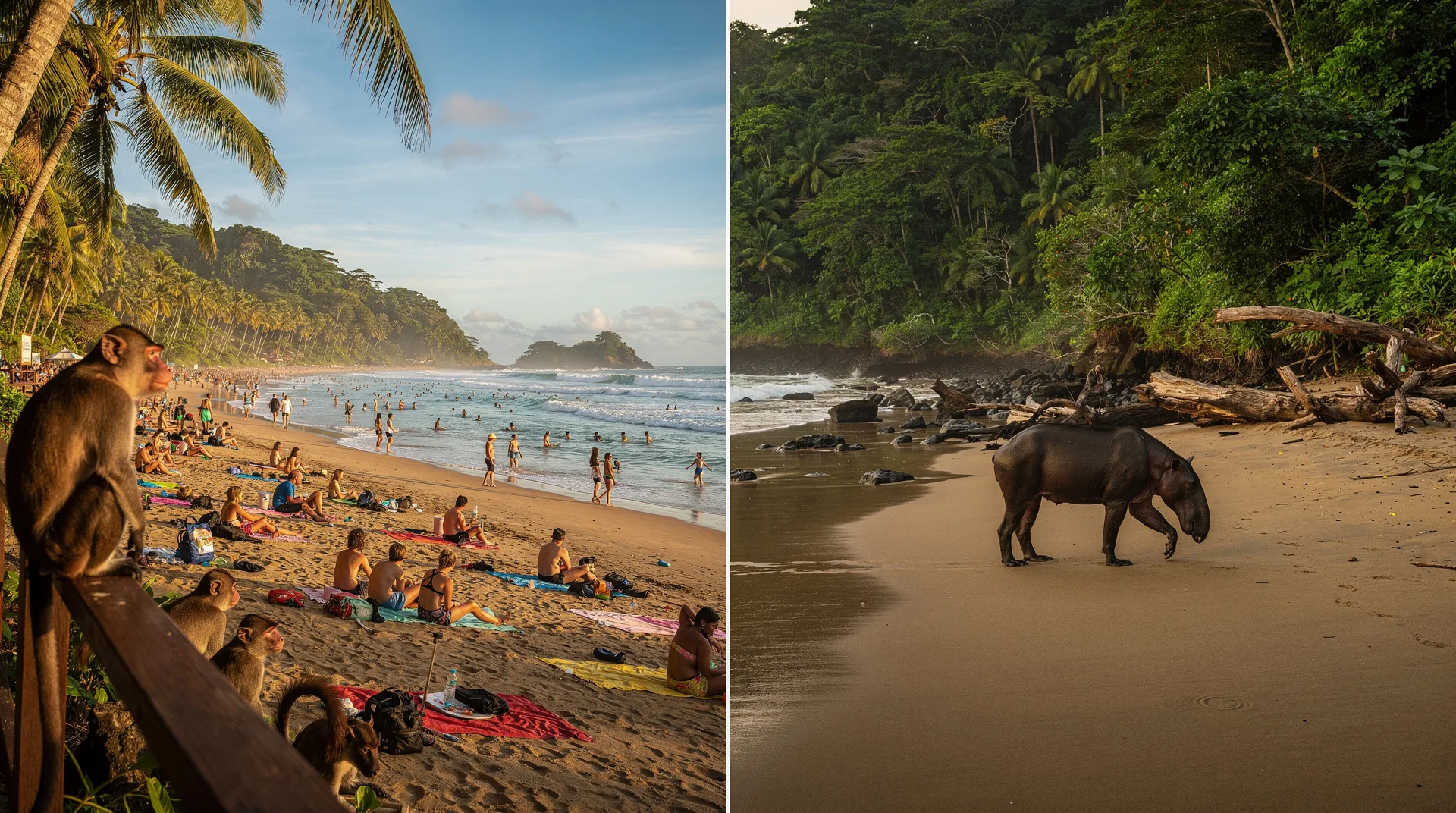
Manuel Antonio vs Corcovado: easy park or true wilderness?
Manuel Antonio or Corcovado?
Manuel Antonio suits short trips, families, and first-timers who want wildlife in a comfortable setting. Corcovado is for dedicated nature travelers prepared for logistics, cost, and genuine wilderness — it is the most biodiverse park in Central America.
The park question every Costa Rica visitor faces
Costa Rica has 28 national parks covering 25% of its territory, but two dominate the conversation for wildlife travelers: Manuel Antonio on the central Pacific coast and Corcovado on the remote Osa Peninsula. They share a coast, a general time zone, and the label “tropical national park.” Everything else about them is different.
Manuel Antonio is Costa Rica’s most visited national park for good reason — it combines beach access, reliable wildlife sightings, short well-maintained trails, and proximity to the tourist infrastructure of Quepos and Manuel Antonio town. Corcovado has been called “the most biologically intense place on Earth” by National Geographic, and that reputation rests on decades of scientific research. It is also genuinely difficult to reach, requires a certified guide by law, and rewards only visitors with time and physical preparation.
Choosing between them is not really about choosing the “better” park. It is about choosing the experience that matches your trip.
At a glance
| Manuel Antonio | Corcovado | |
|---|---|---|
| Size | 6,830 ha | 54,421 ha |
| Distance from San José | 3 hours (shuttle or car) | 4-6 hours by road, or 50-55 min by domestic flight |
| Guide required | Recommended, not mandatory | Legally mandatory (MINAET-certified) |
| Typical guided tour cost | $60-80 | $80-400+ depending on length |
| Monkey species | 3 (capuchin, howler, squirrel) | 4 (all species including spider) |
| Tapir sightings | Extremely rare | Regular at Sirena at dawn |
| Jaguar present | No viable population | Yes — possible sighting with extended stay |
| Best for | Families, first-timers, short trips | Dedicated wildlife travelers, multi-day expeditions |
Manuel Antonio National Park
What makes it special
Manuel Antonio is small — just 6,830 hectares — but its combination of habitats is extraordinary. Primary and secondary tropical forest meets pristine beaches within a park where the trail system is accessible to casual walkers. Wildlife sightings are excellent for the effort required: three-toed sloths are routinely found by guides within the first 30 minutes; white-faced capuchin monkeys are almost guaranteed; howler monkeys are heard constantly and seen regularly. Squirrel monkeys — the smallest, rarest, and most charismatic of Costa Rica’s four monkey species — are reliably spotted in the park, making Manuel Antonio one of only two accessible places in the country where all three common species are frequently seen.
The four main beaches inside the park are beautiful. Playa Manuel Antonio is calm, palm-fringed, and safe for swimming. Playa Biesanz (technically just outside the formal park boundary) is a quieter option reachable by trail. The park trail system connects these beaches through forest, creating a loop that most visitors complete in 3-4 hours at a comfortable pace.
Practical realities
Manuel Antonio National Park is closed every Tuesday. It is also one of the most popular parks in the country, with daily visitor quotas that fill on weekends and public holidays — book entrance tickets through the SINAC system (sinac.go.cr) or through a certified guide operator well in advance.
Entry costs approximately $20 for adults. A certified guide — strongly recommended — costs an additional $40-60 for a 3-4 hour park tour. Guides are legally required to be ICT-certified to lead tours within SINAC parks. The guide-to-visitor ratio is regulated, and the best guides carry a spotting scope that transforms a distant sloth into a clear, memorable sighting rather than a brown blob in a tree.
Manuel Antonio NP: guided tour with entrance fee included — from $60The park’s proximity to Quepos (7 km) and the Manuel Antonio tourist zone means excellent logistics: shuttle services from San José (3 hours, approximately $50 per person with Interbus or GrayLine), a wide range of accommodation from budget guesthouses to boutique luxury hotels with Pacific views, and a concentration of restaurants and tour operators.
Closed: Every Tuesday. Also closed during national holidays when crowds are highest.
Tourist traps to avoid: Unofficial “guides” approach visitors at the park entrance offering tours — these are unlicensed and should be declined. Legitimate certified guides are arranged through tour operators, your hotel, or platforms like GetYourGuide before arrival.
Corcovado National Park
What makes it different
Corcovado National Park protects 54,421 hectares of lowland tropical rainforest, cloud forest, mangroves, swamps, and coastline — the most diverse combination of tropical habitats in Central America within a single protected area. It sits at the southern tip of the Osa Peninsula, one of the most isolated parts of Costa Rica.
The biodiversity numbers justify the superlatives. Corcovado contains an estimated 500 species of trees (the entire UK has about 60), over 400 bird species, all four Costa Rican monkey species together in the same forest, tapirs (the largest land mammal in Central America), white-lipped peccaries in groups of hundreds, jaguar, puma, ocelot, and margay. If you spend 2 nights at the Sirena ranger station — the main base inside the park — a tapir encounter is likely, a jaguar track is probable, and a jaguar sighting is possible.
This is not Manuel Antonio’s curated wildlife-viewing experience. Corcovado is a functional, largely pristine rainforest that is large enough and undisturbed enough to support apex predators in viable populations. The wildlife encounters happen because the ecosystem works, not because guides have learned where habituated animals sit.
Drake Bay: Corcovado NP and Sirena Station tour — from $135 Manuel Antonio NP tour with tickets included — from $68The mandatory guide rule
Since 2014, all visitors to Corcovado National Park must enter with a certified guide (MINAET-certified). This rule is strictly enforced. You cannot enter independently. The reason is partly conservation (limiting impact) and partly safety — the park is remote, the terrain can be difficult, and evacuation takes time.
This changes the economics significantly. A day tour to Corcovado from Drake Bay costs approximately $80-140 per person. A 2-day/1-night trip with the Sirena ranger station as base costs $200-400+ depending on accommodation (ranger station bunk beds vs private tour with tent lodging) and departure point. An overnight or multi-day expedition makes far better use of the journey.
Getting there
Corcovado is accessed via two main gateways:
- Drake Bay (Bahía Drake): 4 hours by car from San José to Sierpe, plus a 1-hour boat ride down the Río Sierpe to Drake Bay. Alternatively, a 50-minute domestic flight with Sansa from San José to Drake Bay.
- Puerto Jiménez: 6 hours by car from San José (via Palmar Norte), or 55 minutes by Sansa flight. Puerto Jiménez is the most common base for visitors doing the Sirena sector or the Los Patos trail.
The road to Drake Bay is unpaved and can be difficult in wet season. The boat crossing of the Río Sierpe is straightforward. Puerto Jiménez has basic infrastructure — a small town with guesthouses, restaurants, and tour operators focused on Corcovado access.
Corcovado: three days and two nights — from $695Head-to-head comparison
| Criterion | Manuel Antonio | Corcovado |
|---|---|---|
| Size | 6,830 ha | 54,421 ha |
| Distance from San José | 3 hours | 4-6 hours (or 50-55 min flight) |
| Guide required? | Recommended, not mandatory | Legally mandatory |
| Park entry fee | ~$20 | ~$20 |
| Typical guided tour cost | $60-80 | $80-400+ depending on length |
| Monkey species | 3 (capuchin, howler, squirrel) | 4 (all species) |
| Tapir sightings | Extremely rare | Regular at Sirena |
| Jaguar | No viable population | Present, possible sighting |
| Beach swimming | Yes (park beaches) | Limited (remote, rough) |
| Overnight inside park | No | Yes (Sirena ranger station) |
| Infrastructure nearby | Extensive (Quepos/MA town) | Minimal (Drake Bay, Puerto Jiménez) |
| Closed one day/week | Yes (Tuesday) | No, but access regulated |
| Best for families | Yes | No (logistics too complex) |
| Best for wildlife purists | Good | Outstanding |
| Physical demand | Low-moderate | Moderate-high |
| Planning lead time | 1-4 weeks | 2-6 months for Sirena overnight |
Sirena ranger station: the heart of Corcovado
If you have decided on Corcovado, the Sirena ranger station in the interior is where the most significant wildlife experiences happen. Accessible only by foot (2-4 hour trail from La Leona on the coast), by boat landing at high tide, or via chartered small plane, Sirena is surrounded by trails that penetrate primary forest. Most large mammal encounters — tapirs coming to the river to drink at dawn, peccary herds moving through camp, great green macaws in the fig trees — happen within walking distance of the station.
Overnight accommodation at the station is bunk-bed dormitory style. Meals are included. Maximum 40 visitors per night (reservation through SINAC mandatory — book 2-6 months ahead for dry season dates). This is not luxury: it is a ranger station in a remote national park, with generators, limited hot water, and the sounds of the rainforest replacing everything else. Most visitors describe the Sirena experience as one of the most memorable of their lives.
Day trips to Corcovado from Drake Bay or Puerto Jiménez are possible and worthwhile, but the wildlife density at Sirena — particularly at dawn and dusk — is not replicated by day visitors who arrive mid-morning and leave by 4pm.
The combined itinerary: Manuel Antonio then Corcovado
Many visitors solve the choice problem by doing both. The geography supports this: Manuel Antonio (Quepos) is on the central Pacific coast; Uvita and Dominical are 2 hours south; Drake Bay or Puerto Jiménez is another 2-3 hours south. A 10-14 day south Pacific itinerary can include 2 nights at Manuel Antonio, 2 nights at Uvita (with whale watching if the season aligns), and 3 nights at Drake Bay including a full Corcovado day or overnight.
See our 12-day southern Pacific deep dive for a full route that incorporates both parks. The 7-day Arenal and Manuel Antonio itinerary is the standard approach for Manuel Antonio as a standalone.
Wildlife you can expect: realistic expectations
Manuel Antonio
- Sloths: Three-toed sloths are visible in trees along the main trails. A guide with a spotting scope makes a significant difference.
- Capuchin monkeys: Bold and habituated. They approach visitors and can be aggressive around food — never feed them.
- Squirrel monkeys: The park is one of their last strongholds on the Pacific coast. A reliable sighting is not guaranteed but likely with a guide.
- Howler monkeys: Heard daily. Seen regularly in the canopy.
- Iguanas and basilisks: Abundant on the beach and trail edges.
- Birds: 184 species recorded in the park, including black-and-white hawk-eagle, fiery-billed aracari, and the endemic Baird’s trogon.
Corcovado
All of the above, plus:
-
Tapirs: Baird’s tapir (the largest land mammal in Central America) is regularly seen at Sirena and along river edges at dawn.
-
Spider monkeys: The largest of the four species, and the most impressive in the canopy.
-
White-lipped peccaries: Herds of 50-200 individuals move through Corcovado. They can be intimidating but are not aggressive unless provoked.
-
Jaguar: Corcovado has the healthiest jaguar population in Central America outside the Amazon. Sightings require extended time; tracks and trail camera evidence are more common than visual encounters.
-
Scarlet macaws: Both Manuel Antonio and Corcovado have macaw populations, but Corcovado’s are larger and more visible.
-
Whale sharks and dolphins: Seen offshore, particularly off the Drake Bay coast.
Frequently asked questions about Manuel Antonio vs Corcovado
Is Manuel Antonio worth visiting if you have already been to other Costa Rica national parks?
Yes, because Manuel Antonio’s specific combination of accessible wildlife, beach access, and short trails is genuinely unique even compared to other well-known parks. The squirrel monkey population alone is a reason to return. That said, if you have visited Corcovado, Manuel Antonio will feel tame by comparison.
How far in advance do I need to book Corcovado?
For day tours from Drake Bay or Puerto Jiménez, 2-4 weeks in advance is generally sufficient outside peak season. For overnight stays at Sirena ranger station during dry season (January–April), book through SINAC 2-6 months ahead. Availability is very limited and the station is one of the most sought-after wildlife lodgings in Central America.
Can children visit Corcovado?
Technically yes, but it is not well-suited for young children. The trails are not strenuous but the logistics are demanding, the heat and humidity are significant, the boat crossings can be rough, and the accommodation at Sirena is basic. Manuel Antonio is by far the better family option. Most operators suggest a minimum age of 12 for Corcovado, and 16 for overnight stays.
What is the best time of year to visit each park?
Manuel Antonio: year-round, but Tuesday closures are non-negotiable. Dry season (December–April) is most comfortable. Green season (May–November) can be good — the park empties out and wildlife is easier to spot.
Corcovado: dry season (December–April) is optimal for trail conditions and Sirena access. Wet season brings heavy rain, potential flooding on some trails, and the Sirena station sometimes limits access. The September–October period can see significant flooding and some closures.
Is there a beach inside Corcovado that I can swim at?
There are beaches within the park perimeter, including the famous one near the La Leona entrance. However, swimming conditions are not reliably safe — surf can be strong and there are no lifeguards. The beach experience inside Corcovado is better understood as a wilderness experience than a beach holiday.
Which park has better bird watching?
Corcovado has more species and more endemic or specialized species — 400+ species versus 184 at Manuel Antonio. For serious birders, Corcovado is not comparable to anything else on the Pacific coast. For casual wildlife watchers, both parks provide excellent bird encounters.
Accommodation near each park
Understanding where to stay is as important as understanding the parks themselves.
Near Manuel Antonio
Manuel Antonio town and the road between Quepos and the park entrance form a strip of hotels, restaurants, and tour operators. The range is comprehensive — from budget guesthouses ($30-60/night) to boutique hotels with Pacific views ($200-400/night) to a handful of small luxury properties. Notable options include Arenas del Mar (high-end, directly above the park), Hotel Makanda by the Sea (adults-only boutique, stunning views), and La Mariposa (classic hillside perch).
Quepos (7 km from the park) has the widest budget range and good local restaurant options. The town itself is a working fishing port with more local character than the tourist strip.
Near Corcovado
Accommodation options depend on your gateway:
Drake Bay: A small cluster of eco-lodges and guesthouses accessible only by boat (from Sierpe) or light aircraft. Most accommodation is inclusive of meals because the bay has few independent restaurants. Prices range from basic guesthouses ($60-90/night all-inclusive) to Aguila de Osa Inn and Las Caletas Lodge ($200-400+ inclusive). Drake Bay offers exceptional whale and dolphin sighting conditions from the lodges themselves.
Puerto Jiménez: A small Tico town with budget guesthouses ($30-60/night), a handful of mid-range hotels, and a few eco-lodges in the surrounding forest. It is a functional base for Corcovado day tours with more infrastructure than Drake Bay.
Inside the park (Sirena): Bunk dormitory at the ranger station. Basic, communal, and extraordinary — you fall asleep to the sounds of the rainforest and wake to sunrise over the Pacific.
Getting to each park from San José
The distance difference between Manuel Antonio and Corcovado is one of the key practical factors in choosing between them.
Manuel Antonio is 3 hours from San José by car or shuttle (approximately $45-55 per person with Interbus, GrayLine, or Caribe Shuttle). The final road to Quepos is paved and fast. A rental car is not required — the shuttle drops you in Quepos or directly at your hotel.
Corcovado via Drake Bay requires: San José → Palmar Norte (3h) → Sierpe (30 min) → boat down the Río Sierpe to Drake Bay (1h). Total: approximately 5-6 hours by road and boat, or 50 minutes by Sansa domestic flight from SJO directly to Drake Bay. Via Puerto Jiménez: San José → Palmar Norte → Puerto Jiménez by car (6h), or Sansa flight to Puerto Jiménez (55 min).
The domestic flight option makes Corcovado significantly more accessible than the ground route suggests. At approximately $120-150 per person each way on Sansa, it adds cost but saves 5+ hours of travel.
Making your choice
Manuel Antonio if you have 1-2 days, are traveling with family or first-timers, want beach access inside a park, value easy logistics, and are satisfied with sloths, three monkey species, and excellent birding.
Corcovado if you are a dedicated nature traveler with 3-7 days to spend in the south, are prepared for the logistical demands and cost of reaching and touring the park properly, and want the most biodiverse national park experience available in Central America.
Both if you have 10-14 days and are building a southern Pacific circuit. Start at Manuel Antonio for the first two nights, work south through Uvita for whale watching, and end at Drake Bay or Puerto Jiménez for Corcovado. See our 12-day southern Pacific deep dive for the full route.
Visitor caps and conservation impact
Both parks manage visitor numbers, but for different reasons and with different consequences for your planning. Manuel Antonio’s daily cap (around 600-800 visitors, split between morning and afternoon entry windows) exists mainly to protect trail infrastructure and manage crowding in a genuinely small park — 6,830 hectares absorbing hundreds of thousands of annual visitors requires active management. SINAC has occasionally increased the cap during high-demand periods, which is one reason booking ahead matters more than it did a decade ago.
Corcovado’s mandatory-guide rule is a stricter form of the same logic, applied to a much larger and more fragile system. Because the park protects functioning predator populations — jaguar and puma need large, undisturbed territories — even modest increases in uncontrolled foot traffic could measurably affect wildlife behaviour. The Sirena ranger station cap of 40 overnight guests is not a marketing device; it reflects the station’s actual water, waste, and staffing capacity in a location with no road access.
For visitors, the practical takeaway is the same at both parks: book your slot before you arrive, arrive on time for your entry window, and treat the cap as confirmation that you are visiting a well-managed protected area rather than an inconvenience. Parks that manage visitor numbers well tend to be the ones where wildlife sightings remain reliable decades from now.
Weather and seasonal timing for both parks
Manuel Antonio is comfortable to visit in any month, but the dry season (December-April) brings the most consistent trail conditions and the clearest beach days; the green season (May-November) thins the crowds substantially and wildlife is, if anything, easier to spot as forest fruiting increases. Afternoon rain in green season rarely lasts more than an hour or two, and mornings stay reliably dry.
Corcovado is more weather-sensitive. Dry season is the operational sweet spot — trails are passable, the Sirena airstrip and boat landings function normally, and the heat, while intense, is manageable with an early start. Wet season (roughly May-November) brings genuine logistical friction: some trail sections flood, the Río Sierpe boat crossing can be delayed by high water, and September-October in particular sees the heaviest rainfall of the year on the Osa Peninsula, occasionally forcing operators to cancel Sirena access altogether. If your trip window is flexible, aim for December-April at Corcovado and treat any other month as a itinerary that needs a backup day built in.
Where to go next once you have picked a park
Once the park question is settled, the rest of the planning falls into place around it. For the full picture of what each park offers on the ground, read the dedicated Manuel Antonio National Park guide and the Corcovado National Park guide. If sloths are the main draw, where to see sloths in Costa Rica compares the options beyond these two parks.
Getting to the Osa is the part that surprises most people, so it helps to read about internal flights with Sansa and Aerobell before deciding between road and air. For the Manuel Antonio side, the nearby town of Quepos is a practical base with more budget choice than the strip along the park road.
If the Osa has caught your imagination, the blog post on how the Osa Peninsula changed our trip planning is an honest account of what the region asks of a traveler, and the update on Corcovado restrictions is worth a look before you book.