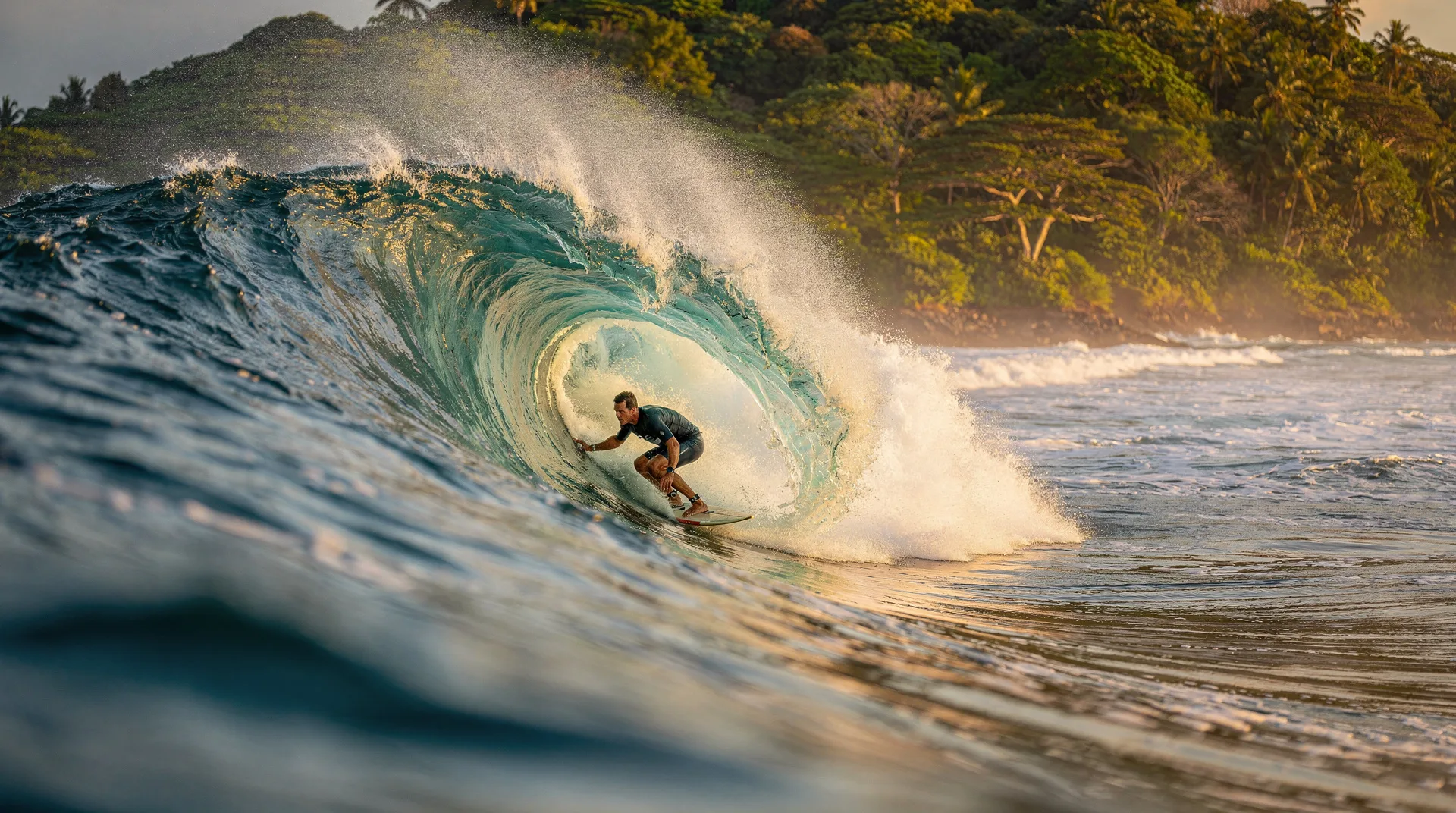
Best surf beaches in Costa Rica by level
Top surf beaches by level?
Tamarindo (begin), Nosara/Santa Teresa (inter), Pavones (advanced).
Costa Rica’s surf geography: why location and season both matter
Costa Rica sits in one of the most privileged surfing positions in the world — two coasts, each with distinct swell patterns, creating year-round surf for those willing to move between them. The Pacific coast receives northwest swells in the dry season (December-April) and more powerful south and southwest swells from April through October. The Caribbean coast, facing northeast, peaks in its surf season from November through March when trade winds and North Atlantic storms generate consistent swell.
Knowing the distinction matters for planning. Someone arriving in July for two weeks will find the south-facing Pacific breaks — Nosara, Santa Teresa, Dominical — at or near their best. The same person in February would find the northwest-facing Guanacaste breaks (Tamarindo, Witch’s Rock, Playa Grande) more consistent.
This guide organises beaches by skill level, not by coast or season, so you can match your ability to the right destination.
| Beginner | Tamarindo, Jacó, Sámara |
| Intermediate | Nosara, Santa Teresa, Dominical |
| Advanced | Pavones, Witch’s Rock, Ollies Point |
| Group lesson cost | around $40-70 for 2 hours |
| Board rental | around $15-35/day |
Timing is the other half of the decision. Our surf seasons by region guide goes deeper on which coast to pick in which month, and the tide and surf conditions guide explains how tides change the same beach from one hour to the next.
Beginner surf beaches
Tamarindo — the learn-to-surf capital
Tamarindo is where most visitors take their first lesson, and for good reason. The main beach break has a forgiving reform wave in the shallower middle section — waves that have already broken once on the outer bar and reform with reduced power closer to shore. This is the ideal learner environment: waves that push you without punishing you.
Tamarindo surf: learn and practice surfing — from $50The surf school density here is remarkable: over 30 licensed schools operate in Tamarindo, and competition keeps lesson prices at $50-70 for a two-hour group session with board and rash guard. Most schools guarantee you will stand up on the first lesson or give you a second for free.
The honest truth about Tamarindo: The water is shared by dozens of learners, surf instructors, kayakers, boat tours, and the occasional paddleboarder. Peak season mornings are chaotic in the water. If you go, book early (7-8am) before the crowds build and avoid the main Tamarindo beach on days when tour boats are operating. Playa Langosta, 3 km south, is a quieter alternative that works well for beginners when the tide is right.
Season: Year-round, best December-April for the northwest swell that generates clean beginner-friendly conditions.
If Tamarindo becomes your base, the Tamarindo destination page covers where to stay and what else to do on non-surf days, and the beginner surf spots guide compares it with other gentle waves around the country.
Jacó — accessible and reliable
Jacó is the closest surf beach to San José (2 hours on the Costanera highway) and its accessibility makes it the most visited beach in Costa Rica. The surf is a beach break that works in most swell directions and at most tide stages — not elegant, but consistent. Beginners benefit from the quantity of instruction available and the forgiving wave shape in the middle of the beach.
Jacó: surf lesson with certified instructor — from $50 Jacó Beach: learn to surf - surf for families — from $55The honest truth about Jacó: The town has a party scene and a petty theft problem. Keep your valuables locked in a hotel safe. The beach itself is grey volcanic sand and not particularly beautiful. Use Jacó for surf lessons and proximity to activities (Tortuga Island, Manuel Antonio day trip) rather than for a beach vacation in its own right.
Season: Works year-round, peaks with Pacific south swells April-October.
For more on the town itself, see the Jacó surf guide and the Jacó destination page. Before you paddle out anywhere on this coast, read the beach safety guide so you recognise a rip current when you see one.
Sámara — the most beginner-friendly natural wave
Sámara’s offshore reef creates a wave that is genuinely gentle without the need for a reform zone trick. The swell arrives, hits the reef, and produces a slow, rolly wave with a long ride for learners. Tico Surf School and several others operate here with quality instruction at fair prices ($50-60 for group lessons).
The main advantage of Sámara for beginners: the town is calm, the beach is uncrowded compared to Tamarindo, and the water conditions inside the bay are consistent. The main disadvantage is that Sámara’s reef means the wave is not always clean — on some days the swell angle creates messy, cross-chop conditions that are confusing for learners.
Playa Avellanas — for beginners who want to progress
Avellanas (Avellana), 20 km south of Tamarindo, is a quieter beach with multiple breaks including a beginner-friendly reform wave at the north end (Little Hawaii). If you have already done your first lesson in Tamarindo and want to practice without the crowds, Avellanas offers more space and a better progression environment. The legendary Lola’s restaurant on the beach has been a surf community institution for years.
Intermediate surf beaches
Nosara (Playa Guiones) — the best intermediate wave in Costa Rica
Playa Guiones is a 6-kilometre beach break that is one of the most consistent surf spots in Central America. The wave here works at almost every tide stage, handles swell from multiple directions, and has both left and right options. The peak season runs from April through October, when south swells generate 1-3 metre faces on the better days.
The intermediate community at Nosara is large and welcoming. Corky Carroll’s Surf School, Safari Surf School, and Coconut Harry’s all operate quality programmes for 5-day and 7-day adult camps ($800-1,200 per week including accommodation). The surf camp infrastructure here is genuinely one of the best in the world for intermediate development.
Tamarindo surf: learn and practice surfing — from $50What separates Guiones from Tamarindo: Guiones has no close-out sections (waves that break all at once with no way through), making it technically more rewarding for surfers developing their reading of waves and positioning.
Santa Teresa — lifestyle and performance surf
Santa Teresa is where intermediate surfers who want to improve quickly come — and stay longer than planned. The waves here have more power than Nosara, with stronger swell exposures and less forgiveness for poor positioning. Playa Santa Teresa has multiple peaks spread across 8 km of coastline; the section in front of the main village is the most consistent.
The lifestyle pull of Santa Teresa is real: the yoga studios, farm-to-table restaurants, and community of long-term expat surfers create an environment where surf progression and wellness overlap. Many visitors arrive for a week and extend to a month.
What to expect: The road into Santa Teresa can be rough in green season. A 4WD is strongly recommended from May through November. The dry season (December-April) sees the most crowded line-up — arrive early or surf the less-accessed breaks toward Playa Carmen or Mal Pais to the south.
Dominical — intermediate with advanced potential
Dominical is a 2-hour drive south of Manuel Antonio on the Costanera Sur highway. The main break is a powerful beach break that works best with south swells from April through October. Intermediate surfers who can duck-dive and read the shore break will find excellent, uncrowded waves here; the 8-day surf camp programme from Uvita covers this stretch of coast.
Uvita: surf some of the best waves of Costa Rica 8 days — from $1495Honest warning: Dominical gets hollow and heavy. The shore break can dump you hard. If you are not yet confident duck-diving or getting through the break, this is not the right spot.
The Dominical and southern Pacific surf guide and the Dominical destination page give more detail on this stretch of coast. If you would rather combine lessons with a longer stay, the surf camps guide compares the options.
Advanced surf beaches
Pavones — one of the world’s longest left-hand waves
Pavones sits on the Osa Peninsula, reached via a 4-hour drive from Golfito and then a 4WD dirt road along the coast. The wave here, when it works, is a left-hand point break that can give rides of over 1 kilometre — one of the longest waves in the world. It works best on big south and southwest swells from April through October.
Getting here requires commitment: the road is rough, facilities in the village are basic (a few cabinas and a soda), and the wave itself is fast, heavy, and suitable only for experienced surfers with solid tube-riding ability. There is no surf school, no instructor industry, and no forgiveness for poor wave selection.
Stay: Tiskita Jungle Lodge ($180-250) is the only quality accommodation nearby. The remote location means self-sufficiency — stock up in Golfito before driving south.
Witch’s Rock (Roca Bruja) — the legendary reef point
Witch’s Rock sits inside the Guanacaste dry forest just offshore of Santa Rosa National Park. It is accessible only by boat from Playas del Coco or Tamarindo (1.5-2 hour boat ride). The wave — a right-hand reef and beach break — is one of the most photographed in Costa Rica and works best from December through April on northwest swells.
Access requires coordination: SINAC (the national parks authority) charges a park entry fee and the boat operation requires a licensed captain. The combination of remote location, boat cost ($150-200 for the day split between 4-6 surfers), and advanced wave quality means Witch’s Rock self-selects for experienced surfers.
Ollies Point — the long right in Santa Rosa NP
Ollies Point (Punta Descartes) is a right-hand point break accessible by the same boat trip as Witch’s Rock, 20 minutes further north. The wave can peel for 400-500 metres on a good day. Ollies is generally more consistent than Witch’s Rock but requires similarly advanced skills — powerful, long walls that punish improper positioning.
Our Witch’s Rock and Ollie’s Point guide covers the boat logistics in more depth, and the Pavones guide does the same for the long southern left.
Surf seasons at a glance
| Beach | Best months | Swell direction | Difficulty |
|---|---|---|---|
| Tamarindo | Dec-Apr | NW | Beginner |
| Playa Grande | Dec-Apr | NW | Intermediate |
| Nosara | Apr-Oct | SW | Intermediate |
| Santa Teresa | Apr-Oct | SW | Intermediate+ |
| Dominical | Apr-Oct | S/SW | Intermediate+ |
| Pavones | Apr-Oct | S/SW | Advanced |
| Witch’s Rock | Dec-Apr | NW | Advanced |
| Jacó | Year-round | Multiple | Beginner-Int |
| Caribbean coast | Nov-Mar | NE | Intermediate |
Frequently asked questions about surf beaches
How long does it take to learn to surf in Costa Rica?
Most beginners stand up on their first 2-hour lesson in Tamarindo or Jacó. Catching waves independently (without an instructor pushing you) typically takes 3-5 lessons. Riding unbroken wave faces (rather than whitewater) takes most adults 5-10 days of consistent practice. Surf camps of 5-7 days with twice-daily sessions accelerate progress significantly.
Is it safe to surf in Costa Rica?
Surf injuries are common — cuts from reef, board strikes, and wipeouts are part of the game. What distinguishes Costa Rica is the riptide risk on beach breaks and the remoteness of some advanced spots. Witch’s Rock and Pavones have no immediate medical access; carry a first-aid kit and always surf with a partner. For beginners, the staffed surf schools at Tamarindo and Jacó are the safest learning environments.
Are there surf camps for adults?
Yes — Costa Rica has one of the strongest surf camp industries in the world. Safari Surf in Nosara, Witch’s Rock Surf Camp in Tamarindo, and Blue Zone Surf in Santa Teresa all offer week-long adult programmes ($800-1,500 including accommodation, meals, and twice-daily lessons). Most cater to beginner-intermediate adults rather than experienced surfers.
Do I need to bring my own board?
No — every major surf destination has board rental shops charging $15-25 per day for a foam longboard (ideal for beginners) or $20-35 for a fibreglass shortboard. Bringing your own board on airlines involves significant fees ($75-150 per flight on most carriers) and is only worth it if you are travelling specifically for performance surfing.
What is the water temperature?
Pacific water temperatures range from 24°C to 28°C year-round. A rash guard (UV protection) is all you need — wetsuits are not used in Costa Rica. Caribbean water is similarly warm, around 26-28°C.
Can children learn to surf in Costa Rica?
Absolutely. The family surf programmes at Jacó are specifically designed for children from age 6 upward. Tamarindo surf schools also run children’s lessons. Sámara’s calm wave is the safest environment for very young learners (age 5-8). See our family beaches guide for family-specific beach recommendations.
Reading a swell forecast before you commit to a beach
Most visiting surfers check a forecast site (Surfline, Windy, or Magicseaweed) before deciding where to surf on a given day, and it’s worth understanding the basics rather than just looking at a wave-height number. Swell direction matters more than size for beginners — a northwest swell hitting Tamarindo produces the clean, reformed waves this guide recommends for learners, while the same swell direction can make a south-facing beach like Dominical flat and unsurfable.
Period (the gap in seconds between wave crests) indicates swell quality: a longer period (14+ seconds) means more organised, powerful waves, while a short period (8-10 seconds) produces choppier, weaker surf better suited to nervous beginners. Wind direction is the other key variable — offshore wind (blowing from land to sea) grooms wave faces into clean lines, while onshore wind (common on Pacific afternoons) creates messy, wind-chopped conditions. This is the practical reason every surf school in this guide recommends morning sessions.
Where to fit surf beaches in your itinerary
The 10-day surf trip itinerary covers Tamarindo (2-3 days of lessons), Nosara (3-4 days of intermediate practice), and Santa Teresa (3 days) with a car rental loop of the Nicoya Peninsula. For a shorter surf focus, a 5-day Tamarindo stay with day trips to Avellanas and Playa Grande covers the beginner-intermediate spectrum.
See the full Tamarindo surf guide, Nosara surf guide, and Santa Teresa surf guide for detailed local knowledge on each destination. If you’re travelling with young children who won’t be surfing, our best family beaches guide covers calm-water alternatives nearby.