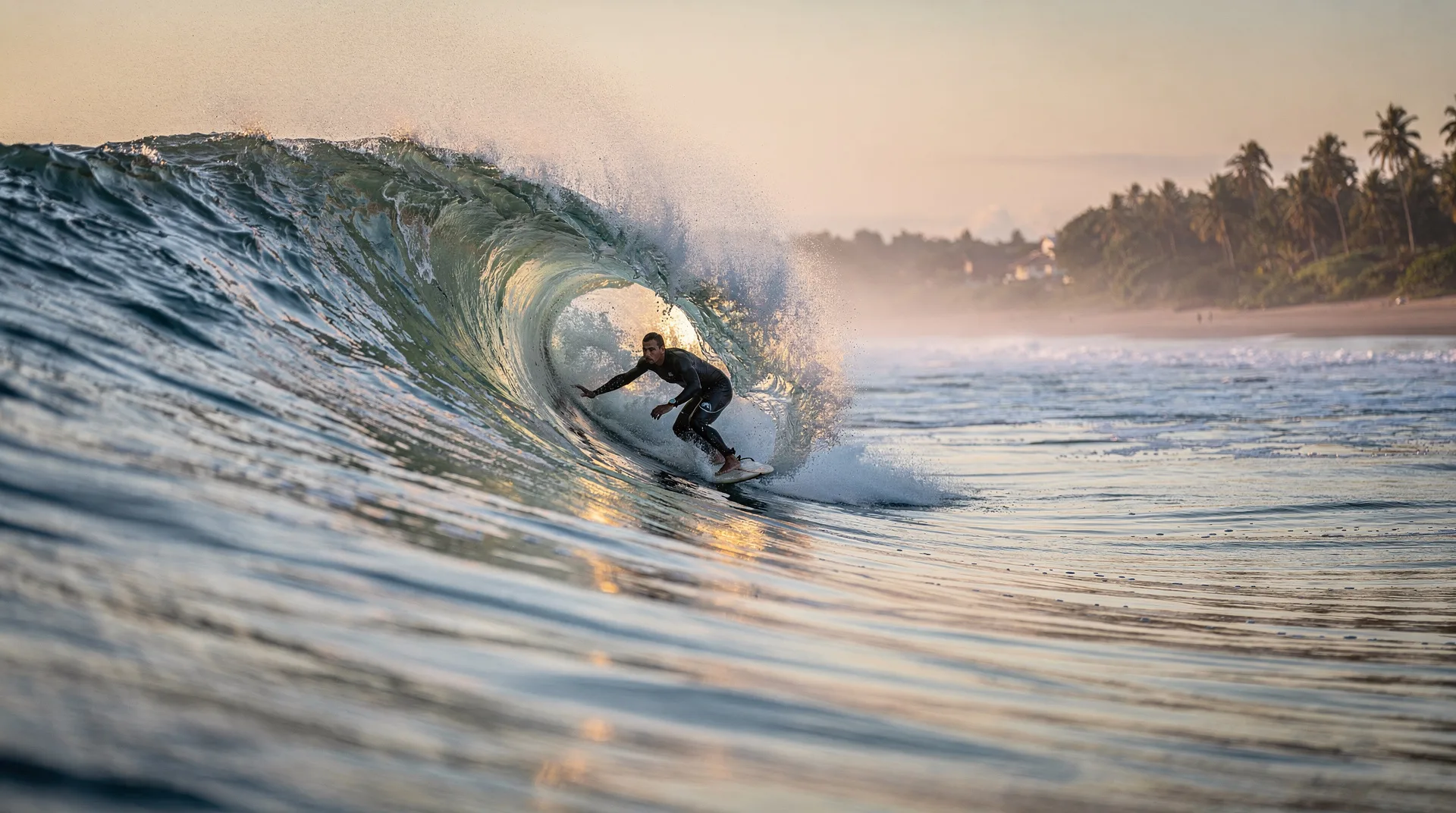
Nosara surf guide: Guiones, the yoga coast, and what to expect
Why is Nosara famous for surfing?
Playa Guiones offers some of the most consistent beach break waves in Central America, firing year-round with well-shaped peaks and relatively uncrowded lineups compared to Tamarindo. The surf-yoga community gives the town a distinct, low-key energy.
Guiones: Costa Rica’s most consistently shaped beach break
Nosara sits on the Nicoya Peninsula roughly 30 kilometres south of Sámara, separated from most of Guanacaste’s resort belt by a long dirt road and a set of creek crossings that, even in the dry season, require confidence behind the wheel. That natural friction has kept Nosara smaller and more intentional than Tamarindo — which is exactly the point.
| Where | Playa Guiones, Nicoya Peninsula, Guanacaste |
| Skill level | Intermediate-friendly, beginner-manageable |
| Best season | April–October (south swell), consistent year-round |
| Lesson cost | Around $45–60 group, $70–90 private |
| Getting there | 4.5–5hrs from San José by road, or ~45min flight |
The surf magnet here is Playa Guiones, a 7-kilometre arc of dark sand stretching south from the estuary mouth. The continental shelf geometry and the exposure to open Pacific swell combine to produce waves that break cleanly from well offshore, giving surfers a longer ride and more time to set their lines compared to the heavy, dumping shore breaks found further south. It fires in the 2–6 foot range reliably enough that most intermediate surfers will find their best waves of a Costa Rica trip here.
The town behind the beach is an eccentric mix of surf shops, juice bars, yoga shalas, eco-lodges, and organic restaurants. There is almost no nightlife and no party scene — a deliberate community choice. People come here to surf, practise yoga, eat well, and repeat. If that sounds like your kind of rhythm, Nosara will be hard to leave.
Reading the breaks at Playa Guiones
The main peaks
Guiones is a sandbottom beach break, which means the best peaks shift with the sand after each swell. The most reliable peaks tend to cluster around three zones: the far north near the estuary, a series of middle peaks that produce long right-handers on south swells, and the southern section near the rocks that picks up more swell energy and gets hollow on overhead days.
At 2–4 feet, Guiones is a genuinely ideal intermediate break. The waves have enough push to do proper turns and enough shape to reward timing. The shoulder is rideable for a solid 3–5 seconds before the section closes out, which is more than most Costa Rican beach breaks offer.
At 5–7 feet, the tone changes. The peaks become more powerful and selective, the channel is trickier to navigate, and the sets that hit the southern rocks produce the kind of sharp barrels that only advanced surfers should target. Guiones at 6 feet overhead has legitimately tested experienced shortboarders who underestimated it on approach.
Playa Pelada
A 15-minute walk north of the Guiones estuary lies Playa Pelada, a small cove of darker sand and exposed rock shelves. There’s a left-hand point on the south side that fires up on overhead south swells — short, punchy, requiring commitment. The cove itself has calmer water and a tidal pool area that’s popular for swimming when the swell is too big to surf. Pelada is much quieter than Guiones and worth a visit even if you’re not paddling out.
Playa Garza (north)
Twenty minutes north by car, Garza is a sheltered bay that calms down significantly. It’s not a surf destination but makes a good swimming and snorkelling alternative on days when Guiones is too big for your level.
Surf seasons at Nosara
South swell (April to October): peak surfing
The Southern Hemisphere winter generates consistent south and southwest swells that march up the Pacific coast and hit Guiones with clean lines from April through October. July and August are the peak months — head-high to overhead on most days, with the occasional 8-foot set after large storms in the Southern Ocean. The mornings are glassy, the afternoons can get onshore, and the water is at its most powerful.
This is the green season, which means afternoon rain is normal — usually from 3pm onward. Mornings are often clear and warm. For surfers, this is the optimal travel window: consistent waves, reduced tourist crowds, lower accommodation rates, and the town feeling more like a proper surf community than a resort.
North swell season (November to March)
The dry season brings smaller but still fun surf, predominantly from northwest swells generated in the North Pacific. Waves are typically 2–4 feet, more suited to longboarding, progression work, and beginners advancing beyond whitewash. Crowds increase significantly in December and January as the dry season attracts Guanacaste’s peak tourism.
The Papagayo wind effect can make mornings choppy in December through February. Dawn patrol is essential — by 10am some days, the wind chop makes Guiones ugly. Mid-December to mid-January is when Nosara is at its most crowded and most expensive.
Surf schools and instruction at Nosara
Group and private lessons
The Nosara surf scene has historically been intermediate-to-advanced, but in recent years several good schools have opened beginner programs. Expect to pay $45–60 per person for a 2-hour group lesson, $70–90 for a 90-minute private.
Safari Surf School has the best local reputation for beginner and intermediate coaching. Their instructors split the beach by level and use video analysis for intermediate students. Coconut Harry’s is a venerable Nosara institution — more laid back, less structured, but reliable for beginners who want a relaxed introduction.
Tamarindo surf: learn and practice surfing — from $50Board rentals
Rentals run $20–30 per day for hard boards, $15–20 for foamies. Most shops will negotiate weekly rates — a week-long hard board rental usually costs $100–140. Bring your own fins if you’re particular; the local supply is functional but basic.
Surf and yoga packages
Nosara’s signature offering is the combined surf-yoga retreat. Bodhi Tree Yoga Resort, Blue Spirit, and several smaller operations offer weekly packages that typically combine daily yoga, surf instruction or guided sessions, healthy meals, and accommodation. Prices range from $1,200–2,500 per week depending on the property and room type. These packages are particularly popular with women travelling solo or in groups, and with surfers at the intermediate plateau who want to break through.
Getting to Nosara
The standard approach from San José (SJO) is a 4.5–5 hour drive combining the Pan-American Highway south, the Nicoya ferry crossing at Puntarenas–Paquera, and then the road north along the Nicoya Peninsula. This route is scenic and fully navigable in a standard car in the dry season.
The alternative is flying. Sansa operates small-plane flights from San José’s Tobías Bolaños airport to Nosara’s dirt strip — about 45 minutes in the air, roughly $90 one-way. If you are time-limited, this removes 4 hours of driving each way and is worth every dollar during peak season.
From Tamarindo (north), the direct coastal road takes about 2 hours in the dry season. In the wet season, some creek crossings require 4WD. If driving a 2WD rental, take the inland paved route via Santa Cruz — about 2.5 hours but without the creek drama.
Where to stay in Nosara
Nosara has no large hotel chains. Everything is independently owned, which keeps the quality conversation interesting.
Budget: The Garden House Hostel and several guesthouses near the Guiones entrance rent simple rooms from $50–75 per night. Basic but clean, always with surfboard storage.
Mid-range: Gilded Iguana Hotel sits closest to the Guiones access point — convenient, with a pool, good restaurant, and a board-storage rack worth its weight in salt. Rates $130–180 per night.
Eco-luxury: Bodhi Tree Yoga Resort and Harmony Hotel are the standard-bearers. Harmony in particular is beautifully designed — palm-shaded, open-air dining, cold-plunge pool — and books out months in advance in peak season. Rates $250–450 per night.
Food and drink in Nosara
Nosara’s restaurant scene is small but punchy. The Gilded Iguana is a reliable all-rounder. Robin’s Ice Cream is a local institution selling natural fruit sorbets. La Dolce Vita does solid wood-fired pizza. The organic farmers market near the soccer field on weekend mornings is the best place to stock up on tropical fruit, fresh bread, and local honey.
If you drink, Nosara’s nightlife ceiling is a couple of craft beers at the bar, a bonfire on the beach, and early to bed. The community has actively resisted the Tamarindo party trajectory and the result is a town that wakes up well-rested for dawn patrol.
Nosara catamaran sunset charter — from $135Honest notes on Nosara
Nosara is not cheap. The remoteness of the location pushes up food, accommodation, and transport costs. A mid-range week — 7 nights in a mid-range hotel, daily board rental, one lesson, eating at local restaurants — will run $1,400–1,800 per person all-in.
The road conditions in the wet season (May–October) are the other reality check. Parts of the access road wash out and some travellers get stuck or need a 4WD to get through. Plan a buffer day if arriving or departing during the green season, and confirm road conditions locally before driving.
Frequently asked questions about Nosara surf
Is Nosara good for beginner surfers?
It can be. Guiones is gentler than you might expect given its intermediate reputation, and a good school can teach beginners here. However, if you’ve never surfed before, Tamarindo’s main beach or Sámara’s protected bay offer more forgiving environments for first lessons. Nosara shines from the intermediate level up.
How crowded is the Guiones lineup?
Less crowded than Tamarindo, more crowded than Pavones. Peak season (December–March) sees noticeable competition for waves on better days. In May–October, the lineup spreads out significantly and sharing peaks is common. The etiquette at Guiones tends to be respectful — the surf community here polices itself quietly.
Is there a surf report for Nosara?
Surfline and Magic Seaweed both provide forecasts for Nosara and Guiones. The NOAA buoy data for the Central Pacific can be used to estimate swell arrival times. Local surf schools post conditions on their Instagram pages daily — often the most reliable near-term read.
What board works best at Guiones?
An intermediate surfer will get the most out of a mid-length (7–8 foot) or a higher-volume shortboard at smaller sizes. On bigger days (5 feet+), a standard shortboard in the 6’2”–6’6” range performs well. Beginners should stick to 8–9 foot foamies for first sessions. Longboarders can ride Guiones on the smaller days during the north-swell season (November–February).
Can I walk to the beach from central Nosara?
Yes, though it’s about 1.5 kilometres from the main road area to the Guiones beach access. Golf carts are the town’s primary short-distance transport — rentals available from $50–70 per day and they carry boards.
Are there surf hazards at Guiones?
The main hazards are riptide currents that form between sandbars during bigger swells, and the occasional reef section at the Pelada end. Neither is extreme by Pacific coast standards, but neither is trivial. Surf inside your level, check with locals on big days, and know how to float and signal if you get caught in a rip.
Progressing beyond Guiones
Surfers who spend a week or more at Guiones and want to push their level often use the mid-length board sessions in the morning to work on turns, then paddle out at Pelada on a smaller afternoon swell to practise reading a punchier, less forgiving wave. It’s a natural progression pattern the local schools recommend informally: Guiones for volume and consistency, Pelada for commitment. If you’re chasing bigger, more technical waves after Nosara, the Santa Teresa surf guide is the next logical stop on the peninsula, and the surf camps in Costa Rica guide rounds up week-long programmes across the whole country if Nosara’s offerings don’t fit your dates or budget.
Non-surfing days at Nosara
Even dedicated surfers benefit from a rest day, and Nosara has enough beyond the waves to fill one without leaving town. A morning yoga class at one of the studios along the Guiones road is the default choice — see the Nosara yoga retreats guide for drop-in options that don’t require a full retreat booking. The Ostional wildlife refuge, roughly 45 minutes north, has occasional mass arribada nestings of olive ridley turtles worth timing a visit around if the dates align. Otherwise, a slow day of the farmers market, a swim at Playa Pelada’s tidal pools, and an early dinner is exactly what the town is built for.
Nosara catamaran sunset charter — from $135Related guides
For the full picture of Costa Rica’s surf calendar, the surf seasons by region guide is essential reading before booking. The Santa Teresa surf guide covers Nosara’s southern sibling — more crowded, more powerful. If you’re coming for wellness as much as waves, our Nosara yoga retreats guide maps the best retreat options. Browse the Nosara destination page for a broader orientation to the town.