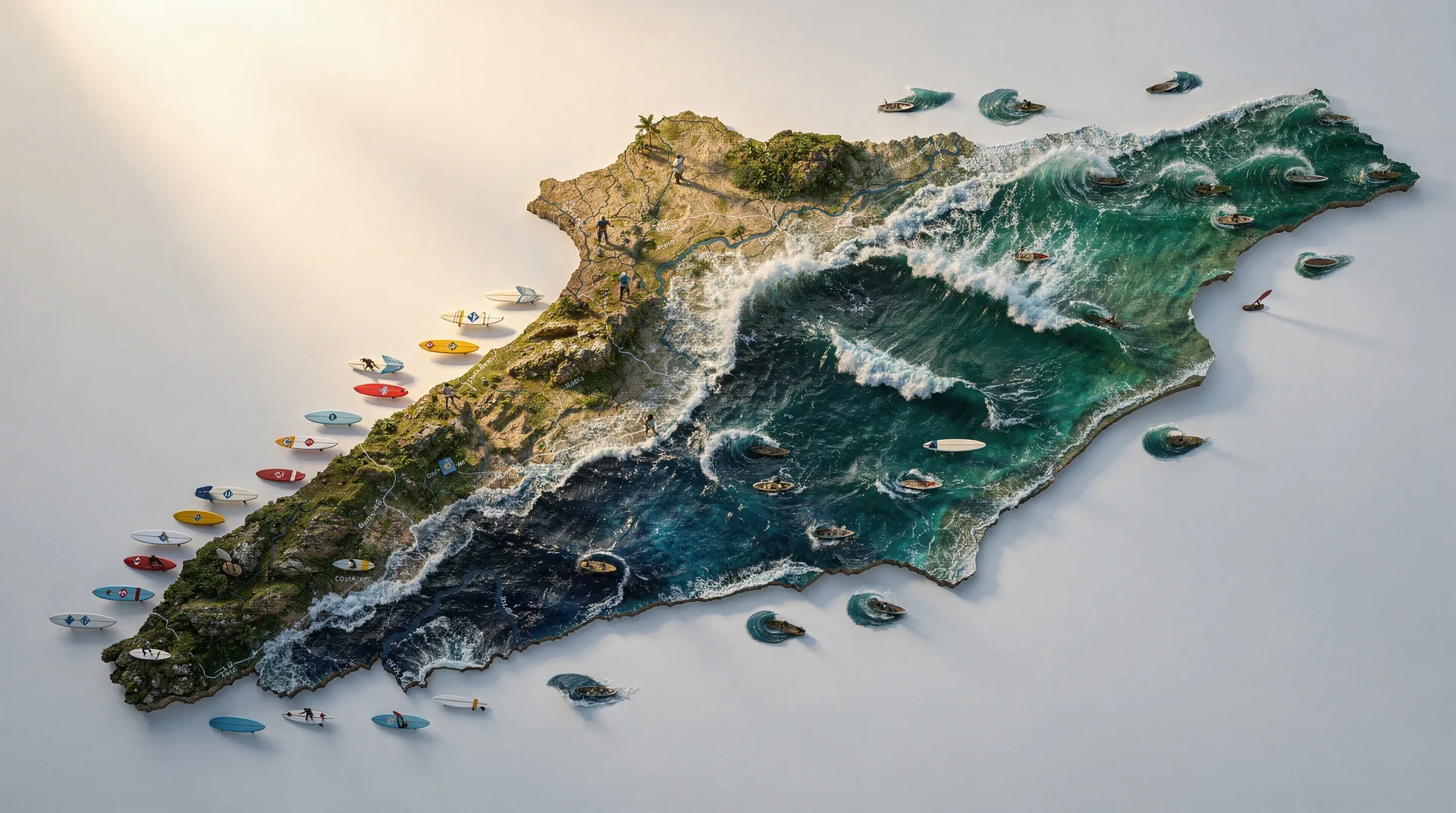
Surf seasons by region: when and where to surf in Costa Rica
When to surf where in Costa Rica?
Pacific south swells run April–October, peaking July–August — best for Guanacaste, Nosara, Santa Teresa, and Pavones. Caribbean surf season is December–February, anchored by the powerful Salsa Brava at Puerto Viejo. Year-round options exist on both coasts.
Costa Rica’s two coasts run on entirely different swell systems, so “when should I surf Costa Rica” only has a useful answer once you know which coast and which region.
| Pacific south swell peak | May–October, best July–August |
| Pacific north swell (smaller) | December–February |
| Caribbean (Salsa Brava) season | December–February |
| Best beginner window | December–April (smaller, more consistent) |
| Best advanced window | July–October (Pacific), Dec–Feb (Caribbean) |
Two coasts, four swell windows: the surfer’s calendar for Costa Rica
Costa Rica is one of the few countries on earth where a surfer can find legitimate waves year-round without flying to a different continent. The Pacific and Caribbean coasts operate on different swell systems, different wind patterns, and different seasonality — and understanding how they interact is the foundation of planning a surf trip that delivers rather than disappoints.
The core reality: the Pacific coast is the dominant surf destination, receiving consistent south and southwest swells for roughly six months of the year and residual north swells through the dry season. The Caribbean coast is a secondary surf scene — far smaller, geographically concentrated, and firing on a completely different swell system — but when it’s on, it’s seriously good. Puerto Viejo’s Salsa Brava is one of Central America’s heaviest reef breaks.
This guide breaks down every coast and region with honest seasonal assessments, specific months to target, and practical advice on timing your travel.
The Pacific coast swell system
Where swell comes from
The Pacific swell that powers Costa Rica’s most famous breaks originates in the Southern Ocean and the South Pacific — thousands of kilometres of open water that generates long-period (10–18 second) swell trains. These swells travel north, losing size but maintaining period, and arrive at Costa Rica’s Pacific coast from the southwest and south.
The generation zone is most active during the austral winter (April to September in the Southern Hemisphere), which is why Costa Rica’s Pacific surf peaks during what is locally called the green season.
A secondary swell source operates in winter: North Pacific storms generate northwest swells that hit Costa Rica’s Pacific coast from November to February. These north swells are typically smaller (2–5 feet) and shorter period than south swells but produce rideable surf on beaches that face northwest.
Wind patterns
Wind is the other half of the surf quality equation. Costa Rica’s dominant wind pattern during the dry season (December to April) is the Papagayo — a powerful northeaster that funnels through the Central American isthmus and creates choppy, onshore conditions for Pacific Guanacaste beaches by mid-morning. The solution is dawn patrol: early sessions before the wind builds.
During the green season (May to November), wind patterns become more variable and generally lighter in the mornings. The result is more glassy or light-offshore mornings — the classic “green season glass” that experienced travellers plan specifically around.
Pacific regions by season
Guanacaste (Tamarindo, Nosara, Samara, Coco)
Best months: May–October (south swells), with year-round rideable waves.
Guanacaste’s north-facing and northwest-facing beaches receive south swells at an oblique angle, meaning the swell wraps around headlands and arrives slightly reduced in size compared to more exposed southern breaks. This is actually a feature, not a bug — it means Tamarindo and Sámara work reliably at beginner-friendly sizes when the south is running large further south.
Nosara’s Playa Guiones, with its more open southwest exposure, picks up south swells more directly than Tamarindo and fires more cleanly in the 4–6 foot range during the July–August peak. See the Nosara surf guide for details.
November to March: Papagayo wind season. Dawn patrol essential. Swell is smaller (2–4 feet) and dominated by north windows. Still fun, still learnable, but not the best Guanacaste has to offer. Crowds are significantly higher in this dry-season tourist window.
Tamarindo specifically: Year-round lessons possible, surf school infrastructure functions best December–April despite the smaller swell, because this is also peak tourist season. The best actual waves for progression are May–October.
Tamarindo surf: learn and practice surfing — from $50Nicoya Peninsula — mid-coast (Santa Teresa, Mal País, Montezuma)
Best months: April–October, with July–September peak.
The Nicoya Peninsula’s southern tip has a more exposed southwest orientation, meaning it picks up south swells more directly than Tamarindo. Santa Teresa and Mal País get genuinely powerful 5–8 foot surf during the peak south swell season. The waves here are heavier and more hollow than the north Nicoya breaks — intermediate and above.
Crowd levels are lower in May–October despite the better swell. December to April sees peak tourist pressure despite smaller, less consistent surf. The “best waves with worst crowds” paradox that characterises most of Costa Rica’s Pacific coast.
For beginner surfers visiting this region: Sámara on the northern Nicoya coast is the gentler alternative in any season. Its protected bay geometry reduces wave power significantly and makes it consistently learnable.
Central Pacific (Jacó, Dominical, Uvita)
Best months: March–October, with June–September most consistent.
The central Pacific coast (Puntarenas province) faces southwest more directly than Guanacaste and receives south swells with good power and clean lines. Jacó fires reliably from April onward. Dominical gets large and powerful (and dangerous) on the bigger July–August swells. Playa Hermosa near Jacó (advanced only) is one of the most consistent powerful beach breaks in the country April through October.
North swells in December–February produce some surf at Jacó but the central Pacific faces away from the northwest and doesn’t pick up north energy as well as Guanacaste. The green season is genuinely when the central Pacific is at its best.
See the Jacó surf guide and Dominical guide for specific break analysis.
Southern Pacific (Pavones, Golfito area)
Best months: June–October, with July–September peak.
The southern Pacific — Pavones, the Golfo Dulce area, and the Osa Peninsula coast — picks up south swells more consistently and with more power than any other Costa Rica region. Pavones’s legendary left-hand point break requires a genuine south swell to activate, which is why the June–October window is so specifically valued by surfers who make the pilgrimage.
South swells outside this window (April–May) can still produce sessions at Pavones but with less frequency and reliability. November to March is genuinely off-season for this area — the point doesn’t work well on north swells.
See the Pavones guide for full details.
Caribbean coast: Salsa Brava and the winter wave window
The Caribbean swell system
The Caribbean coast operates on a completely different system. Swell here comes from North Atlantic storms — the same weather systems that power surf in the Canaries, the Azores, and Western Europe’s Atlantic coast. These storms are most active from November through February, generating northeast and east swells that travel across the Caribbean Sea and hit Costa Rica’s Caribbean coast.
The swell period is typically shorter than Pacific swells (8–12 seconds) and the power more immediate, less rolled. The wave character is correspondingly punchier and hollower.
Puerto Viejo and Salsa Brava
Puerto Viejo de Talamanca in Limón province is the heart of Caribbean surf. The primary attraction is Salsa Brava — a shallow coral reef break that produces some of the heaviest, most challenging waves in Central America on a solid northeast swell.
Salsa Brava season: December to February. This is when northeast swells arrive with enough energy to activate the reef properly. Solid swell weeks produce overhead to double-overhead hollow rights that break over exposed coral at low tide. This is an advanced-to-expert wave only. The coral is sharp, the hold-down times are real, and the consequence of a wrong take-off is a collision with the reef at speed.
Who should surf Salsa Brava: Advanced surfers with experience at reef breaks, comfortable at overhead-plus, who understand how to take a hold-down. If you’ve never surfed a reef break before, Salsa Brava in its prime condition is not where to start.
Smaller Caribbean surf: When Salsa Brava is too big or too hollow, Playa Negra at Puerto Viejo and the beach breaks at Cahuita further south provide more manageable options. These work on medium-sized Caribbean swells and are accessible to confident intermediates.
March to November: The Caribbean coast flattens significantly outside the November–February core window. October is the one exception — Caribbean surf sometimes fires during what is locally called the Caribbean’s relative dry season (September–October), when Atlantic storm tracks occasionally produce swell. It’s inconsistent but worth monitoring if you’re in the area.
See the Puerto Viejo destination page for logistics, accommodation, and culture around the Caribbean surf scene.
Month-by-month surf planner
| Month | Pacific (Guanacaste) | Pacific (Central/South) | Caribbean |
|---|---|---|---|
| January | 2–4 ft, Papagayo wind | 2–4 ft, smaller | 4–8 ft, Salsa Brava season |
| February | 2–4 ft, wind choppy | 2–4 ft | 3–7 ft, good window |
| March | 2–5 ft improving | 3–5 ft | 2–4 ft, winding down |
| April | 3–5 ft, swell building | 3–6 ft | 1–3 ft, off-season |
| May | 4–6 ft, green season starts | 4–7 ft | 1–3 ft |
| June | 4–7 ft, consistent | 5–8 ft, powerful | 1–3 ft |
| July | 5–8 ft, peak south | 6–10 ft, peak | 1–3 ft |
| August | 5–8 ft, peak south | 6–10 ft, peak | 1–3 ft |
| September | 4–7 ft, still firing | 5–8 ft | 1–4 ft, occasional swell |
| October | 3–6 ft | 4–7 ft | 2–5 ft, occasional |
| November | 2–5 ft, transitional | 2–5 ft | 3–6 ft, season starting |
| December | 2–4 ft, dry season | 2–4 ft | 4–8 ft, Salsa Brava |
Heights are rough face-height estimates. Specific breaks vary significantly.
Planning your surf trip: practical framework
The key question: Pacific or Caribbean?
For 9 out of 10 surf travellers to Costa Rica, the Pacific coast is the right choice. It has more breaks, more surf infrastructure, more schools, more camps, and more geographic variety. The Caribbean is a specific addition for experienced surfers chasing Salsa Brava in December–February.
Matching swell to skill level
Beginners: Year-round options at Tamarindo, Sámara, and Jacó. Instruction infrastructure is strongest December–April despite the smaller swell, because this is peak tourist season. May–October provides better waves but requires finding the right section.
Intermediates: Target May–October on the Pacific coast. The south swells provide more consistent, better-shaped waves for progression. Nosara, Santa Teresa, and the central Pacific are all firing in this window.
Advanced: July–October for the southern Pacific (Pavones, Dominical). December–February for Caribbean (Salsa Brava). November–April at Witch’s Rock and Ollie’s Point (northern Pacific, boat access).
Swell forecasting resources
- Surfline: The most detailed professional forecasts. Subscription required for detailed data but free basic forecasts available.
- Magic Seaweed: Free and reliable for most Costa Rica spots.
- Windguru: Excellent wind forecasting — critical for knowing when the Papagayo will destroy a Guanacaste morning session.
- Local surf schools: Instagram pages and WhatsApp condition updates are often the best near-term source. Ask your accommodation to connect you.
Regional surf recap
Guanacaste (Tamarindo, Nosara, Coco): Dawn patrol essential in dry season; May–October for consistent swell. Best beginner infrastructure on the Pacific coast.
Nicoya south (Santa Teresa, Mal País): More powerful than Guanacaste. Best May–October. Crowd pressure highest December–April on inferior swell.
Central Pacific (Jacó, Dominical): Heavy beach break, quality May–October. Dominical is advanced-only. Playa Hermosa (near Jacó) is expert territory.
Southern Pacific (Pavones): World-class left-hand point, June–October. Remote, advanced only. Worth the pilgrimage.
Caribbean (Puerto Viejo): Salsa Brava December–February. Expert only. Other Caribbean breaks more accessible but limited variety.
Matching swell timing to a surf camp
If you’re planning a structured week of coaching rather than independent surfing, timing matters even more — a camp during a flat window wastes the investment in daily lessons. The surf camps guide covers established week-long programs by region; cross-reference your target camp’s location against the regional season windows above before booking dates.
Tamarindo surf lesson booking — from $50Frequently asked questions about Costa Rica surf seasons
Is Costa Rica good for surfing year-round?
Yes, on the Pacific coast. There is always rideable surf somewhere, though the optimal window for each region varies significantly. The Caribbean is more seasonal, peaking December–February.
When is the best month to surf Costa Rica?
For maximum Pacific wave quality: July or August. For a balance of waves and weather (less rain): May–June or September. For beginners with stable conditions: January–March (small but consistent, sunshine guaranteed).
Does rain affect surfing quality?
Afternoon rain in the green season (May–November) does not affect wave quality — in fact, rain often calms the wind and produces glassy conditions. Morning rain is rarer and doesn’t change surf forecasting. The only weather effect that directly impacts surfing quality is wind, not rain.
Can I surf both coasts on one trip?
Yes, but it requires planning. Getting from Nosara (Pacific) to Puerto Viejo (Caribbean) takes a full travel day via San José. Most itineraries focus one coast or the other. A 2-week trip could combine 10 days on the Pacific with 3–4 days in the Caribbean — viable if travelling December–February when both coasts are active simultaneously.
What happens during El Niño years?
El Niño can significantly reduce south swell frequency and intensity during Pacific prime season (June–October). In strong El Niño years, the north swells in winter can be more powerful than average. Check ENSO forecasts before planning a trip specifically around a peak south swell period.
What’s the best Costa Rica surf trip for 10 days?
A typical well-planned 10-day Pacific surf circuit: 3 nights Tamarindo (lessons or warm-up), 3 nights Nosara (intermediate progression), 2 nights Santa Teresa (intermediate-advanced), 2 days Jacó (day sessions, overnight San José transit). This covers four distinct break environments and multiple swell exposures. Full itinerary in the 10-day Pacific surf trip.
Related guides
Match this seasonal overview with the specific break guides: Tamarindo, Nosara, Santa Teresa, Pavones, and Witch’s Rock. For beginner planning, see best beginner surf spots. For a complete overview of Costa Rica’s weather patterns, visit the best time to visit Costa Rica guide.