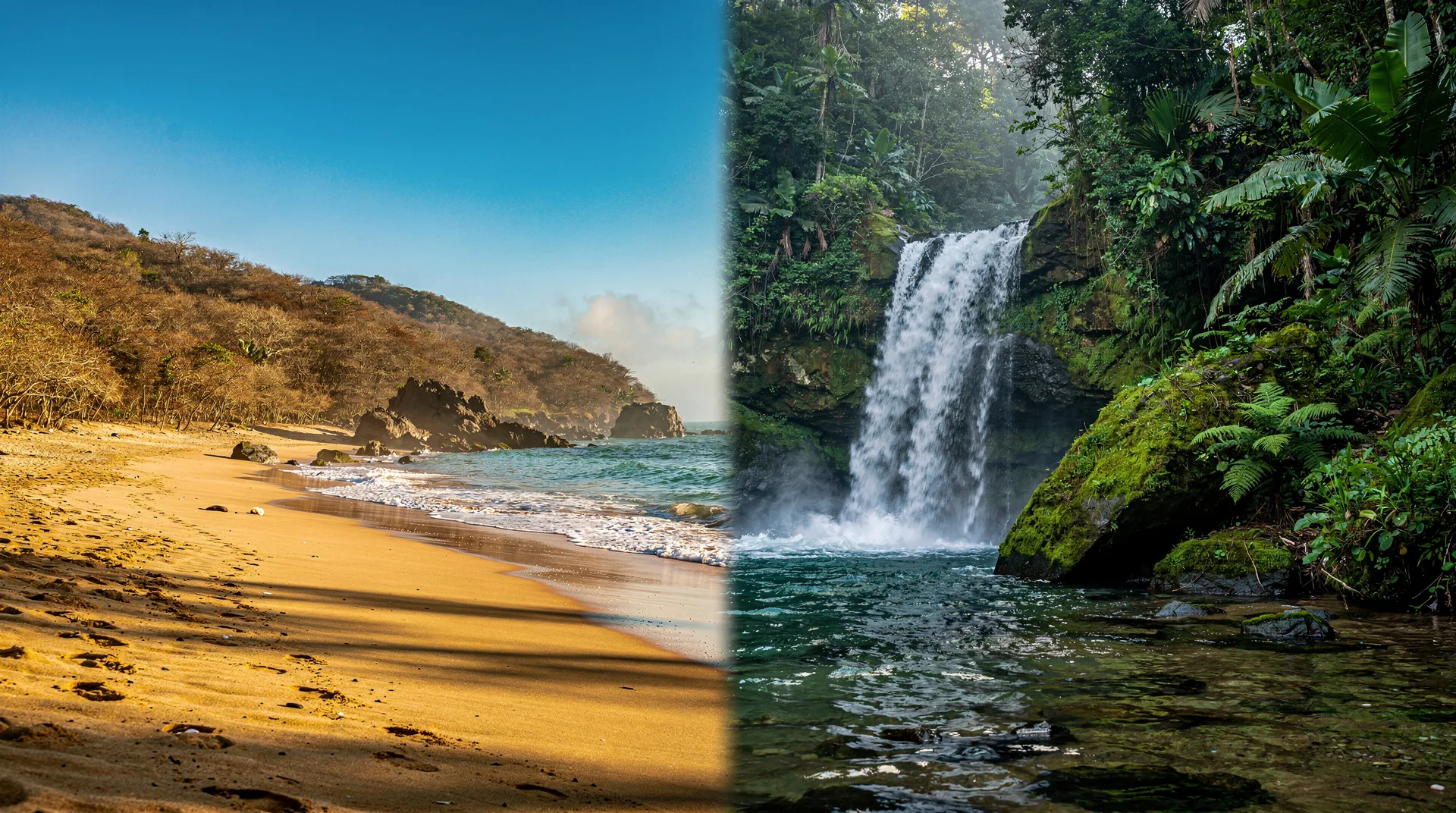
Best time to visit Costa Rica: honest month-by-month guide
When is the best time to visit Costa Rica?
December to April is the dry season on the Pacific coast — sunny, predictable, and expensive. May to November is green season — lush, affordable, and rainy afternoons only. The Caribbean works on an inverse pattern, with September-October being its driest window. There is no universally bad month.
Why the “best time” question is more complicated than you think
Most Costa Rica travel sites will tell you “December to April is best.” That answer is incomplete. It is accurate for the Pacific coast, particularly Guanacaste and the beaches of Manuel Antonio, but it ignores the Caribbean, the highlands, and the nuanced microclimate system that makes Costa Rica one of the most weather-diverse countries on earth for its size.
The honest answer is: the best time to visit Costa Rica depends on what you want to do and which part of the country you plan to visit. This guide breaks that down month by month, region by region, with real numbers on rainfall, prices, and wildlife timing — so you can make a decision that fits your actual trip, not a generic composite.
| Dry season | December–April, Pacific coast — sunniest, most expensive |
| Green season | May–November — lush, roughly 30–50% cheaper |
| Caribbean pattern | Reversed — driest around September–October and February–March |
| Best all-round window | Late November or the first half of May |
| Book ahead if | Traveling Dec–March, especially for Manuel Antonio or Poás |
Understanding Costa Rica’s two seasons
Costa Rica has two named seasons, not four.
Dry season (temporada seca) runs from December through April. On the Pacific coast, this means clear skies, minimal rain, warm temperatures, and the highest prices. Inland Guanacaste becomes very hot and the landscape turns a golden-brown as grasses dry out. Pacific beaches fill up and hotels require advance booking.
Green season (temporada verde), also called the rainy season, runs from May through November. On the Pacific side, this typically means sunny mornings followed by afternoon rain showers, usually clearing by early evening. The countryside explodes with colour — waterfalls run full, the jungle is at its most lush, and wildlife is active. Prices drop significantly and crowds thin out. This is the season that has rebranded itself over the past decade from “rainy season” (which sounds bad) to “green season” (which sounds appealing — and accurately so).
What most sources fail to mention is that the Caribbean coast operates on the opposite pattern. The Caribbean’s relative dry windows are September-October and February-March, while May-August can be its wettest period. This is critical if your trip includes Tortuguero, Cahuita, or Puerto Viejo.
Month-by-month breakdown
December and January: peak dry season
December and January are the most reliable months for Pacific coast visitors. Rainfall is near zero in Guanacaste (Tamarindo, Nosara, Liberia, Playa Conchal), temperatures climb to 33-35°C at the coast, and blue skies are virtually guaranteed.
The downside: this is also when prices peak. A room that costs $90 in October can cost $150-180 in January. Manuel Antonio National Park fills its 600-visitor daily cap on weekends. Booking 6-8 weeks ahead is not optional at this time of year.
The Caribbean is wetter in December-January, though the southern Caribbean (Puerto Viejo, Cahuita) is typically drier than the northern zone (Tortuguero). Wildlife-wise, sea turtle nesting season in Tortuguero has ended by December; humpback whale activity off Marino Ballena and Uvita continues through January as part of the December-March northern hemisphere whale migration.
February and March: still excellent, crowds building
February and March mirror January’s weather on the Pacific coast. The winds pick up in Guanacaste during February and March — a phenomenon locals call the Papagayo winds — making some exposed beaches choppy and excellent for kite surfing. Sheltered bays around Papagayo and Playa Hermosa are calmer.
March marks spring break season in North America, which floods Tamarindo and Manuel Antonio with families. If you travel in late February or early March, you will find very similar weather but marginally fewer visitors than the January-mid March peak.
The Caribbean sees its own short dry window in February-March, making it one of the better times for a combined Pacific-Caribbean itinerary. San José and the Central Valley are beautifully clear during these months: Volcán Poás, Volcán Irazú, and the Orosi Valley all offer spectacular views.
April: the end of the dry season
April is the last full dry-season month, but it behaves differently across regions. Guanacaste starts to transition — first rains often arrive in late April and feel welcome after months of dryness. Temperatures are extreme: the Guanacaste coast can reach 38°C at midday, making outdoor activity in the middle of the day uncomfortable.
Manuel Antonio and the Central Pacific remain largely dry through April, with the transition rains arriving in May. The Caribbean coast can be unpredictable in April.
April is also when the quetzal nesting season begins in the highlands of San Gerardo de Dota and the Monteverde cloud forest. If quetzal watching is your priority, April through June is your window. See our quetzal watching guide for more on timing.
Monteverde: cloud forest and butterfly farm full-day tour — from $95May: the start of green season
May marks the official start of green season across most of Costa Rica. The change is dramatic in Guanacaste: the brown hillsides green up within weeks of the first substantial rains. Temperatures ease slightly (still 30-32°C at the coast) and afternoon thunderstorms become a regular feature.
The pattern in May is typically sunny mornings until around noon or 1pm, then building clouds, rain for 2-4 hours in the afternoon, clearing by early evening. This is a workable pattern for most activities, as tours run in the morning and hiking can be done before the afternoon showers arrive.
Prices in May drop sharply — 25-40% lower than January across most accommodation. Crowds at national parks thin out noticeably. Manuel Antonio becomes much more pleasant to visit. This makes May one of the best value months in the entire calendar, especially for the first two or three weeks before the rains fully establish.
June and July: mid green season with a twist
June and July are reliably wet on the Pacific coast, but with an important exception: the veranillo, or “little summer.” This mini-dry spell typically occurs for one to two weeks in late June or early July, bringing a brief return of drier, clearer conditions to Guanacaste and the Central Valley. The timing varies by year, but it is a real and predictable phenomenon.
July is also when green turtle nesting begins in Tortuguero — a significant wildlife highlight. If turtle watching is on your itinerary, plan for July through October with the peak in August and September. See our Tortuguero turtle nesting guide for exact timing.
The Caribbean coast can be wet in June and July, though Tortuguero’s canal system and wildlife remain excellent regardless of rain. Puerto Viejo and Cahuita tend to have rain but also long sunny patches — prepare for both.
August and September: peak green season
August and September are the wettest months across most of Costa Rica, particularly on the Pacific side. In Guanacaste, August can see 200-300 mm of rain. The roads to some destinations (particularly in the Osa Peninsula) become challenging.
However, September is when wildlife peaks: green sea turtles are at their most active in Tortuguero, humpback whales off Uvita enter the main August-October season (southern hemisphere whales), Olive Ridley arrivals begin at Ostional. Wildlife density in Corcovado National Park is extraordinarily high.
The Caribbean coast around September-October sees its relative dry window — one of the few parts of Costa Rica where September can mean sunshine. This makes a Caribbean-focused trip in September genuinely rewarding.
September also sees the absolute lowest hotel prices of the year — sometimes 50% below January rates. For budget-focused travellers who can tolerate some rain, September-October is the sweet spot.
October: wettest Pacific month, Caribbean dry window
October is statistically the wettest month on the Pacific coast. Guanacaste averages 200+ mm. The Osa Peninsula can receive 300-400 mm. Road closures and flooding are possible, particularly in remote areas.
At the same time, the Caribbean coast around Puerto Viejo and Cahuita sees a distinct improvement — some of its clearest, driest days of the year arrive in October. The Caribbean reef at Cahuita National Park is at its best visibility in October. Snorkelling conditions are excellent.
For anyone planning a Caribbean-focused trip, October is perhaps the single best month in Costa Rica. For Pacific travellers, October requires flexibility and a high tolerance for rain.
November: the transition month
November marks the return to drier conditions on the Pacific coast. The first two weeks can still be wet, particularly in the south (Manuel Antonio, Uvita, Osa). By mid-to-late November, Guanacaste is transitioning back to dry season conditions and the roads are drying out.
Late November is excellent value — prices are still near green season levels but weather is improving daily. This is shoulder season at its best: fewer crowds than January, better weather than October, and real savings. See our shoulder season best deals guide for how to capitalise on this window.
Best time by region
Guanacaste (Tamarindo, Nosara, Liberia, Papagayo)
Best: December through April (dry season, warm, clear) Good value: November (late) — prices dropping, drying out Avoid: August-September if you dislike heavy rain
Central Pacific (Jacó, Manuel Antonio, Quepos)
Best: December through April Good compromise: May (first rains, still mostly sunny mornings, 30% cheaper) Budget pick: September-October (very wet but very affordable)
Southern Pacific (Uvita, Drake Bay, Osa Peninsula, Corcovado)
Best dry roads: December-April (Corcovado fully operational) Wildlife peak: August-October (but roads challenging) Whale watching: August-October (southern humpbacks) + December-March (northern humpbacks)
Caribbean (Puerto Viejo, Cahuita, Tortuguero)
Best weather: September-October + February-March Turtle watching: July-October (Tortuguero) Avoid: December-January for heavy rain
Central Valley and highlands (San José, Monteverde, San Gerardo de Dota)
Best views: January-March (dry, crystal clear mornings) Quetzal season: April-June Year-round: comfortable 20-25°C at altitude Tamarindo surf: learn and practice surfing — from $50
Best time for specific activities
Surfing: Pacific surf peaks May-October with southern swells. Tamarindo and Nosara have waves year-round but better swell size in green season. Caribbean surf (Puerto Viejo) peaks December-February.
Whale watching: Two seasons — December-March (northern hemisphere humpbacks, Marino Ballena) and August-October (southern hemisphere humpbacks). See our whale watching guide for Uvita.
Sea turtle watching: Green turtles in Tortuguero July-October, peak August-September. Leatherbacks at Playa Grande October-February. Olive Ridley arrivals at Ostional August-December.
Birding and quetzals: Dry season is generally better for birding as birds are visible in open, leafless trees. Quetzal nesting peaks April-June in San Gerardo de Dota.
Rafting (Pacuare, Sarapiquí): Best volume in May-November with swollen rivers, but passable year-round. See our Pacuare River rafting guide.
Corcovado National Park: Best access December-April. Sirena station sometimes closes September-November for maintenance. Book rangers and guides well ahead regardless of season.
Volcán Poás: Requires SINAC reservation 4 weeks ahead. Best crater views in the early morning, December-April for clearest skies.
What about budget?
If timing is flexible and budget is a priority, the green season offers genuine savings:
| Month | Relative accommodation cost |
|---|---|
| January | 100% (peak baseline) |
| February | 95-100% |
| March | 85-95% (spring break spike mid-March) |
| April | 80-90% |
| May | 65-75% |
| June-July | 60-70% |
| August | 55-65% |
| September | 50-60% (lowest) |
| October | 55-65% |
| November | 60-75% (rising toward season) |
| December | 80-100% (Christmas week = peak pricing) |
Tour prices are more stable and do not fluctuate as dramatically as accommodation. Flights follow a similar curve to hotels: fares into San José (SJO) or Liberia (LIR) are highest around the December holidays and Easter week, and noticeably cheaper in the September-October low season. Booking flights 2-3 months ahead for peak dates and being flexible by even a few days in shoulder months can meaningfully lower the total trip cost, often more than any single hotel discount.
The verdict
For first-time visitors who want reliable Pacific beach weather and the full range of activities without weather risk: January through March is the safest choice.
For travellers who want to balance experience and cost: May (first two weeks) or November (second half) offer excellent conditions at 25-40% lower prices.
For wildlife specialists: plan around the specific animal — August-October for turtles and southern whales; December-March for northern whales; April-June for quetzals.
For Caribbean coast trips: September-October is the local dry season and rivals any Pacific month for quality.
Drake Bay: Corcovado NP and Sirena Station tour — from $135Frequently asked questions about timing a Costa Rica visit
Is there a rainy season in Costa Rica?
Yes. The green season (May-November) brings regular afternoon rain to the Pacific coast and most of the country. Rain rarely lasts all day — the typical pattern is sunny until noon or 1pm, then showers for 2-4 hours, often clearing by evening. The Caribbean coast has a different pattern and its relative dry windows are September-October and February-March.
Is it worth visiting Costa Rica in the rainy season?
Absolutely. The green season offers lower prices (30-50% savings on accommodation), far fewer crowds, lush green scenery, full waterfalls, and excellent wildlife. Most activities operate normally. The main adjustment is planning outdoor excursions for the morning and accepting that some afternoons will be wet.
When is Costa Rica cheapest?
September and October are the cheapest months, with accommodation sometimes 40-50% below January peak rates. May and June are also significantly cheaper than the dry season while still offering reasonable weather for the morning hours.
Do I need to avoid hurricane season?
Costa Rica sits below the primary hurricane belt and rarely experiences direct hurricane impacts. However, tropical depressions occasionally cause heavy rain in the Caribbean zone during September-November. The Pacific coast is not in the hurricane corridor. Tropical storms are a risk in the Caribbean but not a reliable reason to avoid the country entirely.
What should I book in advance regardless of season?
Always book in advance: Manuel Antonio National Park entry (SINAC online, especially weekends), Volcán Poás entry (4 weeks ahead recommended), Corcovado guided hike (ranger station spots fill fast), Tabacón and Eco Termales hot springs in Arenal (busy year-round), and popular lodges in Drake Bay and Tortuguero.
Can I visit multiple regions in one trip?
Yes, but be aware that Costa Rica is more time-consuming to navigate than its small size suggests. San José to La Fortuna takes 3 hours; La Fortuna to Monteverde takes 3 hours via the lake crossing; Manuel Antonio is 3 hours from San José. Factor realistic drive times into your itinerary. A 10-day trip can comfortably cover two or three distinct regions — see our 10-day Arenal-Monteverde-Manuel Antonio itinerary for a proven route.
Practical booking windows by season
How far in advance you need to book varies dramatically by season:
January-March peak: Book accommodation 6-10 weeks ahead for mid-range properties in Tamarindo, Manuel Antonio, and La Fortuna. For Christmas-New Year week, 3-4 months ahead is not excessive. Manuel Antonio park entry: book 72 hours ahead minimum, 1-2 weeks ahead for weekend visits. Poás volcano: 4 weeks ahead through SINAC. Popular tours (Corcovado day hikes from Drake Bay): 2-4 weeks.
April-May (shoulder and early green): 2-4 weeks ahead suffices for most accommodation. Easter week requires the same advance planning as peak season. Tours and transport are easier to book short-notice.
June-August green season: Walk-in availability at many properties. Popular Pacific coast hotels fill faster than interior destinations. Tortuguero lodges for July-August turtle season: book 2-3 months ahead.
September-October low season: Most accommodation is walkable without advance booking. Properties actively compete for guests. The exception is Caribbean coast in October (its dry season peak): Puerto Viejo and Cahuita guesthouses fill faster in October than in June.
November-December (transition and early peak): Second half of November is flexible but December 20+ requires Christmas-peak booking windows.
Planning your timing around a complete itinerary
Most visitors combine regions — typically the Arenal/La Fortuna volcanic zone with either the Pacific coast or Monteverde’s cloud forest. The seasonal timing of such combinations matters.
A December-April trip from Arenal to the Pacific coast is consistently excellent. An August-October trip is more rewarding if you include Tortuguero or the Caribbean but requires flexibility for the Pacific portion.
For a deep dive into a specific month’s conditions, see our January weather guide, April weather guide, July weather guide, and October weather guide. For regional climate detail, our microclimates explained guide covers the altitude bands and watershed differences that drive all of this variation.
Packing differently by season
What you pack should shift with the season, not just the destination. For dry-season trips (December–April), prioritize sun protection: high-SPF sunscreen, a wide-brim hat, sunglasses, and light, breathable clothing for the Guanacaste heat, which regularly tops 33-35°C at midday. A light long-sleeve layer helps for early-morning volcano viewing at Volcán Poás or Irazú, where temperatures at altitude can feel cool before sunrise.
For green-season trips (May–November), a lightweight rain jacket and a dry bag for electronics matter more than an umbrella, since afternoon downpours are usually brief but heavy. Quick-dry clothing beats cotton, which stays damp in the humidity. Waterproof or quick-drying footwear is worth the extra weight in your bag, particularly if your itinerary includes muddy trails in Monteverde’s cloud forest or the Osa Peninsula. Regardless of season, insect repellent with DEET or picaridin is essential in lowland and Caribbean areas, and a reusable water bottle saves money at the many refill stations now common at hotels and lodges.
Photography and light conditions by season
Photographers have their own seasonal calculus. Dry season delivers the most reliable blue-sky shots and the golden-brown Guanacaste landscape that photographs dramatically at sunset, but the midday light is harsh and often better avoided for portraits. Green season brings the opposite trade-off: dramatic cloud formations, rain-freshened greenery, and the kind of moody, layered light that many photographers actually prefer, especially in the hour after a storm clears.
Waterfalls are at their fullest and most photogenic from June through November, when rivers are swollen — a detail worth weighing if capturing cascades like La Fortuna or Nauyaca is a priority. For wildlife photography, early morning remains the best light window in any season, since animals are most active and temperatures are cooler before the midday heat sets in.
Common timing mistakes worth avoiding
A surprising number of trips get derailed not by bad weather but by bad assumptions about weather. Travelers often build a Pacific-and-Caribbean itinerary around a single “good month” without realizing the two coasts run on near-opposite calendars — a September trip planned for Guanacaste sunshine can mean disappointment, while the same month is genuinely excellent for Puerto Viejo or Cahuita. Others underestimate how long driving takes between regions and end up racing the afternoon rains on mountain roads instead of building in a buffer. And some assume “rainy season” means constant rain, then over-plan indoor activities and miss the reliably sunny mornings that make green season workable for hiking, rafting and wildlife watching.
Uvita whale-watching tour in Marino Ballena National Park — from $80