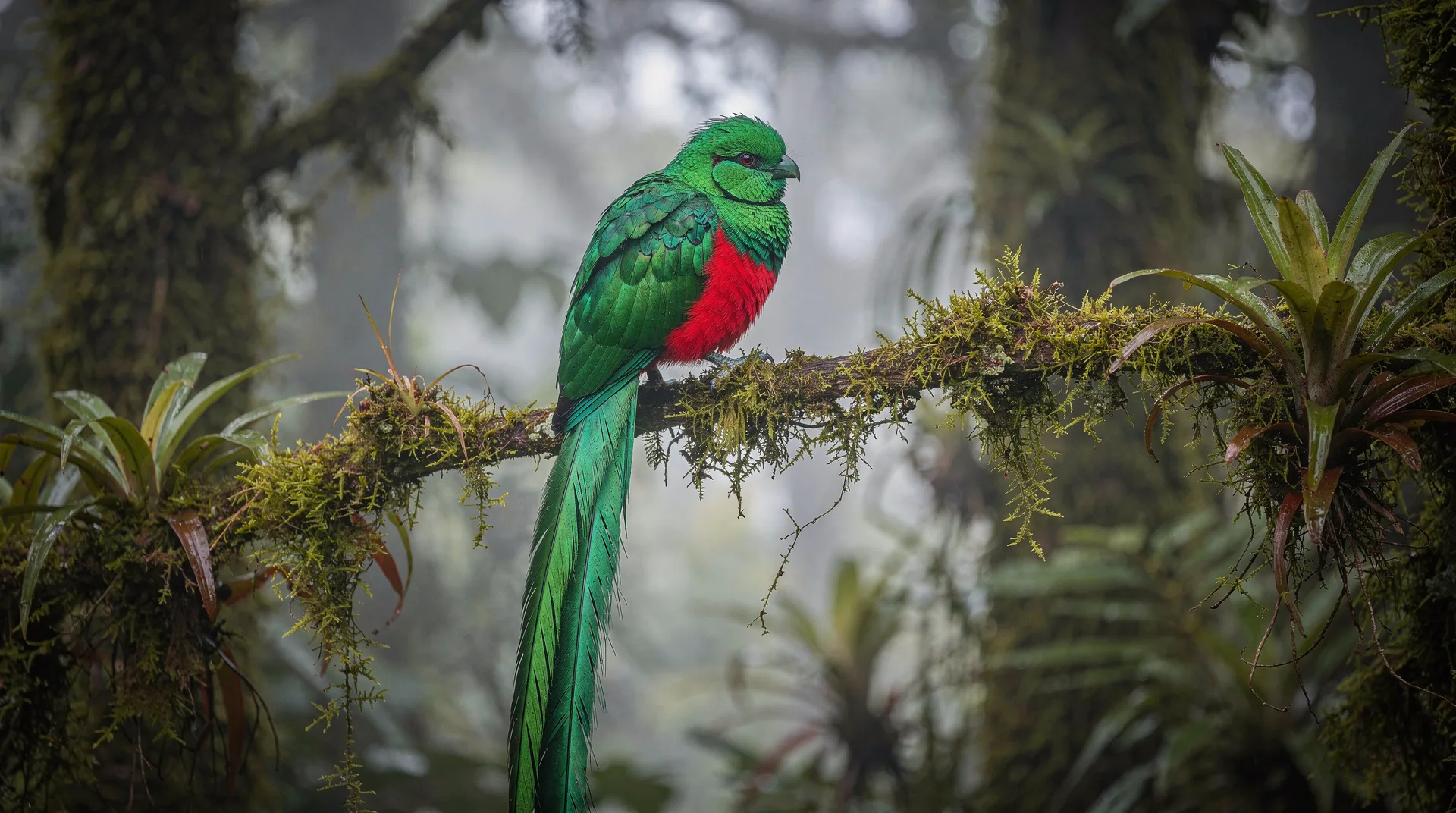
Quetzal watching guide for Costa Rica
When and where can I see the resplendent quetzal in Costa Rica?
San Gerardo de Dota in the Talamanca cloud forest is the most reliable spot, with peak sightings from April to June during nesting season. Monteverde and Curi-Cancha Reserve also produce consistent sightings from March through May.
The holy grail of neotropical birding
The resplendent quetzal (Pharomachrus mocinoa) has been revered for over a thousand years. The ancient Maya and Aztec considered it the god of the air, its iridescent green tail feathers so sacred that killing the bird was punishable by death. Today, birders fly from Europe, Japan, and North America to glimpse those same feathers flashing through a Costa Rican cloud forest.
Costa Rica is one of the most reliable places in the world to see a wild quetzal, which puts it in rare company — the bird’s range spans from southern Mexico to western Panama, but finding one without local knowledge is genuinely difficult. What Costa Rica offers is infrastructure: experienced guides, known nesting trees, lodges built at the right altitude, and two distinct cloud forest zones where quetzals concentrate.
This guide tells you exactly where to go, when to go, and what to do when you get there.
| Where | San Gerardo de Dota (best) or Monteverde/Curi-Cancha |
| Best time | April-June (nesting, full tail plumes) |
| Cost | guide around $30-85; overnight stay recommended |
| Getting there | ~2.5hrs from San José (Dota) or 3-4hrs (Monteverde) |
| Key gear | 8x42/10x42 binoculars, telephoto 400mm+ for photos |
San Gerardo de Dota vs Monteverde: which to choose
| San Gerardo de Dota | Monteverde/Curi-Cancha | |
|---|---|---|
| Reliability | highest, especially Apr-Jun | good but more variable |
| Best season | January-June, peak Apr-Jun | March-May |
| Distance from San José | ~2.5 hrs | 3-4 hrs |
| Beyond birding | limited — quetzal-focused | ziplines, bridges, butterfly farms |
| Best for | dedicated birders | travellers wanting a fuller destination |
If quetzals are your priority, San Gerardo de Dota wins outright. If you want a broader cloud-forest destination with quetzal sightings as one highlight among several, Monteverde makes more sense — see the Monteverde vs Santa Elena reserve guide for choosing between the two reserves there.
Understanding the quetzal’s habits and habitat
Altitude and forest type
Quetzals live in cloud forest between approximately 1,200 and 3,000 metres elevation. In Costa Rica, this means the Talamanca mountain range and the Tilarán Cordillera (home to Monteverde). They require mature forest with large, fruiting wild avocado trees (Lauraceae family), which form the core of their diet. When wild avocados fruit, quetzals follow.
The male’s spectacular tail plumes — which can reach 65 centimetres — are present from roughly January through July, peaking during the April–June nesting season. Outside this window, males are present but considerably less dramatic, their tails shortened or absent.
Altitudinal migration
Quetzals in Costa Rica perform seasonal altitudinal migration, moving upslope in the dry season and descending to lower elevations as wild avocado crops ripen at different altitudes. This movement is well understood by local guides, which is why experienced naturalists in San Gerardo de Dota can often predict where birds will be on a given morning.
San Gerardo de Dota — the top quetzal destination
Why San Gerardo is exceptional
San Gerardo de Dota sits in a steep valley at around 2,200 metres elevation, accessed via a narrow switchback road off the Interamericana highway at kilometre marker 80, about 2.5 hours south of San José. The combination of undisturbed cloud forest, small-scale agriculture (apple orchards, trout farms), and remarkably experienced local guides has made it the go-to quetzal destination in the country.
Quetzal sightings here are not guaranteed, but they are very common from January through June and especially reliable in April, May, and June when pairs nest in natural tree cavities. The main nesting area centres on the Savegre valley — Dantica Lodge, Savegre Hotel, and Trogon Lodge all sit within the corridor.
When to go to San Gerardo de Dota
The absolute best window is April through June. Pairs are nesting, males are performing courtship displays with full tail plumes spread, and both sexes are highly visible around nesting trees. Guides can often locate active nests and observe males entering and exiting with food for the chicks.
January through March is good but the male tail plumes are shorter. July through September sees most males in moult, reducing the visual spectacle considerably. October and November are the cloudiest months in this valley — fog can be thick enough to ground all birding.
Practical logistics for San Gerardo de Dota
San Gerardo de Dota is a tertiary destination — no shuttle services run here and public transport is limited to one daily bus connection. Most visitors arrive by rental car (a standard 2WD car handles the paved descent) or book a transfer from San José.
Overnight stays are strongly recommended: the best sightings happen at first light (6–7am) and again around 4–5pm, and both windows require being on-site rather than driving up from a distance. Savegre Hotel Natural Reserve and Spa charges around $140–200 per night for a room including guided morning bird walks. Trogon Lodge is a more budget-friendly option at $90–130. Dantica Cloud Forest Lodge offers a contemporary eco-design option at the higher end.
Temperatures here drop to 8–12°C at night year-round and rarely exceed 18°C during the day. Pack layers regardless of when you visit.
Monteverde — the accessible alternative
Quetzal sightings in the cloud forest reserves
Monteverde and the adjacent Santa Elena cloud forest reserves sit at 1,440–1,800 metres and cover the other main quetzal habitat in Costa Rica. Sightings are consistent from March through May and less reliable than San Gerardo, partly because Monteverde’s forest is more fragmented and receives far more visitors.
That said, Monteverde has significant advantages for travellers who are not primarily birders: the ziplines, hanging bridges, and butterfly farms make it a fuller destination, and the town of Santa Elena has a wide range of accommodation, restaurants, and services. If you cannot justify a dedicated quetzal trip to San Gerardo, adding an early morning bird walk at Curi-Cancha Reserve in Monteverde is a reasonable compromise.
Curi-Cancha is generally considered the best birding reserve within the Monteverde zone — smaller than the main Monteverde Biological Preserve, less crowded, and with a guide-to-visitor ratio that allows for proper bird-finding. Quetzal sightings at Curi-Cancha are reported throughout the nesting season.
a cloud forest bird-watching tour in Monteverde and Santa Elena — from $65Getting to Monteverde
Monteverde is accessible by road from San José in about 4 hours (via Sardinal) or 3 hours (via the Lake Arenal jeep-boat-jeep transfer). See the Monteverde destination guide for accommodation and transport options. The road to Monteverde remains unpaved in sections — a regular car handles it but slowly.
What a quetzal guide actually does
Hiring a local guide is not optional if you want a reliable sighting. Here is what they bring:
Tree knowledge. Guides know which wild avocado species are fruiting that week, which tree cavities have active nests, and which trees quetzals visit most consistently at each season.
Telescopic access. A spotting scope at 40x magnification turns a small green speck 30 metres up into a full-resolution portrait. Most guides carry one.
Patience and positioning. Quetzals are shy birds that flush easily from human movement. Experienced guides know to wait downwind and still rather than chasing birds through dense cloud forest.
Call recognition. The quetzal’s call — a resonant, mellow series of notes sometimes described as “co-weet, co-weet” — carries through cloud forest mist. Guides use the call to locate birds in fog conditions when visual scanning is impossible.
Guide costs in San Gerardo de Dota range from $30–60 for a 2–3 hour morning walk. Most lodges offer in-house guiding; independent guides are also available in the village. In Monteverde, tour operators charge $60–85 for a morning birding tour at Curi-Cancha or the main reserve.
Other species to expect during quetzal walks
A morning in San Gerardo de Dota rarely produces just one species. Common co-occurring birds include:
- Black-and-yellow silky-flycatcher — flocks of 10–20 move through fruiting trees
- Collared trogon — a relative of the quetzal, far more common, also vividly coloured
- Flame-throated warbler — a high-altitude endemic found nowhere outside Costa Rica and western Panama
- Long-tailed silky-flycatcher — regularly confused with the quetzal by beginners (no tail plumes, different structure)
- Highland motmot — the cloud forest equivalent of the turquoise-browed lowland species
- Ruddy-capped nightingale-thrush — heard far more often than seen
- Acorn woodpecker — abundant and noisy along forest edges
The cloud forest at San Gerardo is also productive for highland hummingbirds, including the magnificent hummingbird and the violet sabrewing. See bird watching by region for a broader overview of Costa Rican birding zones.
Photography tips for quetzal watching
If you are visiting Monteverde and want to add cloud forest birding alongside hanging bridges and other activities, the Curi-Cancha area is the best integrated option. A half-day guided birding tour in the Monteverde zone is a sensible addition to any cloud forest day.
a full-day cloud forest experience in Monteverde including guided birding and butterfly farm — from $95The main challenge in cloud forest photography is light. Cloud forest is, by definition, often under cloud — diffuse light, low contrast, and a bird that is predominantly deep iridescent green (which turns black when backlit). A few practical points:
Aim for the first 90 minutes after sunrise, when cloud cover is often thinner and angled light catches the feathers at their most spectacular. The afternoon window (3–5pm) can also work, especially around nesting trees when males are delivering food.
A telephoto lens of at least 400mm is recommended for perched birds; 500–600mm is more comfortable. Image stabilisation matters more than extra length in the low-light conditions of cloud forest. See wildlife photography tips for a complete equipment and ethics guide.
Etiquette and responsible viewing
Quetzals are shy and sensitive to disturbance, particularly around active nest cavities during the April-June breeding season. A few rules matter more here than at most Costa Rican wildlife sites: stay on marked trails and follow your guide’s lead rather than pushing closer for a better photo, keep voices low and movements slow, and never use playback calls to lure a bird in unless your guide judges it appropriate and brief — overused playback can stress nesting pairs and disrupt feeding routines.
Flash photography near a nest is a hard no; the low light that makes quetzal photography challenging is exactly why patience with natural light matters more than a bright flash. If a guide asks the group to back away or stay still, that instruction takes priority over getting the shot.
Quetzal watching combined with a road trip
San Gerardo de Dota sits on the Interamericana highway at a point equidistant between San José (2.5 hours) and San Isidro de El General (45 minutes), which is the gateway to the Osa Peninsula and Drake Bay. Many travellers combine a one-night quetzal stop in San Gerardo with onward travel south to Corcovado National Park or Uvita — the road is good and the scenery through the Chirripó highlands is dramatic.
Coming from the Pacific, you can also add a Chirripó angle: the trailhead for Cerro Chirripó is at San Gerardo de Rivas, a different valley about 20 kilometres south. The two San Gerardos — de Dota and de Rivas — are commonly confused, so confirm your destination with your accommodation.
Frequently asked questions about quetzal watching in Costa Rica
Is April or May better for quetzal sightings?
Both are excellent. April tends to have slightly better weather in the Talamanca range (the dry season is winding down but not yet fully ended), and nesting activity is already well underway. May has the most active chick-feeding behaviour, which makes males particularly visible around nest trees. June is also excellent but weather becomes more overcast.
Can I see quetzals on a day trip from San José?
Technically yes — San Gerardo de Dota is 2.5 hours from San José, so a very early departure (4am) puts you at the valley at first light. But an overnight stay is strongly preferred. Dawn sightings from a lodge porch or a short walk from your door before 6am are consistently the best, and a single day trip with a 5-hour round drive leaves very little time for the patient watching the bird requires.
Are quetzals present year-round in Costa Rica?
Yes, the birds are resident (not migratory). But their visibility varies enormously by season. The April–June nesting window is when sightings are most reliable, males are most visible, and behaviour is most interesting. Outside nesting season, sightings are possible but require more effort.
What is the difference between the resplendent quetzal and a trogon?
Trogons (Trogonidae) are the family; the quetzal is a specialised trogon. Costa Rica has six trogon species, and beginners sometimes confuse the collared trogon or slaty-tailed trogon with a quetzal from a distance. The resplendent quetzal male is unmistakeable when seen properly — the metallic green plumage extends to the chest (trogons have a sharp chest border), the tail plumes are unique, and the size is noticeably larger.
Do I need binoculars?
Absolutely, and decent ones. Cloud forest birding demands quality optics because light levels are low and birds are often partially obscured by foliage. An 8x42 or 10x42 binocular from brands like Nikon Monarch, Vortex Viper, or Swarovski EL is suitable. Your guide will have a spotting scope, but binoculars let you track moving birds independently.
Can I combine quetzal watching with Corcovado or Uvita on the same trip?
Yes, and it’s a popular route. San Gerardo de Dota sits on the Interamericana about 45 minutes from San Isidro de El General, the gateway south toward Corcovado National Park and Uvita. A common itinerary spends one night in San Gerardo for dawn and dusk quetzal walks, then continues south the next morning — the drive through the Chirripó highlands is scenic in its own right, so it doesn’t feel like a detour.
How much does a quetzal-watching trip to San Gerardo cost?
A one-night budget at Trogon Lodge: roughly $90–130. Guide for a morning walk: $30–60. Meals at local restaurants: $10–20 per meal. Transport from San José by rental car adds fuel (about $15 each way) or a private transfer costs $120–180. Total for a one-night quetzal trip: approximately $250–400 per person, depending on choices.
Related guides
The quetzal is the most sought-after bird in Costa Rica, but the country’s birding goes far deeper. Bird watching by region maps out Caño Negro, Carara, Sarapiquí, and the Osa Peninsula as complementary destinations. The San Gerardo de Dota cloud forest guide covers the valley in full detail beyond birding.
For the wider context of what makes Costa Rica so biologically exceptional, see Costa Rica wildlife overview. And if you’re planning a dedicated wildlife photography trip, the 14-day wildlife photography itinerary builds a route that includes San Gerardo de Dota alongside Tortuguero, Monteverde, and the Osa Peninsula.