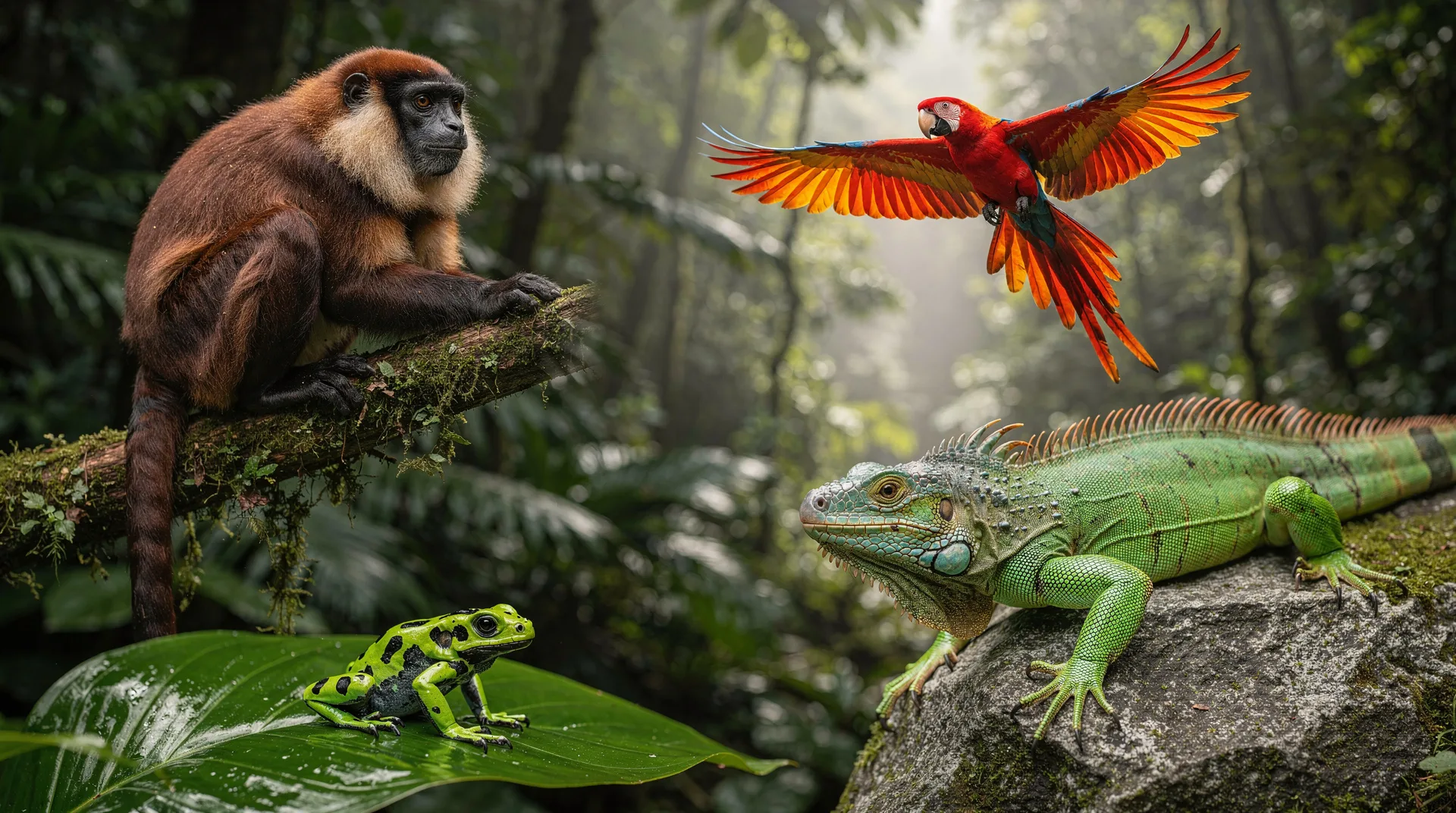
Costa Rica wildlife overview: why this tiny country holds so much life
Why is Costa Rica so wildlife-rich?
Costa Rica contains roughly six percent of the world's biodiversity in just 0.03 percent of Earth's land surface. The combination of two coastlines, eleven distinct ecological zones, a mountain range rising to 3,820 metres, and over 28 percent of the territory protected as national park or reserve creates an extraordinary mosaic of habitats.
Costa Rica packs roughly 6% of the world’s documented species into 0.03% of its land surface — this overview explains why, maps the ecosystems that make it possible, and points you to the right park for your experience level.
| Best first-timer park | Manuel Antonio — high density, short walks |
| Best for serious wildlife travellers | Corcovado — jaguar tracks, all 4 monkey species |
| Best season for dry-forest visibility | December–April (leaf-off, macaws visible) |
| Best season for amphibians/reptiles | May–November (wet season) |
| Guide vs no guide | A good guide roughly doubles or triples sightings |
The numbers that define Costa Rica’s biodiversity
Costa Rica covers 51,100 square kilometres — about 0.03 percent of the planet’s land surface. In that space, it hosts:
- More than 900 bird species (more than the USA and Canada combined)
- Around 220 reptile species
- Approximately 200 mammal species, including all six Central American wildcat species
- Over 34,000 insect species (still being catalogued)
- 9,000+ plant species, including 1,400 orchid species
- 160+ amphibian species
These figures represent roughly six percent of all documented species on Earth — a concentration that makes Costa Rica one of the five most biodiverse countries per unit area in the world. Understanding why this concentration exists explains where and how to see wildlife during a visit.
The ecological explanation: position, altitude, and history
A land bridge and a mixing zone
Costa Rica occupies the narrowest part of the Central American isthmus, where North and South American fauna have been intermixing for approximately three million years — ever since the Panamanian land bridge closed the gap between the continents. Species from North America (white-tailed deer, pumas, ocelots) share habitat with species of South American origin (tapirs, two-toed sloths, scarlet macaws).
This mixing does not just add species numbers; it creates ecological interactions that occur nowhere else — predator-prey relationships, pollinator networks, and seed-dispersal systems that have evolved specifically in this convergence zone.
Elevational diversity
Costa Rica’s two main mountain ranges — the Cordillera Central (Arenal, Poás, Irazú) and the Cordillera de Talamanca (Chirripó, Cerro de la Muerte) — create a vertical stack of ecological zones that runs from sea level to 3,820 metres within 150 kilometres. Each hundred metres of altitude change shifts temperature, rainfall, and vegetation composition, producing new bird and mammal communities.
A traveller who visits both the coast at Tortuguero and the high-altitude cloud forest at San Gerardo de Dota in the same trip will encounter two entirely different faunal communities — as different as, say, Louisiana swamps and the Rocky Mountains — in a country the size of Switzerland.
Two very different coasts
The Pacific and Caribbean coasts of Costa Rica are separated by the mountain ranges, creating distinctly different climatic regimes. The Caribbean coast is wet nearly year-round, with a relative dry window from September to October. The Pacific alternates between a clear dry season (December–April) and an afternoon-rain wet season (May–November). The contrast creates additional habitat diversity — deciduous dry forest on the Guanacaste Pacific coast versus evergreen rainforest on the Caribbean slope.
Thirty years of conservation reinvestment
Costa Rica abolished its military in 1948, redirecting defence spending toward education and conservation. The country now protects over 28 percent of its territory in a system of national parks, biological reserves, and wildlife refuges — one of the highest percentages in the world. This protection has allowed forest recovery in previously deforested areas, and today Costa Rica has more forest cover than it did in 1985.
The SINAC (National System of Conservation Areas) oversees 163 protected areas. UNESCO has designated two World Heritage Sites: the Talamanca Range–La Amistad Reserves (shared with Panama) and the Área de Conservación Guanacaste. These designations bring international protection and funding.
Key ecosystems and what lives in them
Tropical lowland rainforest
Found along the Caribbean coast and the southern Pacific slope (Osa Peninsula), this ecosystem receives over 3,000mm of rain annually and maintains canopy height of 30–50 metres. It is the richest ecosystem in terms of species diversity — Corcovado National Park, which protects the largest remaining old-growth tropical rainforest on the Pacific coast of the Americas, has been called “the most biologically intense place on Earth” by National Geographic.
Key species: jaguar, Baird’s tapir, white-lipped peccary, Geoffroy’s spider monkey, scarlet macaw, harpy eagle, American crocodile, boa constrictor.
a guided day tour of Corcovado’s Sirena station — the heart of Costa Rica’s lowland rainforest — from $135Tropical dry forest
Guanacaste in the northwest is home to the most extensive remaining tropical dry forest in Central America, most of it protected within Santa Rosa National Park, Guanacaste National Park, and Palo Verde. Dry forest is characterised by trees that lose their leaves in the dry season, revealing an open canopy that is surprisingly rich in wildlife precisely because animals are more visible without dense leaf cover.
Key species: white-tailed deer, coati, white-throated magpie-jay, Turquoise-browed Motmot, burrowing owl, painted bunting (wintering migrant).
Cloud forest
From 1,200 to 3,000 metres, cloud forest is defined by persistent mist — clouds that form against mountain slopes and bathe the vegetation in moisture. The result is a forest dripping with mosses, bromeliads, orchids, and ferns, with visibility often reduced to 20–30 metres. The resplendent quetzal (see quetzal watching guide) is the iconic species. Temperature ranges from 8°C to 18°C depending on altitude.
Key species: resplendent quetzal, Three-wattled Bellbird, Bare-shanked Screech-Owl, cloud forest salamanders, glass frogs, the enormous bromeliad frog communities.
Mangroves and estuaries
The Tárcoles estuary, the Nicoya Gulf, the Terraba-Sierpe wetlands (the largest mangrove complex in the Americas), and the Tortuguero canal system all represent critical mangrove habitat. Mangroves nurse marine fish, shelter waterbirds, and are among the most carbon-dense ecosystems on the planet.
Key species: American crocodile, mangrove hummingbird (a Costa Rican endemic found only in Pacific mangroves), Roseate Spoonbill, White Ibis, Yellow-billed Cotinga (Terraba-Sierpe), caimans.
Wetlands
Caño Negro Wildlife Refuge in the north and Palo Verde National Park on the Río Tempisque represent Costa Rica’s main freshwater wetland systems. During the wet season, these expand dramatically and concentrate extraordinary numbers of waterbirds, including the Jabiru stork, Anhinga, and multiple heron and egret species.
a turtle watching tour at Tortuguero, where Caribbean rainforest meets wetland canal — from $45The main wildlife-viewing parks by region
| Region | Park/Reserve | Star Species |
|---|---|---|
| Caribbean | Tortuguero NP | Green sea turtle, jaguar, manatee |
| Caribbean | Cahuita NP | Reef fish, sloth, capuchin |
| Central Pacific | Manuel Antonio NP | Squirrel monkey, sloth, scarlet macaw |
| Central Pacific | Carara NP | Scarlet macaw, crocodile, riverside birds |
| South Pacific | Corcovado NP | Jaguar, tapir, harpy eagle, all 4 monkeys |
| Guanacaste | Rincón de la Vieja NP | Bare-throated Tiger Heron, coati, volcano |
| North Pacific | Caño Negro WR | Jabiru stork, Roseate Spoonbill, caiman |
| Highlands | San Gerardo de Dota | Quetzal, flame-throated warbler |
| Central Valley | La Paz Waterfall Gardens | Hummingbirds, glass frogs (paid attraction) |
What to expect at different experience levels
For first-time visitors
Manuel Antonio National Park is the correct starting point. Its small size, managed visitor numbers, abundance of guides, and extraordinary wildlife density — squirrel monkeys, capuchin monkeys, howler monkeys, sloths, scarlet macaws, Jesus Christ lizards — mean that a three-hour morning walk almost always delivers multiple memorable encounters, even for visitors who have never been on a wildlife walk before.
a naturalist-led walking tour of Manuel Antonio National Park — from $65For experienced wildlife travellers
Corcovado’s Sirena station is the benchmark. Getting there requires planning, a licensed guide, a boat from Drake Bay or a lengthy hike from Los Patos, and some tolerance for heat, humidity, and the possibility of rain. What it delivers — tapir sightings, jaguar tracks (and occasional sightings), all four monkey species in a single day, and birding that exceeds almost any other Pacific coast site — is simply unmatched.
For those with limited time
The La Paz Waterfall Gardens near Poás volcano (an hour from San José) is a paid wildlife attraction rather than a wild ecosystem, but it is genuinely impressive as a first exposure: hummingbird garden, butterfly observatory, glass frog nocturnal house, toucan and macaw aviaries, and a waterfall hike. It is a condensed version of what the country’s nature has to offer — useful for airport-day additions or short layovers.
Wildlife safety: what to respect
Crocodiles are present in virtually every river and estuary on the Pacific coast. The Río Tárcoles near Carara has some of the densest crocodile populations in the world. Never swim in rivers or cross on foot without asking locals whether crocodiles are present.
Venomous snakes: Costa Rica has around 22 venomous snake species, including the fer-de-lance (terciopelo), the most responsible for human bites. Walking at night, reaching under logs, or stepping off trails without looking increases risk. Sturdy footwear and attentiveness are the main precautions.
Bullet ants: present throughout lowland forest, their sting is among the most painful of any insect. They are easily visible — 2–3 cm long, shiny black — and avoiding their trails is straightforward.
None of these hazards should deter a visit. Millions of tourists explore Costa Rica’s national parks every year without incident. A licensed guide, decent footwear, and basic trail awareness are sufficient.
Insects beyond bullet ants are worth a brief mention too: mosquito-borne illness risk (dengue, and more rarely Zika) exists in lowland areas, particularly during and after the wet season, so repellent and covering up at dawn and dusk are sensible habits rather than paranoia. Chiggers in tall grass around some dry-forest and pasture areas can cause an itchy, persistent rash — long trousers tucked into socks on grassland walks largely prevent this. None of these risks are unusual for tropical travel generally, and none should be weighed more heavily than the genuinely low-probability hazards like snakebite that tend to attract more attention.
Building a wildlife-focused itinerary
The single most common planning mistake is trying to cover every ecosystem in a short trip. Because Costa Rica’s ecosystems are defined by altitude and coastline rather than distance, a realistic wildlife itinerary should pick two or three contrasting zones rather than attempting all of them.
A workable pattern for a 10–12 day trip: one lowland rainforest park (Corcovado or Tortuguero) for the highest species density, one cloud forest stop (Monteverde or San Gerardo de Dota) for the quetzal and cloud-forest specialists, and one accessible coastal park (Manuel Antonio or Cahuita) that pairs wildlife with beach time and requires minimal logistics. Trying to add a fourth or fifth ecosystem usually means less time at each site and fewer actual sightings, not more.
What separates a good wildlife guide from an average one
Not all certified naturalist guides deliver the same experience, and the difference matters more than which park you choose. A strong guide identifies species by call before you see them, knows which specific tree is fruiting and therefore likely to attract feeding animals that week, positions the group to avoid startling wildlife, and reads subtle signs — a shaking branch, a distant alarm call from another species — that an inexperienced visitor would miss entirely. Group size matters too: a guide leading four people spots and explains far more than one managing a group of fifteen. When booking, a smaller advertised group size is usually a better predictor of sighting quality than the specific park or the tour’s marketing photos.
Frequently asked questions about Costa Rica wildlife
What is the most dangerous animal in Costa Rica?
Ecologically, the American crocodile poses the highest statistical risk to humans who ignore warnings about river swimming. The fer-de-lance snake is responsible for most reported bites, though deaths are extremely rare with prompt antivenom treatment. Tourist safety records in Costa Rica’s national parks are very good.
Can I see a jaguar in Costa Rica?
Jaguars are present but rarely seen. Corcovado has the highest wild jaguar density in Costa Rica, and tracks are commonly found near the Sirena station. Direct sightings are the exception, not the rule. Night patrols at Tortuguero or multi-day expeditions at Corcovado are the most productive approach, but even then, a sighting cannot be guaranteed.
Are there sharks in Costa Rican waters?
Yes. Bull sharks are present in Pacific estuaries and rivers (including the Río Tárcoles). Open-water species (blacktip, hammerhead, whale shark) are encountered at offshore sites like Caño Island and Cocos Island. Swimming beach risks are very low — documented attacks at tourist beaches are nearly non-existent.
What is the difference between Costa Rica’s rainy and dry seasons for wildlife?
The dry season (December–April on the Pacific) is better for predictable weather and trail conditions. The rainy season (May–November) is better for amphibians, many reptile species active in wet conditions, and dramatically lush landscapes. Some species — scarlet macaws, for instance — are more visible in the dry season when trees lose their leaves. Year-round birding is productive in all seasons.
Is wildlife spotting better with or without a guide?
Consistently better with a guide, in every park and ecosystem in the country. The difference is not marginal — a good guide doubles or triples sightings by knowing where to look, what to listen for, and how to position observers relative to animals without causing disturbance. See wildlife photography tips for advice on working effectively with naturalist guides.
When is the best season for wildlife watching?
For the Pacific coast, December through April is the dry season and most comfortable period. For amphibians and insects, the wet season (May–November) is far better. For sea turtles at Tortuguero, July–October is the peak nesting period. Quetzal nesting in San Gerardo de Dota peaks April–June. See the best time to visit Costa Rica guide and the wildlife calendar tool for a month-by-month breakdown.
Can I combine wildlife watching with beach time?
Absolutely — the circuit that most wildlife-focused travellers follow naturally incorporates beaches. Manuel Antonio has both a wildlife-rich national park and excellent swimming beaches. Cahuita pairs a coral reef snorkelling experience with superb sloth and monkey watching. Tortuguero combines canoe wildlife tours with turtle watching from the beach. Even the Osa Peninsula has accessible Pacific beach access between forest excursions.
Related guides
This overview is the starting point for a deep exploration of Costa Rica’s natural world. For specific animals, see where to see sloths in Costa Rica, monkey species of Costa Rica, and bird watching by region.
For the parks themselves, the Corcovado National Park guide and Tortuguero National Park guide cover the two most wildlife-dense options in the country. For night encounters, the nocturnal wildlife guide is the essential companion. And for a complete 14-day route built around wildlife, see the wildlife photography itinerary.