Nocturnal wildlife guide for Costa Rica
What can I see on a night tour in Costa Rica?
Poison dart frogs and tree frogs active after dark, kinkajous moving through fruiting trees, sleeping birds visible on branches, two-toed sloths foraging nocturnally, eyelash palm pit vipers, and a range of moths, beetles, and tarantulas. Monteverde, Arenal, and Puerto Viejo are the most productive night-tour zones.
A different Costa Rica after dark
The Costa Rica you see at 10am — all capuchin antics, motionless sloths, and hyperactive hummingbirds — transforms completely once the sun drops below the forest canopy. A separate community of animals, perfectly evolved for darkness, emerges. Frogs that were invisible during the day crowd every puddle and leaf. Kinkajous — rarely glimpsed in daylight — work their way through fruiting tree canopies. Snakes that have spent the day coiled under leaf litter stretch out on warm dirt roads.
A night tour in Costa Rica is not a consolation prize for travellers who ran out of daytime activities. For many regulars, it is the highlight of their trip — the experience that produces the most dramatic photographs, the most unexpected encounters, and the most vivid memories.
This guide covers the main species, the best locations, what to expect from a guided night walk, and how to make the most of after-dark Costa Rica.
| Best zones | Monteverde, Arenal/La Fortuna, Puerto Viejo/Cahuita |
| Cost | Around $28–65 per person depending on location |
| Duration | 2–3 hours, usually starting 7–8pm |
| Group size | Typically 6–12 people with one guide |
| Booking | Advance recommended December–April |
The stars of the night tour
Red-eyed tree frog (Agalychnis callidryas)
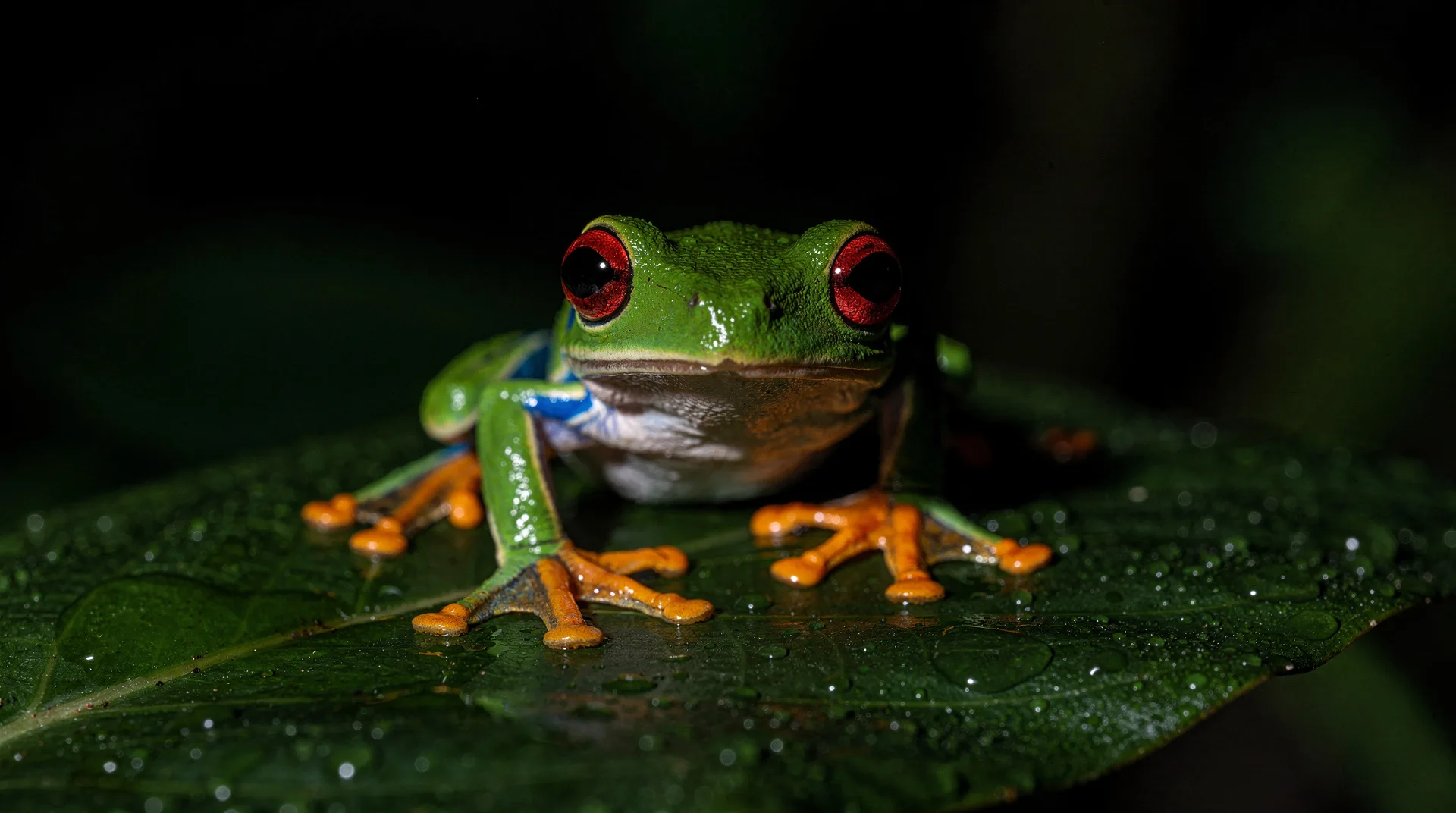
The red-eyed tree frog is Costa Rica’s unofficial mascot — the most photographed frog on the planet. By day, they rest with their ruby eyes shut, appearing as an unremarkable bump on a leaf surface. After dark, those red eyes open, the green body becomes active, and they move to water sources to breed and feed.
Night tours that pass near ponds, streams, or standing water in lowland rainforest have a very high chance of red-eyed tree frog sightings. The species is common across the Caribbean and southern Pacific lowlands, with La Selva and Tortuguero among the most reliable spots.
Glass frogs
Named for the transparent belly skin through which internal organs are visible, glass frogs are most active on vegetation overhanging streams in cloud forest and lower montane zones. Monteverde and the Arenal foothills are productive. Males call from leaves above water — a thin, insect-like peeping — and guard egg clutches deposited on the leaf underside.
Poison dart frogs
Several poison dart frog species are active well into the early evening. The strawberry poison dart frog (Oophaga pumilio) of the Caribbean slope — brilliant red with blue-black legs — is commonly seen on guided night walks in Cahuita, Puerto Viejo, and Tortuguero-area forest. The green-and-black poison dart frog (Dendrobates auratus) is widespread in lowland forest. Neither is dangerous to observe — their toxins are passive and require ingestion to cause harm.
Two-toed sloth
The two-toed sloth (Choloepus hoffmanni) is nocturnal — the opposite of its three-toed relative, which is active during daylight. Night tours in Monteverde, Arenal, and the Caribbean lowlands regularly find two-toed sloths foraging slowly through lower canopy, feeding on fruits, leaves, and the occasional insect. Unlike the sleepy daytime sloth, a two-toed animal after dark is alert, curious, and occasionally startling in its response speed — they can move considerably faster than their diurnal reputation suggests.
See where to see sloths in Costa Rica for a full guide to sloth encounters by season and location.
Kinkajou
The kinkajou (Potos flavus) is one of the night tour species that produces the most delighted reactions from visitors. A honey-bear relative the size of a large cat, with a prehensile tail, enormous eyes, and a remarkably long tongue evolved for extracting nectar and fruit, kinkajous are genuinely appealing animals. They are also fast, agile, and completely arboreal — guides locate them by the rustling of fruiting trees and the occasional reflection of torchlight in those gold eyes.
Kinkajous occur throughout Costa Rica’s forested lowlands and are most reliably found in Monteverde, Corcovado, and Cahuita. They are frequently encountered in residential areas adjacent to forest — their opportunistic feeding habits bring them to mango trees and balsa wood flowers in gardens.
Eyelash palm pit viper
The eyelash palm pit viper (Bothriechis schlegelii) is the most commonly encountered venomous snake on night tours — and also one of the most photogenic. This small, arboreal viper (30–75 cm) comes in a remarkable range of colour morphs: yellow, grey-green, pinkish-brown, and occasionally a brick-red phase. The distinctive “eyelash” scales above the eyes give it its name. It coils in the vegetation at shoulder height or lower, often on heliconia plants or low shrubs near water.
It is venomous and should not be touched. But it is also extremely reluctant to strike without provocation. Thousands of night tours encounter eyelash palm pit vipers each year with no incidents — the key is simply not reaching toward one.
Owls and nightjars
Several owl species hunt after dark in Costa Rica’s forests. The Bare-shanked Screech-Owl is the most commonly encountered in cloud forest zones. The Black-and-white Owl occupies lowland forest and is frequently detected by its distinctive call. Common Pauraque nightjars roost directly on roads and trails at night, their eyes producing a bright red reflection in torchlight — possibly the most common night-tour surprise for first-time visitors.
Where to take a night tour
Monteverde
Monteverde’s cloud forest is the most famous night-tour destination in Costa Rica. Several operators offer guided walks starting around 7–8pm that run 2–2.5 hours through the forest edge and gardens adjacent to the main biological reserves. The combination of glass frogs, sleeping birds, two-toed sloths, and kinkajous makes it consistently productive.
a wildlife observation night walk in Monteverde — from $32 a guided night hike near Santa Elena town in the Monteverde zone — from $28The town of Santa Elena itself has several operators running nightly departures. Booking in advance is recommended December–April (peak season) but walk-up availability is usually possible in the green season.
a cloud forest night walking tour in the Monteverde or Santa Elena area — from $30Arenal and La Fortuna
The Arenal volcano area has excellent night-tour infrastructure. The forest around Lake Arenal and the transitional zones between the volcano national park and the lake produce great diversity — snakes, frogs, and kinkajous are regularly found, along with the occasional tarantula in roadside burrows.
an Arenal Volcano rainforest night tour from La Fortuna — from $60Night walks near La Fortuna also sometimes reveal tayras (weasel-like predators), white-nosed coatis foraging after dark, and an occasional common opossum moving through the canopy.
Puerto Viejo and the Caribbean coast
The Caribbean lowland forest around Puerto Viejo de Talamanca and Cahuita is excellent for poison dart frogs, red-eyed tree frogs, and the remarkable variety of invertebrate life that defines lowland rainforest nights. Cahuita National Park perimeter trails after dusk can be very productive for herps.
a nature and wildlife night tour in the tropical forest near Puerto Viejo — from $45How a guided night tour works
Most night tours operate in small groups (6–12 people) with a single certified naturalist guide who carries a powerful torch and, typically, an additional red-light headlamp for minimising animal disturbance during photography. Tours last 2–3 hours and cover 2–4 kilometres of trail or forest road at a very slow pace.
The guide leads the group in silence when scanning vegetation, pausing frequently to listen for calls and directing torchlight into the canopy and undergrowth. When an animal is found, the guide describes it and allows the group to observe and photograph before moving on. Good guides also identify the abundant invertebrate life — walking sticks, leaf-cutter ants on nocturnal foraging runs, tarantulas in burrow entrances, and the bioluminescent fungi that glow faintly on rotting logs.
Prices for night tours range from $28–65 depending on location and operator. Monteverde tours tend to be at the higher end; Caribbean coast tours are typically cheaper.
What to bring on a night tour
Your own headlamp. Guides carry torches, but having your own light for looking where you are stepping is important. A red-light mode is useful if your headlamp has one — it preserves night vision and is less disturbing to many animal species.
Closed-toe shoes. Essential. Trails after dark have surface irregularities, and the same snakes you will be looking for in the canopy are also found on the ground.
Long sleeves and long trousers. Mosquitoes, bullet ants, and small ticks all operate after dark. Light colours make tick detection easier post-walk.
Camera with high ISO capability or flash. Low-light photography of nocturnal animals is technically challenging. A mirrorless or DSLR with a lens at f/2.8 or wider will outperform a smartphone. If using flash, diffuse it — direct flash flattens the detail that makes frog photographs interesting. See wildlife photography tips for full guidance.
Insect repellent. DEET or picaridin-based formulas are effective. Reef-safe sunscreen obviously matters less at night, but repellent matters more.
Night tours with children
Night tours are accessible to most children aged 6 and above, depending on the child. The slow pace, the torch experience, and the frog and insect encounters tend to be engaging rather than frightening for most kids. The main consideration is footwear and the child’s ability to walk quietly — some guides specify a minimum age of 8.
Adult supervision is obviously required. Evening start times (7–8pm) mean early dinners and an adjusted sleep schedule, which some families find easier to manage than others.
Conservation note
Night tours done responsibly — staying on trails, not touching animals, not using bright white flash directly at animals, keeping groups quiet — have minimal ecological impact. The issues arise when guides or operators allow or encourage handling of wild animals (particularly frogs and snakes), use UV lights on sensitive eyes, or take groups into nesting areas.
Ask operators whether their guides are licensed by the ICT (Costa Rica Tourism Board) and whether the tour avoids the core of any national park after hours. Reputable operators in Monteverde and Arenal are generally well-regulated.
Frequently asked questions about night tours in Costa Rica
Is a night tour safe for tourists?
Yes, when conducted by a licensed guide on established trails. The main risks are the same as daytime trail hiking — stepping on an uneven root or surface — with the addition of the need for torchlight. Encounters with venomous snakes are common (eyelash palm pit vipers, fer-de-lance occasionally), but with a guide in the lead maintaining awareness of the trail ahead, incidents are extremely rare.
Will I definitely see frogs on a night tour?
In the lowland rainforest zones (Puerto Viejo, Cahuita, Tortuguero area) and in Monteverde during the wet season (May–November), frog sightings are nearly guaranteed. The dry season in Monteverde (January–April) produces fewer frogs since amphibians are less active without standing water. Overall, Costa Rica’s frog diversity is so high that some frog encounter is almost inevitable on any night walk.
What is the best season for night tours?
The wet season (May–November) is the peak season for amphibians specifically — breeding aggregations, egg masses, and tadpoles all accompany the rains. The dry season is better for reptile encounters (snakes sunning on roads after warm nights, gecko activity on walls). Year-round, kinkajous, sloths, and sleeping birds are equally accessible.
Can I do a self-guided night walk?
Not recommended in any national park (where it is illegal without a guide) and unproductive in most forest areas. Without a guide’s knowledge of where to look and what to listen for, independent night walks typically produce far fewer sightings and carry more navigational risk. Private land operators sometimes have self-guided trails with marked waypoints for nocturnal wildlife — these are acceptable alternatives if you genuinely prefer independence.
How do guides find animals in the dark?
Primarily by call recognition (frogs, insects, nightjars), by slow scanning of vegetation at torch height, by looking for eye-shine (reflected torchlight) in the canopy for kinkajous, possums, and owls, and by pattern recognition in leaf surfaces for resting insects and frogs. Guides also know which specific plants attract which species — eyelash palm pit vipers on heliconia, glass frogs on overhanging streamside vegetation, and red-eyed tree frogs near any standing water.
Where can I combine a night tour with daytime wildlife activities?
Monteverde is the easiest combination: morning hanging bridges or cloud forest walk, afternoon Ranario frog exhibit, evening night walk — three complementary experiences in one destination. In La Fortuna near Arenal, the hanging bridges park at Mistico Arenal provides excellent daytime birding, followed by a night tour in the adjacent lowland forest.
On the Caribbean coast, Puerto Viejo and Cahuita combine beach and snorkelling by day with productive night walks in the lowland forest after dark. For a fully wildlife-focused schedule, see the 10-day wildlife photography itinerary.
What should I eat before a night tour?
Dinner before departure is recommended — tours typically run 7–9:30pm and most groups are hungry by the end. Avoid strong perfumes or scented sunscreen, which can alert animals to your presence. Bring water and a light snack. The pace is slow enough that physical exertion is minimal, but the time commitment means arriving on an empty stomach is uncomfortable.
Osa Peninsula and Tortuguero at night
Two zones worth a special mention don’t get the tour infrastructure of Monteverde or Arenal but reward those staying overnight in or near the forest. In Corcovado on the Osa Peninsula, lodge-based night walks (rather than standalone tours) are common, since most accommodation sits directly on the forest edge — kinkajous, olingos, and the occasional tapir moving through camp at night are a realistic possibility without booking anything separately.
In Tortuguero, night walks are secondary to the turtle-nesting night tours (July–October for green turtles, February–July for leatherbacks), which are a different regulated activity run by park rangers rather than a general wildlife walk — book that separately if turtles are the goal, and treat any general night wildlife walk there as a bonus rather than the main event.
Night tours versus night drives
Most Costa Rica night wildlife experiences are walking tours, but a handful of lodges near Arenal and in the lowlands offer open-vehicle night drives along private roads. Drives cover more ground and are gentler for travellers who struggle with a slow 2–3 hour walk, and they’re often better for spotting larger, more skittish mammals like tayras, ocelots, or armadillos that keep well back from foot traffic. Walking tours, by contrast, get you closer to the small stuff — frogs, insects, and low-lying snakes — that a vehicle simply drives past. If mobility is a concern, ask specifically whether an operator offers a drive option rather than assuming all night tours are on foot.
Related guides
The nocturnal world connects to several other Costa Rica experiences. Butterflies and frogs guide covers the daytime side of amphibian and insect watching, including the Monteverde butterfly garden and La Paz Waterfall Gardens frog exhibit. Where to see sloths explains the difference between the nocturnal two-toed and the diurnal three-toed species and where to see each reliably.
The Costa Rica wildlife overview provides the ecological context for what you see after dark. Bird watching by region covers the owl and nightjar species found in each zone. And wildlife photography tips is essential reading before you try to photograph a red-eyed tree frog in torchlight conditions.