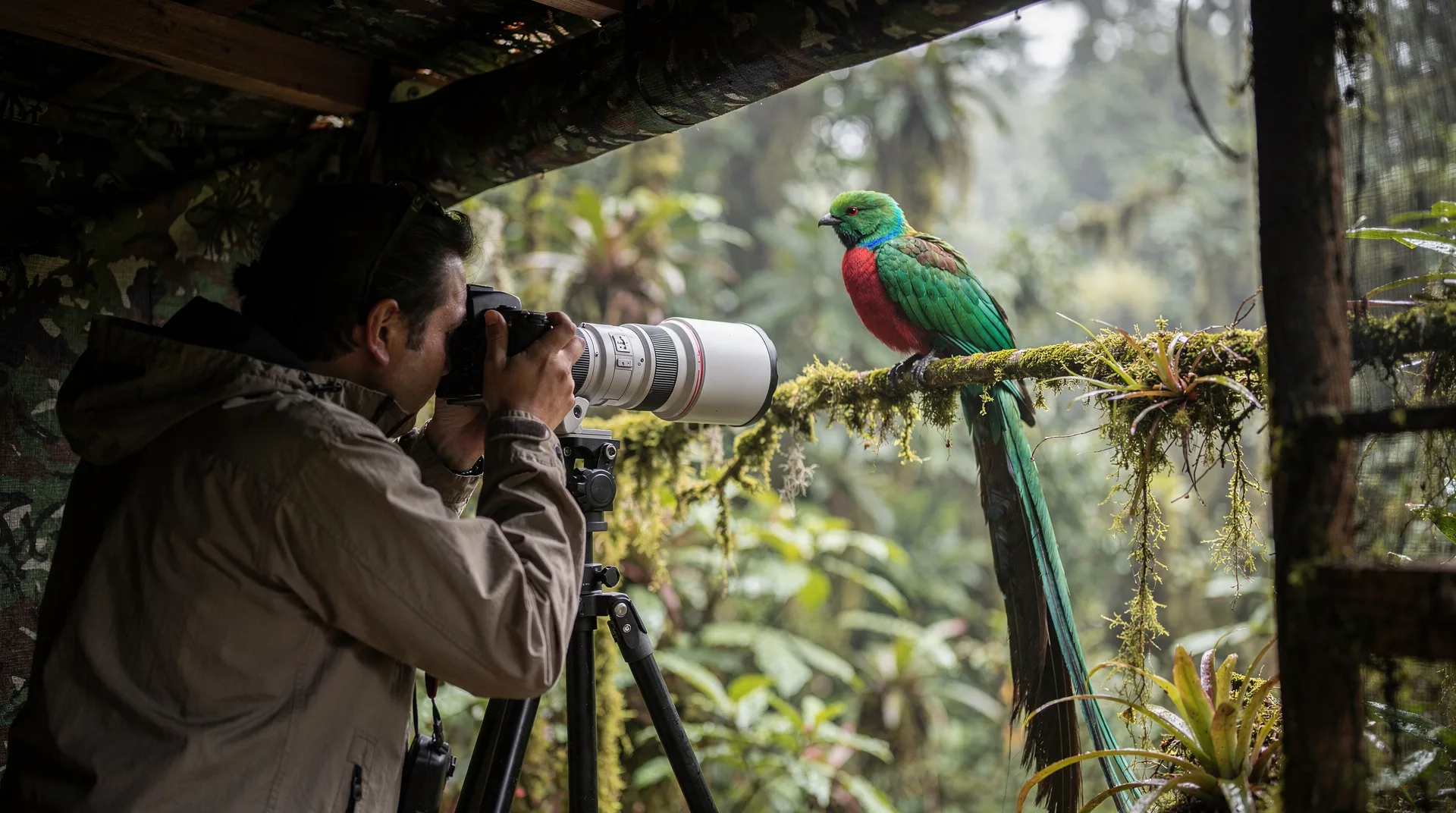
14-day Costa Rica wildlife photography expedition
Costa Rica’s best wildlife photography corridor
Few countries on earth deliver photographic diversity like Costa Rica. This 14-day expedition is designed around the country’s highest-yield zones for wildlife photography: sea turtles nesting on dark Caribbean beaches, river-level canopy at Sarapiquí where toucans and kingfishers perch within reach, the mist-wrapped cloud forest of Monteverde, the oak forest páramo of San Gerardo de Dota for resplendent quetzals, and finally Drake Bay on the Osa Peninsula — the most biodiverse marine region of Central America.
The route uses a mix of shuttles, boats, and one domestic flight. A rental car is not recommended for this itinerary because Tortuguero is boat-access only, Monteverde roads are hard on equipment, and San Gerardo and Drake Bay require very different vehicles. Instead, pre-book shuttles and book Sansa flights for the segments that justify it. The logistics are more complex than a car-based itinerary, but the photographic payoff is unmatched.
Best months: April–June for quetzals in San Gerardo; July–October for Tortuguero sea turtles; December–March for dry-season Osa with clearer skies. This route is designed for a July–August departure when Tortuguero peaks and the veranillo (mini dry season) brings reliable mornings across most regions.
At a glance
| Stat | Value |
|---|---|
| Total days | 14 |
| Best for | Wildlife photographers, serious birders |
| With/without car | No car — shuttles, boats, and domestic flights |
| Budget range | USD 120–200 per person per day (mix) |
| Best season | July–October (turtle season); Apr–Jun (quetzals) |
| Equipment note | Bring weatherproofing — three of five zones involve rain or mist |
Day-by-day breakdown
Phase 1: Tortuguero — sea turtles and jungle canals (Days 1–3)
Tortuguero is inaccessible by road. You approach by boat from the Caribbean port town of Cahuita or Moín, or by a combination of San José–Limón bus and river taxi from Cariari. The most comfortable option from San José is a shuttle transfer that includes the water taxi — about 4 hours total.
Tortuguero: sea turtle tour — from $50Day 1: arrive in Tortuguero by early afternoon. Check in, stow your gear, and take an afternoon canal tour with a certified guide. Tortuguero’s canals are lined with torchwood, silk cotton trees, and heliconia — and the slow boat gives you time to shoot green herons, anhingas, and the occasional river otter from a stable platform.
Day 2: sea turtle nesting tour. During July–October, green turtles nest on Tortuguero’s Caribbean beach — you’ll observe them laying eggs in darkness, guided by headlamps with red filters. Flash photography is strictly prohibited and red-filter flashlights are the only acceptable light source. The window for photography is limited but extraordinary — turtle silhouettes on dark sand under starlight are among the most evocative images any Costa Rica visitor brings home.
Turtle watching in Tortuguero, Costa Rica — from $45Day 3: dawn canoe or kayak on the secondary canals. Small craft get into narrower channels that the motorized boats cannot access — this is where you’ll find Jesus Christ lizards, freshwater turtles, and occasionally the rare Nicaraguan river turtle. Return to the main village for the Tortuguero Hill trail — a 45-minute climb to a viewpoint over the Caribbean jungle.
Tortuguero: hike the Cerro Tortuguero trail — from $30Stay: Mawamba Lodge (mid-range, from $120/night full-board, on the beach side between canal and sea, excellent guide network) or Tortuga Lodge (luxury, from $280/night full-board, gardens, excellent food, fastest boat guides).
Phase 2: Sarapiquí — canopy and river (Days 4–5)
Take the river taxi north from Tortuguero to Pavona, then ground transport to Puerto Viejo de Sarapiquí — a 4–5 hour journey but a remarkable one, passing through banana plantations and Caribbean lowland forest. Sarapiquí is one of Costa Rica’s most productive birding destinations: the Selva Verde Lodge grounds alone list over 400 bird species.
Day 4: arrive in Sarapiquí by midday. Afternoon birding walk on the lodge trails — dawn and dusk are the productive hours, but mid-afternoon offers reliable sightings of toucans, motmots, and the occasional resplendent quetzal if you’re in the higher elevations.
Day 5: Sarapiquí rafting river tour — not for the whitewater (though Class II-III rapids are photogenic), but for the kingfishers and sunbitterns that hunt the river margins. A slow float on a raft gives you a river-level perspective that’s very different from a forest trail.
Arenal: rafting Sarapiqui River day tour Class II-III — from $85Afternoon: visit the frog and butterfly exhibits at Tirimbina Rainforest Reserve — a private reserve near La Virgen with excellent habitat and permitted close-focus photography of poison dart frogs.
Stay: Selva Verde Lodge (mid-range, from $95/night full-board, exceptional grounds and birdlist, good guided walks).
Phase 3: Monteverde — cloud forest canopy (Days 6–8)
Shuttle from Sarapiquí to Monteverde via San José — about 5–6 hours. The direct shuttle through La Virgen and north toward Tilarán is the most efficient route. Arrive in Santa Elena late afternoon.
Day 6: acclimate to the cloud forest. Moisture-protected camera equipment matters here — the cloud forest lives in perpetual mist and humidity. The Monteverde Cloud Forest Biological Reserve at dawn (6 AM opening) is where you start.
Monteverde and Santa Elena: cloud forest bird-watching tour — from $65Day 7: Curi-Cancha Reserve — less visited than the main reserve, with better quetzal sighting probability and smaller groups. A 4-hour morning walk with a certified ornithological guide is the best use of this day. Curi-Cancha allows tripods and extended photography stops that the crowded main reserve sometimes discourages.
Immerse yourself in the Monteverde Cloud Forest — from $55Day 8: Selvatura Park — hanging bridges at canopy level above the cloud forest. The bridges offer elevated angles for bird photography (trogons, emerald toucanets) and the frog and butterfly exhibits permit very close-focus macro work.
Evening: night walk in the cloud forest — kinkajous, olingo, sleeping quetzals, tree frogs, and pit vipers are active after dark. Red headlamps only.
Monteverde: wildlife observation night walking tour — from $32Stay: Monteverde Lodge and Gardens (mid-range, from $120/night, forest access, good guiding network).
Phase 4: San Gerardo de Dota — quetzals (Days 9–10)
Drive from Monteverde to San Gerardo de Dota via San José — about 4 hours total. San Gerardo de Dota sits at 2,100 meters elevation in the Chirripó valley, significantly colder than anywhere else on this itinerary (bring layers — overnight temps drop to 8–12°C). The Savegre River valley here is the most reliable quetzal location in Costa Rica, particularly during April–June nesting season. In July–August, they’re still present but less predictable.
Day 9: arrive in San Gerardo by midday. Afternoon walk on the Savegre Hotel trails — the avocado orchards above the hotel are where quetzals feed most reliably. Your guide will know where the active nests are.
Day 10: pre-dawn quetzal walk (5 AM departure) when males display and females visit nests. The Savegre valley’s elevation gives you an oak forest habitat unlike anything on the coast — siligo, oak-moss-draped trees, and epiphytes that catch morning light in extraordinary ways. Other species: dark Pegasus, black guan, and multiple hummingbird species unique to high elevation.
Stay: Savegre Hotel Natural Reserve and Spa (mid-range, from $120/night, on-site trails, expert bird guides, good food).
Phase 5: Drake Bay — Osa Peninsula and Corcovado (Days 11–14)
San Gerardo to Drake Bay requires a return to San José and either a 4-hour drive to Sierpe followed by a 1.5-hour boat ride, or a 50-minute domestic flight from SJO to Drake Bay airstrip. For photographers with heavy equipment, the Sansa flight is worth every cent.
Drake Bay is the base for the Osa Peninsula’s extraordinary biodiversity — Corcovado National Park, which contains an estimated 2.5% of all biodiversity on earth in 424 square kilometers. Certified guide required; no independent hiking allowed.
Day 11: arrive in Drake Bay. Afternoon sea walk along the Río Claro coastline — scarlet macaws roost in the palms above the beach and the tide pools harbor octopus and sea stars.
Drake Bay: bird watching tour — from $95Day 12: full-day Corcovado guided hike from San Pedrillo station (northernmost entry, reachable by boat from Drake Bay). This is the route for tapir and peccary sightings, plus four species of monkeys in a single morning. The Río Claro trail near San Pedrillo is excellent for kingfishers and trogons.
Drake Bay: Corcovado NP and Sirena Station tour — from $135Day 13: Caño Island snorkel tour from Drake Bay — not just for underwater photography but for the boat transit, which passes through humpback whale territory (August peak) and consistently yields spinner dolphin bow-riding. Underwater photographers will find sea turtles, reef fish, and the occasional manta ray in the island’s marine reserve.
Caño Island Biological Reserve - snorkeling or diving — from $140Day 14: morning at Drake Bay’s community beach, then boat transfer to Sierpe and road back to San José for the international flight — allow 6–7 hours total.
Gear notes for wildlife photographers
Sensor protection: The Caribbean (Tortuguero) and cloud forest (Monteverde) phases require sealed bodies or waterproof covers. Humidity in Tortuguero exceeds 90% and cloud forest is literally inside a cloud.
Reach: A 400mm or 500mm lens is essential for bird photography. Bring your longest lens and a teleconverter. Many shots at Corcovado and Monteverde are at 8–20 meters in mixed light.
Flash: Strictly prohibited at sea turtle nesting sites. Use high-ISO, f/2.8, and available light only.
Tripod: Selvatura’s hanging bridges are slightly unstable — use a monopod for bridge photography. San Gerardo’s dawn sessions are cold enough for lens mist; bring lens warmers.
Cost breakdown
| Category | Per person (mid-range) |
|---|---|
| Accommodation (13 nights, often full-board) | $1,500–2,000 |
| Shuttles and boat transfers | $400–600 |
| Domestic flight (SJO–Drake Bay) | $180–220 |
| Guided tours (8–10 tours) | $600–900 |
| Park fees (Tortuguero, Corcovado, Caño Island) | $120–160 |
| Food (some meals outside full-board) | $200–350 |
| Total per person | $3,000–4,230 |
When to go
This route is optimized for July–August: Tortuguero green turtle nesting is at peak (July–September), the veranillo mini-dry-season brings reliable morning light across most regions, Corcovado is accessible (note that Sirena station can close September–November for maintenance), and Drake Bay’s offshore is prime for whale sightings.
For quetzals as the primary subject, shift to April–June: nesting males are brilliantly plumed and territories are active. During this period, replace Tortuguero (off-peak for turtles) with a longer stay in San Gerardo and an extension to Carara National Park for scarlet macaws.
Avoid October and November for this circuit: Corcovado can be closed for erosion repair, Monteverde is at peak cloud cover, and Sarapiquí experiences its heaviest rainfall.
Frequently asked questions about this photography itinerary
Is a guide mandatory for Corcovado?
Yes, by law. Costa Rica requires all visitors to Corcovado National Park to be accompanied by a certified guide (ICT-registered). This is not optional and is enforced at the park entrance. The requirement was introduced in 2014 after several independent hikers became lost or injured. Book guides through established operators in Drake Bay or Puerto Jiménez.
Can I bring a large telephoto lens on the boats in Tortuguero?
Yes, but bring a waterproof bag or housing. Canal boats are open and spray can reach equipment on sharp corners. Foam padding for the lens barrel is advisable. Stable shooting from a slow-moving canal boat is quite achievable with image stabilization and good technique.
How cold does San Gerardo de Dota get?
Night temperatures in July–August average 10–14°C. By day, it warms to 18–22°C. Pack a fleece and a light rain jacket. The cold is a genuine shock after the Caribbean lowland heat of Tortuguero and the coastal heat of Sarapiquí — plan your bag accordingly.
Is the Sansa flight to Drake Bay reliable?
Generally yes, but small aircraft flights are weather-dependent. In July–August, occasional delays are possible. Build one buffer day into your Drake Bay section if an important shoot depends on your arrival. The alternative (Sierpe boat route) is a 6-hour journey from San José by road plus boat.
Do I need a PADI certification for Caño Island?
Not for snorkeling — Caño Island snorkel tours are open to all swimmers. For scuba diving at Caño Island, an Open Water certification is required. The snorkel experience at Caño is exceptional enough that certification is not necessary for most photographers interested in surface and shallow reef work.
What’s the single best wildlife photography moment on this route?
Subjectively: a green sea turtle returning to the ocean at Tortuguero just before dawn, photographed at ISO 12800 in the first hint of blue light. Objectively: whatever you see first on the Corcovado trail — a tapir crossing, a jaguar footprint, or all four monkey species in the same tree.
How do I protect my equipment from humidity at Tortuguero?
Dry bags, silica gel packets in your camera bag, and acclimatizing your gear slowly between air-conditioned lodge rooms and the outside air. If possible, seal your secondary lenses in zip-lock bags when entering or exiting air conditioning — the rapid temperature differential causes condensation inside the lens housing.
Logistical planning for photographers
This itinerary involves five distinct ecosystems across 14 days — logistical planning is more critical than for a typical tourist circuit because the photography constraints (access hours, light windows, permit requirements, equipment transport) add complexity that requires advance coordination.
Booking guide services: In Tortuguero, MINAE-certified turtle guides must be booked through your lodge or the local ATEC organization — no walk-in bookings at the beach. In Corcovado, ICT-certified guides must be secured before you arrive in Drake Bay — contact guide associations in Puerto Jiménez or Drake Bay 3–4 weeks in advance during July–October peak season. Monteverde’s Curi-Cancha Reserve accepts smaller groups than the main reserve — book one of its 8–10 authorized naturalist guides 48 hours ahead.
Permit logistics: Corcovado’s daily visitor quota is enforced at San Pedrillo and Sirena stations. San Pedrillo entry for day-visitors from Drake Bay is $15 (guide fee additional); Sirena requires an overnight permit (camping or the ranger station bunkhouse) which must be reserved through SINAC months in advance during peak season. For this itinerary, San Pedrillo day access is the practical option. Caño Island’s boat-tour permits are obtained by your licensed operator — confirm this explicitly when booking.
Best light planning: The photographic windows by zone are tight. Caribbean dawn (5:30–8 AM) is the turtle window and the canal bird window. Sarapiquí’s forest opens photographic access at dawn (Selva Verde trails open at 5:30 AM with guide). Monteverde’s cloud forest has unpredictable light — plan for 6–9 AM when the cloud occasionally lifts to reveal the canopy. San Gerardo’s quetzal dawn walk begins at 5 AM (cold, dark, worth every difficulty). Corcovado afternoon light (3–5 PM) is when the forest edge near San Pedrillo is best lit for flying macaws against a blue sky.
Insurance and equipment: Wildlife photography equipment is high-value cargo. Ensure your camera equipment is covered by a travel insurance policy that specifically includes photography gear — standard travel policies have equipment limits of $500–1,000, insufficient for a serious wildlife kit. Some specialized insurance providers (Photoguard, Lenstag) offer dedicated coverage.
Photographic opportunities by zone — detailed
Tortuguero canal birds (Days 1–3): The kingfisher family provides excellent low-light opportunities — Amazon, green, belted, and the spectacularly colored ringed kingfisher all hunt the canal margins. Use a fast prime lens at f/2.8 and pre-focus on a perch spot; kingfishers return to the same branch repeatedly. River level morning mist provides naturally diffused light between 6–8 AM. The American anhinga spreads its wings to dry after diving — a characteristic pose that appears regularly from the boat.
Sarapiquí canopy photography (Days 4–5): Keel-billed toucans at Selva Verde perch conspicuously on fruiting trees at dawn. Use a 400mm minimum for clean backgrounds — the forest is dense enough that distance helps separate the subject from the foliage. The white-collared manakin performs its distinctive mechanical-sounding courtship display in the understory — a 250mm can capture it in reasonable proximity with a fast shutter speed (1/1000s minimum for the wing-snap).
Monteverde cloud forest (Days 6–8): The cloud forest’s characteristic challenge is dynamic range — bright sky through gaps in the canopy, dark forest interior. Use spot metering on the subject rather than evaluative/matrix. The resplendent quetzal at Monteverde is most reliably found at fruiting aguacatillo trees — your guide will know the current fruiting locations. The tail feathers can reach 60–90 cm in breeding males; a full-frame sensor with a 500mm lens captures both the bird and the tail detail in one frame.
San Gerardo de Dota (Days 9–10): The high-elevation oak forest has different light quality than the lowlands — colder, bluer, with morning frost on the grass. Quetzal males display at dawn by chasing each other through the oak canopy; the golden-green wings against the red chest create one of the most photographically dramatic combinations in avian photography. The Savegre valley’s misty morning light (7–9 AM) is ideal for atmospheric landscape frames with birds. Exposure compensation of +1 to +1.5 EV is typically needed for the white-breasted subjects against dark forest.
Drake Bay and Corcovado (Days 11–14): Scarlet macaws in flight over the beach are the signature Drake Bay image — a 300–500mm telephoto at 1/2000s freezes the wing position cleanly. For Corcovado interiors, a 70–200mm f/2.8 provides versatility for both close forest subjects and longer-distance mammal shots. The coati (pizote) is frequently encountered at the forest edges and is confident enough for close-focus portraits. For the boat transit, a polarizing filter dramatically improves the blue water color and reduces glare for above-surface shots.
Ethics of wildlife photography in Costa Rica
Costa Rica’s wildlife photography community has established informal but widely respected ethics norms that professional and serious amateur photographers follow. Understanding them before arrival avoids conflicts in the field and ensures your presence doesn’t negatively affect the wildlife you’re photographing.
The flash prohibition: Flash photography is prohibited at sea turtle nesting sites throughout Costa Rica by MINAE regulation. The rule extends de facto to any nocturnal wildlife photography with wild animals — kinkajous, frogs, and sleeping birds photographed with flash can be disturbed in ways that are genuinely harmful. High-ISO and fast-aperture lenses are the technical solution; accepting some image noise is the ethical price.
Playback and calls: Using recorded bird calls (playback) to attract birds is a practice that divides the ornithological community. It can stress territorial birds significantly during nesting season. In Costa Rica’s most sensitive bird habitats — San Gerardo de Dota quetzal territories, Corcovado’s interior — using playback is frowned upon by local guides and the birding community. Work with what presents naturally.
Distance from nesting sites: The 10-meter distance rule from active nests is standard for professional wildlife photography — closer approach can cause nest abandonment. Quetzal nest sites in San Gerardo require the most discipline: if the female shows stress behavior (repeated alarm calls, leaving the nest repeatedly), retreat beyond what feels necessary and wait for her to settle.
No baiting: Wildlife food baiting — placing fruit to attract kinkajous, or fish pieces to attract crocodiles — is practiced by some unscrupulous operators in Costa Rica. Any operator suggesting food baiting should be declined. The photographic result may be more predictable; the wildlife welfare cost is not.
Social media geolocation: Posting GPS coordinates or street addresses for active jaguar territories, quetzal nests, or turtle nesting beaches is actively harmful. These locations, once widely shared, attract overwhelming visitor pressure. Photograph, enjoy, and tag broadly (Corcovado, Drake Bay, San Gerardo de Dota) without pinpointing active wildlife sites.
Related itineraries
For a wildlife focus without the photography logistics, the 7-day quick Caribbean route covers Tortuguero and Puerto Viejo in a shorter, more accessible format. For the full south Pacific wildlife experience centered on the Osa Peninsula, see the 12-day south Pacific deep dive. For birders specifically interested in the Monteverde and San Gerardo zones, the 10-day Arenal, Monteverde and Manuel Antonio route includes Monteverde with more days for cloud forest exploration.