Caño Island snorkeling: the complete guide
Caño Island snorkel from where?
Drake Bay (45min boat) or Uvita (1h15 boat).
| Where | Isla del Caño, 19km off the Osa Peninsula |
| Cost | Around $120–145 per person, day trip |
| Getting there | 45min boat from Drake Bay or 75min from Uvita |
| Time needed | Full day; 2–3 hrs of actual snorkeling |
| Best time | December–April for calm seas and 15–25m visibility |
Costa Rica’s best snorkeling reef — and how to reach it
Caño Island Biological Reserve — Reserva Biológica Isla del Caño — is a protected island 19 km off the coast of the Osa Peninsula, sitting where the Pacific’s Cocos tectonic plate and the Caribbean plate interact. The result is an underwater landscape of unusual diversity: living coral formations, sponge gardens, and an animal community that includes almost every Pacific marine species that visitors to Costa Rica hope to encounter.
Caño Island consistently ranks as the country’s best accessible snorkeling site, and for good reason. The clarity, the coral health, and the sheer density of marine life make it categorically better than most coastal reef options. It is not cheap to reach — day trips cost $135-145 — but divers and snorkellers who have done both Cahuita and Caño Island consistently rate Caño as the superior experience.
This guide explains how to get there, what to expect underwater, and how to choose between the two main departure points of Drake Bay and Uvita.
Drake Bay vs Uvita: which departure point?
Drake Bay (45-minute boat ride)
Drake Bay is the closer of the two gateways and the traditional starting point for Caño Island tours. The 45-minute boat crossing from Drake’s small beach is manageable even on moderately choppy days. Most Drake Bay lodges — from budget cabinas to eco-lodges — can arrange Caño Island day trips directly, often bundled with a Corcovado National Park visit.
The downside of Drake Bay as a base: getting there is an adventure in itself. From San José, the options are a 50-minute Sansa flight, a 4-hour drive to Sierpe followed by a 1-hour river and coastal boat, or an 8-hour direct drive. Read our Drake Bay destination guide before committing to this routing.
From Drake Bay, snorkel tour prices: $120-145 per person.
Uvita (1h 15min boat ride)
The longer crossing (75 minutes each way) from Uvita is the more popular choice for travellers who are staying on the Uvita/Dominical/Manuel Antonio corridor, which has far better road access from San José. Uvita is 3.5 hours south of San José on the Costanera Sur highway — a straightforward drive with no mountain roads or river crossings.
The longer boat ride is not without upside: the approach to Caño from the open Pacific offers dolphin sightings frequently, and occasional humpback whale encounters if your trip falls during whale season (August-October or December-March).
From Uvita, snorkel tour prices: $135-145 per person.
What you’ll see underwater
Coral and reef structure
Caño Island’s reef system is among the healthiest in Costa Rica, though not immune to the El Niño bleaching events that have affected Pacific reefs globally. The most impressive formations are along the island’s northwestern and southwestern flanks, at depths of 3-18 m.
Look for massive brain coral domes (Diploria and Pseudodiploria species), branching staghorn coral, and the extensive rubble fields that transition into deeper reef structure. The island’s protected status — no fishing, no anchoring on reef — means the coral is recovering better here than at most sites.
Fish species
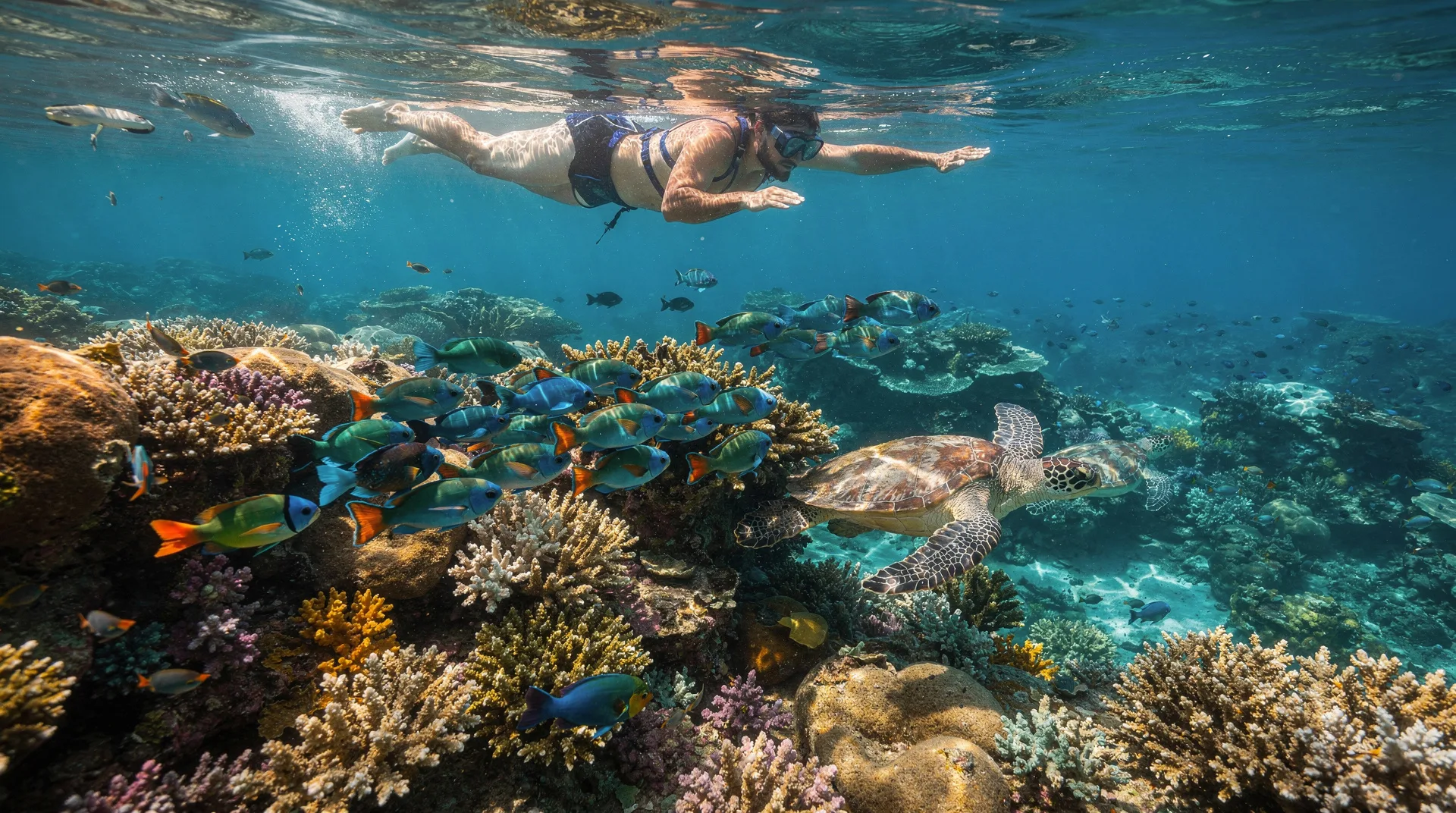
The fish density at Caño is what makes first-time snorkellers go wide-eyed. Common sightings include:
- Panamic sergeant majors — the hyperactive yellow-striped fish around every coral head
- Moorish idols — immediately recognisable by the long dorsal filament
- Parrotfish — several species including the large male rainbow parrotfish, whose colours live up to the name
- Snappers — dense schools of yellow-tail and dog snappers at mid-reef depth
- King angelfish — endemic to the eastern Pacific, bold and conspicuous
- Porcupinefish — invariably hovering under coral overhangs
Large species encounters
The genuine headline draw. Snorkellers (not just divers) regularly encounter:
- Green sea turtles: year-round, particularly reliable on calm mornings when they feed on jellyfish and sea grass
- Eagle rays: common year-round, gliding in pairs or small groups along the reef edge
- White-tipped reef sharks: 1-2 m adults resting under coral overhangs in 4-6 m of water are a near-guarantee
- Spotted eagle rays: similar to eagle rays but patterned, occasionally seen in groups
- Pacific spotted dolphins: frequently encountered on the boat crossing, occasionally swim alongside snorkellers
Humpback whales are sometimes seen from the surface during whale season but do not typically interact with snorkellers in the reserve itself.
Best time to visit
Dry season (December to April)
Visibility: 15-25 m. Sea conditions: calm to slight swell. Rain: minimal. This is the easiest window for snorkelling, particularly for those who are not strong swimmers or are travelling with children. The crossing from Uvita is comfortable even for those prone to seasickness.
Green season (May to November)
Visibility: 8-18 m. Sea conditions: variable, sometimes choppy. Rain: frequent. The reef is equally full of life, but the boat crossing requires a stronger stomach. However, this window overlaps with whale season (August-October is peak humpback time at nearby Marino Ballena National Park), and occasionally whales are sighted from the boat. Green season also means fewer tourists and lower lodge prices.
Bottom line: December-April is the safest bet for clear water and calm seas. If you’re visiting in green season and the sea is calm, go — the marine life is worth it.
Booking your trip
What’s included in tour prices
Standard day trips from Uvita or Drake Bay include:
- Return boat transfers
- Snorkeling equipment (mask, fins, snorkel, wetsuit optional)
- DM guide in the water with the group
- Entry fee to Caño Island Biological Reserve (included in the price)
- Light lunch or snacks on most tours
- Time for a beach walk on the island itself
Verified GYG options
These tours depart from Uvita and have been verified:
Caño Island Biological Reserve - snorkeling or diving — from $140 Uvita: snorkeling at Caño Island - unforgettable — from $140 Caño Island snorkeling tour from Uvita — from $140 Uvita: snorkeling tour in Caño Island Biological Reserve — from $145For alternative options departing from Uvita with slightly different itineraries, these are also valid:
Uvita: snorkeling at Caño Island — from $135Group sizes and quality
The reserve limits the number of visitors per day to protect the reef. Tours typically involve groups of 8-16 people. If you are booking through a lodge in Drake Bay, ask about group size explicitly — some Drake Bay tours run smaller, guiding groups of 6-10.
Reef etiquette and conservation
Caño Island is a protected biological reserve, not a marine park with relaxed rules. SINAC (Costa Rica’s national park service) enforces strict conduct:
- No touching coral — even brief contact kills polyps
- No feeding fish — alters natural behaviour
- Reef-safe sunscreen only — conventional sunscreens damage coral
- No collecting — shells, rocks, and marine organisms must not be taken
- Anchoring on reef is prohibited — boats use mooring buoys only
These rules are enforced by guides and SINAC rangers. Respect them — Caño Island’s reef health is why the trip is worth making.
Combining Caño Island with other activities
Drake Bay 2-3 day itinerary
Caño Island (day 1) + Corcovado National Park Sirena Station (day 2) is the classic Drake Bay combination and one of the most wildlife-rich two-day sequences in Costa Rica. Both experiences are booked through Drake Bay lodges or directly with tour operators. See our Drake Bay guide for lodge recommendations.
Uvita-based multi-day
Pair Caño Island (day 1) with whale watching at Marino Ballena National Park (day 2). Uvita is the base for both. If you’re timing it right in August-October, the whale watching is exceptional — see our full Uvita guide.
Frequently asked questions about Caño Island snorkeling
How fit do I need to be for Caño Island?
You should be a confident swimmer — you will be in open water at depth and need to be comfortable floating and finning for 45-60 minutes without a rest stop. Life jackets are available for non-swimmers, but the experience is significantly better with mask and fins. Strong swimmers will get the most from the trip.
Is there a bathroom on the island?
Yes — basic SINAC facilities on the beach. The island has a ranger station, picnic tables, and a short trail. You will spend 2-3 hours snorkeling and 30-45 minutes on the island between snorkel sessions.
Can children snorkel at Caño Island?
Yes, children who can swim confidently do snorkel here. Most operators accept children from age 8 upward. Wetsuits for small children are sometimes scarce — confirm with your operator in advance.
Does the reserve limit daily visitor numbers?
Yes. SINAC restricts daily visitor capacity to protect the ecosystem. In peak season (Dec-Mar), popular tour operators book out 2-3 days in advance. Book early.
Is it possible to dive at Caño Island rather than snorkel?
Yes. The same boats that bring snorkellers also carry certified scuba divers. Dive sites reach 20-25 m and offer everything the snorkel experience does plus pelagic species, large reef sharks, and better eagle ray encounters. A combined snorkel/dive day trip is offered by most operators — divers go deeper while snorkellers explore the shallows.
How does Caño Island compare to Caribbean snorkeling?
Caño Island’s Pacific reef has more diversity of large species — rays, turtles, sharks — than the Caribbean reefs at Cahuita. However, Caribbean reef fish are more colourful in some respects, and Cahuita is much cheaper and easier to reach. If you are near the Osa Peninsula, Caño Island is the better choice. If you are on the Caribbean coast, Cahuita makes more sense.
What is the entry fee for Caño Island?
The SINAC reserve entry fee is included in most organised tour prices. As of 2026, the fee is approximately $15-18 per person for foreign nationals. Confirm this with your operator, as fees are occasionally adjusted by SINAC.
Related guides
Our marine life guide covers every species you might encounter on a Caño Island trip — from humpback whales to seahorses. If you are on the Caribbean coast, the Cahuita reef snorkel guide covers the Atlantic alternative. Divers who want the full Osa underwater experience should also read the snorkel vs dive comparison, and those planning the Drake Bay loop will find the Corcovado National Park guide an essential companion.
Is Caño Island worth the price gap over Cahuita?
At $120-145 versus Cahuita’s $55-95, Caño Island costs roughly double, and the honest answer to whether that gap is justified depends entirely on what you’re optimising for. For visibility, coral health, and the density of large pelagic species — white-tipped reef sharks under nearly every overhang, near-guaranteed sea turtles, regular eagle rays — Caño Island is unambiguously the better reef, and most snorkellers who’ve done both agree the difference is immediately visible in the water.
What you’re also paying for is logistics: the boat crossing itself, at 45-75 minutes each way through open Pacific water, is a meaningfully bigger undertaking than Cahuita’s short hop from a beach, and the SINAC-managed daily visitor cap keeps group sizes controlled in a way Cahuita’s informal town-dock operators don’t always match. If your Costa Rica itinerary already routes through Drake Bay or Uvita for other reasons — Corcovado, whale watching — the extra cost is easy to justify. If you’d need to detour specifically for Caño Island, weigh that travel cost against simply enjoying a Caribbean-coast reef day at Cahuita instead.
Seasickness and the boat crossing
The open-water crossing is the part of a Caño Island trip that catches unprepared visitors off guard — far more than the snorkeling itself. Both the Drake Bay and Uvita routes cross exposed Pacific swell rather than sheltered coastal water, and even the shorter 45-minute Drake Bay crossing can feel long if conditions are choppy.
If you’re prone to motion sickness, take preventive medication (such as dramamine or a scopolamine patch) at least 30-60 minutes before departure rather than waiting to feel unwell, sit toward the centre of the boat where movement is least pronounced, and keep your eyes on the horizon rather than on a phone or camera screen during the crossing. Dry season (December-April) crossings are calmer on both routes, which is one more reason that window is the safer choice for anyone uncertain about their sea legs.
a Caño Island snorkeling day trip — from $140