Costa Rica marine life guide: every species worth knowing
What marine life can I see?
Humpbacks, mantas, turtles, sailfish, mahi, hammerheads, bull sharks.
Costa Rica’s position at the meeting point of four ocean currents makes it one of the most species-dense marine regions on the planet — this guide is the full reference for what lives here, when it shows up, and where to actually see it.
| Best non-diver option | Caño Island snorkeling |
| Best for certified divers | Cocos Island (week-plus liveaboard) |
| Peak whale season | August–October at Uvita/Marino Ballena |
| No certification needed | Whale watching, Caño Island snorkel, turtle nesting |
| Advanced OW required | Bat Islands bull sharks, Cocos Island hammerheads |
Why Costa Rica’s waters are extraordinary
Costa Rica controls 2.4% of the world’s land surface but lies at the intersection of four major ocean currents — the North Equatorial Counter Current, the South Equatorial Current, the Costa Rica Dome upwelling, and the Humboldt Current’s northern extension. This confluence of currents creates a biological productivity engine: cold, nutrient-rich water rising from depth meets tropical warmth near the surface, generating phytoplankton blooms that anchor a food chain of extraordinary density.
Add to this an official commitment to marine protected areas — including the Caño Island Biological Reserve, Marino Ballena National Park, the Las Baulas Marine National Park, and the massive Cocos Island National Park — and you have a coastal zone that functions as one of the most biodiverse marine regions in the eastern Pacific.
This guide covers the full species list: what lives in Costa Rica’s Pacific and Caribbean waters, when each species is most reliably seen, and where to find them.
Marine mammals
Humpback whales
Costa Rica is one of the few places on earth where humpback whales from both the northern and southern hemispheres visit in their respective winters. This creates two distinct whale seasons:
Southern hemisphere humpbacks (August-October): These whales migrate north from Antarctic feeding grounds to breed and calve in Costa Rica’s warm waters. The peak window is August through October. Marino Ballena National Park off Uvita is the primary viewing location — the famous whale tail sandbar formation visible at low tide is a symbol of the park.
Northern hemisphere humpbacks (December-March/April): A second, less-documented population migrates from Alaskan and North Pacific feeding grounds. Sightings are less predictable than the southern season but well-documented by researchers tracking movements around the Nicoya Peninsula and the Gulf of Dulce.
Where to see them: Uvita’s Marino Ballena National Park for the peak August-October season. Drake Bay and the Gulf of Dulce also produce sightings. Tour boats operating whale-watching trips:
Marino Ballena: whale watching in Uvita — from $80Dolphins
Bottlenose dolphins, spinner dolphins, and spotted dolphins are all common in Costa Rican waters year-round. They frequently ride the bow wake of boats, making any ocean tour a potential dolphin encounter. Spotted dolphins are particularly common offshore in the Osa Peninsula area. Spinner dolphins perform their characteristic aerial spinning leaps near the surface — typically in the early morning before the sea chops up.
Orcas (killer whales) are documented in Costa Rican waters but are genuinely rare sightings, more often reported by sport fishing boats offshore than by tour operators.
Whale sharks
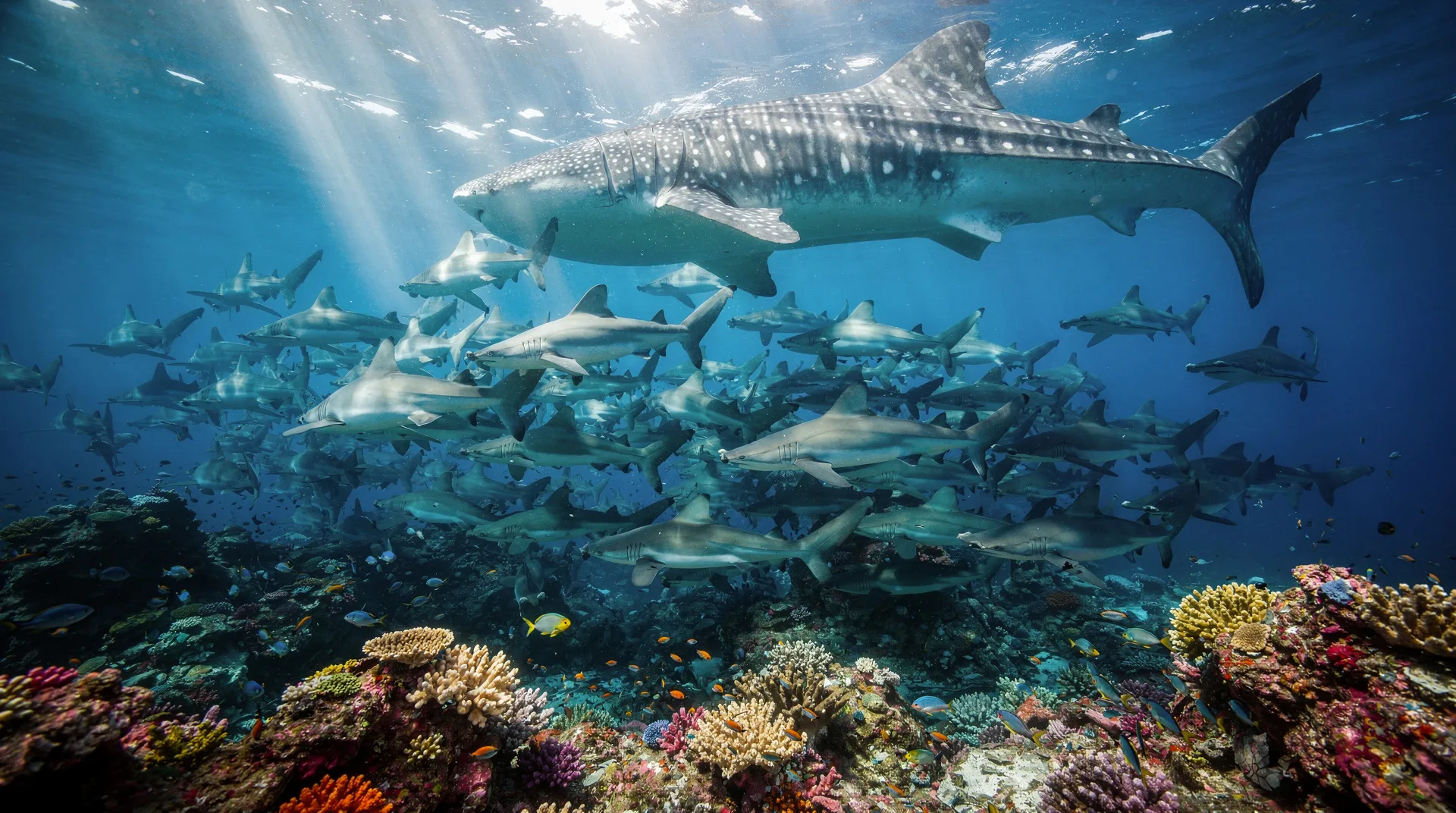
Rhincodon typus — the world’s largest fish — are present in Costa Rican waters, particularly around Cocos Island (June-November) and at oceanic sites off the southern Pacific coast. Unlike the aggregations at Whale Shark feeding sites in Belize, Honduras, or the Philippines, Costa Rica’s whale sharks are individual pelagic animals following the bait fish. Cocos Island offers the most reliable encounters in the eastern Pacific.
Rays
Manta rays
Oceanic manta rays (Mobula birostris, wingspan up to 7 m) are the signature species of Las Catalinas Islands in Guanacaste. From December to May, groups of 3-15 mantas visit cleaning stations on the reef walls, where endemic fish species groom their gill slits. These are large, unhurried animals — their size and grace in the water is one of the most memorable wildlife experiences Costa Rica offers.
For snorkellers, mantas are occasionally visible at the surface in calm conditions. For divers, the cleaning station behaviours at 8-18 m depth are the premier encounter.
Where to see them: Las Catalinas Islands, December-May.
Eagle rays
Spotted eagle rays (Aetobatus narinari) are present year-round at both Caño Island and Las Catalinas. Unlike mantas — which are seasonal — eagle rays are a near-guaranteed sighting on any good dive or snorkel trip at these sites. They travel in pairs and small groups, gliding in formation along reef edges. Wingspan typically 1.5-2 m.
At Cahuita National Park on the Caribbean coast, eagle rays are the most exciting large species encountered by snorkellers — weekly sightings reported by tour operators year-round.
Devil rays
Mobula mobular — smaller than mantas, often aggregating in massive surface schools of hundreds of individuals. Particularly visible at Las Catalinas December-April, where their schooling behaviour near the surface sometimes interrupts boat crossings as the school surfaces en masse.
Stingrays
Yellow stingrays and round stingrays rest in sandy patches at dive sites throughout both coasts. Completely harmless when observed from distance; do not shuffle your feet in sandy shallows.
Sea turtles
Four species of sea turtle nest on Costa Rican beaches and are encountered underwater:
Green sea turtles
The most commonly sighted species while snorkelling or diving. Green turtles feed on seagrass beds and jellyfish in nearshore waters, making them reliable encounters at Caño Island and Cahuita year-round. Nesting season is July-October at Tortuguero on the Caribbean coast — Costa Rica has one of the largest green turtle rookeries in the world.
Hawksbill turtles
Identifiable by their pointed beak, hawksbills feed primarily on sea sponges in reef environments. They are seen in smaller numbers than greens at reef snorkel sites but are present at both Caño Island and Cahuita.
Leatherback turtles
The world’s largest turtle (up to 900 kg) nests at Playa Grande’s Las Baulas Marine National Park (October-February) and at Gandoca on the Caribbean coast. Underwater sightings are rare — leatherbacks are open-ocean animals and dive to extraordinary depths to feed on jellyfish.
Olive ridley turtles
The most numerous turtle globally, olive ridleys congregate in “arribadas” at Playa Ostional in the Nicoya Peninsula — mass nesting events involving thousands of turtles that occur monthly from August to December at each new or waning moon. An extraordinary natural spectacle; combined with underwater encounters possible in Caño Island waters.
Sharks
Hammerhead sharks
Scalloped hammerheads (Sphyrna lewini) are the defining species at Cocos Island, where schools of 50-300 individuals have been photographed in conditions that have made Cocos one of the most famous dive destinations in the world. Hammerheads are also sighted at Bat Islands and occasionally at Las Catalinas during current-driven aggregations.
Bull sharks
Carcharhinus leucas at the Bat Islands — see our dedicated bull shark guide for the full logistics. Occasional bull shark sightings are reported at Las Catalinas’ northern pinnacles, but reliable aggregations are at Bat Islands June-September.
Whitetip reef sharks
The most commonly encountered shark during reef dives. Triaenodon obesus rests under coral overhangs during the day at Caño Island, Las Catalinas, and other rocky reef sites. Completely non-threatening to divers; they typically remain motionless and ignore bubbles. Easily identified by the distinctive white tips on dorsal and tail fins.
Nurse sharks
Ginglymostoma cirratum rest on sandy bottoms in groups at several Guanacaste dive sites. Like whitetips, they are non-aggressive and habituated to diver presence.
Whale sharks, Galapagos sharks, silky sharks
All present at Cocos Island. Galapagos sharks are also encountered at the Bat Islands. Silky sharks school in open water near Cocos in impressive formations.
Bony fish: the big charismatic species
Sailfish
Pacific sailfish (Istiophorus platypterus) are a celebrated sport fishing species off the Guanacaste and Quepos coasts. From December to April, sailfish hunting schools of sardines close to the surface create some of the most dramatic offshore encounters available — the fish surface and slash through bait balls at speed. Sport fishing tours from Tamarindo and Quepos target them.
Mahi-mahi (dorado)
Coryphaena hippurus are present offshore year-round, with peak abundance during green season (May-October). Brilliant yellow-green colouration when fresh, turning grey quickly after catch. A favoured catch-and-release species for sport fishing.
Roosterfish, marlin, wahoo
All present in Pacific offshore waters and targeted by sport fishing operators. Marlin (Pacific blue marlin and striped marlin) peak December-April. Wahoo year-round offshore.
Pacific fish highlights for snorkellers
- Moorish idol: distinctive long dorsal filament, yellow-black-white colouration, common at Caño Island and Las Catalinas
- King angelfish: eastern Pacific endemic, large and conspicuous, seen at cleaning stations
- Panamic sergeant major: everywhere in Pacific reef environments
- Rainbow parrotfish: large males up to 60 cm, electric colouring, seen actively feeding on coral
- Spotted porcupinefish: inflatable, slow-moving, invariably charming
Seasonal marine life calendar
| Species | Peak months | Best location |
|---|---|---|
| Humpback whales (south) | Aug-Oct | Marino Ballena, Uvita |
| Humpback whales (north) | Dec-Mar | Gulf of Dulce, Nicoya |
| Manta rays (oceanic) | Dec-May | Las Catalinas Islands |
| Devil rays (schooling) | Jan-Apr | Las Catalinas Islands |
| Bull sharks | Jun-Sep | Bat Islands |
| Whale sharks | Jun-Nov | Cocos Island |
| Hammerheads (schooling) | Jun-Sep | Cocos Island |
| Green turtle (nesting) | Jul-Oct | Tortuguero |
| Leatherback (nesting) | Oct-Feb | Playa Grande |
| Olive ridley (arribada) | Aug-Dec | Ostional |
| Sailfish | Dec-Apr | Tamarindo, Quepos offshore |
| Eagle rays | Year-round | Caño Island, Cahuita |
Snorkeling vs diving for marine life encounters
Not every species on this list requires a dive certification, and it’s worth being clear-eyed about which is which before planning a trip around marine life. Whale watching, sea turtle encounters at nesting beaches, surface sightings of dolphins and rays, and reef snorkeling at Caño Island or Cahuita are all achievable without any certification — a mask, snorkel, and a boat trip covers a genuinely large share of what makes Costa Rica’s waters special.
The species that require diving specifically are the ones living deeper or further offshore: hammerhead schools at Cocos and the Bat Islands, manta cleaning stations at 8–18m off Las Catalinas, and most whitetip and nurse shark encounters under reef overhangs. If you are not certified and marine life is a priority, Caño Island snorkeling delivers eagle rays, green turtles, and reef fish at a fraction of the cost and logistics of a liveaboard trip — see the snorkel vs dive guide for a fuller comparison of what each approach actually gets you.
Photography and etiquette around marine wildlife
Costa Rica’s marine protected areas enforce genuine no-touch, no-chase rules, and reputable operators brief guests before every trip — but the etiquette matters beyond compliance. Never touch or ride a sea turtle, even a seemingly unbothered one at a cleaning station; the stress response is not always visible to an untrained observer.
Keep a respectful distance from whales (Costa Rican law mandates minimum approach distances, enforced more strictly at Marino Ballena than at some other sites) and let the animal set the pace of any encounter rather than manoeuvring a boat toward it. For underwater photography, avoid flash on reef fish and rays at close range, and never stand on coral to steady a shot — coral growth is measured in centimetres per decade, and a single careless fin kick can undo years of growth.
Planning your marine life trip
The Osa-Uvita combination
Uvita (whale watching at Marino Ballena) + Caño Island snorkeling from the same base = the best single-region marine life concentration accessible without an advanced dive certification. Two days covers both. Uvita guide here.
The Guanacaste dive circuit
Tamarindo/Playas del Coco base → Las Catalinas (day 1) → Papagayo Gulf dives (day 2) → optional Bat Islands (day 3, Advanced OW required). Three dive days cover the main Guanacaste pelagic species.
Tamarindo: discover scuba diving at Catalina Islands — from $135The Cocos Island expedition
If you have the budget, certification, and week-plus available, Cocos Island is the logical endpoint of any serious Costa Rica diving career. No other accessible location in the eastern Pacific comes close for shark species diversity.
Frequently asked questions about Costa Rica’s marine life
What is the single best place to see marine life in Costa Rica?
For non-divers, Caño Island snorkeling. For certified divers, Cocos Island. For whale watching, Uvita’s Marino Ballena National Park in August-October.
Are there dangerous marine animals in Costa Rica?
Bull sharks at Bat Islands are the most powerful species in accessible waters, but incidents involving divers are not documented. The most practical risk for casual beachgoers is stingrays resting in shallow sand — shuffle your feet rather than lifting them when wading in sandy areas. Box jellyfish are rare on Pacific beaches.
Can I see dolphins from the shore?
Occasionally — spinner dolphins sometimes come into coastal bays. However, boat-based tours reliably encounter dolphins in most offshore areas. Any Caño Island day trip will likely pass through spinner or spotted dolphin schools.
When is the best time to see whale sharks in Costa Rica?
June to November at Cocos Island. Whale shark sightings at other Costa Rica locations are opportunistic and unpredictable.
Do Costa Rican waters have coral reefs?
Yes, on both coasts. The Pacific reef at Caño Island Biological Reserve is the most extensive. Caribbean reef at Cahuita National Park is recovering from historical bleaching. Both are marine protected areas with no fishing allowed.
Is it safe to swim in the ocean in Costa Rica?
On Pacific beaches, riptides are the primary hazard — they cause the majority of ocean drownings involving tourists. Always check with locals or beach flags before entering the water. Never swim alone on remote beaches. Caribbean beaches tend to be calmer but still require awareness of current conditions.
Related guides
Our site covers all the major marine life sites in detail. Caño Island snorkeling for the best accessible reef. Cahuita reef for the Caribbean alternative. Las Catalinas diving for ray encounters in Guanacaste. Bat Islands for advanced bull shark diving. And our whale watching guide at Uvita covers the humpback seasons in the most detail.