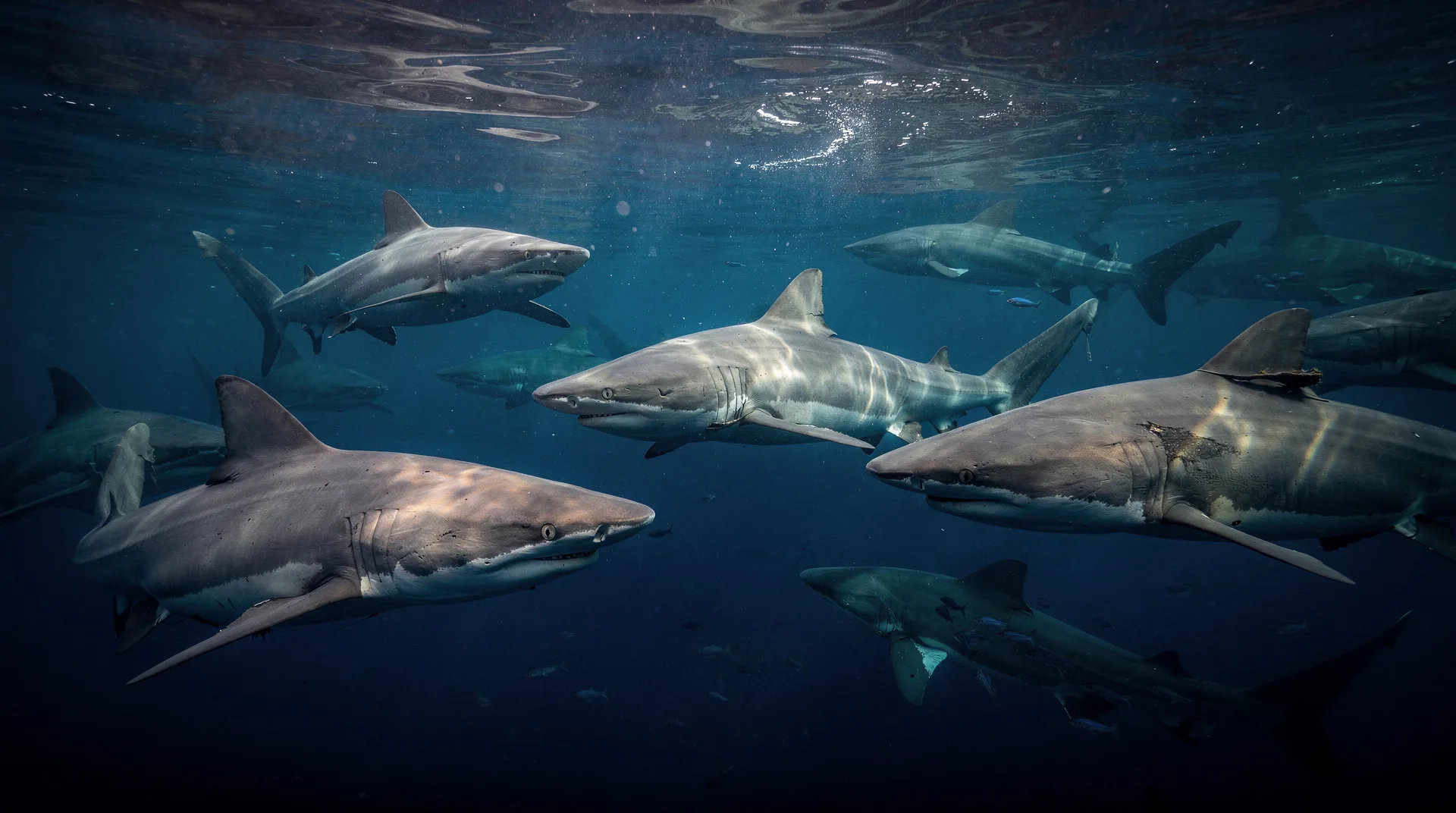
Bat Islands bull shark diving: the definitive guide
Bull sharks at Bat Islands?
Yes — advanced PADI + 30+ logged dives required. Best Jun-Sep when sharks aggregate.
The Bat Islands: Costa Rica’s most serious dive destination
The Bat Islands — Islas Murciélagos in Spanish — sit at the northern tip of Guanacaste province, inside the Santa Rosa National Park marine protected area. They are remote, exposed to open Pacific swells, and not accessible from the main tourist towns of Tamarindo or Coco without a long boat ride. This is deliberate. The difficulty of access has kept these islands relatively uncrowded, and their status inside a national park has protected the ecosystem that draws divers from around the world: a reliable aggregation of Carcharhinus leucas — bull sharks.
If you are looking for a gentle intro-to-diving experience, this is not the right guide. The Bat Islands demand Advanced Open Water certification, a logged dive history, tolerance for strong currents, and a capacity to stay calm in the presence of one of the ocean’s most powerful predators. For those who meet those criteria, a day at Murciélagos is among the most memorable dives in Central America.
This guide covers the sites, the sharks, the season, and the logistics — including honest notes on what you realistically should and shouldn’t expect.
| Where | Isla Murciélagos, Santa Rosa National Park marine zone |
| Cost | around $195-220 per diver, two dives incl. Nitrox, DM, lunch |
| Requirements | Advanced Open Water + 30 logged dives minimum |
| Best time | June-September (peak bull shark aggregation) |
| Getting there | 1.5-2hr boat from Playas del Coco |
Why bull sharks aggregate here
Bull sharks are not specifically attracted to the Bat Islands by feeding or breeding imperatives — they are drawn by the same oceanic mechanics that drive much of Guanacaste’s pelagic life. From June to September, the green season brings strong currents through the Santa Elena Gulf, turbulent upwelling, and the kind of nutrient-rich cold water columns that concentrate fish. Bull sharks follow the bait fish, and divers follow the bull sharks.
The combination of a deep, rocky underwater topography — the sites drop to 30-40 m — with the regular presence of sizable prey creates conditions where bull sharks stay in the area rather than simply passing through. Dive masters at established operators have dived these sites for years and know the feeding windows and likely shark routes better than anyone.
Crucially, there is no feeding or baiting at the Bat Islands. What you see is wild behaviour, not theatre. This also means that encounters are not guaranteed — but during peak season (late June to early September), regular sightings of 5-15 bull sharks per dive are reliably reported by operators like Rich Coast Diving and Ocotal Diving.
The dive sites
The Cathedral
The most dramatic site and the primary bull shark location. A massive submerged rock formation at 20-30 m depth, with walls covered in black coral and cup corals, surrounded by a resident school of thousands of Pacific horse-eye jacks. The jacks circle the Cathedral’s walls in a dizzying tornado formation — and the bull sharks patrol the edges of this school. This is a mid-current dive; buoyancy control and comfort with drift diving are essential.
Punta Gorda
A long rocky point that generates significant current — the kind that allows divers to drift over the reef at 3-4 knots without swimming. Hammerhead sharks are occasionally sighted here, though not reliably. Whitetip reef sharks are common at depth. Bull shark sightings are less frequent than at the Cathedral but still possible.
El Cuartel (The Barracks)
The shallowest of the main sites, at 12-20 m. Suitable as a second dive when divers are managing nitrogen loading after a deep Cathedral dive. Diverse reef fish population, good coral coverage, moray eels, and the occasional eagle ray passing through.
Season and realistic expectations
June to September: peak season
This is the window when bull shark sightings are most reliable. Green season water is productive — visibility drops to 8-15 m compared to 18-25 m in dry season, but the animal activity more than compensates. Water temperature sits at 28-29°C throughout these months.
The dive community’s honest assessment: during peak season, a certified group of 6-8 divers at The Cathedral has roughly an 80-90% chance of seeing bull sharks. Sightings of 5-20 sharks in a single dive are reported several times per week by reputable operators.
October to November
Conditions become unpredictable. Visibility can drop further, and shark aggregations disperse. Some operators suspend Bat Islands trips entirely in October and November due to weather windows and reduced sighting probability.
December to May
Bull sharks are present but not aggregated. The dry season’s Papagayo winds create rough crossing conditions from Playas del Coco (the 2-hour boat ride becomes genuinely uncomfortable). Occasional winter dry-season trips are offered by some operators, but ray-focused diving at Las Catalinas is a better use of a dry-season dive day.
Certification requirements and physical fitness
Every reputable operator at the Bat Islands enforces strict prerequisites:
- Minimum: Advanced Open Water (PADI, SSI, CMAS, or equivalent)
- Minimum: 30 logged dives before the trip
- Nitrox certification strongly recommended (allows extended bottom time at depth)
- Drift diving experience is an advantage — some operators list it as a requirement
- Physical comfort in open water, with some choppiness on the surface
These are not bureaucratic box-ticking requirements. The Cathedral sits at 30 m, currents are real, and the 2-hour boat crossing in green season can be rough. Underprepared divers who misrepresent their experience level create risk for everyone in their group. Operators who check logbooks are being responsible, not pedantic.
For divers who want to do the Bat Islands but don’t yet have 30 dives, spending 3-4 days diving Las Catalinas and Papagayo Gulf sites will get you there while letting you explore other parts of Guanacaste.
Operators and logistics
No dive operator is permanently based on Murciélagos — all trips depart from the mainland. The most common departure point is Playas del Coco, with the boat ride taking 1.5-2 hours depending on sea conditions.
Rich Coast Diving (Playas del Coco) is the most frequently recommended operator for the Bat Islands among the international dive community. They run small groups, enforce the certification requirements, and have long-standing knowledge of the site. Prices: $195-220 per diver including two dives, Nitrox, DM guide, and lunch.
Ocotal Diving also offers periodic Bat Islands trips from El Ocotal. Their small-group policy (max 6-8 divers) makes for a more personal experience. Contact them directly for Bat Islands scheduling, as these trips are weather-dependent and not always listed on booking platforms.
For a discover scuba or introductory diving experience in Papagayo Gulf — if you are not yet Advanced certified but want to start building toward the Bat Islands — these verified options are a solid starting point:
Guanacaste: discover scuba dive day in Papagayo Gulf — from $155 Papagayo Gulf: 2 dives half-day scuba dive tour — from $135The honest assessment: is it worth it?
The Bat Islands require significant investment — in logistics, cost ($195-220 is among the pricier day dives in Costa Rica), and in accumulated dive experience. For advanced divers who have been building toward a bull shark dive, the answer is yes: The Cathedral in peak season is a genuinely wild, adrenaline-charged experience that a feeding dive at an artificial site cannot replicate.
For divers who are simply curious about sharks but don’t yet have the certification or dive count, a better short-term plan is to see the manta rays at Las Catalinas and build experience there. The Catalinas are beginner-certified, beautiful, and impressive enough in their own right.
And if bull sharks are your primary motivation and you want the ultimate experience, read our Cocos Island liveaboard guide — Cocos is the Bat Islands multiplied by ten, with hammerheads, whale sharks, and schooling shark aggregations that have no parallel in the eastern Pacific.
Getting there
From Liberia (LIR) airport, drive to Playas del Coco (45 min). The boat departs early — typically 6:00-6:30am to allow time for the crossing and two dives before weather conditions change in the afternoon. Plan to stay in Playas del Coco or Playa Flamingo the night before.
From Tamarindo, Playas del Coco is about 35-40 minutes by car. An early departure the day before, with a night in Coco, is the most relaxed approach.
Frequently asked questions about Bat Islands bull shark diving
How far out are the Bat Islands?
The Bat Islands are approximately 30 km north of Playas del Coco, which translates to a 1.5-2 hour boat ride depending on sea conditions. In green season (Jun-Sep), the crossing can be choppy.
Is there a risk of shark attack during the dive?
Bull sharks are one of the species involved in unprovoked attacks globally, but these incidents occur in very different conditions from organised dive trips. On a guided dive at The Cathedral, sharks are habituated to diver presence and show no aggression toward bubble-blowing scuba divers. No incidents involving divers have been reported at the Bat Islands by the major operators. Maintain calm, avoid erratic movements, don’t carry shiny accessories, and follow your dive master’s briefing.
Can I do the Bat Islands on a day trip from San José?
Technically possible but not recommended. San José to Playas del Coco is 4-4.5 hours by road. An early departure from San José would get you there in time, but you would need to drive back after two dives — an exhausting day. Staying 2-3 nights in the Coco/Flamingo area and making the Bat Islands the dive-day centrepiece is the better plan.
What visibility should I expect?
During peak season (Jun-Sep), expect 8-15 m. Some days it’s better, some days less. Visibility is not the point of this dive — the shark encounters are. In dry season (Jan-Apr) when bulls are absent, visibility improves to 18-25 m, but the headline species aren’t reliably there.
Do operators cancel trips for weather?
Yes. The Bat Islands are exposed to open Pacific conditions, and responsible operators cancel when seas are unsafe. Most have a weather-check policy and will offer a refund or rebooking if conditions aren’t safe. Book with an operator that has this policy explicitly stated.
Is Nitrox necessary?
Not mandatory, but strongly recommended. The Cathedral sits at 25-30 m; without Nitrox, bottom time is limited to 20-25 minutes. With Nitrox (32% or 36%), you can extend comfortably to 35-40 minutes — which makes a significant difference when you are watching a shark cruising below.
What to expect on the boat and between dives
Departures are early — most operators leave the dock at Playas del Coco between 6:00 and 6:30am to maximise calm-water crossing time and fit two dives before afternoon wind picks up. The boat ride itself (1.5-2 hours each way) is part of the day: bring motion-sickness prevention if you’re prone to it, since a 4-hour round trip on open Pacific swell is a real factor for some divers.
Between the two dives, operators typically anchor in a sheltered cove for a surface interval of 60-90 minutes, serving a simple lunch (sandwiches, fruit, water) while briefing the second site. Full gear rental (BCD, regulator, wetsuit) is usually available for an additional $25-40 if you’re not travelling with your own kit, though experienced divers generally prefer their own regulator for a dive of this seriousness.
Related guides
If the Bat Islands have sold you on dedicated shark diving, our Cocos Island liveaboard guide covers the pinnacle of Costa Rica shark diving — hammerheads, whale sharks, and Galapagos sharks in numbers that have made Cocos internationally famous. For a more accessible first dive experience in Guanacaste, Las Catalinas offers manta rays and eagle rays for Open Water certified divers. Our marine life guide lists all the species you might encounter across Costa Rica’s Pacific coast, and the snorkel vs dive comparison helps travellers on the fence decide which format suits them best.