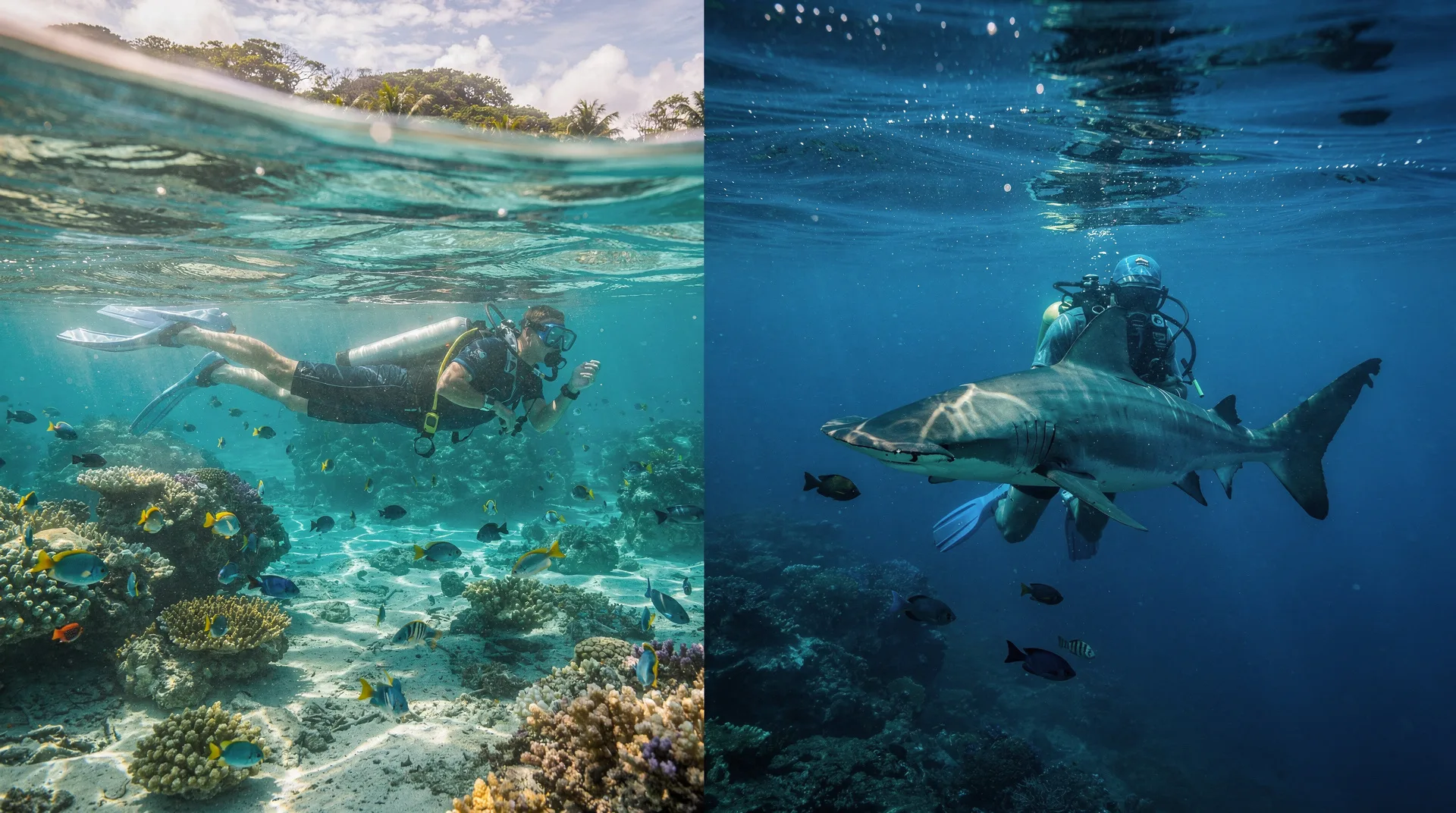
Snorkel or scuba dive in Costa Rica: which is right for you?
Snorkel or dive — best CR sites for each?
Snorkel: Caño Island, Cahuita reef. Dive: Catalinas, Cocos, Bat Islands.
Costa Rica’s underwater world spans a gentle Caribbean reef snorkel to a liveaboard hammerhead expedition — the right call depends on your certification, budget, and what you actually want to see.
| Best snorkel | Caño Island (Pacific), Cahuita (Caribbean) |
| Best dive | Catalinas Islands, Bat Islands, Cocos Island |
| Certification needed | None for snorkel; Open Water minimum for most dives |
| Best season | Dec–Apr (Pacific visibility), Sep–Oct (Caribbean) |
| Budget range | $55 snorkel day trip to $6,000 Cocos liveaboard |
Making the call: two very different water experiences
Costa Rica’s reputation as a diving destination has grown steadily over the past two decades, and for good reason. The country sits at a biological crossroads where Pacific currents, upwelling systems, and a series of protected marine areas combine to produce underwater environments of unusual richness. But “underwater Costa Rica” is not a single experience — it is a spectrum that ranges from a gentle snorkel in knee-deep Caribbean reef to a 30-metre drift dive with 200 schooling hammerheads at Cocos Island.
The question of whether to snorkel or dive is more nuanced than it sounds. It depends on your certification status, your budget, where you are geographically in Costa Rica, what time of year you’re visiting, and crucially — what you want to see.
This guide breaks down every major underwater site in Costa Rica and helps you decide which format — and which location — is the right match.
The snorkeling case: why non-divers see a lot
The misconception that snorkelling is the “lesser” water activity needs addressing first. At Costa Rica’s best snorkel sites, the marine life encountered from the surface is extraordinary — sea turtles, eagle rays, reef sharks, and dolphins are all visible without a tank.
The key factors in a good snorkel experience are water clarity and shallow reef depth. When both are present, snorkellers see 80-90% of what divers see. When one is absent — poor visibility, or a reef that only starts at 15 m — the experience suffers.
Snorkeling site 1: Caño Island
The best snorkeling site in Costa Rica, by most measures. The reef sits at 1-18 m depth; the top 6 m is accessible to any confident swimmer. Visibility in dry season (December-April) reaches 15-25 m. The species list includes white-tipped reef sharks (resting under coral ledges in 4-6 m), green sea turtles year-round, eagle rays gliding along the reef edge, and more parrotfish, king angelfish, and moorish idols than you’ll know what to do with.
Day trips depart from Drake Bay (45 min crossing) and Uvita (75 min crossing). Price: $135-145 per person.
Caño Island Biological Reserve - snorkeling or diving — from $140Snorkeling site 2: Cahuita National Park
Costa Rica’s main Caribbean snorkel site. The reef is shallower — 1-6 m — and the coral is recovering from bleaching damage, but the fish population is impressive and the setting inside a national park is beautiful. The experience is different from Caño Island (Caribbean rather than Pacific species), cheaper ($55-85), and easier to access for those already on the Caribbean coast.
Snorkel in Cahuita National Park: explore the reef — from $60Snorkeling site 3: Las Catalinas Islands (non-diving)
Organised snorkel tours to Las Catalinas in Guanacaste target the island’s shallower coves. You won’t access the deeper sites where divers encounter mantas, but eagle rays are sighted regularly in the top 5-8 m, and the coral gardens at El Jardín offer excellent reef fish variety. An accessible and reasonably priced option for Guanacaste-based visitors.
Flamingo & Tamarindo: snorkeling at Las Catalinas Islands — from $95Snorkeling site 4: Manuel Antonio coast and Isla Damas
Less famous than Caño Island or Cahuita, but the channels around Isla Damas near Quepos offer mangrove snorkeling with sea horses, pipefish, and juvenile fish species not seen on open reefs. Suitable for families and those wanting something gentler. Not a reef snorkel — a mangrove snorkel. Different ecosystem, different species list.
The diving case: what you access with a tank
Scuba diving unlocks the pelagic zone — the open water column beyond the reef edge where big animals travel. Below 15 m, thermoclines shift, visibility changes, and the species that define Costa Rica’s international dive reputation appear in earnest.
Diving site 1: Las Catalinas Islands
The top accessible dive destination in Guanacaste. Open Water certified divers can access La Pared Wall (5-25 m) and El Jardín (8-16 m). The headline marine life — manta rays, eagle rays, devil rays — peaks December through May, driven by nutrient upwelling and the Papagayo wind system. Day trips depart from Tamarindo, Playas del Coco, and Playa Flamingo.
Full guide: Catalinas Islands diving
Diving site 2: Bat Islands (Isla Murciélagos)
Advanced Open Water required, 30+ logged dives, 2-hour boat crossing from Playas del Coco. The reward is The Cathedral site — a submerged pinnacle surrounded by jack tornadoes and patrolled by bull sharks in aggregations of 5-20 during peak season (June-September). Not for the unprepared, but unforgettable for experienced divers.
Full guide: Bat Islands bull shark diving
Diving site 3: Caño Island (dive option)
The same boats that carry snorkellers also carry certified divers to deeper sites. Scuba divers access reef sections at 15-25 m with better eagle ray encounters, cleaner visibility of the deep coral structures, and occasional encounters with whitetip reef sharks that the surface snorkellers rarely see. If you are certified and visiting Caño Island, dive rather than snorkel.
Diving site 4: Cocos Island
The apex of Costa Rica diving — and of eastern Pacific diving globally. A 10-day liveaboard from Puntarenas costing $4,000-6,000. Hammerhead sharks in schools of 100-300, whale sharks, Galapagos sharks, and silky sharks in one of the ocean’s most productive pelagic zones. Not a day trip, not a casual experience — a dedicated dive expedition.
Full guide: Cocos Island liveaboards
Diving site 5: Papagayo Gulf sites
The Gulf of Papagayo offers multiple dive sites accessible from Playas del Coco and the Papagayo Peninsula. Less dramatic than Catalinas or Bat Islands, but good for divers who want to log dives in warm, accessible conditions. Visibility 10-18 m year-round. Good for Open Water divers building experience.
Papagayo Gulf: 2 dives half-day scuba dive tour — from $135Comparison table: Costa Rica’s main underwater sites
| Site | Format | Cert needed | Price | Best season | Top species |
|---|---|---|---|---|---|
| Caño Island | Snorkel or dive | None (snorkel) / OW (dive) | $135-145 | Dec-Apr | Turtles, eagle rays, reef sharks |
| Cahuita NP | Snorkel | None | $55-85 | Sep-Oct | Parrotfish, brain coral, eagle rays |
| Catalinas | Dive (or snorkel) | OW (dive) | $135-155 | Dec-May | Manta rays, eagle rays, devil rays |
| Bat Islands | Dive | AOW + 30 dives | $195-220 | Jun-Sep | Bull sharks, jacks, hammerheads |
| Papagayo | Dive | OW or try-dive | $135-155 | Year-round | Reef fish, rays, small sharks |
| Cocos Island | Dive (liveaboard) | AOW + 100 dives | $4,000-6,000 | Jun-Nov | Hammerheads, whale sharks, mantas |
| Manzanillo | Snorkel | None | $65-95 | Sep-Oct | Caribbean reef, sea fans |
Budget and geography: the practical guide to choosing
If you are in Guanacaste (Tamarindo, Coco, Flamingo)
Snorkel: Las Catalinas Islands boat tour — $95, eagle rays, 5 hours. Dive: Las Catalinas dive trip — $135-155, manta rays (Dec-May), Open Water required. Advanced dive: Bat Islands — $195-220, bull sharks, Advanced OW + 30 dives required.
If you are in the Osa Peninsula / Uvita area
Snorkel: Caño Island is the obvious choice — world-class, $135-145. Dive: Caño Island dive extension — same boat, deeper sites. Add-on: Whale watching at Marino Ballena pairs naturally with a Uvita base.
If you are on the Caribbean coast
Snorkel: Cahuita National Park reef — affordable, accessible, good fish population, $55-85. Second option: Manzanillo reef — slightly better coral, combo tours available. Dive: No significant scuba dive infrastructure on the Caribbean coast compared to the Pacific.
If you have a dedicated dive budget and a week
Open Water: Las Catalinas (2 days) + Papagayo (1 day) = full Guanacaste dive experience. Advanced: Las Catalinas (1 day) + Bat Islands (1 day) + Caño Island (1 day from Uvita) = the Pacific dive circuit. Expedition: Budget the full trip for a Cocos Island liveaboard.
Is try-diving (discover scuba) worth it?
Discover scuba — a supervised introductory dive without prior certification — is offered at most Guanacaste operators. The experience takes you to 12 m maximum with a dive master holding your arm. For first-timers, it is excellent: you get genuine underwater time at a fraction of the certification process.
However, if you plan to dive more than once in your life, getting Open Water certified before the trip is a far better investment. PADI Open Water can be completed in 4 days in San José, Tamarindo, or Jacó. Once certified, every dive site in this guide (except Bat Islands and Cocos) is open to you. Try-dive is a gateway; certification is a key.
Getting certified in Costa Rica if you’re not already
If the comparison above has you leaning toward diving, note that certification does not need to happen before you arrive. PADI Open Water courses run 4 days in Tamarindo, Jacó, and Playas del Coco, combining pool sessions, classroom theory, and open-water dives — often at Catalinas or Papagayo sites, so your certification dives double as sightseeing. Cost is typically $450–550, less than many home-country equivalents. Building 3–4 unhurried days into your itinerary for this is worth it if you plan to dive more than once — try-dives are memorable but limited to 12m depth with a dive master holding your arm the whole time.
Papagayo discover scuba diving experience — from $155Frequently asked questions about snorkeling and diving in Costa Rica
Which is better value: snorkeling or diving in Costa Rica?
For non-certified travellers, snorkelling at Caño Island or Cahuita offers genuine marine life encounters at a fraction of the dive trip cost. For certified divers, the manta ray experience at Las Catalinas or the bull shark encounter at Bat Islands is only available underwater. Value depends entirely on what you want to see.
Can children snorkel at Caño Island?
Yes, from approximately age 8 upward, for confident swimmers. Operators have children’s equipment. The trip itself (75 min from Uvita) requires children to be comfortable on a boat.
Do I need reef-safe sunscreen for all sites?
Yes. All marine protected areas in Costa Rica — Caño Island Biological Reserve, Cahuita National Park, Marino Ballena — prohibit conventional sunscreen. Bring certified reef-safe versions (zinc oxide or titanium dioxide based), or wear a full rash guard instead.
When is the best overall month for underwater Costa Rica?
December-April for the Pacific coast (Caño Island, Catalinas — calm seas and good visibility). September-October for the Caribbean (Cahuita — the relative dry season on that coast).
Are there dive schools in San José?
Yes, but it’s not the most practical place to complete a course. Dive schools in Tamarindo, Jacó, and Playas del Coco are closer to the actual dive sites. Budget 4-5 days for Open Water certification including pool and open-water sessions.
Related guides
Each site mentioned in this comparison has its own detailed guide on this site. Caño Island covers the Osa’s best reef from both departure points. Cahuita reef gives the honest picture of the Caribbean’s main snorkel site including the bleaching history. Las Catalinas details the Guanacaste dive experience including operators and seasonal ray windows. And our marine life guide is the master species reference for both coasts.