Cocos Island liveaboards: everything you need to know
How to dive Cocos Island?
36-hour boat from Puntarenas; multi-day liveaboard only ($4-6k for 10-day trip).
The island that rewrites what diving means
Cocos Island — Isla del Coco — sits 550 km southwest of Costa Rica’s mainland, a volcanic speck in the middle of open Pacific. It has no permanent human population, no hotels, no restaurants, and no infrastructure beyond a small Costa Rican park ranger station. The only way to reach it is by a 36-hour ocean crossing from Puntarenas. And yet, among the global dive community, Cocos Island carries a reputation that few places on earth can match.
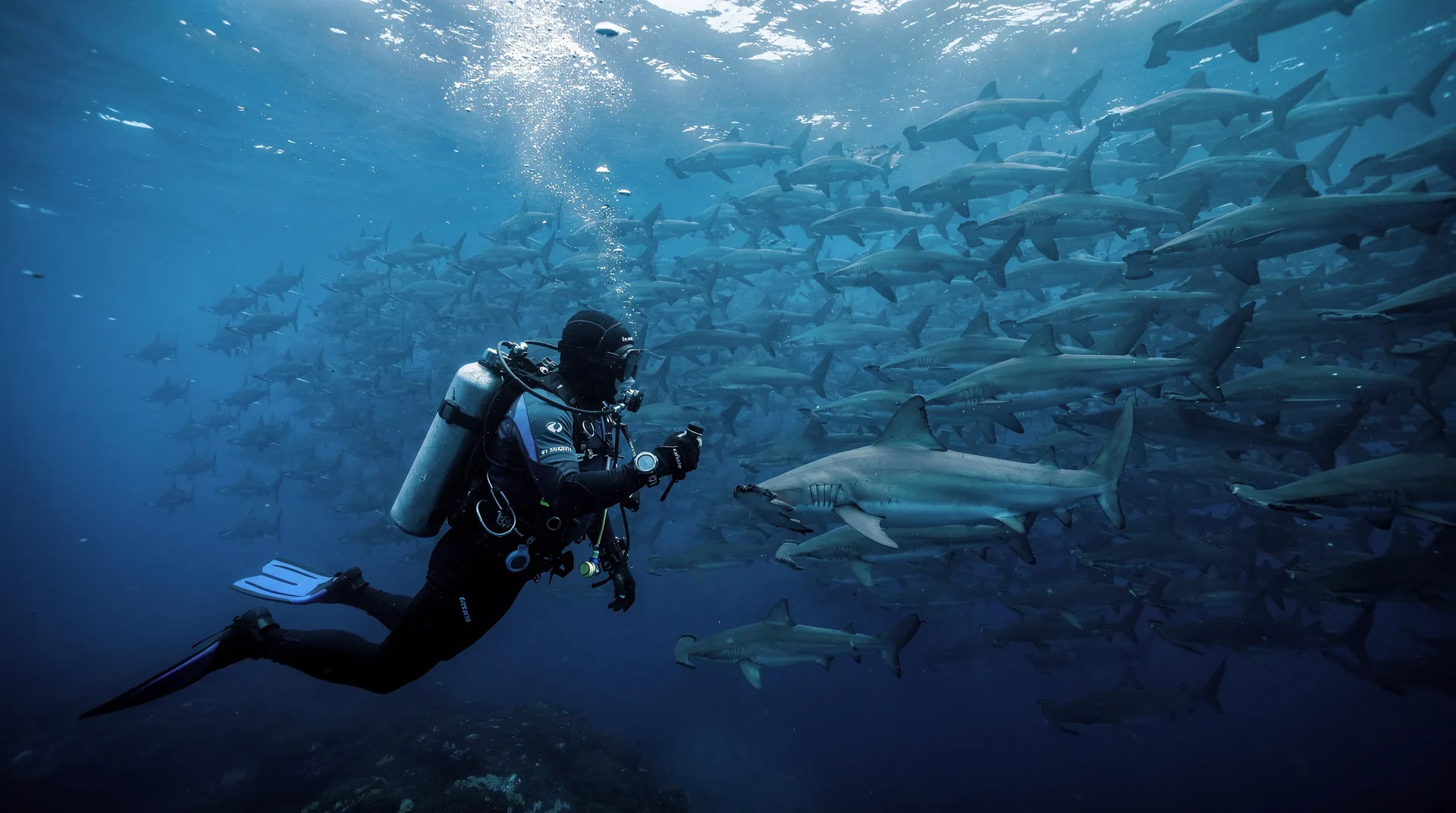
Jacques Cousteau called it “the most beautiful island in the world.” More practically, it was listed by the World Wildlife Fund as one of the Top 10 dive destinations on the planet. The reason is simple and spectacular: the underwater world at Cocos is dominated by schooling pelagics — hammerhead sharks in aggregations of 100-300 individuals, whale sharks, silky sharks, Galapagos sharks, bottlenose dolphins, manta rays, and the occasional tiger shark — all co-existing in the same dive, in the same current stream, in numbers that have no parallel in the eastern Pacific.
This guide is for serious divers who are ready to plan the trip. It covers costs, operators, seasonality, certification requirements, and what to realistically expect.
The honest cost conversation
Cocos Island is not affordable diving. A 10-day liveaboard trip — which is the standard format — costs $4,000-6,000 per person, including the liveaboard berth, all meals, tanks, weights, and guided diving (typically 4 dives per day). Flights to San José are additional.
Here is why it costs what it costs:
- The 36-hour ocean crossing each way requires a large, seaworthy vessel with significant fuel consumption
- Costa Rica’s SINAC charges a park entrance fee for all liveaboard guests ($100+ per diver as of 2026)
- The best vessels carry 18-22 passengers with a dive crew of 6-10 — economics do not allow budget pricing
- Permits for operators at Cocos are limited and expensive
A 6-day trip (less popular, offered by some operators) costs proportionally less — approximately $2,800-3,500 — but the lost travel time means fewer dives relative to the crossing cost. Most Cocos veterans strongly recommend the 10-day format.
The crossing: Puntarenas to Cocos Island
Puntarenas, on Costa Rica’s central Pacific coast (2 hours west of San José), is the departure point for all liveaboard operations. The crossing takes 32-38 hours depending on vessel speed and sea conditions.
The crossing itself is an experience. Open Pacific swells in the first 12-18 hours can be rough — take seasickness precautions seriously. The final approach to Cocos brings first views of the island’s cliffs and waterfalls, a genuinely dramatic arrival. By the time you anchor and make your first dive, the crossing already feels worth it.
What you’ll dive
Manuelita
The most iconic site. An underwater pinnacle 8-15 m below the surface, swept by currents that aggregate schooling fish — and the hammerheads that follow them. Scalloped hammerheads (Sphyrna lewini) circle Manuelita in groups of 40-100+ during morning dives. These are not individual sharks — they are coordinated schools behaving like a single organism.
Dirty Rock (Roca Sucia)
Arguably the best single dive site in the eastern Pacific. A series of submerged pinnacles at 10-40 m, swept by upwelling currents that concentrate nutrients. Whale sharks patrol the blue water edge. Silky sharks at mid-depth. Bottlenose dolphins investigating the pinnacles. Mantas at cleaning stations. A single dive at Dirty Rock can include encounters with 6-8 species simultaneously.
Alcyone
Named after the Cousteau Society vessel that conducted research here for years. A sloped wall and current channel that produce the island’s best hammerhead concentrations — some divers report 300+ individual hammerheads visible simultaneously. Requires bottom time at 25-35 m; Nitrox is essential.
Submerged Bank and Viking Rock
Additional sites for the experienced diver seeking variety. Galapagos sharks are more common at Viking Rock than elsewhere at Cocos. Occasional tiger shark sightings are reported but not reliable.
Certification and experience requirements
All operators at Cocos Island impose strict prerequisites:
- Minimum: Advanced Open Water (PADI, SSI, NAUI, or equivalent)
- Minimum: 100 logged dives (some operators require 200+)
- Nitrox certification: mandatory or strongly required — bottom time at Cocos without Nitrox is significantly shorter
- Strong buoyancy control: essential in currents and near seamounts where crash-landing on coral is a serious concern
- Drift diving experience: the main sites are current-driven; passive drift technique is required
This is genuine expert territory. Unlike the Bat Islands, where 30 dives gets you through the door, Cocos Island demands accumulated experience. Operators who accept less than 100 dives are cutting corners. The best vessels attract dedicated, experienced divers — the quality of your diving companions matters at a site where the dive briefing is as complex as a mountain rescue plan.
Top liveaboard operators
Undersea Hunter Group (MV Argo and MV Sea Hunter)
The gold standard for Cocos Island operations. Undersea Hunter has operated at Cocos for over 30 years, pioneering the current dive protocols and contributing to scientific research on shark behaviour. The Argo carries 18 divers, the Sea Hunter 22. Nitrox included. Rebreather access available. Price: $5,200-6,000 per person for 10 days.
Okeanos Aggressor
Part of the international Aggressor Fleet, with vessels operating at Cocos year-round. Slightly more affordable than Undersea Hunter — $4,000-5,000 for 10 days. Good safety record, comfortable cabins, strong dive crew.
Nautilus Belle Amie and Spirit
The Nautilus fleet divides its time between Cocos Island and Socorro (Mexico’s Revillagigedo Islands). If you are planning a Pacific pelagic diving trip, combining Cocos with Socorro on a Nautilus voyage is the ultimate expedition.
Best season for Cocos Island
Unlike Guanacaste diving, Cocos Island is year-round diving — the island’s remote location means it doesn’t follow the same coastal seasonality.
June to November is considered the peak season for shark aggregations. Hammerhead schools are at their densest, whale shark encounters are more frequent (particularly August-October), and manta ray numbers peak. Water temperature at surface: 27-29°C. At depth (30 m+): 20-24°C. Thermoclines are more dramatic.
December to May still offers excellent diving — hammerheads are present year-round. Visibility is slightly better (15-25 m vs 10-18 m in green season). The crossing can be rougher in Papagayo wind season (December-March).
The honest assessment from long-time Cocos operators: any month at Cocos is extraordinary. The question is which species you prioritise. Whale shark encounters are best June-September; hammerhead schooling is reliable year-round but peaks in the same window.
Booking and planning timeline
- Book 3-6 months ahead: Popular departures (especially peak June-October) fill months in advance. Serious divers book a year out for the best vessels.
- Puntarenas logistics: Fly into San José (SJO), not Liberia. The drive from SJO to Puntarenas is 2 hours. Most operators organise a group transfer on departure day.
- Gear: The vessels have tanks, weights, BCDs (rental available), and wetsuit rentals. Serious divers bring personal BCDs and regulators. Underwater camera housing rigs are welcome.
- Seasickness: Do not underestimate the crossing. Scopolamine patches (prescribed in some countries) and ginger-based remedies are the most effective interventions. Book a sea-facing cabin and eat light on crossing day.
Cocos Island vs other Costa Rica diving
It is worth being direct about this comparison. If you are a certified diver visiting Costa Rica for a week and considering whether to spend a day at Las Catalinas, a day at Bat Islands, or your entire budget on a Cocos liveaboard — these are fundamentally different experiences.
For most visitors, the Las Catalinas day dive is the right choice: accessible, affordable ($135-155), excellent for manta and eagle rays, and fits into a week-long trip. The Bat Islands is a step up in experience and cost but still a day trip.
Cocos Island is an expedition. It consumes the entire trip budget, requires serious dive experience, and demands commitment. The reward is proportional: it is simply the greatest shark diving experience in the eastern Pacific.
For the trip that combines land and sea exploration — including accessible snorkeling at Caño Island from nearby Uvita:
Papagayo Gulf: 2 dives half-day scuba dive tour — from $135Building a wider Costa Rica trip around the crossing
A Cocos liveaboard fills the middle of a trip, but the days before departure and after return are worth planning on purpose. Arriving a day early takes pressure off the departure, and it lets you sort out airport transfers or a shuttle to Puntarenas without a tight connection. Check visa and entry requirements well ahead, and read our notes on travel insurance before you book: a remote expedition is exactly the kind of trip where dive-specific cover matters.
If your dive partner or family would rather stay above water, the south Pacific has plenty to fill the time. The Drake Bay area pairs naturally with a marine-focused holiday, and Corcovado National Park is the obvious wildlife add-on. For a relaxed morning in the water without tanks, a guided snorkelling outing around Caño Island is a good fit, and you can book a snorkelling trip to the waters around Caño Island — from $140 for the non-divers in your group. Our guide to the best snorkel beaches covers easier options closer to shore.
Timing a whale-watching add-on is simple if you read the Uvita whale watching season and the Marino Ballena National Park guides alongside this one. Whatever you choose, follow the principles in our wildlife watching ethics guide, in the water and on land.
A few practical notes round things out. Our packing list helps with the non-dive items, money and currency explains how to handle cash before you leave the mainland, and the best time to visit Costa Rica guide helps you choose the land portion of your trip. For general reassurance, see safety in Costa Rica.
Frequently asked questions about Cocos Island liveaboards
Can I visit Cocos Island without diving?
No. There is no day-trip service, no ferry, and no accommodation on the island. The ranger station does not host tourists. A liveaboard diving trip is the only way to visit. Non-divers are sometimes permitted on certain vessels as snorkellers, but this is rare and expensive.
Is Cocos Island in Costa Rica or is it international territory?
It is Costa Rican sovereign territory — an Insular Territory administered directly by the central government. It became a UNESCO World Heritage Site in 1997. Costa Rican park rangers maintain a permanent station there.
How long does the liveaboard trip take total?
A 10-day Cocos Island trip typically involves 2 days of crossing each way plus 6 days of diving at the island — roughly 16 dives. You board the vessel in Puntarenas on day 1, arrive at Cocos on day 3, dive for 6 days, and return by day 10.
What is the best cabin class to book?
For the crossing comfort, a superior cabin (private bathroom, larger bunk, lower position in the hull) is worth paying extra for. Motion during the crossing is significant; the lower you are in the vessel, the less you feel the swell.
Are there whale sharks at Cocos?
Yes. Cocos Island is one of the most reliable whale shark sighting locations in the Pacific, particularly June to November. These are the open-ocean form of whale sharks — larger on average (8-12 m) than the aggregations seen at feeding sites like Ningaloo Reef in Australia. You are likely to see one on a 10-day trip during peak season.
Is the cost negotiable or are there budget options?
Not meaningfully. The operating costs at Cocos are what they are. The cheapest legitimate operators (Okeanos Aggressor) are around $4,000 for 10 days — any operation offering significantly lower prices should be researched carefully for safety record and permit legitimacy.
Is Cocos Island right for you? A quick self-check
Before committing $4,000-6,000 and 10 days, be honest about where you actually stand against the prerequisites. If you have fewer than 100 logged dives, are not Nitrox certified, or have limited drift-diving experience, the responsible move is to build experience at accessible sites first — Las Catalinas for ray encounters or Bat Islands for a taste of bigger pelagic action — rather than booking Cocos and hoping the operator waves you through.
Divers who genuinely meet the prerequisites and can tolerate a rough 36-hour crossing each way describe Cocos as the best diving of their life without qualification; it is a poor fit for anyone treating it as a bucket-list checkbox rather than an expedition matched to their actual experience level.
Related guides
For divers building toward a Cocos trip, Bat Islands is the logical preceding step — advanced certification required, genuine shark encounters, day trip format. The Las Catalinas diving guide covers Guanacaste’s best accessible dive site for Open Water certified divers. Our marine life guide covers every species you might see across all Costa Rica dive destinations, and the snorkel vs dive comparison is the starting point for travellers who haven’t yet decided on format.