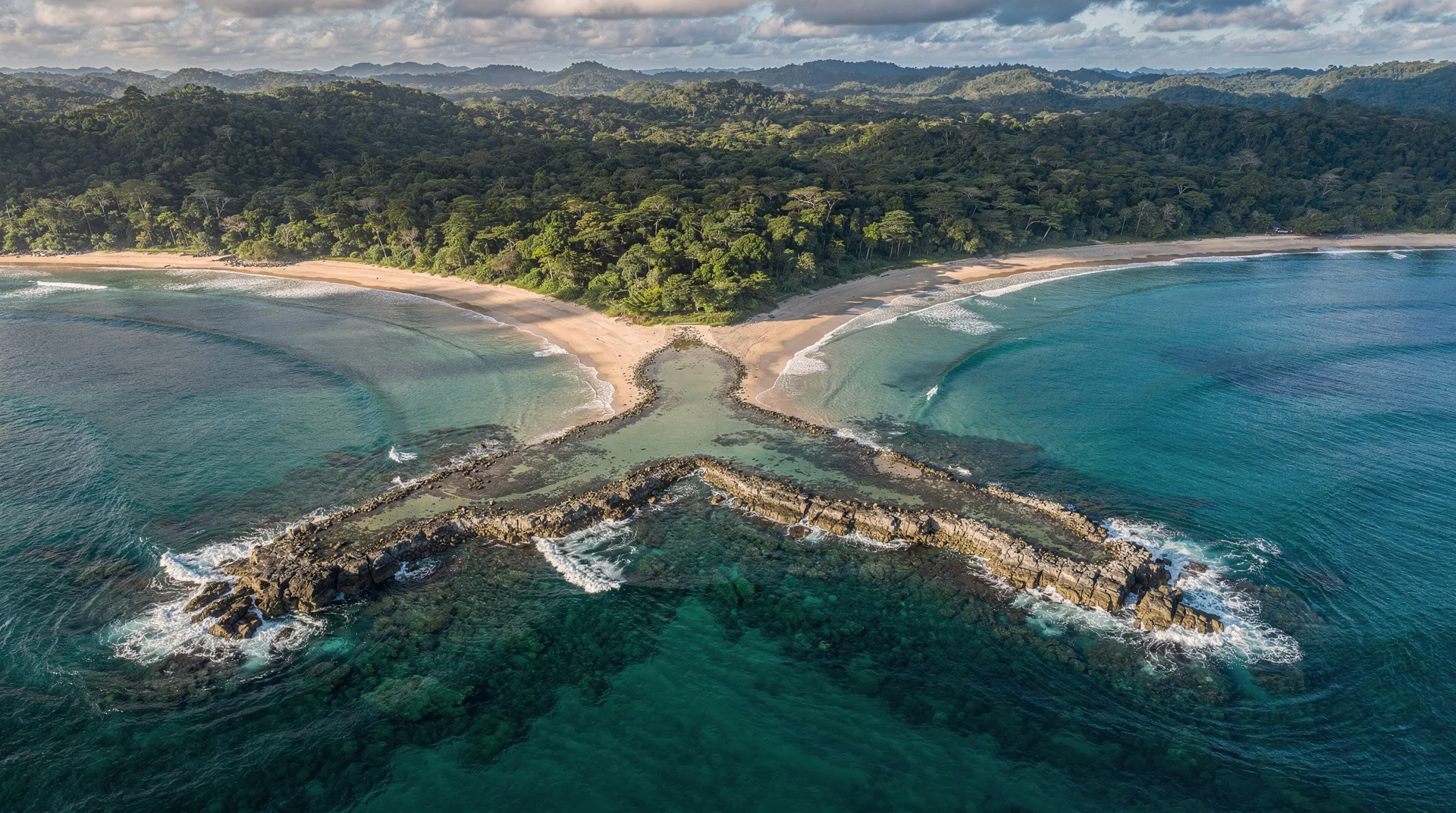
Marino Ballena National Park: humpback whales, the whale tail, and Uvita's marine wonder
Why visit Marino Ballena National Park?
Marino Ballena is Costa Rica's first marine national park and one of only a handful of places in the world with two annual humpback whale seasons — August to October (southern hemisphere whales) and December to March (northern hemisphere whales). It also features the famous Punta Uvita whale tail sandbar, visible only at low tide, and excellent year-round dolphin sightings.
Costa Rica’s first marine park and its extraordinary whale calendar
Established in 1990, Marino Ballena National Park was Costa Rica’s first marine protected area. The park covers 5,375 hectares of ocean and 110 hectares of land along a stretch of southern Pacific coastline between Uvita and Bahía Ballena — a series of coves, beaches, and rocky headlands that form one of the most scenic coastal zones in the country.
The name “Ballena” means whale, and humpback whales are the park’s signature attraction. What makes Marino Ballena biologically extraordinary is that it receives two separate humpback whale populations each year — one migrating from Antarctica (arriving August to October) and one from northern Pacific waters (arriving December to March). The result is one of the longest humpback whale seasons anywhere on Earth, with whales potentially present in the park for 8 to 9 months per year.
The park also holds resident pods of bottlenose dolphins, spinner dolphins, and pantropical spotted dolphins that are reliably encountered year-round. Sea turtles nest on the beaches from July to November. Humpback whales breed, calve, and nurse young in these warm protected waters.
| Where | Uvita, southern Pacific coast (Costanera Sur) |
| Land entry | ~$6/person, 7am-5pm daily |
| Boat tour | ~$50-70/person, 3-3.5 hours |
| Whale seasons | Aug-Oct (southern) and Dec-Mar (northern) |
| Getting there | 3.5-4hrs from San José by car or shuttle |
The whale tail sandbar: Punta Uvita
The iconic feature of Marino Ballena — visible in every drone photograph of Uvita — is the whale tail sandbar at Punta Uvita. At low tide, a tombolo (sand bridge) connects the main beach to an offshore point, and the sand formation curves into a shape that resembles, unmistakably, a humpback whale’s tail fluke. The symmetry is remarkable enough that it appears to have been designed.
The whale tail is only visible at low tide — and completely submerged at high tide. Before visiting, check the tide tables (the MINAE office in Uvita and most hotels can provide them, or use a free tide chart app for Uvita/Bahía Ballena). The best photographs are taken from the air or from the hillsides behind the beach.
Walking to the tip of the tail at low tide and looking back at the shore gives a perspective that feels genuinely remote — with the Pacific on three sides and the Southern Pacific rainforest visible on the hills. Sea turtles occasionally rest in the tidal pools near the tip. Octopuses and moray eels inhabit the rocky edges.
Visiting the whale tail: Walk from the main Uvita beach parking area south along the beach until you reach the tombolo. The full walk from the parking area to the tip takes about 15 to 20 minutes at low tide. Entry fee for the beach section: $6 per person.
Timing the walk is the whole trick. Our tide and surf conditions guide explains how to read a tide table, and the beach safety guide covers currents and what to watch for when you are standing on a sandbar that the sea will soon reclaim. Give yourself a comfortable margin on the way back rather than staying until the last minute.
Marino Ballena: whale watching in Uvita — from $80Humpback whale watching: the two seasons
Southern hemisphere population (August to October): These whales migrate from their Antarctic feeding grounds to breed and calve in the warm tropical waters of Costa Rica’s Pacific coast. The peak months are September and October. This is the larger and more reliable of the two seasons — whale sightings are almost guaranteed during September. The whales are actively breeding, which means you are likely to observe competitive behaviour between males, breaching, fin slapping, and the spectacular sight of a 40-tonne animal launching completely clear of the water.
Northern hemisphere population (December to March): A separate population of North Pacific humpbacks arrives from waters off Mexico and California. The December to March season is slightly less reliable than the southern season in terms of raw numbers, but whale behaviour during this period includes mothers with calves — a more intimate sighting experience.
Dolphin season: Bottlenose and spinner dolphins are present year-round and are encountered on virtually every whale watching boat trip regardless of season.
All whale watching is conducted by licensed boat operators from Uvita beach or the Bahía Ballena area. Trips last approximately 3 to 3.5 hours. Regulations require boats to maintain minimum distances from whales — legitimate operators follow these strictly. The marine mammal laws are enforced.
If you want to understand what you are seeing, our marine life guide puts the humpbacks and dolphins in context alongside the rest of the Pacific coast. For how to behave around the animals, and how to judge an operator by the way it approaches them, read the wildlife watching ethics guide before you book.
Uvita: whale watching tour in Marino Ballena — from $80Entry fees and park rules
Land section (whale tail beach, Uvita): $6 per person.
Marine zone entry: The park entrance fee for the marine zone is typically included in the boat tour fee, which is charged by operators and remitted to SINAC.
Opening hours: The land section is accessible daily from 7am to 5pm. Boat tours operate year-round — operators run morning and afternoon departures.
Rules:
- No littering on the beach or in the marine zone
- No drone flights without a permit
- Swimming near whale watching boats while whales are present is prohibited
- Collecting shells, coral, or marine life is illegal in the park
Snorkelling in Marino Ballena
The rocky headlands within the park protect several snorkelling sites where the underwater diversity is genuine:
La Viuda rock formation: Offshore rocks near Punta Uvita support significant coral coverage and fish diversity. This is the most popular snorkel site, typically included in boat tours. Visibility varies with rainfall and season — January to April is best.
Ballena Island (Isla Ballena): A small offshore island within the park boundary accessible by boat. Rocky substrate with sea fans, coral, and dense fish populations. Sea turtles are frequently seen underwater here.
Near the whale tail: The shallow tidal pools and rocky edges at low tide support crabs, urchins, starfish, and moray eels — excellent for snorkelling in calm conditions.
Snorkelling here is a bonus on a whale trip rather than the main event. If underwater time is your priority, compare options in snorkel vs dive: where to go and the list of best snorkel beaches in Costa Rica, then decide how much of your stay to give to the water.
Marino Ballena: whale/dolphin watching experience — from $78Sea turtles and other wildlife
Beyond whales and dolphins, the park is active habitat for:
Olive ridley sea turtles: Nest on Uvita and Bahía Ballena beaches from July through November. Night-time turtle watching is less formally organised here than at Tortuguero — ask at the park ranger station for current nesting activity.
Pacific green sea turtles and hawksbills: Occasional nesters on the beaches within the park.
Humpback whale calves: Calves nurse in the shallow, warm waters of the bay from January through March (northern population). Boat operators who respect regulations provide excellent viewing of mother-calf pairs.
Crocodiles: American crocodiles inhabit the Río Morete, which empties onto the beach at Uvita. Not a significant risk for swimmers on the main beach sections, but the river mouth should be avoided.
Travellers who want a bigger turtle spectacle can compare this coast with the Ostional olive ridley arribada or the Tortuguero turtle nesting guide. Marino Ballena is the quieter, more informal option, and it pairs naturally with whales.
Scarlet macaws: The coastal forest behind the park beaches holds a healthy macaw population. Morning visits to the beach frequently produce sightings of pairs flying over.
Uvita: Marino Ballena whale-watching tour — from $75Getting to Uvita and Marino Ballena
Uvita sits on the Costanera Sur (Route 34), the main coastal highway of the southern Pacific.
From San José: 3.5 to 4 hours by car via Jacó and the Costanera Sur. A direct shuttle from San José costs around $50 to $60 per person.
From Jacó: 2 hours south on Route 34.
From Dominical: 20 minutes south on Route 34 — Dominical is frequently used as an overflow base when Uvita hotels are full.
If you plan to drive yourself, read our driving in Costa Rica guide and check rent a car or not to decide whether a vehicle suits your route. Those who prefer not to drive can compare the options in the shuttle services overview.
From Drake Bay and Osa Peninsula: 3 hours north. Uvita is commonly the northern anchor of a southern Pacific circuit that includes Drake Bay and Corcovado.
Where to stay near the park
Uvita town: Several mid-range hotels and guesthouses clustered around the main intersection and the beach access road. La Ballena Jungle Hotel, Tucan Hotel, and Villas Alturas are reliable mid-range options at $80–150/night.
Bahía Ballena (south of Uvita): Quieter, with some eco-lodge options on hillsides above the bay. Excellent views of the whale tail from elevated positions.
Luxury: Kura Design Villas (boutique, high-end, hillside infinity pools overlooking the ocean) is the standout luxury option in the area. Pricey but exceptional.
Best time overall for Marino Ballena
- Peak whale watching: August to October (southern humpbacks)
- Second whale season + baby calves: December to March
- Best snorkelling visibility: January to April
- Whale tail photography (low tide combination): Year-round, but clearest skies December to April
- Avoid: May to July (shoulder season between whale populations, but still good for dolphins and turtles)
Packing and planning around the park
A day on the water and the beach calls for sun protection, quick-dry layers and a dry bag, and our packing list covers the rest. Travelling north afterwards, Manuel Antonio is a natural next stop for more coastal wildlife, and the best Pacific beaches guide helps you choose where to spend your remaining beach days.
Frequently asked questions about Marino Ballena National Park
Is whale watching guaranteed?
No tour operator can guarantee sightings. However, during peak season (September to October), operators report whale encounters on well over 90% of trips. The bottlenose dolphin sighting rate is near 100% year-round — dolphins are consistently found within 20 to 30 minutes of departure.
How far offshore do you go for whale watching?
Typically 3 to 8km offshore. The marine park boundary extends well out to sea, and whales are found throughout this zone. Humpbacks often venture close inshore near the whale tail formation during calm conditions.
Can I kayak or paddleboard in the park?
Yes, in the designated zones. Kayak and SUP rentals are available from operators near the beach. You are required to stay well clear of marine mammals under Costa Rican law — enforcement varies but legitimate operators enforce minimum distances.
Are there restaurants near the beach?
Uvita has a small but growing restaurant scene along the main road. Roadside sodas serve the best-value food. For a more upscale meal, La Pecora Nera in Uvita town and the restaurants at Kura Design Villas have good reputations.
What boat tours are most ethical?
Look for operators licensed with SINAC and members of the Cámara Nacional de Turismo (CANATUR). Ask whether they maintain minimum whale distances (60m minimum in Costa Rican law) and whether they have a marine biologist or naturalist guide on board. Smaller boats with 8 to 12 passengers are generally better for wildlife viewing than larger catamarans.
What should I bring on a whale watching boat trip?
Motion sickness medication if you are prone to seasickness (take it 30-60 minutes before departure), reef-safe sunscreen, a hat with a strap, polarised sunglasses to cut glare off the water, and a waterproof case or dry bag for your phone or camera — spray is common even on calm days. A light long-sleeve layer helps with sun exposure on the open water for the full 3+ hour trip.
Where to fit Marino Ballena in your itinerary
Uvita and Marino Ballena anchor the central section of a southern Pacific circuit. The natural combination is Jacó (2 hours north), Uvita (2 to 3 nights), and then south to Drake Bay and Corcovado for wilderness. The 12-day South Pacific deep itinerary routes through all three. For whale watching comparison with Tortuguero turtle season timing, see our wildlife calendar tool and the uvita whale watching season guide.