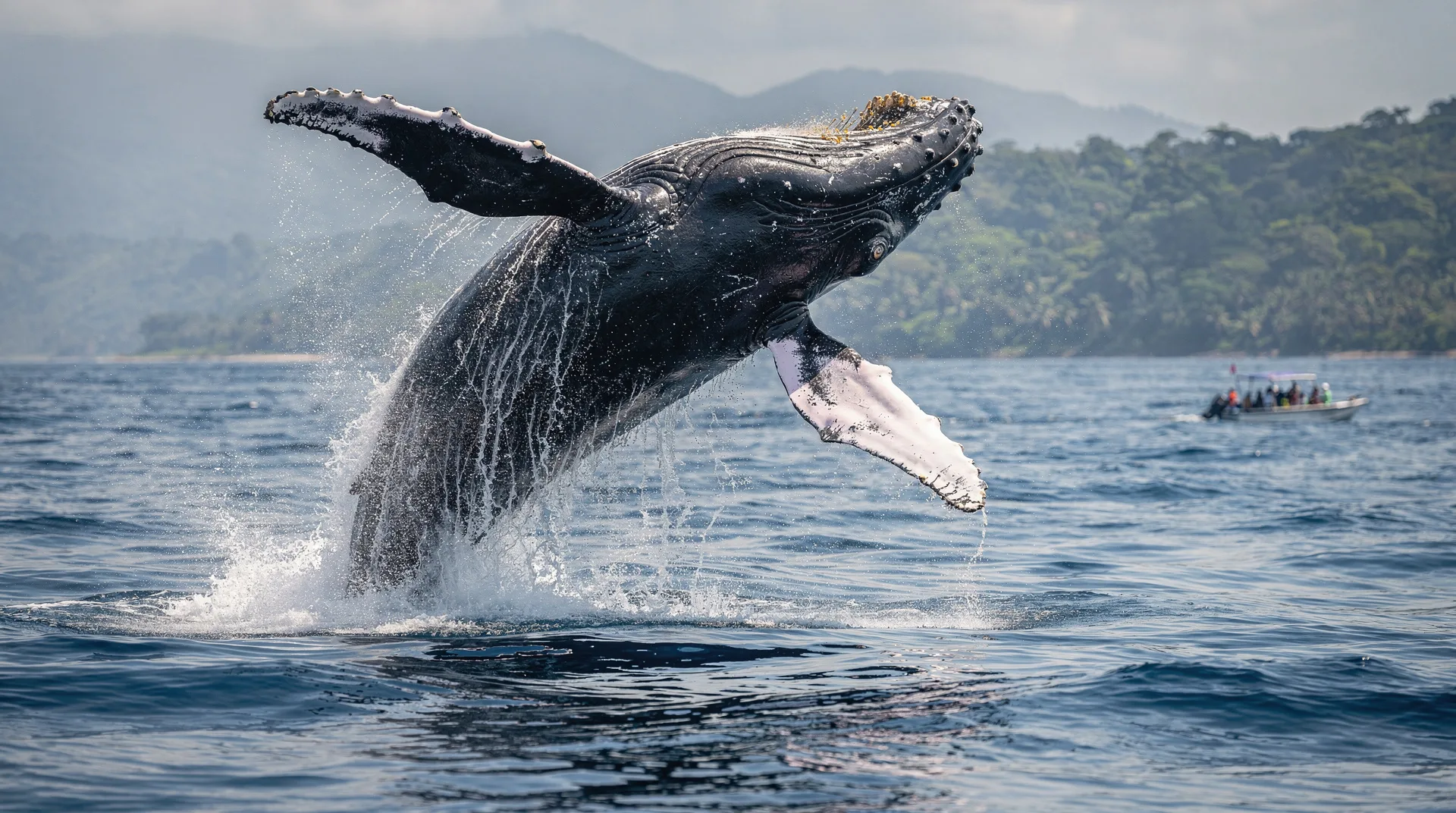
Uvita whale watching season: complete guide to Marino Ballena
When are humpbacks at Marino Ballena?
Aug–Oct (south population) and Dec–Apr (north population) — two distinct seasons.
| Southern population | July–October, peak August–September |
| Northern population | December–April, peak January–February |
| Tour cost | Around $75–95 per person, 3–4 hours |
| Park entry fee | Around $18 for foreigners |
| Base yourself | Uvita — most operators depart within 5 minutes |
Two populations, two seasons — the science behind the spectacle
Marino Ballena National Park, just off the coast of Uvita in the southern Pacific, is one of the few places on earth where you can reliably observe humpback whales during two completely separate seasons in a single calendar year. That is not a marketing claim. It is basic cetacean biology.
The Southern Hemisphere population of humpback whales — sometimes called the “Group F” stock — migrates from Antarctic feeding grounds to tropical breeding and calving waters along Costa Rica’s Pacific coast between approximately July and October, with the peak usually falling in August and September. The Northern Hemisphere population, migrating from Alaskan and North Pacific waters, arrives for its own breeding season from roughly December to April, peaking in January and February.
This guide is written for anyone planning a trip to Uvita specifically to see humpbacks or dolphins — whether that means scheduling around the peak window, understanding what ethical whale watching actually looks like, or simply knowing which boat operators to trust.
Exact season windows at Marino Ballena
Southern population (Jul–Oct)
July marks the soft opening of the south season. Sightings are possible from mid-July but not yet reliable enough to plan an entire trip around. August is the month most guides and biologists cite as peak — water is calmer after the rainy season ramps up, and the concentration of animals is highest. September continues strongly, with some operators reporting it as their best month for mother-calf pairs. October sees numbers thin out as animals begin returning south.
The south season coincides with Costa Rica’s green season, which means afternoon rain is common and the sea can be choppier in the mornings. Pack a light rain layer and book morning departures.
Northern population (Dec–Apr)
The north season overlaps with Costa Rica’s dry season, making it the more comfortable of the two for tourists. December sees the first arrivals; January and February are peak; March continues well; April is a taper. This population often includes more active competitive groups — multiple males competing for a female — which produces spectacular surface behaviour like breaching and tail slapping.
December and January are school holiday months across Europe and North America, so boat trips sell out earlier. Book well in advance for late December and early January departures.
The gap months (May–Jun)
May and June are the genuine low period. Sightings are sporadic and unpredictable. If your primary goal is whale watching, avoid these months at Uvita. Caño Island snorkeling and dolphin watching remain strong year-round, so the area is still worth visiting.
Season overview
| Window | Population | Weather | Notes |
|---|---|---|---|
| Jul–Oct | Southern (Antarctic) | Green season, choppier mornings | Best mother-calf sightings Aug–Sep |
| Dec–Apr | Northern (Alaskan) | Dry season, calmer seas | More competitive-group surface behaviour |
| May–Jun | Gap months | Transitional | Sporadic sightings — skip if whales are the priority |
What to expect on the water
Species you may encounter
Humpbacks are the headline act, but Marino Ballena and the surrounding waters are home to several other species year-round. Bottlenose dolphins are seen almost daily and often ride the bow wave of whale-watching boats. Spinner dolphins form large, acrobatic groups and are particularly active at dawn. Spotted dolphins (Pacific spotted) are common further offshore.
In season, you may also encounter false killer whales (rare but spectacular), pilot whales, and occasionally a Brydes whale offshore. Sea turtles — particularly olive ridleys and the occasional leatherback — are common year-round in Ballena Bay.
Boat trip logistics
Most tours depart from Playa Bahía Ballena, the beach directly below the whale tail sandbar formation that defines the park. The majority run between 3 and 4 hours and combine whale watching with dolphin observation and sometimes a stop at a snorkeling point near Isla Ballena (not the same as Caño Island).
Standard departure times are 7am and 1pm. Morning trips generally offer calmer seas and better light for photography. Prices run from about $75 to $95 per person for the standard shared boat experience.
Marino Ballena: whale watching in Uvita — from $80 Uvita: whales and dolphins watching tour - Bahía Ballena — from $78What to bring
- Polarized sunglasses — essential for scanning the water surface
- A dry bag — spray is inevitable even on calm days
- Motion sickness remedy — take it the night before if you are prone; don’t wait until you are on the water
- Light rain jacket — during the south season especially
- Binoculars if you have them; guides carry radios and communicate between boats, so they often know where animals are before you can see them
- Sunscreen (reef-safe) — you will be in direct sun for 3+ hours
Where to base yourself
Uvita is the natural base. It is a small, low-key town with a good range of accommodation from backpacker hostels to mid-range eco-lodges. Most whale watching operators depart from within the park itself, a 5-minute drive from town.
Dominical, 20 km north of Uvita, is another option — quieter, more surf-focused, with shared shuttles to Uvita tours. Ojochal, 15 km south, is a small expat community with some excellent restaurants and a handful of boutique lodges.
For those combining whale watching with the broader southern Pacific circuit — Caño Island, Corcovado, Drake Bay — see our 12-day south Pacific itinerary for a detailed routing.
Ethical whale watching rules
Costa Rica’s ICT (Instituto Costarricense de Turismo) and SINAC (Sistema Nacional de Áreas de Conservación) maintain regulations for whale watching within Marino Ballena. Reputable operators follow these — and you should choose operators who do.
The core rules:
- Minimum approach distance: 100 metres from any whale; never approach a mother-calf pair from the front
- No engine revving near surfacing animals — approach at slow trolling speed, cut engine when within observation range
- Maximum 3 boats per animal group at any time
- No swimming with whales — it is both illegal and stressful for the animals
- No feeding — ever
- No flash photography at night if a turtle is on the beach (relevant at Ballena if staying on-site)
The phrase “we follow the SINAC regulations” is the minimum bar. A good guide will explain these rules before departure without being asked.
Marino Ballena: whale/dolphin watching experience — from $78Operators: who to trust
Dozens of companies offer whale watching in Uvita. The honest picture:
What distinguishes good operators: ICT-registered, maximum boat size respected (usually under 20 passengers for manoeuvrability), guides with biological knowledge (not just driver-guides), willingness to call off a trip if sea state is dangerous.
Red flags: Operators guaranteeing sightings in writing (no one can guarantee wildlife), boats taking 30+ passengers, guides who do not know species by sight, operators who approach animals faster than regulations allow for “better photos.”
Uvita Waterfall Hostel, Uvita Info Center, and Southern Expeditions are consistently mentioned positively in recent traveller feedback (as of 2026). Cross-check recent TripAdvisor reviews before booking.
The whale tail formation: when is it visible?
Marino Ballena’s famous whale tail sandbar — a tombolo that connects Isla Ballena to the shore — is visible at low tide. At high tide it is submerged. The shape is genuinely striking from the air and partly visible even from the shore at low water. If you want the aerial view, scenic flights are available but expensive. The best ground-level view of the tail is from the beach at Playa Bahía Ballena during a minus-tide morning.
The Marino Ballena National Park guide covers park entry fees, trail maps, and the best spots to photograph the whale tail.
Combining whale watching with other activities
A whale watching morning leaves the afternoon free. Options from Uvita:
- Caño Island snorkeling (full day): one of Costa Rica’s premier snorkel sites, about 90 minutes offshore by boat — see our Caño Island guide
- Waterfall hiking: La Uvita waterfall is a 45-minute hike from town through forest
- Dominical beach: 20 minutes north for reliable surf, a range of beach bars, and the Sunday afternoon farmers’ market
- Nauyaca Waterfalls: 14 km round-trip hike (or horseback) to one of the most spectacular two-tiered falls in the country
For wildlife photography specifically, the morning whale watch followed by an afternoon walk through the park’s forest trail — where you may encounter howler monkeys, coatis, and iguanas — is a strong combination.
Frequently asked questions about whale watching at Uvita
Are dolphin sightings guaranteed?
No wildlife sighting is guaranteed, but bottlenose and spinner dolphins are encountered on the vast majority of departures year-round. Dolphin populations in Ballena Bay are resident, not migratory, so the chances of seeing them are genuinely high regardless of whale season.
Can I swim with dolphins from the boat?
No. Swimming with wild dolphins from commercial vessels in Costa Rica is prohibited within national park waters. Operators offering this are violating regulations and should be avoided. Wild dolphins are not performing animals — jumping in without invitation causes stress and disrupts natural behaviour.
How choppy does it get during the south season (Aug–Oct)?
August and September are mid-green season: swells are moderate, typically 0.5–1.5m. Afternoon seas can build. Book morning departures and take seasickness medication if you have any history of motion sickness. The choppiness during this period is manageable for most people, but it is not flat-calm like the dry season.
Is there an entrance fee for Marino Ballena National Park?
Yes — as of 2026, the SINAC entrance fee is approximately $18 for foreigners. Your boat tour operator may include this in the ticket price or collect it separately at the dock. Confirm before booking. The fee goes directly to park management and conservation.
What is the best month overall for whale watching at Uvita?
For guaranteed good weather and maximum whale activity combined, January and February (north population, dry season) are the strongest choice. For those who cannot travel in dry season, August and September (south population) offer excellent sightings despite afternoon rain. Either window is legitimate — the choice depends on your schedule.
How far is Uvita from San José?
Approximately 3 to 3.5 hours by car on the Costanera Sur coastal highway (Route 34). The road is paved and in good condition. Public buses from San José Terminal Tracopa run twice daily. No 4WD required. See our transport guide for options.
Do humpbacks come into the bay with calves?
Yes — both populations include mother-calf pairs, and the southern season in particular coincides with calving. Calf sightings are common in August and September. These are the encounters that require the most careful approach: SINAC regulations prohibit approaching mother-calf pairs from the front, and good guides will position the boat to observe from the side or rear.
Should I book a morning or afternoon whale watching tour?
Morning (7am) departures are generally the better choice — seas are calmer before the afternoon breeze picks up, and the light is better for photography. The 1pm departure can still be worthwhile if morning slots are full, but expect more chop, especially during the south season (Aug–Oct).
Can I combine Uvita whale watching with Corcovado or Drake Bay?
Yes, and many travellers do. Uvita sits at the northern end of the southern Pacific circuit, with Drake Bay and Corcovado roughly 2–3 hours further south. A common routing spends 2 nights in Uvita for whale watching and Caño Island, then continues to Drake Bay for Corcovado access — see the 12-day south Pacific itinerary for a full routing.
Related guides
Whale watching is just one part of what makes Uvita and the southern Pacific so rewarding for wildlife enthusiasts. The wildlife watching ethics guide covers principles that apply across every encounter — on water and on land. For the full scope of marine life in Costa Rica, the marine life guide goes deeper on species identification. If turtles are also on your list, the nearby beaches at Camaronal and the spectacular nesting beaches further north at Tortuguero deserve their own planning — start with the Tortuguero turtle nesting guide.
Uvita: whale watching tour in Marino Ballena — from $80