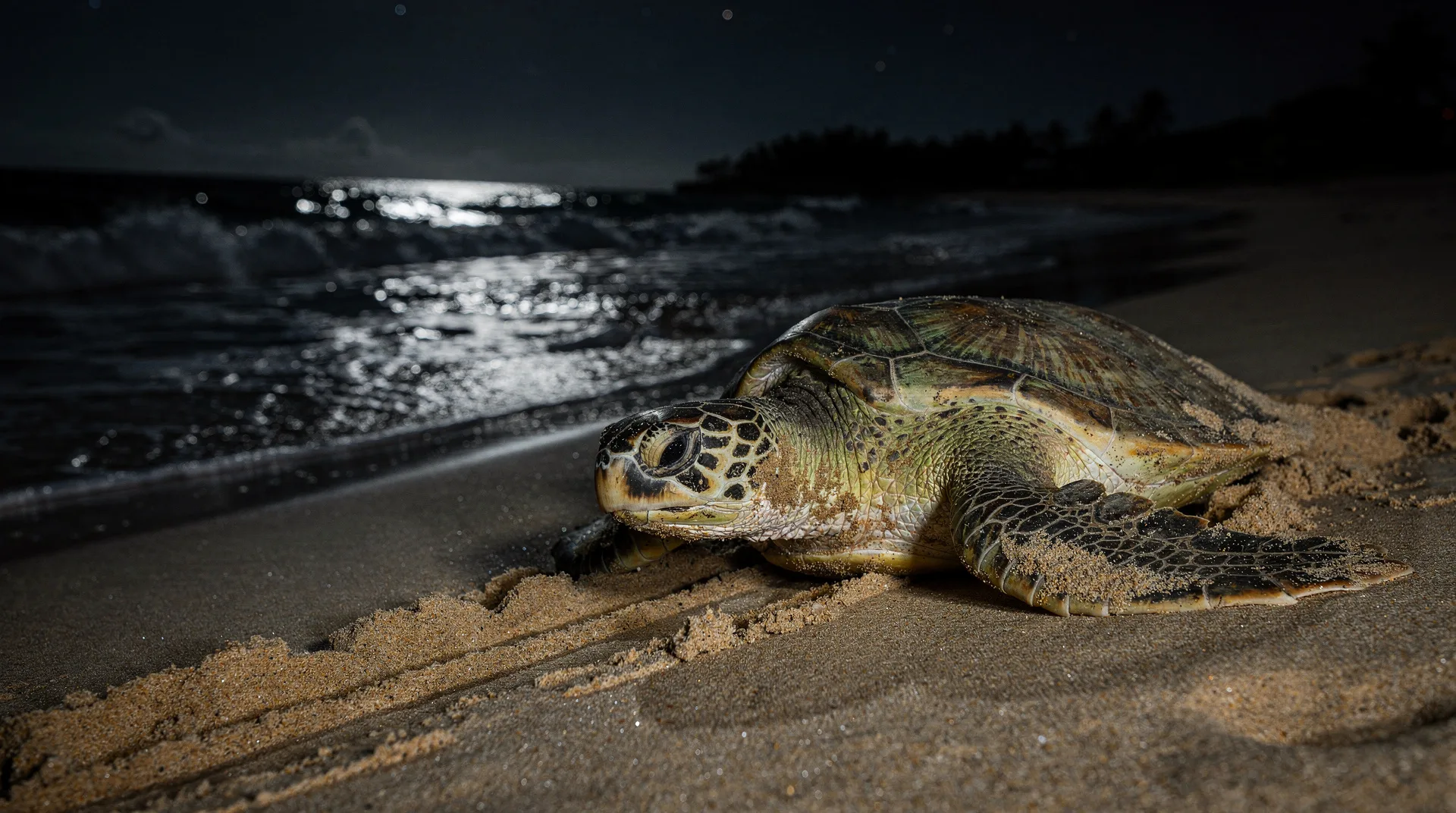
Tortuguero turtle nesting guide: seasons, ethics, and logistics
Tortuguero turtle nesting?
Greens Jul–Oct, Hawksbill year-round, Leatherback Mar–Jul.
| Green turtles | July–October, peak August–September |
| Leatherbacks | March–July, peak April–May |
| Hawksbills | Year-round, peak May–October |
| Tour cost | $40–55/person for a SINAC-licensed night tour |
| Rule #1 | No white light or flash photography — ever |
Why Tortuguero matters: the global importance of one beach
Tortuguero Beach stretches for roughly 35 kilometres along Costa Rica’s northern Caribbean coast, accessible only by boat or small plane. No road reaches it. That isolation — an accident of geography — has made it one of the most important sea turtle nesting sites in the Western Hemisphere.
The Caribbean Conservation Corporation (now Sea Turtle Conservancy) has operated at Tortuguero since 1955, making it the longest continuous sea turtle monitoring program in the world. The data collected here underpins much of what scientists know about green turtle migration, nesting behaviour, and population recovery. The green turtle population nesting at Tortuguero had declined catastrophically by the 1950s; today it is recovering, thanks in large part to that monitoring work and the legal protections that followed.
This guide covers everything you need to plan a responsible visit — including the species calendar, how the night tours work, what ethical behaviour looks like, and the honest logistics of getting there.
If you are still deciding whether the Caribbean fits your dates, the best time to visit Costa Rica guide and the Tortuguero destination page put the turtle calendar in a wider seasonal context.
Species calendar: who nests when
Green turtles (Chelonia mydas) — July to October
Green turtles are the species Tortuguero is most famous for, and they nest in extraordinary numbers. The season runs from approximately July through October, with the peak in August and September. On a busy peak-season night, dozens of females may come ashore simultaneously.
Females return to the beach where they were born (natal beach fidelity is precise), nest multiple times per season (usually 3–5 clutches), and lay approximately 100 eggs per clutch. The eggs incubate for about 60 days, so a female nesting in August will have hatchlings emerging in October.
Green turtles are listed as Endangered on the IUCN Red List globally, though the western Atlantic population nesting at Tortuguero is considered one of the stronger sub-populations. They are so-named for the colour of their fat, not their shell.
Leatherback turtles (Dermochelys coriacea) — March to July
Leatherbacks nest earlier in the year than greens. The season at Tortuguero runs roughly March through July, with peak activity in April and May. Leatherbacks are the largest reptile on earth — adults weigh 300–900 kg and measure up to 2 metres in length. Seeing one come ashore is a genuinely overwhelming experience.
Leatherbacks are critically endangered. The eastern Pacific population has declined by over 90% since the 1980s; the Atlantic population, which includes Tortuguero, is in better shape but still under threat from longline fishing bycatch and beach development. Ethical viewing of leatherbacks is particularly important precisely because of this.
Hawksbill turtles (Eretmochelys imbricata) — year-round, peak May–October
Hawksbills nest at Tortuguero throughout the year, though numbers are smaller than greens. They are distinguished by their narrow, pointed beak and their strikingly patterned shell — the same shell that historically made them targets of the tortoiseshell trade. Hawksbills are Critically Endangered. Seeing one nest is a privilege that fewer visitors experience than they realise.
How Tortuguero compares to Costa Rica’s other turtle beaches
Tortuguero is not the only place to see nesting turtles in Costa Rica, and knowing how it stacks up helps if your itinerary favours the Pacific side:
| Destination | Main species | Season | Access |
|---|---|---|---|
| Tortuguero | Green, leatherback, hawksbill | Jul–Oct (green) | Boat or plane only |
| Playa Grande (Las Baulas) | Leatherback | Oct–Mar | Road, near Tamarindo |
| Ostional | Olive ridley (mass arribadas) | Year-round, strongest Aug–Nov | Road, remote Guanacaste |
For leatherbacks specifically on the Pacific side, see the Playa Grande leatherback guide. For the mass-nesting arribada phenomenon, see the Ostional arribada guide.
How the night tours work
All turtle watching at Tortuguero requires an authorised guide. Solo beach access at night is prohibited — this is enforced, not just suggested, and the reason is legitimate: untrained visitors cause significantly more disturbance than guided groups.
The process works like this:
- You book a night tour through your lodge or a licensed local guide (see below)
- You gather at the assembly point at dusk (usually around 8pm, but timing varies by season and moon phase)
- Guides rotate between beach sectors with small groups (8–12 people maximum per group under current regulations)
- When a turtle is confirmed nesting — confirmed means the female is settled and has begun laying eggs — your group approaches quietly
- You observe for approximately 20–30 minutes, then return
There is no guarantee of seeing a turtle. On peak-season nights in August and September, the chances are excellent (upwards of 80–90% on a good night). In the shoulder months of July and October, success rates are lower. The guides communicate by radio and move groups to wherever nesting females have been confirmed.
Turtle watching in Tortuguero, Costa Rica — from $45Tour providers
Every lodge in Tortuguero village arranges night tours. Prices run from approximately $40 to $55 per person depending on the operator. The key distinction is whether your guide holds a current SINAC certification for turtle monitoring. Ask directly before booking.
The Sea Turtle Conservancy also offers research-oriented experiences where visitors assist with data collection — tag checking, measuring, and egg counting. These are limited in number and book out months in advance, but they represent the gold standard of participatory conservation tourism.
Tortuguero: sea turtle tour — from $50What ethical turtle watching looks like
The following rules apply at Tortuguero and are enforced by SINAC rangers:
- No white light of any kind on the beach at night — use red-filtered flashlights only; your guide will provide these or instruct you
- No flash photography — ever, under any circumstances
- No phone screens facing the turtle — the blue/white light causes disorientation
- Stay behind the turtle while it nests — approach only from the rear
- Do not touch the turtle unless your guide specifically instructs it during a monitoring exercise
- No running on the beach; quiet voices at all times
- Do not place anything on the turtle or position yourself in its path back to the ocean
- Follow guide instructions immediately — if told to move, move
Why does light matter? Sea turtles — particularly hatchlings — use light to orient toward the ocean. Artificial white light on the beach causes them to move inland rather than seaward, which is fatal. It also causes nesting females to abort the process and return to the water before laying.
The guides in Tortuguero are excellent and experienced. Trust them. The visitors who cause problems are almost always those who override guide instructions for a better photo.
Tortuguero: turtle nesting night tour — from $40Getting to Tortuguero
There are two ways to reach Tortuguero: by boat or by small plane. There is no road.
By boat: The most common route from San José involves a shuttle bus to the boat launch point at La Pavona or Caño Blanco, then a 1.5–2 hour canal and river journey through Tortuguero National Park. Total journey time from San José: about 4–5 hours. Several tour operators run organised transfers with guaranteed hotel pickup; this is the most practical option for first-timers.
By plane: Sansa and Aerobell fly to Tortuguero from San José (Juan Santamaría Airport). Flight time is approximately 35 minutes. Return fares start from about $100. This is significantly faster and worth the cost if you have limited time. The aerial view of the canal network through the park is spectacular.
From Tortuguero village, everything is done on foot or by small boat. The village is tiny — you can walk end to end in 10 minutes.
For the road leg to the boat launch, the shuttle services overview explains how shared transfers work, and the guide to internal flights with Sansa and Aerobell covers booking the small plane. Both routes sit inside Limón province, whose southern coast is worth pairing with the trip.
Packing for the beach at night
The beach is dark, damp and often warm, so pack light, quiet clothing in dull colours, a rain layer and closed shoes you do not mind getting sandy. Leave bright torches and noisy bags at the lodge. The packing list for Costa Rica covers the rest of the kit for a Caribbean trip.
Where to stay
Tortuguero village
The village has a range of small lodges, guesthouses, and a few budget options. Casitas Tortuguero, Manatus Hotel, and Turtle Beach Lodge are mid-range options with reliable turtle tour arrangements. For budget travellers, Miss Junie’s and several small family-run guesthouses offer basic rooms with home-cooked meals.
All-inclusive lodges on the park side
Several larger lodges sit across the canal from the village, on the edge of the national park. Aninga Lodge, Laguna Lodge, and Tortuga Lodge (owned by Costa Rica Expeditions, one of the country’s oldest eco-tourism operators) offer all-inclusive packages that include transfers, meals, and turtle tours. Prices run from about $200 to $450 per person per night all-in. These are worth considering if you want a hassle-free experience.
Day trip from San José
It is technically possible to visit Tortuguero on a day trip from San José, including the boat journey and a canal tour — but you cannot do a night turtle tour on a day trip. The night tours require staying overnight.
Canal boat tours during the day
Tortuguero National Park is not only about turtles. The canal network is one of the richest wildlife corridors in Central America. Morning boat tours through the canals routinely produce sightings of river otters, caimans, Jesus Christ lizards (basilisks), fresh-water turtles, boat-billed herons, kingfishers, green and black poison dart frogs, and — with luck — manatees, jaguars (very rare), and tapirs.
The Tortuguero National Park guide covers canal tour logistics in detail.
If the canals leave you wanting more after dark, the nocturnal wildlife guide explains what else comes out at night, while the Costa Rica wildlife overview and the marine life guide place turtles among the country’s other animals.
Tortuguero: turtle nesting tour in their natural habitat — from $50Common tourist trap warnings
“Day tour includes turtle watching” is a red flag. Legitimate turtle watching is a night activity requiring prior arrangement. No reputable operator sells a same-day day-to-night combination as a single product, because the night tour slots are managed separately by SINAC.
Unlicensed beach guides sometimes approach visitors in the village offering cheaper turtle tours. While not all are bad, the guarantee of a SINAC-certified guide matters for both the quality of your experience and the protection of the turtles. Pay the extra $10-15 for a certified tour.
Hatchery visits are offered by some operators. Hatcheries at Tortuguero are generally legitimate conservation operations — eggs are moved from vulnerable beach sections to protected hatcheries to prevent predation and flooding. Hatchery release events (watching hatchlings enter the sea) are genuinely moving and perfectly ethical. Check that any hatchery you visit is affiliated with the Sea Turtle Conservancy or a registered conservation body.
Frequently asked questions about turtle nesting at Tortuguero
How many nights should I spend in Tortuguero?
Two nights is the minimum to do the destination properly — one turtle tour attempt and one full morning canal tour. Three nights allows a second turtle tour attempt (useful if the first was rained out or unsuccessful) and time to hike the Cerro Tortuguero trail during the day.
Is it worth visiting Tortuguero outside turtle season?
Yes, for the canal wildlife. The bird watching is excellent year-round. The reptile and mammal sightings on morning canal tours remain strong even in the off-season. However, the main draw is undeniably the turtles, so off-season visitors should adjust expectations.
Can children go on the turtle night tours?
Yes, with appropriate preparation. Children should understand the rules around silence and no light before arriving. Most lodges recommend ages 8+ for night tours simply because young children struggle with the wait times and the strict quiet requirement. Infants and toddlers are not appropriate for these tours.
Is the journey to Tortuguero difficult?
It requires planning but is not physically challenging. The boat journey through the canals is scenically spectacular and genuinely enjoyable. The difficulty is logistical — no road access means you cannot simply drive in, and transfers need to be pre-arranged. Once in the village, everything is walking distance.
What is the rainy season like in Tortuguero?
The Caribbean coast has a different rain pattern than the Pacific. Tortuguero is genuinely wet — it receives 5,000+ mm of rain per year, more than almost anywhere else in Costa Rica. Rain falls year-round, with relative drying in September and October. Pack waterproofs regardless of month. The canals are navigable in all conditions, and the turtle tours continue in light rain (the guides provide plastic ponchos).
Do I need a reservation to enter Tortuguero National Park?
Tortuguero does not currently require advance SINAC reservations for park entry in the same way that Poás does. However, night turtle tours through SINAC-licensed guides are limited in group size, and peak season (August–September) often sees high demand. Book your night tour at least 2–3 days in advance when in village, or arrange through your lodge before arrival.
How much does a turtle tour cost?
Expect to pay $40–$55 per person for a standard SINAC-permitted night tour arranged through a local certified guide or lodge. All-inclusive lodge packages incorporate this into the nightly rate. The Sea Turtle Conservancy research volunteer programmes range from $80–$120 per session. Do not pay below $35 — it almost certainly means an unlicensed guide.
What is the Sea Turtle Conservancy and can visitors support it?
The STC (formerly Caribbean Conservation Corporation) is the NGO that established turtle monitoring at Tortuguero. It runs a visitor centre in the village, offers educational exhibits, and sells merchandise with proceeds supporting conservation. Visiting the centre and making a donation is a straightforward way to support the science that has made this population recovery possible.
Should I choose Tortuguero or Playa Grande for leatherback nesting?
Both host leatherbacks, but the seasons barely overlap: Tortuguero’s leatherback window runs March–July, while Playa Grande near Tamarindo peaks October–March. If your trip is timed for the Pacific dry season (December–April), Playa Grande is the more convenient and often the only realistic option; Tortuguero’s remoteness makes more sense if you’re already routing through the Caribbean.
Can I photograph turtles at all during the night tour?
Only with your guide’s explicit permission and only using a red-filtered light setting, no flash, and typically after the female has begun laying eggs (when she is less likely to abort the nesting). Many guides restrict photography entirely for hatchling releases, where light disorientation risk is highest. Ask your guide directly what is allowed before the tour starts rather than assuming.
Related guides
The broader context of responsible wildlife travel in Costa Rica starts with wildlife watching ethics — applicable at Tortuguero, at Marino Ballena, and at every other wildlife site in the country. If you are also interested in leatherback nesting on the Pacific coast, Playa Grande in Las Baulas National Park is the complementary destination. To extend the trip south, Puerto Viejo and Cahuita make natural follow-on stops, and Sarapiquí works as a gentler stop on the way in or out. For the full Caribbean trip, including canal transfers and the village atmosphere, the 7-day Caribbean itinerary maps out an efficient routing.
Green sea turtle nesting tour — from $55