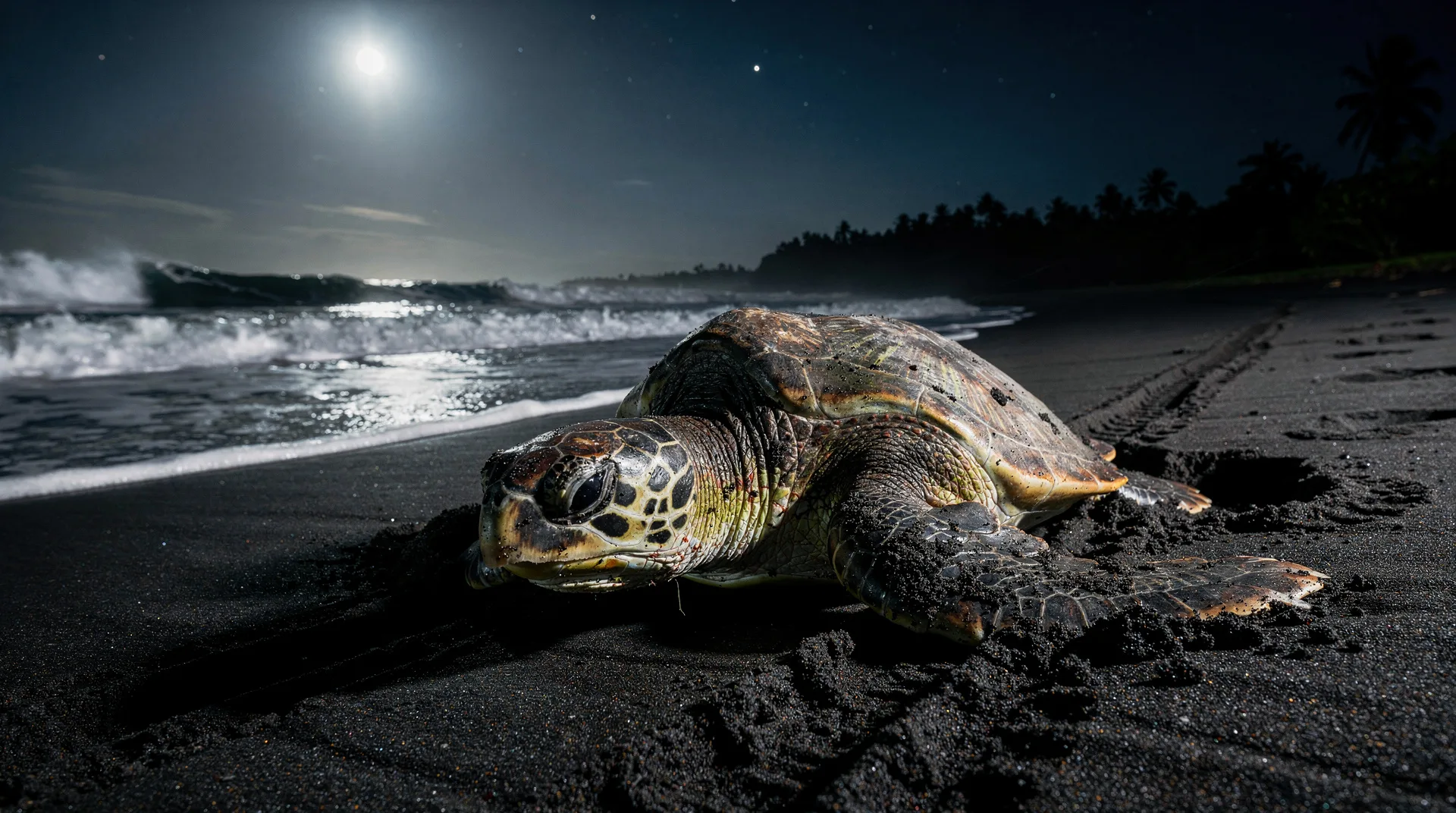
Tortuguero National Park: sea turtles, canals, and Caribbean jungle
When do turtles nest in Tortuguero?
Green sea turtles nest July through October, with peak activity in August and September. Leatherback turtles nest March through July. Hawksbills are present almost year-round. Night tours on the nesting beach are guided and regulated — no flash photography or white lights permitted.
| Where | Limón Province, Caribbean coast — boat or plane only, no roads |
| Cost | $20/day park entry + $10/night turtle beach fee |
| Best time | August–September for green turtle nesting peak |
| Getting there | Bus + boat ( |
| Minimum stay | 2 nights, to fit a canal tour and a turtle night tour |
A roadless park reached only by boat or plane
Tortuguero National Park sits on a narrow strip of Caribbean coastline in Limón Province, sandwiched between the sea and a network of natural canals, lagoons, and rivers that extend south from the Nicaraguan border. There are no roads into Tortuguero village — the only access is by boat up the Tortuguero Canals or by light aircraft from San José. This isolation has been the park’s greatest protector.
The 31,174-hectare park covers some of the most important sea turtle nesting habitat in the western hemisphere. Caribbean green sea turtles have nested on Tortuguero’s 35km beach for centuries. The village that grew alongside the park is one of the most striking examples of community-based conservation in Central America: a former hunting and egg-collecting community that transformed into a model for turtle-based ecotourism over the past four decades, largely through the work of Dr. Archie Carr and the Caribbean Conservation Corporation (now Sea Turtle Conservancy).
Beyond turtles, the canal system is one of the best accessible wildlife corridors in Costa Rica. Boat tours through the canals reliably produce sightings of river otters, caimans, poison-dart frogs, Jesus Christ lizards, white-faced capuchin monkeys, howler monkeys, great green macaws, kingfishers, herons, and the extraordinary sunbittern.
Green sea turtle nesting: the numbers
Green sea turtles (Chelonia mydas): The main event at Tortuguero. Green turtles nest from July through October, with the absolute peak in August and September. A single female may lay up to eight clutches in a season, returning to the beach every 12 to 14 days. The beach supports tens of thousands of nestings per season during peak years — numbers vary considerably year to year based on natural 3 to 5 year population cycles.
Leatherback turtles (Dermochelys coriacea): The world’s largest sea turtle nests from March through July. Their numbers at Tortuguero are smaller than green turtles but seeing a 400kg leatherback hauling herself up the beach at 2am is a once-in-a-lifetime experience.
Hawksbill turtles (Eretmochelys imbricata): Small numbers nest throughout the year. Critically endangered globally, each individual nesting here matters. Guides treat hawksbill encounters with particular care.
Loggerhead turtles: Occasional visitors, not regular nesters at Tortuguero.
Turtle nesting season at a glance
| Species | Season | Peak months |
|---|---|---|
| Green sea turtle | July–October | August–September |
| Leatherback | March–July | April–May |
| Hawksbill | Year-round | May–October |
Night turtle tours: how they work
All turtle watching is conducted under strict rules enforced by the Sea Turtle Conservancy and the national park:
- No white lights or flash photography. Red-filtered torches only. This is a hard rule, not a suggestion.
- Groups of maximum 8 people per guide. Guides patrol assigned beach sections.
- Visitors wait in a designated area until a guide radios in a confirmed nesting female. You then walk quickly to the site.
- Touching turtles is prohibited.
- No mobile phones with flash settings enabled on the nesting beach.
Tours typically begin at 8pm and last 2 to 3 hours, with no guarantee of a sighting (though guides report very high success rates during peak season). The $10 beach access fee is separate from tour operator fees.
Tortuguero: sea turtle tour — from $50Canal wildlife tours: what to expect
The park’s canal system is explored by boat — both motorised launches and kayaks, depending on the operator and your preference. Morning tours (6am to 8am) are best for bird activity. Afternoon tours (2pm to 4pm) tend to produce monkey sightings as they descend to drink.
What you’ll typically see:
- White-faced capuchin monkeys, mantled howler monkeys, and spider monkeys along the canal banks
- American caimans basking on partially submerged logs
- Northern river otters if you are very quiet and very lucky
- Great green macaws (highly endangered — Tortuguero is one of their last strongholds)
- Dozens of heron and egret species
- Keel-billed toucans
- Poison-dart frogs (Dendrobates pumilio — vivid red with blue legs) along forest trails
- Basilisk lizards (Jesus Christ lizards) running across water surfaces Tortuguero: turtle nesting night tour — from $40
Getting more from the canals
A quiet boat is the single biggest factor in what you see. Engines are kept low, voices lower, and guides cut the motor to drift when an animal is spotted. If you care about photographs, the wildlife photography tips cover how to work from a moving boat in low, humid light, and the wildlife watching ethics guide explains why keeping distance matters for animals that live their whole lives along these banks.
The monkeys you meet along the water are worth identifying rather than lumping together; the monkey species guide helps you tell capuchins, howlers, and spiders apart by sight and sound. The forest edge also hides smaller residents, and the butterflies and frogs guide is useful before you walk any trail. Much of the park’s life becomes active after dark, so the nocturnal wildlife guide is a good companion to the evening beach walk. Birders will find more context in the bird watching by region guide, and the herons, kingfishers, and sunbitterns here reward patience on any morning outing.
Getting to Tortuguero
There is no road to Tortuguero. The two options are:
Option 1 — Bus + boat (budget/mid-range, ~$30–50 each way): Take a bus from San José to Cariari, then a public bus to La Geest (a landing on the canal system), then a colectivo water taxi to Tortuguero. The full journey takes 4 to 5 hours. Alternatively, operators run direct tourist shuttle-and-boat packages from San José for around $50 one-way — considerably easier and worth the premium.
Option 2 — Domestic flight (from San José SJO to TTQ, ~$80–110 one-way): Sansa Airlines flies the route in about 30 minutes. Book ahead — the aircraft are small (often 12-seaters) and popular months fill quickly. The flight over the Caribbean coast and canal system gives a spectacular aerial view of the park.
Most visitors use the bus-boat route inbound and the flight outbound, or vice versa.
Because the village is small and remote, plan your money before you leave the mainland. The money and currency guide and the ATM and cash tips explain what to carry, since you should not count on easy cash once you are on the canals. For more on the aircraft and schedules involved, read the internal flights guide, and for the overland side see the shuttle services overview. Pack with the packing list in hand, because space and weight on small aircraft and boats are limited.
Where to stay in Tortuguero
The village of Tortuguero has a range of lodging from backpacker guesthouses to mid-range eco-lodges. Most accommodation is simple but comfortable, and meals are included in many packages.
Budget to mid-range: La Casona Guesthouse, Turtle Beach Lodge budget rooms, and several family guesthouses in the village offer clean rooms with meals for $40–80/night.
Eco-lodges: Aninga Lodge, Mawamba Lodge, Laguna Lodge, and Pachira Lodge all offer comfortable bungalows, swimming pools, guided activities included, and the canal access that makes independent wildlife watching straightforward. Prices run $150–250/night with meals and tours. These lodges are on the opposite (park) side of the canal from the village.
Key tip: Most packages include return boat transfer, meals, a canal tour, and the turtle tour. Comparing packages rather than room rates gives a more accurate cost picture.
Entry fees
National park entrance: $20 per person per day. This is collected at the ranger station and does not cover turtle beach access, which carries an additional $10 fee per night. Guides are not legally mandatory at Tortuguero as they are at Corcovado, but the turtle beach rules require licensed guides for the nesting tours.
Weather and what to pack
Tortuguero is genuinely one of the wettest places in Costa Rica — the canal system exists precisely because rainfall here is so heavy, feeding the network of rivers and lagoons year-round. Expect rain in any month, though it falls more consistently October through December and eases somewhat September–October (a quirk explained below). Days are hot and humid regardless of rainfall, typically 25–30°C.
Pack lightweight, quick-dry clothing that covers arms and legs for dusk mosquito activity, waterproof sandals or water shoes for wet canal landings, a dry bag or waterproof phone pouch for boat tours, insect repellent with DEET, reef-safe sunscreen, and a light rain jacket. A red-filtered flashlight for the turtle beach is essential — some lodges provide these, but confirm before your tour rather than assuming.
Best time to go beyond turtle season
Tortuguero is worth visiting even outside peak turtle season for the canal wildlife and birding.
February to June: Fewer tourists, great birding, leatherback turtle season (March–July), lower prices. The canals are productive year-round.
Caribbean dry season quirk: Tortuguero follows Caribbean weather patterns, which run opposite to the Pacific coast. September and October — often the wettest months on the Pacific — are a relative dry season on the Caribbean. Canal conditions improve and visitor numbers drop.
Tortuguero: turtle nesting tour in their natural habitat — from $50Frequently asked questions about Tortuguero National Park
Is it guaranteed I will see a turtle nesting?
During peak season (August–September), guides report success rates above 90%. Earlier in the season (July) and later (October), chances are still good but success is not guaranteed — turtles nest on their own schedule. The $10 beach access fee is non-refundable.
How long should I spend in Tortuguero?
Two nights is the minimum to do the experience justice: one canal tour, one turtle night tour, and perhaps a morning village walk. Three nights allows for a kayak session and a hike on the Cerro Tortuguero trail, the only inland trail in the park.
Can I visit Tortuguero as a day trip from San José?
Day trips exist (bus-boat-bus round trip in one very long day, or fly in-tour-fly out). But they are exhausting and you sacrifice the turtle night tour, which requires being there after dark. Day trips are recommended only for travellers with severe time constraints.
What should I bring to Tortuguero?
Light clothing that covers legs and arms (insects at dusk), waterproof sandals or water shoes for the canal areas, insect repellent, reef-safe sunscreen for the beach, and a red-filtered torch or head lamp for turtle tours (some operators provide these — confirm ahead of time).
Is Tortuguero village safe to walk around?
Yes. Tortuguero village is a small Caribbean community of around 600 residents that is extremely accustomed to tourists. It is safe to walk the single main street at any hour. The usual common-sense travel precautions apply.
Is Tortuguero worth it if I can’t get a turtle nesting sighting?
Yes. Even setting turtles aside, the canal wildlife tours are among the strongest in the country — otters, caimans, macaws, and dozens of bird species are close to guaranteed on a morning boat tour. Treat the turtle sighting as the highlight rather than the sole reason to go, and the trip holds up regardless of season or luck on the night.
Other turtle experiences and how Tortuguero compares
Tortuguero is not the only place to meet nesting turtles, and seeing how the others differ helps you decide how much to build your trip around it. On the Pacific side, Playa Grande is known for leatherbacks, while Ostional is famous for the mass arrivals of olive ridleys. Tortuguero’s strength is the combination: turtles at night and a full canal ecosystem by day, all inside one protected area in Limón Province.
If you are still deciding between coasts, the Caribbean versus Pacific coast trip guide lays out the trade-offs. The Tortuguero destination page covers the village itself, and travellers who want more time with birds can build on the bird watching itineraries.
Where to fit Tortuguero in your itinerary
Tortuguero naturally anchors a Caribbean route. The 7-day Caribbean quick itinerary pairs Tortuguero with Puerto Viejo and Cahuita for a full Caribbean coast circuit. Wildlife photographers should look at the 14-day wildlife photography itinerary which starts in Tortuguero before moving to Sarapiquí and Monteverde. For a comparison of Costa Rica’s most important turtle destinations, see the Tortuguero turtle nesting guide.
Green sea turtle nesting tour — from $55