Playa Grande leatherback turtles: Las Baulas National Park guide
Where to see leatherbacks?
Playa Grande in Las Baulas National Park, Oct–Feb.
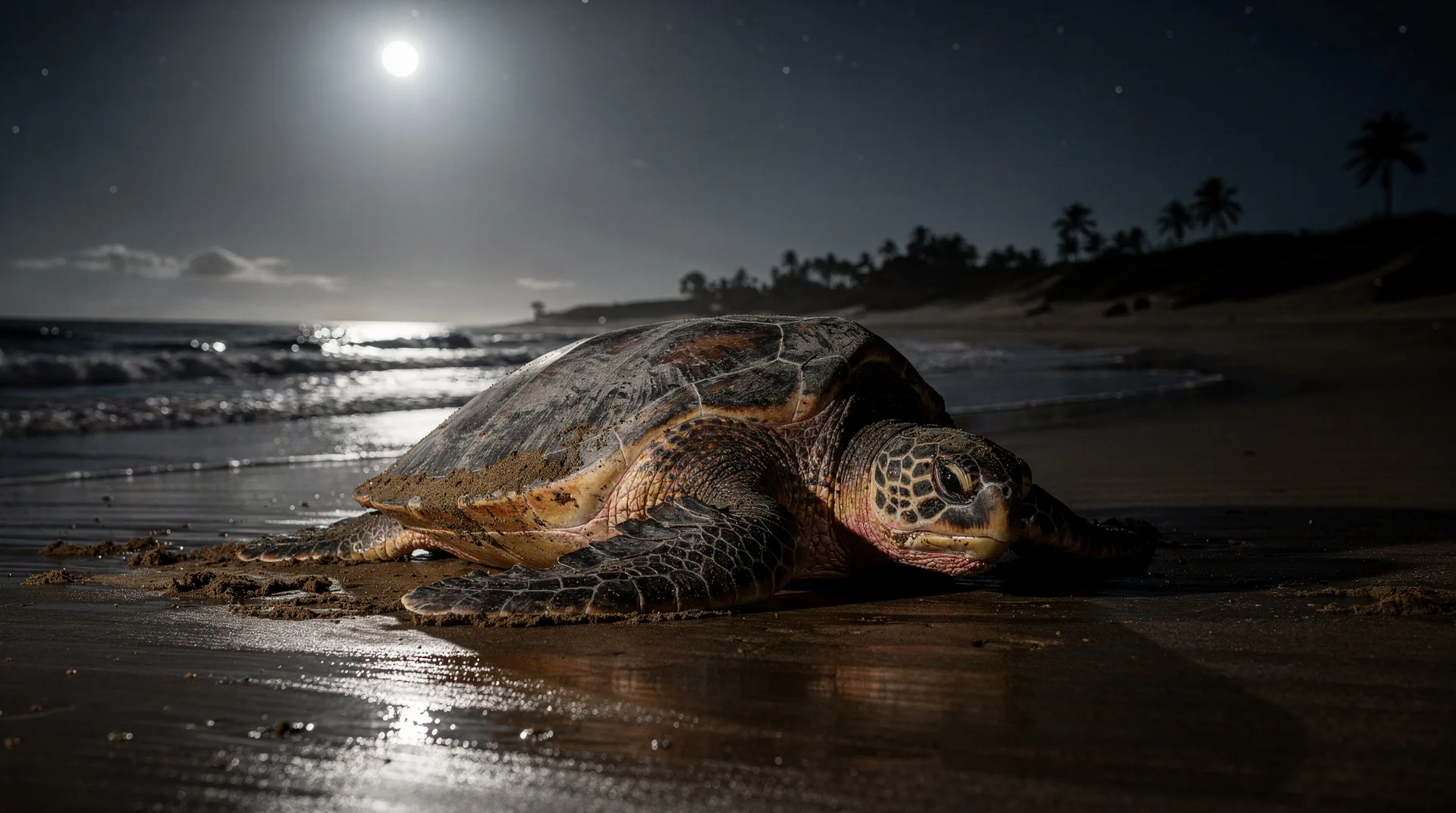
The largest reptile on earth comes to Playa Grande
Playa Grande sits in Guanacaste, directly across the Tamarindo estuary from Tamarindo town. Administratively it falls within Las Baulas National Park, a protected area established specifically to safeguard the leatherback turtle (Dermochelys coriacea) nesting on this beach. The park’s name — “Las Baulas” — is the local word for leatherbacks.
| Where | Playa Grande, Las Baulas National Park, across the estuary from Tamarindo |
| Season | October-February, peak Nov-Jan |
| Cost | around $85-100/person incl. park entrance and guide |
| Getting there | 3-5 min boat from Tamarindo, or ~1hr drive from Liberia (LIR) |
| Wait time | 1-5+ hours, no sighting guaranteed |
Leatherbacks are not just the world’s largest turtle. They are one of the most ancient lineages of living reptiles, existing largely unchanged for over 65 million years. An adult leatherback weighs between 300 and 900 kilograms and can dive to depths of 1,000 metres in pursuit of jellyfish. They are warm-blooded in a loose sense — capable of maintaining body temperature above the surrounding water — which allows them to feed in cold sub-polar oceans. The females that nest at Playa Grande migrate from as far away as the coast of Canada and Greenland.
They are also critically endangered. The eastern Pacific leatherback population collapsed from approximately 90,000 nesting females in the 1980s to fewer than 1,000 by the early 2000s — a 99% decline driven primarily by longline fishing, egg poaching, and coastal development. Playa Grande is one of the most important remaining Pacific nesting sites, which makes what happens here matter enormously.
Nesting season: October to February
The leatherback season at Playa Grande runs from approximately October through February, with peak activity in November, December, and January. The number of females nesting per season varies dramatically — in good years, 40–70 females may use the beach; in poor years, fewer than 20. These numbers, while far below historical levels, represent a partial recovery driven by park protection.
Peak months for the best probability of a sighting:
- November: Season underway, first significant arrivals
- December: Often the strongest month for numbers
- January: Still strong; overlaps with Costa Rica’s high tourist season, so tours book out quickly
- February: Numbers taper off toward season’s end
October sees sporadic early arrivals. March onwards is effectively post-season, with only occasional stragglers.
Moon phase and nesting timing
Unlike the Olive Ridley arribada at Ostional — which is strongly moon-phase dependent — leatherbacks at Playa Grande nest more individualistically. Individual females return on approximately a 10-day interval throughout the season, and nesting at Playa Grande occurs throughout the night rather than being tightly concentrated around the waning moon. However, cloudy, dark nights do seem to produce more activity than bright full-moon nights.
How the night tours work
Access to Playa Grande for turtle watching is entirely controlled by the national park. Visitors cannot simply walk onto the beach — there are ranger checkpoints, and night tours must be booked through park-authorised operators.
The system works as follows:
- Register at the park station in Playa Grande village (a 3-minute boat ride from Tamarindo, or a 30-minute drive around)
- Wait at the station — rangers patrol the beach and radio back when a female is confirmed nesting
- Groups of maximum 8 people are escorted to the turtle by a ranger or certified guide
- 30 minutes of quiet observation near the nesting female before returning to the station
- A second group goes out if additional females have been confirmed
The wait time varies from 1 hour to 5+ hours. Bring a book, snacks, and patience. Sometimes no turtles come and the tour is effectively cancelled (entrance fee is not typically refunded in this case — this is the honest reality of wildlife tourism).
Tamarindo: turtle nesting tour Guanacaste — from $95Fees and booking
Park entrance fees as of 2026 are approximately $18 per person for foreigners. The guided night tour adds additional fees — expect total costs of $85–$100 per person through most operators. Book through the park station at Playa Grande, through reputable Tamarindo operators, or through GetYourGuide-listed tours.
Tamarindo: turtle watching night tour with expert naturalist — from $85Getting there from Tamarindo
Playa Grande is immediately across the estuary from Tamarindo — you can see it from the Tamarindo beachfront. The crossing by small boat takes 3–5 minutes and costs about $2–3 per person. Boats run from the Tamarindo estuary dock throughout the day until early evening; coordinate return timing with your guide as late-night boat crossings require pre-arrangement.
By road, driving around the estuary adds 25–30 minutes from Tamarindo town to Playa Grande. If you are already in Huacas or Brasilito (30–40 minutes from Tamarindo), the road route may be comparable.
From Liberia airport (LIR): approximately 1 hour by car — one of the most accessible major wildlife destinations from the Guanacaste gateway.
If you are still deciding where to base yourself, the Tamarindo destination page covers the town itself, and the Guanacaste province overview puts the whole region in context. Leatherback season falls in the dry months, so what the dry season is really like and the best time to visit Costa Rica are useful reading when you fix your dates.
Where to stay
Playa Grande village
The village has a handful of small hotels and B&Bs, including Hotel Las Tortugas, which has been involved in leatherback conservation since the 1980s and arranges direct park tours. Staying in Playa Grande means you are steps from the park station — no late-night crossing required.
Tamarindo (3 km by boat)
Tamarindo has Costa Rica’s most extensive range of Guanacaste accommodation — from backpacker hostels at $15 per night to boutique hotels at $200+. The boat crossing adds 5 minutes and a small cost to the night tour logistics but gives you access to Tamarindo’s wider range of restaurants, tour operators, and activities.
Tamarindo is also the base for the Guanacaste beach guide circuit, making it efficient if you want to combine leatherback watching with days at Conchal, Flamingo, or Coco.
Huacas and surrounding area
Several boutique eco-lodges between Tamarindo and Playa Grande offer a quieter alternative to Tamarindo’s busier beach town feel. This suits families or couples who want early nights and easy access to the park.
The honest picture: populations and what you will see
We want to be clear about two things that some operators gloss over.
First, the leatherback population at Playa Grande is critically endangered. The probability of seeing a nesting female on any given night depends heavily on where the population is in its annual cycle and on current population levels. In high years (60+ females per season), most nights produce at least one confirmed sighting. In low years, tours may end with no turtle — and rangers will tell you this honestly.
Second, the experience of seeing a leatherback nest is extraordinary even if the wait is long. These animals are enormous — the size of a small car — and the sight of one excavating a nest with its powerful front flippers, laying eggs in a focused, biochemically driven state, and then dragging herself back to the ocean is not easily forgotten.
The people who leave disappointed are usually those who had unrealistic expectations about wait times. Go with patience and curiosity, not a specific outcome in mind.
Tamarindo: turtle nesting tour with guide and snacks — from $100What to bring and how to prepare for the wait
The wait at the ranger station is the part first-timers underestimate. Bring insect repellent (mosquitoes are active at the estuary edge at dusk), a light long-sleeve layer since the evening breeze off the Pacific cools quickly, and snacks and water, since the station has minimal facilities. Do not bring a flashlight, camera with flash, or phone you plan to use — all of it stays off or away for the approach.
Closed shoes or sturdy sandals help on the sand in the dark; the beach is uneven and rocks and driftwood are easy to trip over when no lights are allowed. Families should know that the wait, combined with the late hour (tours often run 8pm to midnight or later), makes this better suited to children who can manage a late, quiet night than to toddlers.
Because the whole experience happens at night on an unlit beach, it helps to read the nocturnal wildlife guide for what else moves after dark, and the Costa Rica beach safety guide for sensible habits around surf and tides. If you also want to see turtles in a different setting, the marine life guide places leatherbacks alongside the other ocean animals you might meet on your trip. Photographers should note that the no-photography rule here is firm; the wildlife photography tips cover what to do instead, such as shooting the estuary birds by day.
Ethical rules at Las Baulas
The rules at Playa Grande are stricter than at many other turtle beaches, reflecting the critically endangered status of leatherbacks:
- Absolute no-light rule — not even red-filtered flashlights unless specifically provided by the ranger guide; total darkness is required during approach
- Maximum group size of 8 — smaller than at Tortuguero
- No photography at all during nesting — cameras may be used from the designated area only with the guide’s explicit permission, and only with no flash
- Phones must be completely off — not just silenced
- No movement within the exclusion zone around the nesting female
- Do not approach from the front or sides — only from the rear
These rules exist because leatherbacks are the species most sensitive to artificial light and human approach during nesting. A disturbed female may abort the nesting attempt and return to the sea, losing an entire clutch. Given population levels, every successful nesting event matters.
Leatherbacks vs green turtles: the key differences
For visitors who have been to Tortuguero and seen green turtle nesting, leatherbacks are a strikingly different experience:
| Feature | Green turtle | Leatherback |
|---|---|---|
| Size | 90–180 kg | 300–900 kg |
| Shell | Bony, patterned | Leathery, black, keeled |
| Beach season | Jul–Oct (Tortuguero) | Oct–Feb (Playa Grande) |
| Nesting duration | 45–75 minutes | 60–90 minutes |
| Group nesting | Individual | Individual |
| IUCN status | Endangered | Critically Endangered |
Frequently asked questions about leatherback watching at Playa Grande
What if no turtle comes during my tour?
It happens. Las Baulas is not a zoo. Rangers will hold groups at the station until a female is confirmed, and in years when population levels are lower, some nights simply produce no arrivals. Responsible operators explain this in advance. The entrance fee is typically not refunded, but a good operator will acknowledge the outcome and may offer a credit toward another activity.
Can I do this as a day trip from San José?
Technically yes — Playa Grande is about 4 hours from San José, and a very early start would allow arrival in time for an evening tour. But the logistics (late-night wait, potential 5-hour wait for a turtle) make the same-day return miserable. An overnight in Tamarindo or Playa Grande is strongly recommended.
Is there daytime wildlife at Las Baulas?
The park has a daytime forest trail where you can see typical Guanacaste dry forest birds and reptiles. The estuary around the crossing point from Tamarindo is excellent for birds — great blue herons, yellow-crowned night herons, and mangrove warblers are reliable. The Tamarindo estuary boat tour from Tamarindo covers this zone well.
Are there other turtle species at Playa Grande?
Olive Ridley turtles also nest at Playa Grande in smaller numbers, primarily during the dry season months (November–March). However, the park is managed primarily around leatherback conservation, and the night tour system prioritises leatherback observation.
Can I combine Playa Grande with surfing or other Tamarindo activities?
Yes, easily. Playa Grande’s beach itself is also a respected surf break during daylight hours (the turtle protections apply to the nesting season at night, not to daytime beach access), and Tamarindo is Costa Rica’s most established surf town — see the Tamarindo surf guide for lessons and board rentals. Most visitors base themselves in Tamarindo, surf or explore by day, and cross the estuary for the leatherback tour in the evening, making it easy to combine with Guanacaste’s beach circuit.
How does Playa Grande compare to Tortuguero for turtle watching?
Tortuguero offers more reliable sightings (green turtles nest in much higher numbers than Playa Grande’s leatherbacks), better surrounding infrastructure, and the additional draw of the canal wildlife. Playa Grande offers more convenient Guanacaste location (useful if already based in that region), a more intimate group experience due to smaller group sizes, and the specific drama of seeing the world’s largest turtle. Both experiences are worthwhile — they complement rather than substitute for each other.
Related guides
The three major turtle nesting destinations in Costa Rica each offer something distinct. Tortuguero for sheer numbers of green turtles on the Caribbean coast. Ostional for the mass Olive Ridley phenomenon on the Nicoya Peninsula. And Playa Grande for the largest, rarest, and most ancient species.
Beyond turtles, the Costa Rica wildlife overview shows what else to look for across the country, and the Nosara destination page is a natural next stop on the Nicoya side if you are heading toward Ostional. Others like to pair the dry-forest coast with a visit to Playas del Coco or Brasilito before or after the night tour.
For the principles that should guide all of these encounters, read wildlife watching ethics before you go anywhere near a nesting beach at night. If you’re building a longer wildlife-focused trip, the 14-day wildlife photography itinerary shows how Playa Grande can fit alongside other sightings.