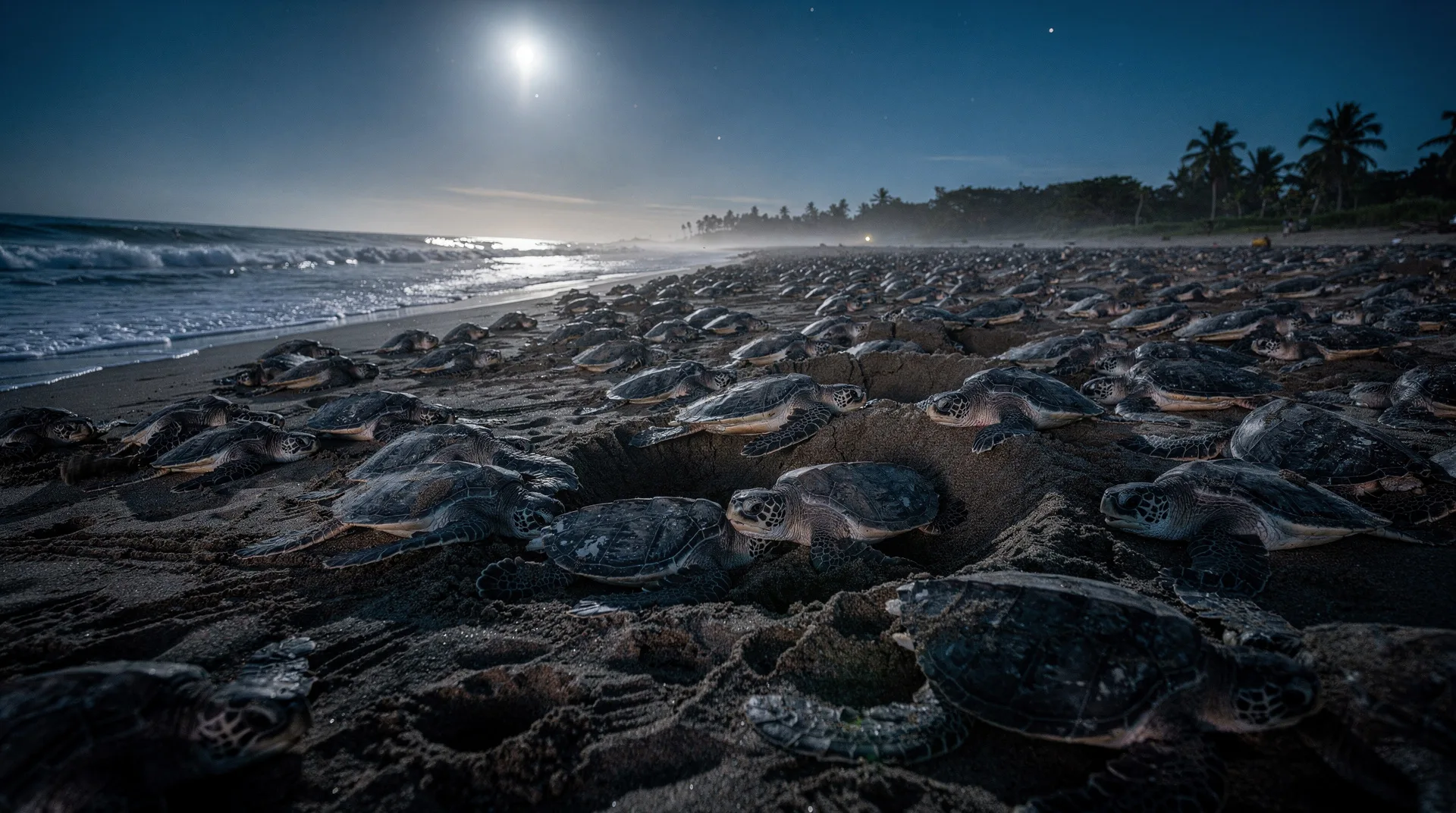
Ostional arribada: witnessing mass Olive Ridley nesting
What is the arribada?
Mass nesting Olive Ridley turtles, monthly Aug–Dec on waning moon — thousands at once.
The most dramatic wildlife event in Costa Rica
In the predawn darkness at Ostional, on the remote Nicoya Peninsula coast, something happens that has no real parallel in the wildlife-watching world. Within the space of a few hours, thousands of Olive Ridley sea turtles emerge simultaneously from the ocean and flood the beach to nest. The sheer density of animals — the sound of shells, the tracks in the sand, the smell of the ocean heavy in the air — is the kind of experience that rewires how you think about the natural world.
This is the arribada (Spanish for “arrival”), and Ostional Wildlife Refuge is one of only three or four beaches in the entire world where it happens reliably. Understanding how, when, and how to visit it responsibly is what this guide is for.
| Where | Ostional Wildlife Refuge, 15km south of Nosara |
| When | August–December, peaking September–October, on the waning moon |
| Cost | Around $10–15 for an ADIO-certified local guide |
| Getting there | 4WD essential in rainy season (May–November) |
| Booking | No advance reservation — confirm via local guides 24–48hrs out |
What is the arribada?
The word describes a synchronised mass nesting event involving Olive Ridley sea turtles (Lepidochelys olivacea). Unlike most sea turtle species — where females come ashore singly or in small groups throughout the night — Olive Ridleys at Ostional aggregate offshore for days before simultaneously landing in numbers that can reach 100,000 or more during peak events.
No one fully understands why they do this. The leading theory involves chemical signalling and possibly magnetic field navigation. What researchers at Ostional have observed over decades of study is that the trigger is almost always the waning moon phase — specifically the nights just after the full moon when light levels are dropping. The timing is consistent enough that local guides and researchers can predict arrivals within a day or two.
What happens during an arribada
- In the days before the event, local fishermen and researchers notice turtles aggregating in the shallow water offshore (palancas)
- At dusk or during the night, the first females emerge — slowly at first, then in accelerating numbers
- Over 3–7 days, waves of turtles continue coming ashore around the clock
- Each female excavates a nest, lays approximately 100 eggs, covers the nest, and returns to the sea
- In the final days, the beach may be so densely packed that later-arriving turtles dig up the eggs of those who nested earlier — this natural egg destruction is not waste; the resulting organic matter supports local marine productivity
The sight of hundreds or thousands of turtles on a beach simultaneously is genuinely overwhelming. It is not a zoo encounter. These animals are not performing for visitors — they are engaged in one of the oldest biological imperatives on earth.
Season and timing
Ostional arrivals occur August through December, with the largest events in September and October. Each event is triggered by the waning moon, so there are roughly 4–5 events per season — one per lunar cycle.
The June and July period sometimes sees small, irregular arrivals, but these are not reliable enough to plan a trip around. The season effectively ends in December, though occasional solitary nesting continues into January.
How to predict an event: The Ostional Development Association (ADIO) and local guides maintain real-time information networks. If you are in Nosara (15 km north) or Sámara (30 km south), local guides and surf shops often know when an event is underway or imminent. Facebook pages maintained by local conservation groups also post updates.
There is no centralised advance booking system for arrivals — you cannot reserve a “slot” for a specific event because the exact timing is not known until 24–48 hours before. Flexibility is essential.
How to visit responsibly
Ostional Wildlife Refuge is co-managed by SINAC and the community organisation ADIO. This co-management model is one of the most interesting conservation stories in Central America.
The ADIO model: legal, sustainable egg harvesting
Here is something that surprises many visitors: egg collection at Ostional is legal during the first 36 hours of an arribada, and it is managed by the local ADIO community. This is not exploitation — it is a science-based concession. Research has shown that eggs laid during the first phase of an arrival are frequently dug up and destroyed by later arrivals anyway. Collecting a portion of these first-phase eggs, and selling them through a regulated local cooperative, provides community income that directly funds the guard patrols that protect the remaining eggs from poachers.
The model works. The Ostional colony has remained one of the most stable and abundant in the region while other Olive Ridley beaches have seen dramatic declines.
What this means practically: you may see community members collecting eggs during an arrival. This is legal, regulated, and conservation-compatible. It is emphatically not the same as poaching.
Rules for visitors
- Stay within the roped visitor area assigned by the refuge guard
- No white flashlights — red-filtered lights only (same principle as Tortuguero)
- No flash photography
- Do not touch the turtles
- Stay on the wet-sand line — do not walk through dry sand covered in turtle tracks or nest sites
- Hire a local ADIO-certified guide for arrivals — the $10–15 guide fee goes directly to community conservation
Who to hire
Guides from ADIO operate out of Ostional village (20 minutes off the main road from Nosara). Do not hire guides offering “private access” through back routes — they are not ADIO-affiliated and access restrictions exist for conservation reasons. Reputable Nosara-based lodges and surf camps can connect you with verified local contacts.
If you are based in Nosara and want to combine turtle watching with the wider local culture and food, the traditional Costa Rican cooking experience there is an excellent complement to an evening at Ostional:
Nosara: traditional Costa Rican cooking class and meal — from $95Getting to Ostional
Ostional is approximately 15 km south of Nosara and 30 km north of Sámara. The road from Nosara is unpaved and requires a 4WD during the rainy season (May–November). During the dry season, a regular car can manage it in good weather.
Public buses from Nicoya town (Santa Cruz direction) pass through Ostional once daily — useful for longer stays in the area. Most visitors arrive from Nosara by rented 4WD or as part of an organised evening from a local lodge.
There are no hotels in Ostional village itself — a few basic cabinas exist, run by community families. The nearest mid-range accommodation is in Nosara or Sámara.
What Ostional is — and is not
Ostional is not a comfortable, curated experience. The beach is remote, the access road can be brutal in wet season, and there is no guarantee of an arrival on any given night. If you time it wrong, you may see ordinary solitary nesting, which is beautiful but not the same spectacle.
It is also not Tortuguero. Tortuguero is an infrastructure-rich eco-tourism destination with established lodges, organised night tours, and strong conservation credentials. Ostional is a working community village with a conservation cooperative. The infrastructure is simpler, the access more independent, and the experience rawer.
If you value authenticity, community connection, and honest wildlife encounters over polished delivery, Ostional is one of the most remarkable places in Costa Rica. If you want guarantees, comfortable lodges, and reliable logistics, plan for Tortuguero instead — and use Ostional as a bonus if timing works.
Reading the beach once you are there
An arribada is easier to appreciate if you slow down. Spend the first few minutes simply standing at the edge of the visitor area and listening before you raise a camera. Look at the pattern of tracks, watch how females pick their spot, and notice how the guides move quietly and keep groups small. Patience is the main skill here, and it pays off in a way that rushing never does. If you enjoy photography, the wildlife photography tips guide covers low-light habits that translate well to a dark beach without any flash.
A few practical habits make the night smoother:
- Dress for sun, sand and wind, and bring a layer for the small hours
- Wear shoes you do not mind soaking, since the wet-sand line is where you will spend your time
- Carry only what you need, and keep your phone light dimmed or red-filtered
- Respect the guide’s pace and the guard’s instructions, even when a better view seems a few steps away
If you are travelling with children, read the family travel tips first. A long night on a remote beach suits patient older kids far better than restless toddlers, and the beach safety guide is worth a look for surf and tide awareness after dark.
Combining Ostional with Nosara and the Nicoya Peninsula
Nosara is the natural base. It offers reliable accommodation across all price points, excellent surf at Playa Guiones, a small international food scene, and regular transport links. From Nosara you can:
- Drive to Ostional in 20–30 minutes (4WD essential in rainy season)
- Continue south to Sámara (30 minutes) for quieter beaches and family-friendly swimming
- Head north to Junquillal or Marbella for truly empty beaches
The Nicoya Peninsula beaches guide maps out the full coastal route and what each beach offers.
For more on the base town, see the Nosara destination page, the Nosara surf guide for the waves at Playa Guiones, and the Sámara destination page if you prefer a calmer second base. Between turtle nights, the Nosara yoga retreats guide suggests gentle ways to spend the days, and the Guanacaste destination page places the whole stretch in its wider regional context.
If you would rather watch turtles near Tamarindo on a night when no arribada is running, a guided evening outing such as a night-time turtle nesting outing — from $95 is a more structured option, though it is a different experience from the mass event.
Planning around uncertainty
The single hardest thing about an Ostional trip is that you cannot book it like a normal tour. Build in at least 3-4 nights in Nosara or Sámara if witnessing an arribada matters to you, rather than a single overnight stop — this gives the waning-moon window a real chance to fall inside your trip. Travellers on a tight one-week itinerary who cannot flex their dates should treat an arribada sighting as a bonus rather than the centrepiece, and lean on more reliably scheduled wildlife experiences (Manuel Antonio’s resident sloths and monkeys, or a Corcovado day trip) to anchor the plan.
For broader context on how to approach wildlife encounters generally, wildlife watching ethics is worth reading before any Costa Rica trip built around animal sightings, and bird watching itineraries is a useful companion if you’re stringing together several wildlife-focused stops.
Frequently asked questions about the Ostional arribada
How many turtles actually come during an arribada?
Major events involve between 30,000 and 200,000 females over the course of 3–7 days. Smaller events — particularly early in the season in August — may involve only a few thousand. Numbers vary considerably from event to event and from year to year.
Can I visit Ostional outside of an arrival?
Yes. Solitary nesting occurs throughout the season (August–December), and even outside of arrivals you may encounter individual females nesting at night. The beach is also beautiful during the day and worth visiting for the dramatic landscape even without a turtle event.
Is the egg harvesting really conservation-positive?
The research evidence supports the ADIO model. Studies by Universidad de Costa Rica biologists have found that the controlled first-phase harvest does not reduce overall hatchling production, and that the community income generated by the legal cooperative directly funds guard patrols that deter illegal poaching of eggs from later, undisturbed nest phases. The model is cited internationally as an example of community-based conservation economics.
How far is Ostional from Tamarindo?
Tamarindo is approximately 2 hours north of Ostional by road. The route passes through Santa Cruz and Nicoya and is paved most of the way. It is feasible as a day trip with an early start, though the night-time focus of turtle watching makes a same-day return impractical. An overnight stay in Nosara is the better logistics choice.
Is the road to Ostional passable without a 4WD?
During dry season (December–April), high-clearance vehicles can manage the road. During rainy season (May–November), a 4WD with good ground clearance is genuinely necessary — the road has river crossings and deep ruts that are impassable in a standard sedan. Do not attempt it at night in a 2WD.
Are Olive Ridley turtles endangered?
The global population of Olive Ridley turtles is classified as Vulnerable (not Critically Endangered, unlike leatherbacks and hawksbills). However, several regional populations are in steep decline due to longline fishing bycatch, coastal development, and illegal egg harvest. The Ostional colony is one of the most stable in the world precisely because of the community management model.
Related guides
If the dates simply do not line up, the best time to visit Costa Rica and the green season pros and cons guides help you judge how much of a trip in the wet months is worth building around turtles. The Tortuguero destination page is the natural fallback, and a guided outing such as a green turtle nesting night walk — from $55 gives a more predictable encounter.
Sea turtle nesting in Costa Rica happens across multiple species and multiple beaches. The Tortuguero turtle nesting guide covers green and leatherback nesting on the Caribbean coast. The Playa Grande leatherback guide focuses on the Pacific’s most important leatherback site. And for a broader framework for thinking about all wildlife encounters, wildlife watching ethics is essential reading before any of these visits.