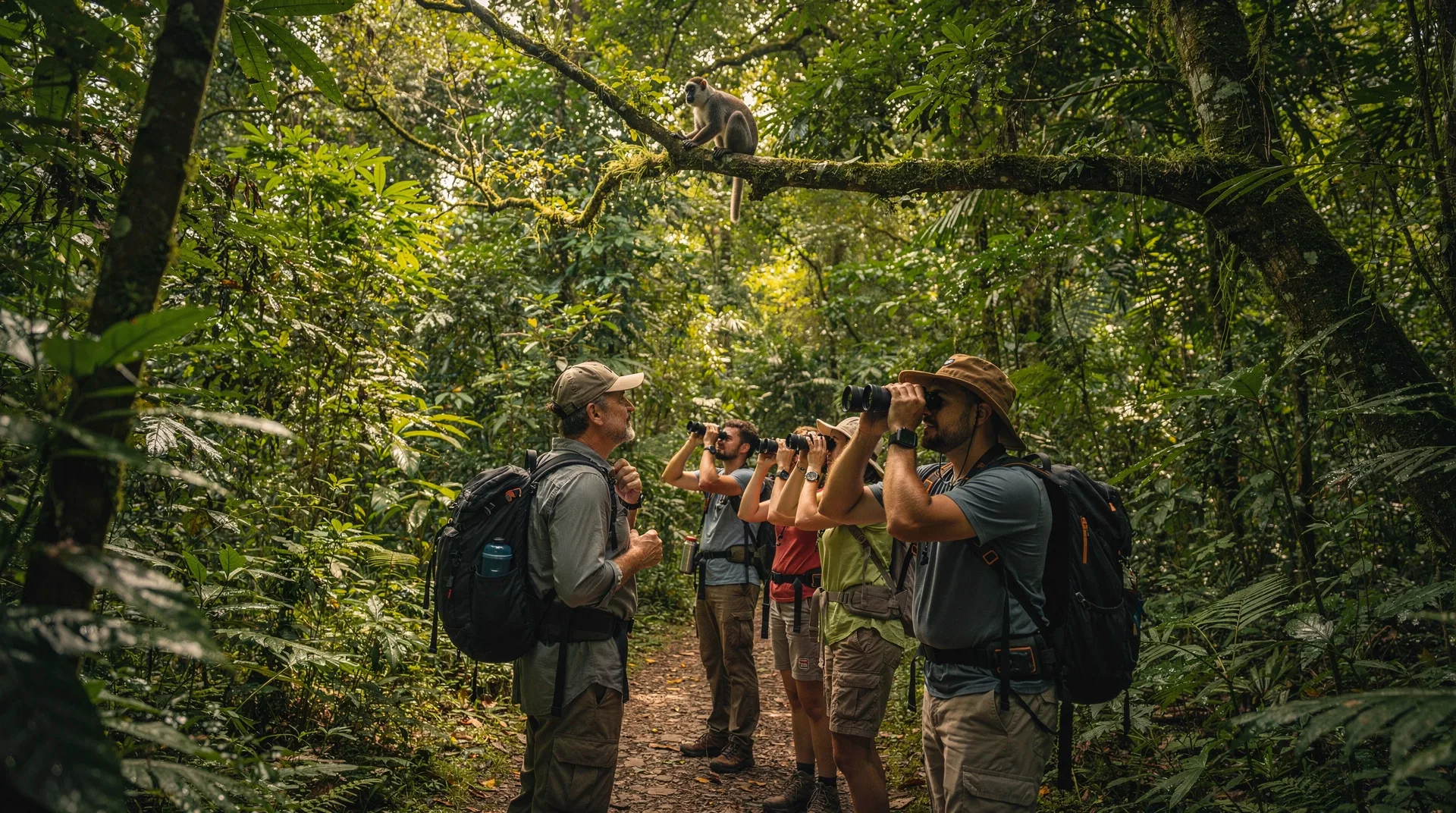
Wildlife watching ethics in Costa Rica: the honest guide
Ethical wildlife watching?
No flash, no feeding, certified guides only — Costa Rica's ICT program is the standard.
The gap between marketing and reality
Costa Rica has built its tourism identity around the word “eco.” The country receives nearly 2 million international visitors per year, and the phrase “responsible ecotourism” appears in virtually every lodge description, every tour company brochure, and most travel articles about the destination. The marketing is consistent.
The reality is more varied. Some operators in Costa Rica set genuinely high standards for wildlife interaction — knowledgeable guides, adherence to approach distances, education of clients, refusal to offer experiences that harm animals. Others use the language of ecotourism while running operations that are harmful, extractive, or simply uninformed.
This guide is designed to give you the practical knowledge to tell the difference — and to be a genuinely respectful visitor regardless of what your tour operator does or does not tell you.
| Standard to check | ICT/CST certification (0–5 leaves) at ict.go.cr |
| Guide certification | SINAC guide registry, park-specific (turtles, naturalist, leatherback) |
| Universal rules | No flash, no feeding, no touching, keep minimum distances |
| Report violations | SINAC wildlife line +506 2522-6597 |
| Applies at | Tortuguero, Manuel Antonio, Marino Ballena, Corcovado, Monteverde |
Costa Rica’s ICT certification system
The Instituto Costarricense de Turismo (ICT) operates the Certification for Sustainable Tourism (CST) program — a graded system for rating tourism businesses on sustainability criteria, including environmental, social, and economic dimensions. Businesses earn between 0 and 5 “leaves,” with 5 representing the highest standard.
The CST certification is publicly searchable at the ICT website. Before booking any lodge, tour company, or wildlife experience, you can verify whether they are CST-certified and what leaf level they hold. This is not the only indicator of quality, but it is the most standardised one available.
Important caveat: CST certification covers broad sustainability metrics, not specifically animal welfare. A 4-leaf certified company is demonstrably committed to sustainability across multiple dimensions; it does not automatically mean their wildlife encounters are ethically conducted. Use CST as one input among several.
SINAC (Sistema Nacional de Áreas de Conservación), which manages Costa Rica’s national parks, issues separate guide certification for operators in specific parks — including Tortuguero (turtle guides), Manuel Antonio (naturalist guides), and Las Baulas (leatherback monitors). These certifications are specific to the encounter type and require training.
The universal rules: what never to do
These rules apply regardless of where you are — whether watching turtles at Tortuguero, whales at Marino Ballena, sloths in Manuel Antonio, or birds in Monteverde:
No flash photography — ever
This deserves its own section because it is the most commonly violated rule and the one with the most direct impact.
White light — including camera flash and phone screens — causes measurable harm in specific contexts:
- Nesting turtles: A nesting female exposed to white light may abort the nesting process and return to the sea, losing an entire clutch. Hatchlings use light to navigate toward the ocean; artificial white light on beaches causes them to move inland, where they die
- Nocturnal animals: Bats, kinkajous, potoos, and frogs have eyes adapted for low-light conditions. Sustained bright light causes temporary blindness and genuine stress
- Birds during nesting: Flash at a nest site can cause parental abandonment
The rule is simple: at night, in low-light conditions, and whenever a guide tells you no flash, no flash. Ever. No photograph is worth the harm.
No feeding
Feeding wildlife habituates animals to human presence and human food — both outcomes are harmful.
Habituated animals lose appropriate fear of humans and may approach vehicles, lodges, and humans in non-tourist situations where they will be killed. White-nosed coatis habituated to tourists in Manuel Antonio are among the most visible examples of this problem — they approach tables aggressively and have bitten children and adults.
Feeding also disrupts nutritional behaviour. Animals that associate humans with food forage less naturally, and the food given — usually fruit, crackers, or similar — is often nutritionally inappropriate for the species.
If a guide or local person offers to “get the monkeys to come closer” by throwing food, this is a red flag. Walk away from that guide.
Minimum approach distances
Different authorities set different minimum approach distances. The general standards that apply in Costa Rica:
- Sea turtles: 100m when on beach, no approach from front; wait for guide confirmation before approaching a nesting female
- Humpback whales: 100m from any individual; 200m from mother-calf pairs; engine cut to idle within observation range
- Dolphins: No swimming with wild dolphins in national park waters
- Sloths: 10m minimum — sloths in trees are not as passive as they appear; the stress response of being approached closely affects their digestion and immune function
- Crocodiles: Do not wade, swim, or approach bank from water side; minimum 5m on dry land
- Monkeys: Do not approach groups; howler monkeys in particular will throw faeces and branches if stressed
Noise levels
Wildlife responds to sound as much as to light and proximity. Loud voices, music from tour boats, and shouting near nesting sites or roosting birds causes flushing behaviour and chronic stress. Guides will signal when to lower voices. Follow immediately without being asked.
No wildlife selfies
Operators who offer direct contact with wildlife — holding sloths, touching monkeys, posing with sedated animals — are causing harm regardless of how the experience is framed. If an animal is calm enough to be held by a tourist, it is either very sick, very stressed, or sedated. A healthy, wild sloth does not want to sit on your shoulder for photographs.
This extends to any experience advertised as “hold the [animal]” or “pose with the [animal].” These are not ecotourism experiences. They are extractive tourism experiences dressed in ecotourism language.
Quick reference: minimum approach distances
| Animal | Minimum distance | Key rule |
|---|---|---|
| Sea turtles (nesting) | 100m, rear approach only | No white light or flash, ever |
| Humpback whales | 100m (200m mother-calf) | Engine idle within observation range |
| Sloths | 10m | Never touched or “banged” from trees |
| Crocodiles | 5m on dry land | Never wade or approach from water |
| Monkeys | No approach to groups | Never feed to encourage proximity |
This table summarises the rules above for quick reference before a tour — the detailed reasoning for each is covered in the sections that follow.
How to identify ethical operators
Questions to ask before booking
- “Do your guides hold current SINAC or ICT guide certification for this specific experience?”
- “What is your approach protocol for [turtles/whales/sloths/etc.]?”
- “What is your group size limit?”
- “Do you work with a research organisation or conservation body?”
- “What is your no-flash policy, and how do you enforce it?”
An operator who bristles at these questions or answers them vaguely has told you something important.
Red flags in marketing language
- “Guaranteed sightings” of any wild animal
- “Get up close with the wildlife”
- “Swim with dolphins”
- “Hold a sloth”
- “100% natural experience” with no mention of guide certification
- “Private beach access” for turtle watching outside of authorised times
Green flags
- Guide names listed on the SINAC registered guide database
- CST certification verifiable at ICT website
- Small group sizes (8–12 maximum for turtle tours, under 20 for whale watching)
- Pre-departure briefing on rules and expected behaviour
- Willingness to cancel or abort if conditions are wrong for the animals
Specific encounter ethics by species
Sloths
Manuel Antonio National Park is the easiest place in Costa Rica to see sloths — which is partly a problem, because the high visitor pressure means sloths in this park are among the most stressed in the country. A good naturalist guide will find animals without using the technique of banging trees to make them move.
Three-toed sloths are more common and diurnal (active in daylight). Two-toed sloths are larger and more nocturnal. Both species should only be observed from a minimum of 10 metres and never touched. If you are offered a “sloth selfie” in any context other than a licensed rescue and rehabilitation centre — refuse.
Drake Bay: bird watching tour — from $95Monkeys
All four Costa Rican monkey species — howlers, spider, capuchin, and squirrel — are found in national park settings where habituated individuals may approach tourists who have previously fed the group. Do not be the person who continues this cycle. Capuchins in particular can be aggressive when food-conditioned, and bites from wild primates require medical attention. See the monkey species of Costa Rica guide for behaviour and identification specifics for each species.
Sea turtles
The rules for each beach are described in the individual guides for Tortuguero, Playa Grande, and Ostional. The shared principles: no white light, no flash, no touching, rear-approach only, follow guide instructions immediately.
Whales and dolphins
Marine mammal watching in Costa Rica is governed by SINAC regulations within national park waters. Outside park waters — including approaches to cetaceans on the open ocean — operators are theoretically regulated but less consistently enforced. Choose operators who follow 100m approach distances even when not legally required to, because those operators are doing it because they genuinely care about the animals rather than because they fear a fine.
Night tours and nocturnal wildlife
Night walks are among the most ethically sensitive tours in Costa Rica because the majority of species encountered — frogs, snakes, kinkajous, owls, tarantulas — have eyes adapted for near-total darkness and are genuinely stressed by sustained light. A responsible night tour uses red-filtered flashlights where possible, keeps white light beams brief (a few seconds of illumination, not sustained spotlighting), and limits group sizes so that fewer beams are pointed at a single animal at once. Our nocturnal wildlife guide covers this in more depth, including which operators in Monteverde and Arenal are known for lower-impact protocols.
Bird photography and playback calls deserve a specific mention: guides who use recorded bird calls to draw a species closer for viewing can produce spectacular sightings, but repeated or aggressive playback disrupts territorial and mating behaviour. Ask whether your guide uses playback sparingly and only for common, non-vulnerable species — the bird watching itineraries guide discusses which regions and operators are considered best practice.
The honest truth about “rescue centres”
Costa Rica has a large number of wildlife rescue and rehabilitation centres, ranging from world-class operations to problematic roadside attractions dressed in conservation language.
Legitimate rescue centres: These facilities take in injured, orphaned, or confiscated wild animals with the goal of rehabilitation and release. They do not breed animals for display, do not allow public contact with wildlife except under specific supervised conditions for education, and can demonstrate release records. Examples include the Jaguar Rescue Center (Caribbean), the Toucan Rescue Ranch (Heredia), and the Sloth Sanctuary of Costa Rica (Limón).
Problematic “sanctuaries”: Facilities that allow unlimited public contact with animals, that breed animals rather than rehabilitate them, that keep healthy wild-caught animals rather than confiscated ones, or that have no stated release programme are not rescue operations — they are petting zoos using conservation language. Research any centre before visiting using Yelp and TripAdvisor reviews from biologists and animal welfare advocates rather than general tourists.
A practical filter: ask the centre directly what percentage of current residents are release candidates versus permanent, non-releasable animals, and ask for their most recent release numbers. A legitimate centre answers specifically and without hesitation. Vague answers, or a heavy emphasis on selfie opportunities in their marketing, are reliable warning signs regardless of how professional the facility looks on arrival.
What you can do as a visitor
Beyond following rules during encounters, thoughtful visitors can contribute positively in several ways:
- Report violations: SINAC has a wildlife crime reporting line (+506 2522-6597). If you witness a guide violating approach rules with turtles, or an operator encouraging feeding, report it
- Choose certified operators: your spending directly funds either ethical or unethical operations
- Leave tracks only: Stay on marked trails, do not collect shells or coral, do not take any organic material from national parks
- Support conservation organisations: The Sea Turtle Conservancy, Corcovado Foundation, and similar organisations have donation mechanisms that directly fund field research
Frequently asked questions about wildlife watching ethics
Is it ethical to visit a zoo or aquarium in Costa Rica?
Costa Rica’s main aquarium in San José has mixed reviews from animal welfare advocates. The country’s public zoos have historically faced criticism for enclosure conditions. Visiting in-country zoos is a personal decision, but the genuine wildlife encounters available in Costa Rica’s national parks are vastly superior to anything a zoo can offer — and arguably more ethical because the animals are wild and in their natural habitat.
Can I touch wild animals at any legitimate facility?
Only under very specific conditions at licensed rehabilitation centres, under direct staff supervision, and only with species for which handling is considered low-impact for that specific individual (often animals that cannot be released). No legitimate facility offers open public handling of primates, big cats, or sea turtles for tourism purposes.
What should I do if I see someone feeding monkeys?
Politely inform them that feeding wild primates is harmful and is prohibited in national parks. Guides should enforce this — if a guide is the one doing it, report the guide to SINAC. You are not being a killjoy by saying something.
Are ziplining and ATV tours harmful to wildlife?
Ziplines through forest cause acoustic disturbance in the canopy. Reputable zipline operators in Monteverde and Arenal operate within designated corridors that minimise crossing through sensitive nesting habitat. ATV tours on beach or forest trails can cause soil compaction and disturb ground-nesting species. These activities are not inherently harmful, but operator responsibility matters — ask about their route design and habitat impact before booking.
Is it okay to photograph wildlife normally (without flash)?
Natural light photography of wildlife from appropriate distances is entirely compatible with ethical wildlife watching. The key qualifiers: appropriate distance (10m minimum for sloths; 100m for turtles or whales), no flash in any context, and no pursuing or flushing behaviour to get a better angle. Document what you find without forcing the encounter.
Related guides
Ethics at wildlife encounters is the foundation; the individual guides for each species and location build on it. Read tortuguero turtle nesting guide for the specific protocol at Costa Rica’s most-visited turtle beach, or uvita whale watching season for the marine mammal encounter standards at Marino Ballena.
The wildlife photography tips guide translates ethics into practical camera technique. For the broader ecological picture, our Costa Rica wildlife overview and Costa Rica marine life guide provide the context behind why these rules exist.