Rent a car in Costa Rica or not? Honest decision guide
Should I rent in Costa Rica?
Most itineraries yes — a 4WD gives freedom and access impossible by shuttle. Urban-only or single-resort trips don't need one.
The honest answer: most itineraries benefit from a rental car
Costa Rica is one of those destinations where the transport question has a real answer rather than a vague “it depends.” If your trip covers two or more distinct regions — say, Arenal plus Manuel Antonio, or Monteverde plus the Nicoya Peninsula — a rental car makes your itinerary dramatically more flexible, cheaper per day than equivalent shuttle coverage, and gives you access to waterfall viewpoints, crater drives, and national park entrances that shuttle services don’t reach.
| Rent if | multi-region itinerary, Nicoya/Osa, want early wildlife hours |
| Skip if | single beach resort, urban San José only, backpacker budget |
| Cost | around $25-100/day depending on season and vehicle |
| 4WD needed for | Monteverde, Drake Bay, Osa Peninsula secondary roads |
| Alternative | shuttles ~$55-65/person/leg, or public buses ~$4-5 |
If you’re spending your entire trip in a single beach resort in Guanacaste, flying into Liberia, taking a transfer to your hotel, and not leaving except on organised day tours — you don’t need a rental car.
Everything else falls somewhere between those two poles. This guide helps you locate your trip on that spectrum.
When a rental car is the right choice
Multi-region itineraries
The classic Costa Rica circuit — San José, Arenal, Monteverde, and Manuel Antonio — involves four region changes across 7–14 days. Shuttle services cover all four legs but require booking each segment separately, cost $50–70 per person per leg, and constrain your departure times to the operator’s fixed schedule. A rental car costs $35–100 per day (depending on season and vehicle type) and lets you leave when you want, stop where you want, and change plans when the weather shifts.
Real cost comparison for two adults, 10-day trip:
Shuttle option (four legs × $55–65 per person): approximately $440–520 total transport cost
Rental car (10 days × $55/day SUV green season + $25/day insurance): approximately $800 total — but includes unlimited stops, national park drives, beach access roads, and day trips that would cost $120–180 each as an organised excursion.
For groups of three or more adults, the rental car almost always wins economically.
The Nicoya Peninsula and southern Osa
Several of Costa Rica’s best destinations are genuinely inaccessible without a vehicle. Cabo Blanco Nature Reserve, the back road from Cóbano to Montezuma, the Río Baru bridges south of Dominical, and most of the roads around Drake Bay require either a 4WD or, at minimum, a high-clearance vehicle. Shuttles don’t go there, and if they did, you’d miss every spontaneous stop.
For families with children, the flexibility to stop at a roadside waterfall, pull over for a sloth sighting on the power line, or take a detour to a quiet beach is practically impossible to replicate with shuttles.
Choosing your own pace
Costa Rica’s morning wildlife hours (6–9am) are when most animals are active. A rental car lets you be at the Místico bridges by 7am before the organised tour groups arrive, at the Manuel Antonio park gate at opening, or at the Poás crater viewpoint before the clouds form. Shuttle services typically depart mid-morning when the wildlife window has closed.
When you don’t need a rental car
Single-destination beach vacations
If you’re flying into Liberia (LIR) and going directly to Tamarindo, Playa Conchal, or a Papagayo resort, an airport transfer (private or shared) gets you there without the stress of driving. Day tours to Rincón de la Vieja or Diamante Park depart from resort areas with hotel pickup. A rental car is an added expense and complexity you don’t need.
Urban San José trip
If you’re spending two nights in San José before flying onward to South America or combining Costa Rica with Panama, you need exactly nothing for transport. Uber works well throughout San José and costs $5–12 per ride. Taxis are metered and reliable. The city’s road system is navigable but parking is expensive and stressful.
Backpacker routes on public buses
Costa Rica’s public bus network is extensive, cheap (San José to La Fortuna: ~$4; San José to Manuel Antonio: ~$5), and surprisingly reliable on main routes. For budget travellers willing to accept fixed departure times and 4–5 hour journeys, the bus system covers the major tourist circuit without any rental car expense. See our shuttle services overview for the middle ground between public bus and rental car.
Choosing the right vehicle
4WD: is it really necessary?
Costa Rica’s tourism operators and rental agencies have an obvious interest in renting you the most expensive vehicle possible. So let’s be specific: which destinations genuinely require 4WD and which don’t.
4WD necessary:
- Monteverde (the road from the Pan-American to the reserves is unpaved and deeply rutted for 35 km — rental agencies will void standard insurance coverage if you attempt it in a 2WD)
- Drake Bay road section (Ruta 245 from Rincón includes river crossings)
- Osa Peninsula secondary roads
- Most dirt roads to private reserves and off-the-beaten-path beaches
4WD recommended but not strictly necessary (in dry season):
- Caño Negro access roads
- Ruta 606 (Sardinal to Carrillo) in Guanacaste
- Rural Caribbean roads (Ruta 36 south of Limón — 2WD possible but higher clearance better)
2WD sufficient:
- SJO to La Fortuna (Ruta 4 via Ciudad Quesada — paved throughout)
- SJO to Manuel Antonio (Ruta 27 to Pacific coast — paved motorway)
- Tamarindo, Nosara, Samara via main Nicoya highways
- La Fortuna to San José
The practical recommendation: book a 4WD unless you’re certain your entire itinerary uses only Ruta 1, Ruta 27, and the Guanacaste coastal highway. 4WD gives peace of mind in the green season when even paved sections flood.
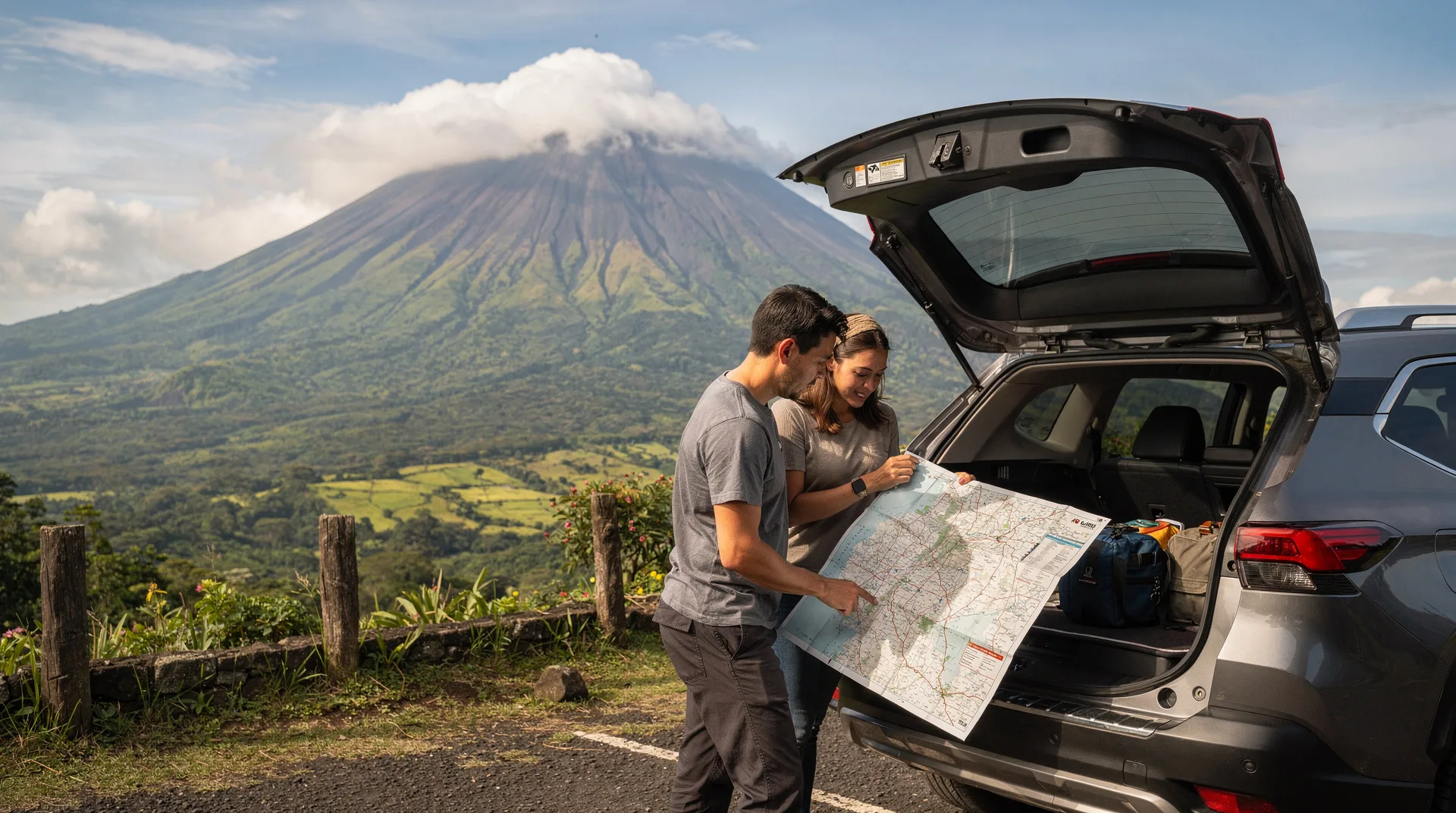
Sketch your route stop by stop and note which legs stay on the paved Ruta 4 or Ruta 27 and which drift toward Drake Bay or the Osa Peninsula. A mixed itinerary is where the vehicle class matters most, so choose the class that covers your toughest leg, and you can compare 4WD and 2WD cars on DiscoverCars for your dates.
Rental car costs in 2026
Daily rates
| Season | Economy 2WD | SUV 4WD | Insurance add-on |
|---|---|---|---|
| Green season (May–Nov) | $25–40/day | $35–65/day | $20–30/day |
| High season (Dec–Apr) | $40–70/day | $55–100/day | $20–30/day |
Insurance is the critical variable. Costa Rica has a mandatory minimum liability insurance (SLI/TPL), but collision and comprehensive coverage is additional. The mandatory basic liability is included in the rental rate but covers only third-party damage. For a trip where you’ll be driving mountain roads, river crossings, and unpaved surfaces, the full CDW (Collision Damage Waiver) at $20–30 per day is strongly recommended.
Best rental car companies in Costa Rica
The three operators with the best reputation for honest insurance pricing and vehicle quality:
Adobe Rent A Car — Costa Rica-owned, excellent vehicle maintenance, honest about what insurance covers, no hidden fees. Available at SJO and LIR.
Vamos Rent A Car — Strong reputation for 4WD quality and transparent pricing. Slightly higher rates but fewer disputes.
Solid Rent A Car — Competitive pricing, good vehicle fleet, honest customer service. Popular with repeat visitors.
Avoid: Several international chains (whose names appear on major booking platforms) have well-documented complaints about mandatory additional fees charged at pickup, aggressive insurance upselling, and disputed damage charges. The Costa Rican tourism consumer protection website (ICT) publishes complaints by company — always check before booking a company you don’t recognise.
The SJO airport rental car scam: protect yourself
The most common rental car problem in Costa Rica occurs at the SJO airport pickup counter. Some operators:
- Claim your existing insurance (from your credit card or third-party provider) is “not recognised” in Costa Rica and pressure you to purchase their full coverage at $60–100/day
- Document pre-existing minor damage as “new” upon return and hold your deposit
- Add mandatory extras (booster seats, GPS, liability upgrades) that inflate the daily rate
Protections:
- Photograph and video every panel, bumper, wheel, and interior before leaving the lot. Walk the agent through your photos and get their confirmation in writing.
- Verify in advance whether your credit card’s rental car benefit covers Costa Rica (many do, but read the policy — some exclude CDW coverage for 4WD vehicles)
- Book only with reputable local companies (Adobe, Vamos, Solid) that have established dispute procedures
- Print your reservation confirmation — verbal agreements at pickup are not binding
Alternatives to renting: when shuttles make sense
If you’re travelling alone or as a couple, the per-person shuttle cost for 3–4 legs can be less than a rental car. Key operators:
Interbus and GrayLine serve the main tourist circuit (San José, La Fortuna, Monteverde, Manuel Antonio, Tamarindo) with hotel-to-hotel pickup. Interbus costs $55 per adult per leg, with free space for a carry-on bag.
Caribe Shuttle specialises in the Caribbean corridor (San José to Puerto Viejo, $65 per person).
For a private door-to-door experience without driving, private transfers can be booked through GYG:
Costa Rica: private transportation service — from $220 Shuttle services San José to La Fortuna — from $55The hybrid approach
Many experienced Costa Rica travellers use a hybrid model: fly into LIR, take a transfer to the Guanacaste coast for the first half of the trip (no car needed for beach resorts with day tours), then collect a rental car in Liberia for the second half when they’re driving to Arenal and Monteverde.
Similarly: arrive at SJO, use a shuttle to La Fortuna and Monteverde, then collect a rental car in Monteverde for the remaining Pacific coast section. This eliminates the most stressful driving (San José urban), but gives the freedom of a car for the scenic parts of the route.
Frequently asked questions about renting a car in Costa Rica
Can I drive to Monteverde without a 4WD?
Technically yes, but rental agencies consider the Monteverde road (Ruta 606 — 35 km of dirt and gravel from the Pan-American) beyond the coverage of standard insurance. If you have an accident on a road that requires 4WD capability, your CDW may not cover the damage. The practical answer is: rent a 4WD for any trip that includes Monteverde. See our road conditions guide for a detailed assessment.
Does my credit card cover rental car insurance in Costa Rica?
Many premium credit cards (Visa Signature, Mastercard World Elite, American Express Gold) include CDW coverage for rental cars up to a certain value, but coverage terms vary significantly. Common exclusions: 4WD vehicles over a certain value, vehicles driven on unpaved roads, and rentals exceeding a specific daily rate. Read your card’s benefits PDF carefully before relying on it, and call the benefits hotline before departure to confirm Costa Rica coverage.
How old do I need to be to rent a car?
Most Costa Rican rental agencies have a minimum age of 21 (sometimes 23 for certain vehicle categories). Drivers aged 21–24 often face a young driver surcharge of $5–10 per day. International driving licence is not required — a valid home country licence in English (or with an official Spanish translation) is sufficient.
Is driving at night dangerous in Costa Rica?
Strongly avoid driving at night on secondary roads. The risks are specific: cattle and horses on the road with no lighting, unmarked potholes and unpaved sections that are invisible until your headlights are directly on them, flash flood debris across roads after afternoon rain, and occasional security concerns on isolated routes. Driving the paved main highways at night (Ruta 1, Ruta 27) is significantly safer but still less advisable than daytime travel.
How do I navigate in Costa Rica?
Download Waze and Google Maps offline for your intended regions before leaving your hotel WiFi. In Costa Rica, roads are frequently referenced by landmarks rather than street names (“200 metres north of the Banco Nacional”) — GPS coordinates or Waze’s crowd-sourced directions are more reliable than standard mapping. See our full driving in Costa Rica guide for navigation specifics.
Can I take my rental car on the Puntarenas-Paquera ferry?
Yes — vehicle reservations on the Naviera Tambor ferry are essential in high season. The crossing takes 1 hour 20 minutes and runs 4–6 times daily. Cost is approximately $25–30 for the vehicle, $1.50 per passenger. Book several days in advance during December–April peak season. See our ferry routes guide for full logistics.
Related guides
The driving in Costa Rica guide covers Waze setup, road number navigation, and what to do at river crossings. Our road conditions guide details which roads are worst by season. For families who decide against driving, the shuttle services overview covers all major operators and their routes. The airport transfers guide handles the arrival day specifically. If your itinerary spans a longer distance than driving comfortably allows, check internal flights with Sansa/Aerobell as a third option.