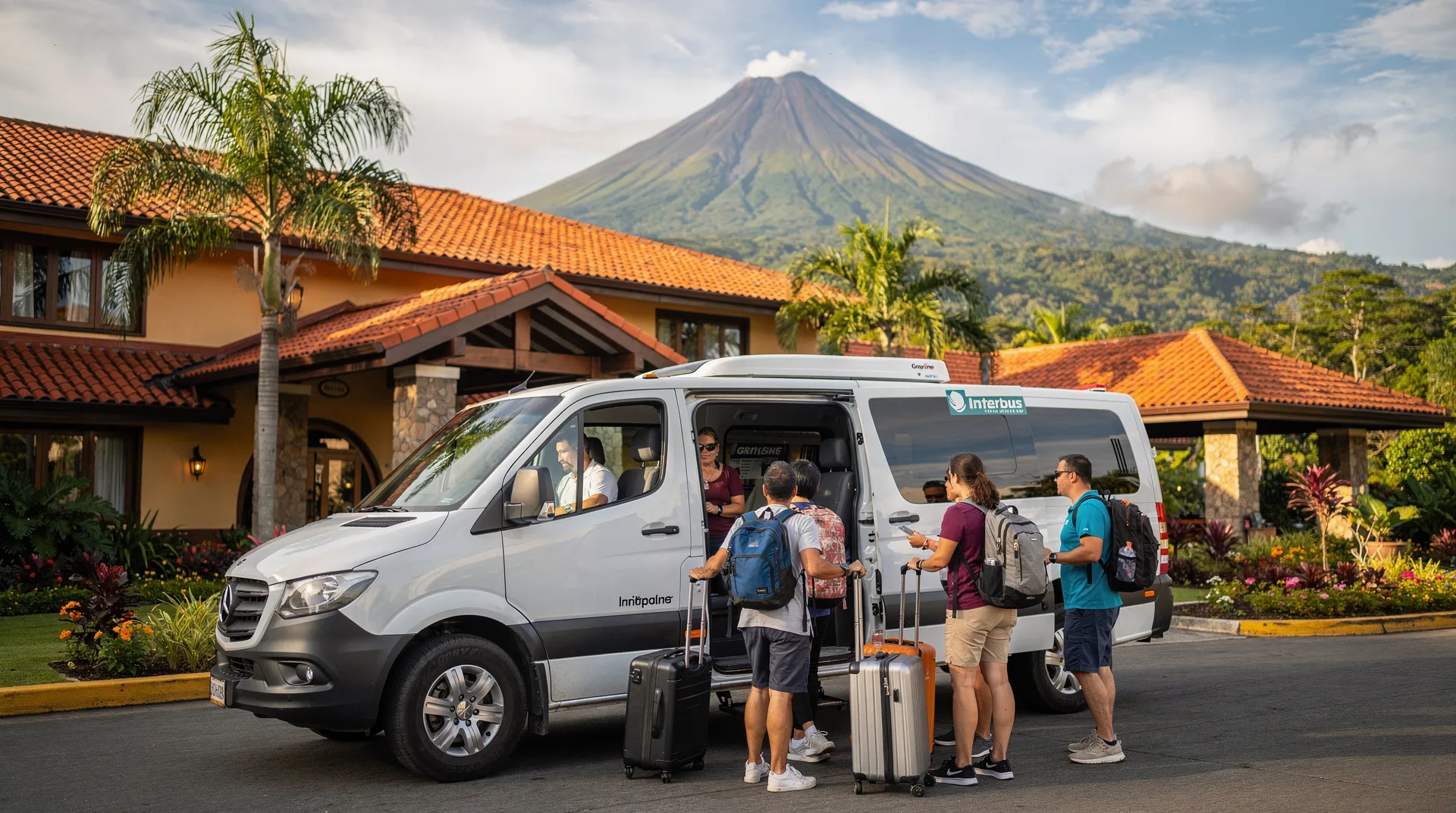
Shuttle services in Costa Rica: the complete operator guide
What are the best shuttle services in Costa Rica?
Interbus and GrayLine cover the main tourist circuit. Caribe Shuttle specialises in the Caribbean coast. Expect $50–70 per person per leg with hotel pickup included.
Shared shuttles are the default transport choice for most non-driving visitors to Costa Rica, and getting the operator and route right saves both money and travel-day stress.
| Main operators | Interbus, GrayLine, Caribe Shuttle (Caribbean) |
| Typical cost | $42–65 per person per leg |
| Booking window | 24hrs ahead min., 48–72hrs in high season |
| Best for | Solo travellers, couples, non-drivers |
| Skip if | You have a large group or want full route flexibility |
How shuttles work in Costa Rica
Private shared shuttles are the middle ground between Costa Rica’s cheap-but-slow public buses and the full freedom — and cost — of a rental car. For a solo traveller or couple covering the standard tourist circuit, shuttles represent the most practical transport option available: they run hotel-to-hotel, include your luggage, and cover the same routes that would otherwise require navigating unmarked secondary roads or absorbing the complexity of multiple public bus transfers.
The system works like this. You book a seat on a departing shuttle at least 24 hours in advance (48–72 hours during high season). A small van picks you up at your hotel in the morning, makes one or two additional pickups at nearby hotels, then drives directly to your destination. At the destination, each passenger is dropped at their individual accommodation. The whole process is clean, predictable, and requires zero navigation on your part.
Three operators dominate this market: Interbus, GrayLine, and Caribe Shuttle. Each has a different network focus, pricing structure, and quality level. Understanding the differences will save you both money and frustration.
Interbus: the most comprehensive network
Interbus is the largest and most route-diverse shuttle operator in Costa Rica. The company has been running since 1994 and now covers over 50 destinations, including routes that other operators do not offer. Their network spans San José, La Fortuna, Monteverde, Tamarindo, Nosara, Sámara, Manuel Antonio, Quepos, Uvita, Jacó, Puerto Viejo, Limón, and the Nicaragua and Panama borders.
Interbus pricing (2026 reference)
| Route | Price per person |
|---|---|
| San José → La Fortuna | $52 |
| La Fortuna → Monteverde | $42 |
| Monteverde → Tamarindo | $52 |
| Monteverde → Manuel Antonio | $62 |
| San José → Manuel Antonio | $52 |
| San José → Tamarindo | $62 |
| San José → Puerto Viejo | $65 |
| La Fortuna → San José | $52 |
These prices include hotel pickup and drop-off within the main tourist zone of each destination. Accommodations more than 2–3 km outside the zone may incur an additional pickup fee of $5–10, or require you to meet the shuttle at a central hotel.
Interbus booking and reliability
Interbus allows online booking at www.interbuscostarica.com with payment by credit card. Pickup times are confirmed by email the afternoon before your departure. The vans are air-conditioned and comfortable — typically Toyota HiAce or similar — and carry 8–12 passengers. Drivers are licensed and the company has liability insurance.
The most common complaint with Interbus is the multi-pickup process: if you are the first passenger collected, you may spend 30–45 minutes collecting other guests before the shuttle actually begins the route. Build this into your timing when planning arrival at the next destination.
Shuttle services San José to La Fortuna — from $55GrayLine: premium product at similar prices
GrayLine Costa Rica positions itself slightly above Interbus in terms of vehicle quality and comfort. Their fleet tends to run newer minibuses with extra luggage space, and they cap passenger numbers per vehicle more conservatively. Routes cover the same main corridor as Interbus — San José, Arenal, Monteverde, Guanacaste coast, Manuel Antonio — with slightly fewer off-the-beaten-path destinations.
GrayLine pricing (2026 reference)
| Route | Price per person |
|---|---|
| San José → La Fortuna | $55 |
| La Fortuna → Monteverde | $45 |
| Monteverde → Tamarindo | $55 |
| San José → Manuel Antonio | $55 |
| San José → Tamarindo | $65 |
GrayLine tends to run fewer pickups per departure than Interbus, which means slightly shorter pickup windows and more on-time departures. For travellers who prioritise comfort and punctuality over cost savings, GrayLine is worth the marginal price difference.
Caribe Shuttle: the Caribbean specialist
Caribe Shuttle is the go-to operator for the Caribbean coast — an area where Interbus and GrayLine offer limited coverage. Their primary routes connect San José to Puerto Viejo de Talamanca, with stops in Cahuita and Limón along the way. They also operate connections between Puerto Viejo and the Panama border crossing at Sixaola.
Caribe Shuttle pricing (2026 reference)
| Route | Price per person |
|---|---|
| San José → Puerto Viejo | $65 |
| San José → Cahuita | $60 |
| Puerto Viejo → San José | $65 |
| Puerto Viejo → Limón | $35 |
| Puerto Viejo → Panama border (Sixaola) | $25 |
The San José to Puerto Viejo route takes approximately 4.5–5 hours via the coastal highway (Ruta 36 south of Limón). This is one of the routes where the shuttle genuinely makes sense compared to driving: the coastal Caribbean highway has poor road surfaces in places, limited petrol stations, and the distance from the main tourist infrastructure means a breakdown is more complicated to handle without local knowledge. See the Caribbean destination page for context on what awaits at the end of the journey.
Shuttle from San José to Puerto Viejo — from $65Private transfers vs shared shuttles
Alongside the shared shuttle operators, a large network of private transfer services operates in Costa Rica — particularly for airport connections and longer point-to-point routes. Private transfers typically run $50–150 for standard routes (SJO to La Fortuna: approximately $120 for a private van) versus $52 per person on a shared shuttle. For a group of three adults, the shared shuttle costs $156 total versus $120 for a private transfer — making private transfers economically competitive for groups.
The advantages of private transfers beyond cost:
- No multi-pickup waiting time
- Direct, non-stop routing
- Flexibility to stop at a roadside attraction, waterfall viewpoint, or lunch spot
- Driver can be retained for the day (rates approximately $60–80 per half-day)
For airport arrivals specifically, private transfers are often the most practical option on day one when you may be jet-lagged and unfamiliar with the surroundings. The airport to destination transfers guide covers the full range of options for getting from SJO or LIR to your first destination.
Costa Rica: private transportation service — from $220 Quepos/Manuel Antonio: one-way shuttle bus to/from San José — from $60Route-by-route shuttle guide
San José to La Fortuna (Arenal)
The most popular single shuttle route in Costa Rica. Interbus and GrayLine both run this route twice daily (morning and afternoon). Journey time is approximately 3.5–4 hours. The route passes through Naranjo, Ciudad Quesada, and the Arenal lowlands — mostly paved road with good infrastructure. This is one of the cases where a shuttle works excellently: the road is driveable but the scenery on arrival in La Fortuna is more enjoyable when you are not navigating.
For the La Fortuna to Monteverde connection, the lake crossing shuttle (boat across Laguna de Arenal plus shuttle on each side) is strongly recommended. This cuts the journey to approximately 3 hours versus 4.5 hours on the southern road via San Ramón. See La Fortuna destination guide for timing details.
La Fortuna to Monteverde
One of the most scenic segments of the standard circuit. The lake crossing route departs around 8am and arrives in Monteverde by 11am. The alternative paved road via San Ramón takes 4.5–5 hours and is less interesting. Interbus offers both options; the lake crossing costs approximately $42–45 per person.
Monteverde to the Guanacaste coast
This is a longer segment — approximately 4 hours to Tamarindo — that runs early morning. The route descends from the cloud forest via the Pan-American Highway and then follows the Guanacaste coastal highway north. One of the cases where a private transfer offers good value for two or more travellers, since the timing flexibility of a private vehicle is worth having on this route.
Manuel Antonio area
Several operators, including Interbus and GrayLine, serve Quepos and Manuel Antonio from San José. Journey time is approximately 3–3.5 hours via Ruta 27 (the paved Pacific motorway). This route is very driveable if you have a rental car, but for travellers without a vehicle the shuttle is a clean option. See the Manuel Antonio destination page for shuttle pickup point logistics.
Shared shuttle: Manuel Antonio to San José — from $55When shuttles make more sense than renting
The shuttle model works best in specific situations:
Solo travellers: A single person paying $52–65 per leg travels more cheaply by shuttle than by rental car ($55–100 per day plus insurance of $20–30). For a 7-day circuit with 4 legs, the shuttle total is approximately $210–260 versus $500–750 for a rental car.
Couples covering the standard circuit: Two people on shuttles cost $420–520 for four legs, versus $500–750 for the same rental car. The gap narrows, but the rental car wins on flexibility. The shuttle wins if you dislike driving unfamiliar roads.
Travellers without an international driving licence: Costa Rica accepts home country driving licences for tourists, but some travellers from countries with non-Roman-script licences find rental car pickup more complicated. Shuttles require no licence at all.
Trips combining Caribbean and Pacific: If your itinerary includes both Puerto Viejo on the Caribbean and Manuel Antonio or Monteverde on the Pacific, the routing is complex by car. The San José hub-and-spoke approach — using shuttles to and from San José — is often more efficient than driving cross-country.
Backpacker routes: For budget-conscious travellers, public buses offer an even cheaper alternative (San José to La Fortuna by public bus costs approximately $4 versus $52 by shuttle). The trade-off is journey time (5–6 hours vs 3.5) and the need to navigate transfers in Spanish. See the 21-day backpacker itinerary for a full bus-and-shuttle approach.
Booking tips and common mistakes
Book at least 48 hours ahead in high season. December through April is peak season and popular routes (La Fortuna to Monteverde, San José to Tamarindo) sell out their limited seats quickly, especially over Christmas week and Easter (Semana Santa, typically March-April).
Confirm your pickup time the day before. Shuttle companies send a confirmation email with exact pickup time. This is typically 30–60 minutes before the departure time listed at booking. Read it carefully — missing your pickup means rebooking at full price.
Have your hotel address ready in Spanish. The driver needs to locate your accommodation. Having the exact address — not just the hotel name — prevents confusion, particularly at accommodations without a clear sign or in rural areas.
Allow flexibility for connections. Do not book a flight, car rental pickup, or timed tour within three hours of a shuttle arrival. Delays of 30–60 minutes are common due to traffic, multi-pickup routing, and road conditions. The road conditions guide explains which stretches are most prone to delays by season.
Luggage policy: Standard allowance is one large bag and one carry-on per person. Surfboards, dive equipment, and oversized items require advance notice and an additional fee (typically $10–20). If you have significant gear, contact the operator directly before booking online.
Shuttle vs public bus: the full comparison
| Factor | Shared Shuttle | Public Bus |
|---|---|---|
| Cost (per leg) | $42–65 | $3–6 |
| Journey time | 3–5 hours typical | 4–7 hours |
| Pickup | Hotel to hotel | Bus station only |
| Luggage | Handled, generous | Under seat/overhead |
| Language | English-speaking driver | Spanish only |
| Flexibility | Fixed departure | Multiple daily departures |
| Best for | Tourists, couples, families | Backpackers, Spanish speakers |
The public bus network is genuinely excellent for budget travellers. Main routes depart from the Terminal Atlantico Norte (Caribbean), Terminal 7-10 (La Fortuna), and Terminal Coca-Cola (most Pacific and Guanacaste destinations) in San José. The Tica Bus company handles international routes to Nicaragua and Panama from the Coca-Cola terminal.
Frequently asked questions about shuttles
Can I bring a surfboard on a shared shuttle?
Most operators accept surfboards with 24–48 hours notice and a surcharge of $10–20. The board travels in the roof rack or cargo area. Contact Interbus, GrayLine, or Caribe Shuttle directly to confirm availability on your specific route — some legs have limited roof space if the shuttle is fully booked.
Do shuttles run during the rainy season?
Yes, year-round. Rainy season (May–November) may cause delays on certain routes — particularly the Monteverde road and the Osa Peninsula approaches — but cancellations are rare. The road conditions guide explains where delays are most likely during the green season.
Is there a night shuttle from San José to La Fortuna?
Neither Interbus nor GrayLine runs night departures on this route. The latest afternoon departure is typically around 2pm. For travellers arriving on a late flight at SJO and wanting to reach La Fortuna the same day, a private transfer (available 24 hours) is the only option — though driving at night in Costa Rica is not recommended for those unfamiliar with the roads.
Can I book one-way on the shuttle network?
Yes, all three operators accept one-way bookings. There is no round-trip discount significant enough to lock you into fixed return dates.
What is the cancellation policy?
Interbus and GrayLine typically offer full refunds with 24 hours notice, 50% refund with 12 hours notice, and no refund for cancellations within 12 hours. Caribe Shuttle has a similar policy. Always check the specific terms at booking.
Are shuttles air-conditioned?
Yes. All three main operators use air-conditioned vehicles. You may want a light layer for longer journeys — the AC in Costa Rican transport can run cold, particularly on 4-hour routes.
Combining shuttles with other transport
One of the most effective approaches to Costa Rica transport is combining modes rather than committing to a single solution for the entire trip. Some combinations that experienced travellers use:
Shuttle from SJO to La Fortuna + rental car collected at a La Fortuna agency. You avoid the stressful San José urban driving on arrival day, enjoy the shuttle ride to Arenal, and then collect a car locally for the more interesting second half of the itinerary — Monteverde, the Nicoya Peninsula, or Manuel Antonio. Several rental agencies including Adobe and Vamos have offices in La Fortuna.
Domestic flight to Drake Bay + rental car for the rest of the circuit. Fly Sansa to Drake Bay (50 minutes from SJO) for the Corcovado section of the trip, then fly back to San José and collect a rental car for Arenal and Manuel Antonio. This eliminates the challenging Osa road driving entirely.
Interbus circuit for a group itinerary. Purchase a multi-segment Interbus pass covering 4–5 legs for a group of four adults — the per-person cost works out similar to renting a car, but nobody has to drive. Popular for groups mixing experienced and inexperienced travellers who cannot all agree on self-driving.
Caribe Shuttle for the Caribbean section only. Drive your rental car for the Pacific circuit, then leave the car in San José and take Caribe Shuttle to Puerto Viejo for the Caribbean section. The San José to Puerto Viejo drive is long and involves the Ruta 32 corridor, which some rental agency insurance policies restrict — Caribe Shuttle eliminates the insurance question entirely.
Shuttles vs domestic flights vs ferries
Shuttles are not the only way to skip driving. For longer distances, a domestic flight can beat a 5-hour shuttle ride: Sansa and Aerobell connect San José to Drake Bay, Tamarindo, Tortuguero, and Puerto Jiménez in 30–60 minutes for $80–150 one-way — worth it if your itinerary includes the Osa Peninsula or Tortuguero, where road access is slow or nonexistent. See the internal flights guide for routes and pricing.
For Nicoya Peninsula destinations (Montezuma, Santa Teresa, Mal País), the Paquera or Naranjo ferry from Puntarenas combined with a short shuttle or taxi connection is often faster and cheaper than the all-road route around the Gulf of Nicoya. The ferry routes guide covers schedules and how to combine ferry crossings with onward shuttle or bus connections.
Related guides
For travellers deciding between the shuttle network and a rental car, the rent a car or not guide provides a detailed cost comparison for different trip types. The driving in Costa Rica guide covers what self-driving actually involves — road navigation, 4WD requirements, and the scam landscape at rental counters.
If your trip starts with an airport arrival, the airport to destination transfers guide covers the crucial first day. For travellers heading to the Caribbean, the Puerto Viejo destination guide and the Cahuita guide explain what to expect at each end of the Caribe Shuttle route.