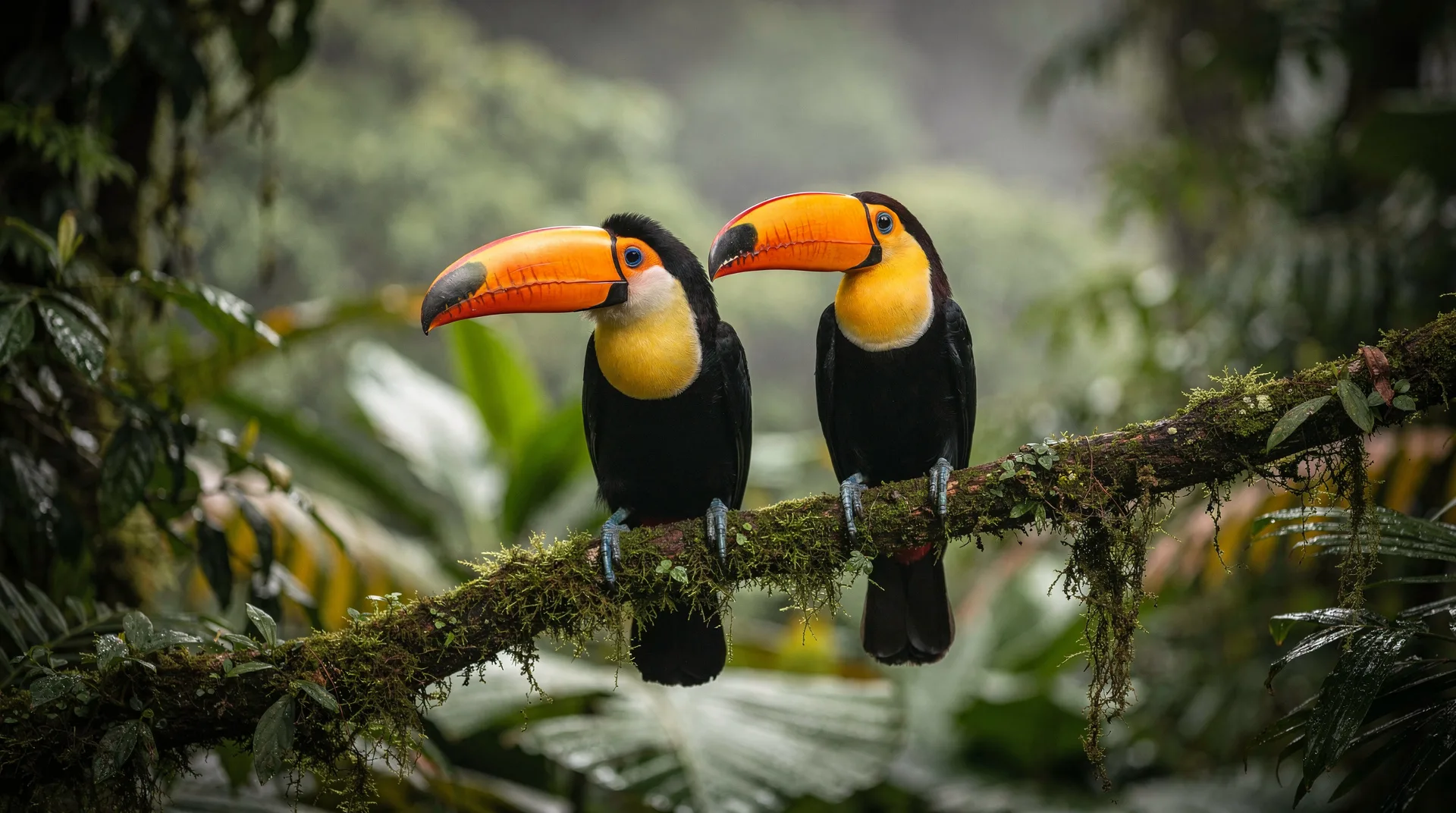
Bird watching by region in Costa Rica
Where is birding best in Costa Rica?
Costa Rica's top birding regions are Caño Negro for waterbirds, Carara for scarlet macaws, San Gerardo de Dota for quetzals and cloud forest endemics, Sarapiquí for lowland rainforest species, Monteverde for cloud forest diversity, and the Osa Peninsula for Corcovado's extraordinary density.
Why Costa Rica is a world-class birding destination
| Species count | 900+, more than all of North America combined |
| Best all-round region | San Gerardo de Dota (quetzals) or Monteverde (diversity) |
| Peak quetzal season | April–June |
| Waterbird peak | January–March at Caño Negro |
| Guide recommended | Strongly, and legally required in Corcovado |
| Gear essential | 8x42 binoculars, neutral clothing, early starts |
Costa Rica records over 900 bird species — a number that exceeds all of North America combined — in a country smaller than West Virginia. The reason is position: Costa Rica sits at the meeting point of North and South American avifaunas, receives both resident species and seasonal migrants, and contains an extraordinary range of altitudinal habitats from sea level to 3,820-metre peaks, each with its own bird community.
For a serious birder, Costa Rica is a lifetime destination. For a casual wildlife traveller, it is the place where you suddenly understand why people spend their entire holidays looking at birds. A single morning at a well-chosen site can produce hummingbirds, toucans, trogons, motmots, and tanagers — a visual experience that no amount of documentary preparation fully anticipates.
This guide maps the major birding regions, the key species each offers, and how to build a practical trip around them.
Caño Negro Wildlife Refuge — waterbird spectacle
Caño Negro, in the far north of the Alajuela province near the Nicaraguan border, is Costa Rica’s premier wetland birding destination. The refuge centres on Lago Caño Negro, a seasonal lake that swells in the wet season and draws extraordinary concentrations of waterbirds when water levels are right.
Key species here include the Jabiru stork (the largest flying bird in the Americas, with a 2.4-metre wingspan), Anhinga, Roseate Spoonbill, Wood Stork, multiple heron species, and one of the largest Neotropical cormorant colonies in Central America. The Nicaragua subspecies of the Olive-throated parakeet is also reliable here.
The best access is by boat along the Río Frío — either from the town of Los Chiles or on an organised day trip. Most tours depart from La Fortuna (about 2.5 hours away) and include a river and lake circuit lasting 4–6 hours.
a bird, flora, and fauna tour through Caño Negro’s rivers and lagoons — from $95Optimal timing is January–March when the dry season concentrates fish in reduced water bodies and draws maximum bird numbers. The wet season has more diffuse bird distribution but adds breeding plumage and nesting activity.
Carara National Park — scarlet macaws and transition forest
Carara sits on the Pacific slope about 90 minutes from San José, near the Tárcoles River bridge (famous for its enormous American crocodiles). It occupies a unique transition zone between the dry forests of Guanacaste and the humid forests of the southern Pacific, producing an exceptional overlap of species from both ecological zones.
The star attraction is the scarlet macaw. Costa Rica’s largest and most spectacular parrot nests in Carara’s tall trees and commutes daily to roosting sites along the Tárcoles River estuary. Dawn and dusk at Carara produce breathtaking flights of macaw pairs over the forest canopy — a sight that even non-birders find remarkable.
Other notable species at Carara include the Turquoise-browed Motmot, Baird’s Trogon, White Ibis, and the Spectacled Owl. The main entrance trail through old-growth primary forest is one of the best single-track birding walks in the Central Pacific region.
Sarapiquí — lowland Caribbean rainforest
The Sarapiquí region, centred on Puerto Viejo de Sarapiquí in Heredia province, is 2–3 hours from San José via the Braulio Carrillo highway. It represents the classic lowland Caribbean rainforest experience: humid, lush, extraordinarily diverse, and underlaid by river systems that support both forest and aquatic species.
Key birding sites in the Sarapiquí area include La Selva Biological Station (operated by the Organization for Tropical Studies), which has recorded over 450 bird species in its 1,600-hectare reserve, and the grounds of Tirimbina Biological Reserve. Selva Verde Lodge is another excellent base, with forest trails running directly from the hotel.
Species highlights include the Great Green Macaw (endangered, more reliably seen here than almost anywhere), Sungrebe, Boat-billed Heron, multiple kingfisher species, and a stunning diversity of antbirds, woodcreepers, and flycatchers. Snail Kite is reliable along the river.
Sarapiquí birding works well year-round, though December–April (dry season) is most comfortable for early morning walks.
San Gerardo de Dota — quetzals and cloud forest endemics
San Gerardo de Dota at 2,200 metres in the Talamanca range is the single most sought-after birding destination in Costa Rica for specialist birders. The reason is the resplendent quetzal — a bird so spectacular that it has powered an entire regional economy of lodges, guides, and visiting birders.
But the quetzal is only the beginning. San Gerardo de Dota and the surrounding Savegre valley host an impressive array of cloud forest endemics and high-altitude specialists found nowhere else in the country. The Flame-throated Warbler is endemic to the Chirripó massif region. The Long-tailed Silky-Flycatcher forms conspicuous flocks in the oak forest. Black-and-yellow Silky-Flycatchers, Magnificent Hummingbirds, Violet Sabrewings, and Mountain Robins are all reliable.
The quetzal watching guide covers this region in full detail, including the optimal months (April–June for nesting), lodge recommendations, and what to expect from a morning bird walk.
Monteverde — cloud forest diversity and night specialists
Monteverde and the Tilarán Cordillera offer a more accessible cloud forest birding experience than San Gerardo de Dota. The Monteverde Biological Preserve and the adjacent Curi-Cancha and Santa Elena reserves between them cover over 10,000 hectares of cloud forest at elevations of 1,400–1,800 metres.
Quetzal sightings are possible here from March through May, though less reliable than at San Gerardo. More consistently, Monteverde excels for cloud forest specialists like the Three-wattled Bellbird (whose call is among the most remarkable bird sounds in the hemisphere — a loud, metallic “bonk” that carries half a kilometre through dense cloud), the Emerald Toucanet, Barred Parakeet, Silvery-fronted Tapaculo, and the full suite of highland hummingbirds.
a cloud forest bird-watching tour across the Monteverde and Santa Elena reserves — from $65Night birding at Monteverde adds a completely different set of possibilities: Bare-shanked Screech-Owl, Mottled Owl, and the remarkable Unspotted Saw-whet Owl are all found here. See the nocturnal wildlife guide for what to expect on a night walk in Monteverde.
For context on how Monteverde’s reserves compare in size, access, and quiet factor, see Monteverde vs Santa Elena Reserve.
The Osa Peninsula and Corcovado — maximum biodiversity
Corcovado National Park on the Osa Peninsula is, by scientific consensus, the most biologically intense place in the Americas. The park has recorded over 400 bird species, including species found nowhere else in Costa Rica. The isolation and near-complete forest cover mean that species eliminated from most of the Pacific lowlands still survive here in healthy populations.
Target species unique to or most reliably seen in Corcovado include:
- Scarlet Macaw — at much higher density than Carara
- Yellow-billed Cotinga — a stunning turquoise-and-yellow endemic highly sought by birders
- Harpy Eagle — extremely rare, but Corcovado holds one of the only confirmed breeding pairs in Costa Rica
- Black-cheeked Ant-Tanager — a critically endangered endemic of the Osa Peninsula
- Fiery-billed Aracari — the southern Pacific toucanet, replaced by Collared Aracari further north
- Baird’s Trogon — consistent here
- Great Tinamou — heard constantly, seen occasionally a bird-watching tour from Drake Bay into the Osa Peninsula forest — from $95
Access to Corcovado’s Sirena station requires a licensed guide. Day trips from Drake Bay and overnight expeditions from Puerto Jiménez are the two main options. See the Corcovado National Park guide for full logistics.
Tortuguero — Caribbean canals and forest edge
Tortuguero on the Caribbean coast is best known for sea turtle nesting but delivers outstanding birding along its canal network. The combination of river, lagoon, and forested bank habitats produces a distinctive suite of Caribbean species: Green Ibis, Agami Heron (one of the most beautiful herons in the Americas, found reliably here), Snowy Cotinga, and large numbers of migratory shorebirds in the November–March window.
The canal boat trips that most visitors take for turtle or manatee watching are simultaneously excellent birding transects — particularly in the early morning when kingfishers, herons, anhingas, and terns are actively feeding along the waterway.
Planning a birding itinerary
A serious Costa Rica birding trip in 10–14 days might look like: San José (1 day, Braulio Carrillo transit birding) → Sarapiquí (2 days, La Selva) → Arenal/Caño Negro day trip (1 day) → Monteverde (2 days) → San Gerardo de Dota (2 days) → Carara (1 day) → Osa Peninsula/Drake Bay (3 days). This circuit covers seven major birding zones and the country’s main ecological systems.
For a shorter trip focused on the iconic species — scarlet macaw, quetzal, toucan, and rainforest diversity — combine Manuel Antonio (capuchins and scarlet macaws) with San Gerardo de Dota (quetzals) and Monteverde (cloud forest diversity) in 7 days.
See the 14-day wildlife photography itinerary for a route that works equally well for birders and general wildlife photographers.
Frequently asked questions about birding in Costa Rica
Do I need a guide for birding in Costa Rica?
Not legally, but practically, the answer is yes for most sites. At Corcovado, a licensed guide is legally required. Elsewhere, an experienced naturalist guide will double or triple your bird count in the same amount of time by knowing calls, knowing which trees are fruiting, and carrying a spotting scope. A morning at Sarapiquí with a guide is worth three mornings without one.
When is the best time to go birding in Costa Rica?
Year-round birding is excellent, but December–April is the most comfortable period for lowland forest sites, and April–June is peak quetzal season in the highlands. October and November are the wettest months on both coasts simultaneously and the least productive for long walking days. See best time to visit Costa Rica for the full seasonal picture.
What binoculars should I bring?
An 8x42 is the most versatile choice for Costa Rica — sufficient magnification for canopy birds, wide enough field of view for fast-moving species, and usable in the low light of dense forest. Swarovski EL 8x42, Zeiss Conquest HD 8x42, and Vortex Viper HD 8x42 are all excellent choices at different price points.
How many birds can I expect to see in a week?
A well-planned 7-day trip focusing on two or three different ecosystems typically produces 250–350 species for an attentive birder with a good local guide. A 14-day trip covering six or seven zones has produced 450+ species for experienced observers. Costa Rica’s record single-day count exceeds 250 species.
Are there birding festivals or organised tours?
Yes — the Costa Rica Bird Route is a collaboration between birding lodges and tour operators that maps out the major birding circuits with standardised guide standards. Organised birding tours are available through operators like Field Guides, Tropical Birding, and Victor Emanuel Nature Tours, which run Costa Rica departures several times per year.
What is the Yellow-billed Cotinga and why do birders seek it?
The Yellow-billed Cotinga (Carpodectes antoniae) is a spectacular black-and-white bird found only in the Pacific lowlands of Costa Rica and extreme western Panama. Males are snowy white with a yellow bill; females are grey-brown. It is classified as Endangered and has a highly restricted range — the Osa Peninsula, Dominical, and Sierpe mangroves are the primary sites. A sighting at Corcovado or Drake Bay is a major tick for any neotropical list.
Related guides
Costa Rica’s birdlife cannot be separated from the habitats that support it. The Costa Rica wildlife overview provides the ecological context for the country’s biodiversity. The quetzal watching guide goes deep on the country’s most sought-after single species. For the highest-density wildlife experience in the country, the Corcovado National Park guide covers everything you need for an Osa Peninsula expedition. And if you want to combine birding with ethical photography, wildlife photography tips covers both the ethics and the practical equipment.
Field etiquette that improves your sightings
Birding success in Costa Rica depends as much on behaviour as on location. Neutral-coloured clothing (khaki, olive, muted greens) helps far more than bright colours, which many forest species read as a threat signal from a distance. Move slowly and pause often rather than walking continuously — most misses happen because a group kept moving through a spot exactly as a bird was settling into view.
Keep conversation low; sound travels far in still forest air, and calling birders alert species long before visual contact. Playback of recorded calls to draw in a bird is a genuinely contested practice among guides: used sparingly it can confirm an identification, but overused near nesting sites it stresses breeding pairs, so defer to your guide’s judgment rather than running an app yourself.
Building a trip around a single target species
Not every visitor wants a comprehensive circuit — many travelers have one bird they specifically want to see, and the itinerary should bend around that goal rather than trying to cover everywhere. If the resplendent quetzal is the priority, San Gerardo de Dota with two full mornings during April–June gives close to a guaranteed sighting; anything less than an overnight stay in the valley meaningfully lowers the odds.
If the scarlet macaw is the target, Carara at dawn or Corcovado at any time of day both deliver reliably, with Corcovado offering noticeably higher density. For the Great Green Macaw, an endangered species far harder to find than the scarlet, Sarapiquí’s La Selva and Tirimbina reserves are the most consistent bet in the country. Building the whole trip around one species and treating everything else as a bonus tends to produce a more satisfying outcome than an ambitious multi-region circuit rushed for time.