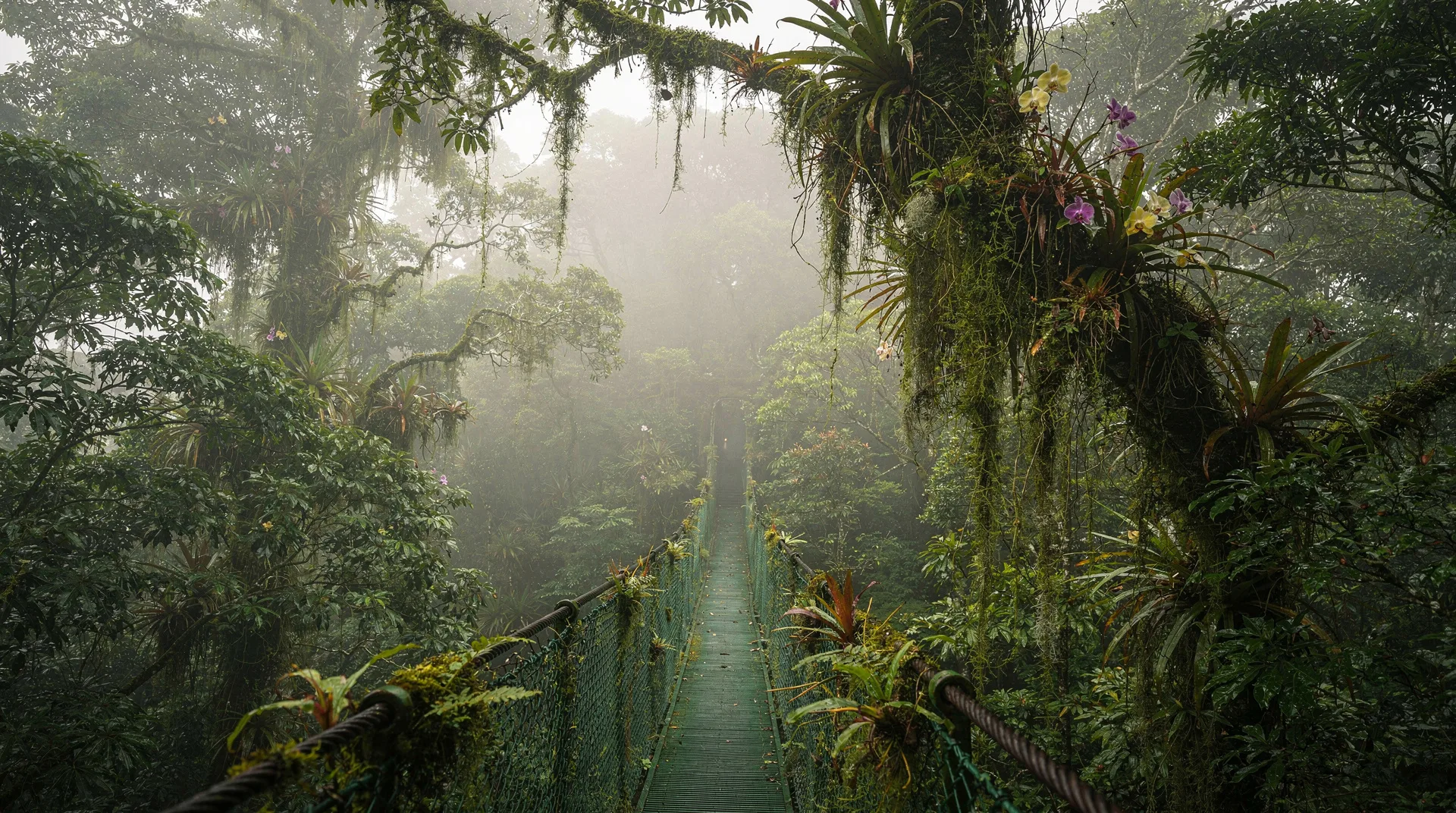
Monteverde vs Santa Elena reserve: which to visit?
Monteverde vs Santa Elena reserve?
Monteverde better trails + biodiversity, Santa Elena cheaper + quieter.
The Monteverde cloud forest question every visitor faces
Almost every visitor to the Monteverde zone faces the same choice: the world-famous Monteverde Cloud Forest Biological Reserve, or the smaller, cheaper, less-trafficked Santa Elena Cloud Forest Reserve a few kilometres away. The two reserves are independent, managed by different organizations, and offer genuinely different experiences — despite being separated by less than 10 km in the same cloud-forest ecosystem.
The honest answer is that neither reserve is categorically “better” — they serve different purposes and different types of traveler. Monteverde has more extensive trails, a longer history of biodiversity research, and the most concentrated quota of cloud forest wildlife in the region. Santa Elena is run by the local community, cheaper to enter, significantly less crowded, and offers a more intimate experience that many visitors prefer precisely because the big name brings the crowds to the other reserve.
If you have time, do both. If you have one day, the choice depends on what you prioritize.
| Monteverde | Santa Elena | |
|---|---|---|
| Entry fee | ~$24 | ~$16 |
| Size | 10,500 ha | 310 ha |
| Crowds | Higher | Lower |
| Best for | Biodiversity depth, research legacy | Budget, quiet, community-run |
The Monteverde Cloud Forest Biological Reserve
History and context
The Monteverde Cloud Forest Biological Reserve was established in 1972, founded by American Quaker settlers who arrived in Costa Rica in 1951 and purchased land in the Tilarán mountains above the town of Santa Elena. The Quakers were pacifists who had left the United States partly to avoid military service — Costa Rica had abolished its army in 1948, making it an appealing destination.
The reserve now protects approximately 10,500 hectares of cloud forest and six distinct ecological zones. It is managed by the Tropical Science Center (TSC), a non-profit Costa Rican research institution. Research has been conducted there continuously since the 1970s, producing decades of data on cloud forest ecology, amphibian populations, and the effects of climate change on montane biodiversity.
Trails and biodiversity
The reserve’s 13 km of maintained trails range from easy loop paths near the entrance to longer circuits that penetrate the primary forest. The most popular route is the Sendero Bosque Nuboso, a 1.9 km loop through old-growth primary cloud forest — moss-draped trees, bromeliad cascades, and the constant presence of mist. The Chomogo trail (4.3 km) reaches the highest point in the reserve for panoramic views on clear mornings.
Biodiversity is exceptional. The reserve’s bird list stands at over 400 species, including six species of toucan and three quetzal nest sites (resplendent quetzal sightings peak in March-June during nesting season). Amphibian diversity is high — over 120 species — and the reserve has been central to research on the golden toad, a species declared extinct in 1989 whose disappearance from Monteverde is considered one of the most documented cases of climate-linked extinction.
Mammals include jaguar, puma, tapir, ocelot, and four species of monkey, though sightings of large cats and tapirs are uncommon. Coatis are reliably seen near the entrance. Three-wattled bellbirds — whose ear-splitting calls echo through the canopy in season — are a Monteverde signature.
Immerse yourself in the Monteverde Cloud Forest — from $55Entry, crowds, and booking
Monteverde receives around 200,000 visitors per year — high for a 10,500-hectare reserve. Daily visitor numbers are capped (approximately 200 at a time in the reserve), and queues at peak season can mean waits of 30-60 minutes without advance booking. Entry fee in 2026 is approximately $24 for adults.
Book your entry in advance at the Tropical Science Center website (reservas.cct.or.cr) or through a guide service. Morning slots (first entry, 7am opening) are most productive for wildlife and beat the mid-morning tour groups. The reserve closes at 4pm.
Guided tours are strongly recommended — cloud forest wildlife requires trained eyes. A competent guide will find quetzals, glass frogs, and emerald toucanets that most independent visitors walk past without seeing. Budget approximately $65-85 for a 3-hour morning guided tour with entry included.
Monteverde: cloud forest reserve guided hike — from $60 Monteverde: guided night walk — from $30Santa Elena Cloud Forest Reserve
History and context
Santa Elena Reserve was established in 1992 by the Santa Elena community as an alternative revenue source to cattle farming. It is owned and managed by the local community — specifically the Colegio Técnico Profesional de Santa Elena — and revenues go directly to the school. This community-ownership model makes it unusually authentic by ecotourism standards: the income goes to education rather than external shareholders.
The reserve protects approximately 310 hectares — significantly smaller than Monteverde — but it occupies similar cloud forest habitat on the ridge above Santa Elena town. At slightly higher elevation than the Monteverde reserve (1,700-1,800 m vs 1,500-1,700 m), it actually captures more precipitation and mist, producing equally lush conditions.
Trails and biodiversity
Santa Elena has approximately 12 km of trails across six circuits, including an observation tower (one of the few in the region) with views above the canopy. The Caño Negro trail (3.5 km) and the El Camino trail (2.8 km) penetrate the primary forest and produce good wildlife sightings. The reserve receives fewer visitors and wildlife is correspondingly less disturbed — some guides argue that their best quetzal sightings come from Santa Elena rather than the more heavily visited Monteverde reserve.
The bird list is shorter but comparable in quality. Resplendent quetzal sightings are reliable in season. The reserve also overlooks the Monteverde reserve from above, giving slightly different ecological access in some trail sections.
Entry, crowds, and booking
Entry fee is approximately $16 — significantly less than Monteverde. Visitor numbers are lower, and walk-in entry is usually possible without advance reservation except during school holidays and peak season (January-March). The reserve opens at 7am.
Santa Elena’s staff are community members with genuine local knowledge. Their guided tours (approximately $45-55 with entry) are knowledgeable and often more personal in pace than larger tour group operations at Monteverde.
Head-to-head comparison
| Criterion | Monteverde Reserve | Santa Elena Reserve |
|---|---|---|
| Size | 10,500 ha | 310 ha |
| Entry fee | ~$24 | ~$16 |
| Daily visitors | High (capped ~200) | Moderate (lower) |
| Crowds | More | Less |
| Trail variety | 13 km, 6 zones | 12 km, 6 circuits |
| Guided tour cost | $65-85 | $45-55 |
| Advance booking needed | Strongly recommended | Weekends/peak only |
| Revenue goes to | Non-profit research (TSC) | Community school |
| Observation tower | No | Yes |
| Primary old-growth | More extensive | Present |
| Quetzal sightings | Good (nesting pairs known) | Good (less disturbed) |
| Best for | Wildlife density, research context | Quiet, community, budget |
The case for visiting both
If you have two days in the Monteverde zone (which we recommend — see our Monteverde destination guide for the full itinerary), there is a compelling argument for splitting them: Monteverde reserve in the morning of day 1, Santa Elena in the morning of day 2. Together they give you access to different parts of the same ridge ecosystem, with the Monteverde reserve giving ecological depth and Santa Elena offering quieter primary forest.
Alternatively, consider Curi-Cancha Reserve as your second day option — smaller crowds than either main reserve and the most reliable quetzal sightings in the zone. See our Curi-Cancha Reserve guide.
Night walks: a strong complement to daytime visits
Both reserves operate guided night walks, and the cloud forest after dark is a completely different experience. Glass frogs (their organs visible through transparent skin), sleeping toucans and bellbirds, striped palm pit vipers, and kinkajous all become active or findable after sunset. Night walk tours typically run 2 hours from 6-8pm.
Monteverde: cloud forest and butterfly farm full-day tour — from $95Getting to the reserves
Both reserves are accessible from Santa Elena village (the main town in the Monteverde zone). The Monteverde reserve is 6 km south of Santa Elena on a gravel road; Santa Elena reserve is 5 km north. Taxis from Santa Elena to either reserve cost approximately $6-8. Public buses operate on limited schedules.
From La Fortuna, the most efficient route is the lake crossing: jeep-boat-jeep via Lake Arenal (3 hours, approximately $32 per person). From San José, the drive takes 3-3.5 hours via the Interamerican Highway and a long gravel road section that requires a 4WD or high-clearance vehicle. A regular saloon car can make it, but slowly.
Beyond the reserves: other cloud forest activities in Monteverde
The reserves are the ecological core of the Monteverde experience, but the zone has a rich complement of activities that can fill 2-3 days without repetition.
Hanging bridges (Monteverde Sky Walk)
The Monteverde Sky Adventures hanging bridges offer 3 km of elevated walkways through the cloud forest canopy, with six suspension bridges at varying heights. Unlike the Mistico bridges at Arenal, these are specifically in cloud forest habitat — the epiphyte density visible at bridge-height is extraordinary. Go early (7am-9am) for the best bird activity and fewer people. Entry is approximately $30 for self-guided; guided options add naturalist commentary.
Selvatura Park
For a closer look at this option, see our Selvatura Park guide. Selvatura is a private reserve on the edge of the cloud forest with the most comprehensive infrastructure in the Monteverde zone: hanging bridges, butterfly garden, reptile and amphibian house, hummingbird garden, and a zipline network. It is a good single-stop option for families or short-stay visitors who want to sample multiple cloud forest experiences without visiting separate locations. Entry packages range from single-activity to full-day combo.
The Monteverde zipline experience
Our Monteverde ziplines guide compares the operators in detail, and zip-line safety and pricing explains what to check before you book. The Monteverde zone has some of the most developed zipline infrastructure in Costa Rica. Sky Adventures Monteverde has a line marketed as the longest zipline in Latin America (1.5 km, though these claims should be taken with appropriate skepticism). Multiple operators run zipline circuits through cloud forest canopy — the experience of crossing above the tree canopy in mist is genuinely spectacular, even if the wildlife encounter rate is low at speed.
Horseback riding
Several ranches around Santa Elena offer horseback rides in the cloud forest zone and on open pasture with volcano views. Typical duration is 2-3 hours; prices range from $45-75. This is a good activity for visitors who want to cover ground and see the landscape without hiking.
The butterfly gardens and insectarium
Monteverde’s butterfly garden (Jardin de Mariposas) houses species in walk-through net enclosures, including the iconic blue morpho at various life stages from egg to adult. The insectarium adjacent to it contains leaf-cutter ant colonies, tarantulas, and a glass frog display with magnified viewing of eggs and juvenile frogs. A good 1-2 hour visit, especially for families.
Frequently asked questions about Monteverde vs Santa Elena reserve
Which reserve is better for seeing a resplendent quetzal?
Both give excellent quetzal opportunities during peak season (February-June, with March-May being optimal for breeding pairs with chicks). Santa Elena is arguably slightly better for quetzal encounters due to lower visitor pressure. However, trained guides at either reserve locate quetzals reliably in season. The Curi-Cancha Reserve is also highly regarded for quetzal sightings.
Can I visit both reserves in one day?
Yes, but it would be rushed. Each reserve merits a minimum 3-4 hours including a guided tour. Morning at Monteverde and afternoon at Santa Elena is logistically possible but leaves little time to absorb either properly. Two days is the better approach.
Is the cloud forest accessible for children?
Yes. Both reserves have well-maintained paths suitable for children aged 5+. The terrain is generally not strenuous, and the wonder factor of the cloud forest environment is very high for young visitors. Bring waterproof layers and footwear with grip — the trails are muddy.
What’s the weather like in Monteverde?
The Monteverde zone receives 2,500-4,000 mm of annual rainfall and is misty or cloudy much of the time — this is the cloud forest, after all. The so-called dry season (December-April) is when the trade winds push mist and cloud over the ridge most aggressively. You may actually see more dramatic mist in “dry season” than in the rainy months. Pack a rain jacket regardless of when you visit. Temperatures range from 15-24°C.
Are there restrooms and cafes at the reserves?
Both reserves have restrooms and basic visitor facilities. The Monteverde reserve has a more developed visitor center with a small cafe. Santa Elena reserve is more basic. Santa Elena town (2 km from each reserve) has numerous cafes and restaurants for post-hike meals.
Which reserve is better if I only have a few hours?
Monteverde is the safer choice for a short window because its trail network and guide availability are more extensive, making it easier to see a representative slice of the ecosystem in 2-3 hours. Santa Elena rewards a similarly short visit but is a better fit if you specifically want fewer people on the trail rather than maximum trail variety.
What to eat and drink in the Monteverde zone
Santa Elena town has evolved significantly as a tourist hub and now has a range of dining options beyond the basic soda. Key recommendations:
Cafe Colibri: A reliable breakfast spot near the town center with strong local coffee, gallo pinto, and fresh fruit plates. Open from 7am — good for early starts before reserve visits.
Treehouse Restaurant: An iconic Santa Elena spot built around a massive tree growing through the dining room floor. The setting is more memorable than the food (which is solidly international backpacker fare), but it’s a fine lunch stop between reserve visits.
El Jardín Restaurant (Monteverde): Higher quality and higher price than town options — appropriate for a special dinner. Serves Costa Rican and international dishes, good wine list.
Local sodas: For authentic Costa Rican meals at half the tourist prices, seek out the sodas on the back streets of Santa Elena. Casado (rice, beans, salad, protein) for approximately $6-8 is the standard.
Coffee: The Monteverde zone produces good coffee from farms on the Pacific slope below. La Lechería (the Monteverde dairy cooperative) also sells local cheese and dairy products — a legacy of the original Quaker dairy farming that economically anchored the community.
Practical logistics for the Monteverde zone
Getting there
The Monteverde zone has an infamously bad road from the Pan-American Highway (Interamerican). The Monteverde gravel road (approximately 35 km from the Sardinal junction on Route 1, or from Las Juntas toward Monteverde) is rough, steep, and potholed — manageable in a regular car but significantly more comfortable in a 4WD or high-clearance vehicle. The drive takes 1.5-2 hours from the highway junction.
The fastest route from La Fortuna is the lake crossing: jeep from La Fortuna to Río Chiquito, boat across Lake Arenal to Río Chiquito on the other shore, then jeep to Santa Elena (approximately 3 hours total, $32 per person). This avoids the highway entirely and is significantly faster than the road alternative.
From San José: approximately 3-3.5 hours by vehicle via the Pan-American. Shuttles from San José to Santa Elena run through Interbus and GrayLine — approximately $55-65 per person, departing around 7am.
Getting around
Santa Elena is walkable. The distance from town to the Monteverde reserve entrance is 6 km downhill (30 minutes by bike, 20 minutes by taxi). Santa Elena reserve is 5 km uphill from town in the other direction. Taxis (approximately $6-8 per trip) are the standard for reserve access. Some visitors rent horses from a local agency for a more scenic approach.
When to visit
The Monteverde zone does not have a “bad” season in the way that beach destinations do — it is always green, always misty, and always active with wildlife. The dry season (December-April) has more consistent morning visibility; the green season (May-November) has more dramatic atmospheric conditions and fewer visitors. December-January and Easter week are peak visitor periods with the highest prices and longest queues.
Related guides
Our Curi-Cancha Reserve guide covers the best alternative for quetzal sightings with smaller crowds. The Children’s Eternal Rainforest guide explains the vast protected area adjacent to both reserves. For the technical difference between cloud forests and lowland rainforests, read our cloud forest vs rainforest guide. Our quetzal watching guide gives month-by-month timing for resplendent quetzal sightings across Costa Rica.
If the cloud forest leaves you wanting more wildlife, the nocturnal wildlife guide and the butterflies and frogs guide cover what to look for after dark and in the understory. Travelers planning a longer route can fit Monteverde into the 10 days Arenal, Monteverde and Manuel Antonio itinerary, and those heading on to the volcano can read about La Fortuna next. For a higher cloud forest option away from the Monteverde crowds, consider San Gerardo de Dota. Before you pack, the packing list covers the rain layers this climate demands.