Cloud forest vs rainforest: what's the actual difference?
Cloud forest vs rainforest?
Altitude (cloud forest 1,200-2,500m), mist source, biodiversity profile differ.
The confusion that most guides don’t clarify
Visitors to Costa Rica frequently use “cloud forest” and “rainforest” interchangeably — partly because tourism marketing encourages it. A ziplining brochure in Monteverde will describe the “cloud forest canopy”; a Corcovado tour will reference the “pristine rainforest.” Both are accurate, but they describe fundamentally different ecosystems with different climates, different species communities, and different experiences underfoot.
Understanding the distinction matters practically. If you plan to see resplendent quetzals, you need cloud forest. If your goal is howler monkeys, scarlet macaws, and tapirs at sea level, you need rainforest. If you want strangler figs taller than apartment buildings, you’re in rainforest territory. If you want moss-draped oak trees dripping with bromeliads in permanent mist, you want cloud forest. These are genuinely different worlds.
Costa Rica has both — which is one of the reasons the country is so ecologically extraordinary. The transition from Caribbean lowland rainforest to the cloud forest of the Cordillera de Tilarán or the Talamanca highlands can happen over a vertical distance of just 30 km, compressing ecological variation that would spread across hundreds of kilometres in temperate regions.
The fundamental difference: altitude and moisture source
Rainforest: warm, tall, floor-level moisture
Tropical rainforest — the type found in Corcovado National Park, Tortuguero, Manuel Antonio, and Cahuita — exists at low elevations (0-600 m) and receives its moisture primarily from rainfall. Corcovado receives approximately 5,000-8,000 mm of annual rainfall — among the highest on earth. This creates the conditions for the tallest tree species in the country, some exceeding 50 metres, and a multilayered canopy structure that creates microhabitats at ground level, understory, mid-canopy, and emergent layers.
Temperature is the other defining characteristic. Lowland rainforest in Costa Rica operates at 25-35°C year-round. The heat drives rapid nutrient cycling, decomposition, and metabolic rates. The rainforest floor is dark, humid, and teeming with decomposers — fungi, beetles, millipedes — that rapidly process fallen organic matter and return nutrients to the thin tropical soil.
Cloud forest: cool, misty, vertical moisture collection
Cloud forest occurs where mountain ridges intersect with persistent cloud layers — typically between 1,200 and 2,500 metres in Costa Rica. Unlike lowland rainforest, cloud forest receives a significant portion of its moisture not from rainfall but from cloud and mist condensation directly onto leaves, branches, and epiphytes (plants that grow on other plants without taking nutrients from them). This “horizontal precipitation” can equal or exceed conventional rainfall in terms of water input.
The Monteverde zone at 1,500-1,800 m is the classic example: the ridge catches the northeast trade winds off the Caribbean, forcing moist air upward and condensing it into the near-permanent mist that defines the habitat. The result is an ecosystem where water is everywhere — dripping from leaves, flowing down bark, pooling in bromeliads — even during the meteorological “dry season.”
Temperature is critical. Cloud forest in Costa Rica ranges from 12-22°C — cool enough to slow decomposition, inhibit certain bacteria, and favour organisms adapted to cold and humidity. This is why cloud forest trees accumulate extraordinary quantities of moss, liverworts, and epiphytes: decomposition is slow, and everything that lands on a branch tends to stay there and grow.
Tree structure: the visible difference
Standing in each ecosystem, the contrast is immediate and striking.
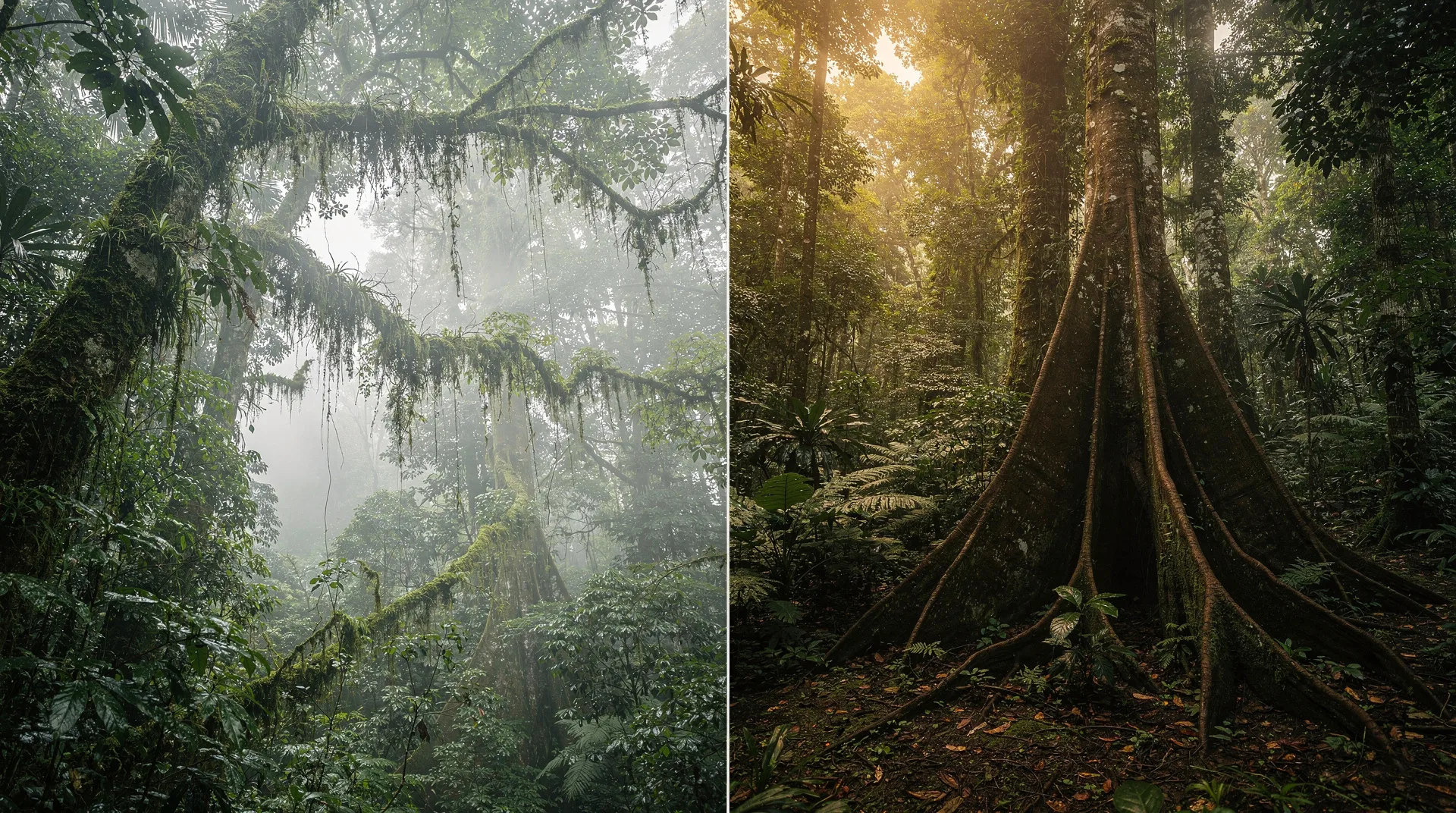
In lowland rainforest: Trees are immensely tall — emergent species like the kapok (Ceiba pentandra) and almendro (Dipteryx panamensis) tower above a closed canopy at 30-40 metres. The canopy is dense and high; the forest floor receives little direct light and is relatively open — you can often see 50-100 metres horizontally. Buttress roots (massive flanges extending from the base of large trees to stabilize them in thin tropical soil) are common.
In cloud forest: Trees are shorter and more gnarled, battered by consistent wind and cold. The characteristic species in Costa Rica’s cloud forests are oaks — the Quercus family — which dominate the middle and upper elevations. These trees are encrusted with mosses, ferns, and orchids to a degree that can be almost overwhelming: a single branch may carry 20 different epiphyte species, the combined weight sometimes exceeding the branch’s own. The forest feels denser and more enclosed than lowland rainforest, with light diffused through mist rather than filtered through a high canopy.
Biodiversity: different types, not simply more or less
The common assumption is that lowland rainforest has higher biodiversity than cloud forest. This is partly true for total species count (lowland Corcovado has higher mammal, reptile, and tree species totals) but misses the critical specificity of cloud forest diversity.
What cloud forest has more of
Epiphytes: Cloud forest supports the highest epiphyte diversity of any ecosystem on earth. Costa Rica’s cloud forests contain more than 500 orchid species, hundreds of bromeliad species, and thousands of moss and fern species. Many are specific to cloud forest conditions and found nowhere else.
Highland endemic birds: Costa Rica’s cloud forests contain a number of bird species found only at high elevations in the Talamanca and Tilarán ranges — highland endemics that evolved in isolation from lowland populations. These include the volcano hummingbird, the flame-throated warbler, the resplendent quetzal (which requires cloud forest for nesting), and the large-footed finch. Birders who want these species must visit cloud forest.
Amphibians: The cool, moist cloud forest is an outstanding amphibian habitat. Glass frogs (whose eggs and juveniles can be seen through their transparent skin) are cloud forest specialists. Some poison dart frog species occur at cloud forest elevations. The permanently wet leaf litter and tree cavities support specialized frog communities not found in lowland rainforest.
What lowland rainforest has more of
Mammal diversity: The jaguar, tapir, giant anteater, peccary, and multiple deer species all achieve their highest densities in lowland primary rainforest — Corcovado’s Sirena sector being the premier example. Large mammal diversity and encounter rates favour lowland forest.
Reptile diversity: Crocodiles, basilisk lizards, and many snake species are lowland specialists. The cloud forest reptile community is smaller.
Overall tree species richness: A single hectare of Corcovado forest may contain more tree species than many temperate countries. Lowland rainforest tree diversity simply cannot be matched at altitude.
The sensory experience: how each ecosystem feels
Understanding the ecosystems intellectually is one thing; knowing what they actually feel and sound like prepares you for the experience in a way that facts do not.
In lowland rainforest (Manuel Antonio, Corcovado, Tortuguero)
Heat is the first sensation — often above 30°C, humidity above 80%, the air feels heavy. Sounds arrive from all directions simultaneously: howler monkey calls that carry 3 km, the machine-gun tapping of a woodpecker, the baseline drone of insects, and the sporadic crash of a branch dropped by a monkey in the canopy above. The forest floor is surprisingly open — primary rainforest has minimal ground-level vegetation in the deep shade, allowing visibility for 50+ metres in some directions.
Mud is seasonal and heavy in the rainy months. The soil is thin and acidic despite the tropical fertility — most nutrients cycle through the above-ground biomass rather than the soil. The smell is rich and slightly fermented: decomposing leaves, fungus, moist earth, and occasional floral overrides from flowering epiphytes.
At night, the rainforest shifts to an even louder register. Frog choruses begin at dusk — multiple species calling simultaneously — and continue until dawn. Insects add layers of sound. The occasional territorial call of a nighthawk cuts through the ambient noise. Rain on the canopy produces a complex percussion that descends to the forest floor in drips and rivulets.
In cloud forest (Monteverde, San Gerardo de Dota)
Cool is the immediate surprise — 15-20°C on a typical cloud forest morning is a shock after the lowland heat, particularly if you have come directly from the coast. Mist is frequently present, reducing visibility and softening sound. The trees here are gnarled and lower — the wind that drives the cloud over the ridge also limits vertical growth.
The sound is quieter than lowland rainforest — fewer insect layers at this altitude, replaced by the drip of condensation from every surface. The three-wattled bellbird’s metallic “BOCK” sound breaks through the mist periodically — startling in its loudness and strangeness. The black-faced solitaire produces a fluid, melodic song that carries through the cloud.
The smell is clean and wet — moss, cold water, and the slight mineral quality of volcanic soil filtered through centuries of leaf litter. There is almost no smell of decomposition because the cold slows microbial activity. A fallen tree trunk in cloud forest retains its structure for years or decades; the same trunk in lowland rainforest would be unrecognizable in months.
The ground is always wet. Streams run even in the dry season. Springs emerge from the moss-covered slopes. The constant moisture is not oppressive — it is the condition that produces the extraordinary epiphyte density and the visual richness of every surface.
Costa Rica’s cloud forest zones
Monteverde and the Tilarán range (1,400-1,800 m)
The most visited cloud forest zone in the country, protected by the Monteverde Cloud Forest Biological Reserve, Santa Elena Reserve, Curi-Cancha Reserve, and the Children’s Eternal Rainforest. The ridge experiences persistent cloud cover from the Caribbean trade winds for most of the year. See our detailed guides: Monteverde vs Santa Elena reserve and Curi-Cancha Reserve guide.
San Gerardo de Dota and the Talamanca range (2,000-3,000 m)
A higher-elevation cloud forest zone with a different species composition, dominated by oak-Quercus forest rather than the mixed cloud forest of Monteverde. The best location in Costa Rica for resplendent quetzal sightings. See our San Gerardo de Dota guide.
Braulio Carrillo National Park (400-2,900 m)
Unusual in spanning the complete altitudinal gradient from lowland rainforest (on the Caribbean slope) to cloud forest (on the ridgeline). The aerial tram that crosses the park boundary provides a visual transect of ecosystem change by altitude. Braulio Carrillo is 1 hour from San José.
Immerse yourself in the Monteverde Cloud Forest — from $55The wildlife visitor’s practical guide
To maximize wildlife encounters — which ecosystem to choose?
| Goal | Ecosystem | Location |
|---|---|---|
| Resplendent quetzal | Cloud forest | San Gerardo de Dota, Monteverde |
| Jaguar / tapir / four monkeys | Lowland rainforest | Corcovado (Sirena station) |
| Epiphytes and orchids | Cloud forest | Monteverde, Curi-Cancha |
| Scarlet macaw | Lowland + transitional | Carara, Osa Peninsula |
| Glass frogs | Cloud forest edge | Monteverde, hanging bridges area |
| Howler monkeys | Both (more visible in lowland) | Manuel Antonio, Monteverde |
| Poison dart frogs | Lowland rainforest | Caribbean coast, Corcovado |
| Highland endemic birds | Cloud forest | Dota, Monteverde |
| Sloth | Both (lower density in cloud forest) | Manuel Antonio, Monteverde |
| Crocodile | Lowland rivers | Tarcoles River bridge, Tortuguero |
Where each ecosystem fits in your route
The practical way to use this distinction is to match each ecosystem to a base that makes sense for the rest of your trip. Monteverde is the natural cloud forest base, while Manuel Antonio and Tortuguero put you in lowland forest with very different light, sound and wildlife. For the park-level detail, the Corcovado National Park guide and the Manuel Antonio National Park guide show what the lowland side looks like on the ground, and the Tortuguero National Park guide covers the Caribbean version of it.
If you are weighing the two big lowland options against each other, the Manuel Antonio vs Corcovado comparison helps you decide how much effort the wilder forest is worth. Altitude is only part of the story, too: the way weather changes from one valley to the next is covered in our microclimates explained guide, which makes it easier to understand why two forests an hour apart can feel like different countries.
Temperature planning: dress for two worlds
If you are visiting both ecosystem types in one trip — and most visitors do — packing for both is essential. Lowland rainforest at Corcovado or Manuel Antonio requires light clothing, sun protection, and abundant insect repellent. Cloud forest at Monteverde or Dota requires warm layers (15-22°C in the day, potentially 10-15°C at night), a proper rain jacket, and waterproof footwear.
The difference is stark. On the same Costa Rica trip, a day in Corcovado can be 35°C and brutally humid; two days later in Monteverde can feel cold enough to want gloves in the morning. Pack both ends of the spectrum.
Guided tours bridge both worlds efficiently. A Monteverde cloud forest morning walk followed by a butterfly farm visit is the classic combination for experiencing cloud forest biodiversity without overwhelming complexity.
Monteverde: cloud forest and butterfly farm full-day tour — from $95Frequently asked questions about cloud forest vs rainforest
Is Monteverde a rainforest or a cloud forest?
Monteverde is a cloud forest. The Monteverde Cloud Forest Biological Reserve protects cloud forest habitat — the defining characteristic is the persistent cloud and mist captured from Caribbean trade winds, not just rainfall. The name “cloud forest” is accurate; calling it a “rainforest” (as is common in casual usage) technically misclassifies the ecosystem type.
Can you see cloud forest and rainforest on the same trip?
Yes, easily. A typical Costa Rica itinerary might include Monteverde (cloud forest) and Manuel Antonio or Corcovado (lowland rainforest) in the same 10-14 day trip. The contrast between the two ecosystems is one of the highlights of a comprehensive Costa Rica visit.
Which is more important for conservation — cloud forest or rainforest?
Both are critically important, but for different reasons. Lowland tropical rainforest contains the highest overall biodiversity per unit area of any biome. Cloud forest is disproportionately important for endemic species, water capture for downstream rivers, and climate regulation. Costa Rica’s conservation system protects both — which is why the country retains more than 50% forest cover despite being one of the most densely populated countries in Central America.
Why are cloud forest trees covered in so much moss?
The combination of persistent humidity, cool temperatures, and low light slows decomposition of organic matter on branches. Moss spores that land on branches find conditions ideal for growth — moisture is constant, temperatures are cool enough to prevent desiccation, and there is sufficient diffuse light. Over time, moss accumulates in thick layers that support further epiphyte growth, creating the extraordinary layered communities visible on old-growth cloud forest trees.
Are cloud forests being lost faster than rainforests?
Cloud forests are particularly vulnerable to climate change because small shifts in temperature and cloud base elevation can push the condensation zone upward, reducing or eliminating the mist that defines the ecosystem. Research in Monteverde has documented significant upward shifts in cloud base since the 1980s, corresponding to warming temperatures. This is considered one of the clearest early signals of climate-linked ecosystem shift in the tropics.
Building a trip around both ecosystems
Most well-planned Costa Rica itineraries deliberately sequence cloud forest and lowland rainforest rather than choosing one. A common structure is Arenal (transitional forest and volcano) → Monteverde (cloud forest) → Manuel Antonio or the Osa Peninsula (lowland rainforest), which lets the ecological contrast register while you travel rather than requiring you to imagine it from a guide’s explanation.
If you want to stretch the idea of a forest sequence further, the bird watching by region guide shows how species lists change as you move between zones, and the Arenal Volcano National Park guide covers the transitional stop that sits between the two. For a ready-made order of stops, the 10-day Arenal, Monteverde and Manuel Antonio itinerary follows exactly this cloud forest to lowland rainforest sequence. The Children’s Eternal Rainforest guide explains how the Monteverde zone’s cloud forest connects, via wildlife corridor, down to Caribbean lowland rainforest — a useful concrete example of how the two ecosystems relate rather than simply differ.
Related guides
For the full cloud forest visitor experience in Monteverde, read our Monteverde vs Santa Elena reserve comparison and Curi-Cancha Reserve guide. For Costa Rica’s best quetzal locations across both cloud forest zones, see our quetzal watching guide. To understand the lowland rainforest side of the comparison, our Costa Rica wildlife overview covers the full ecological context of the country’s biodiversity.