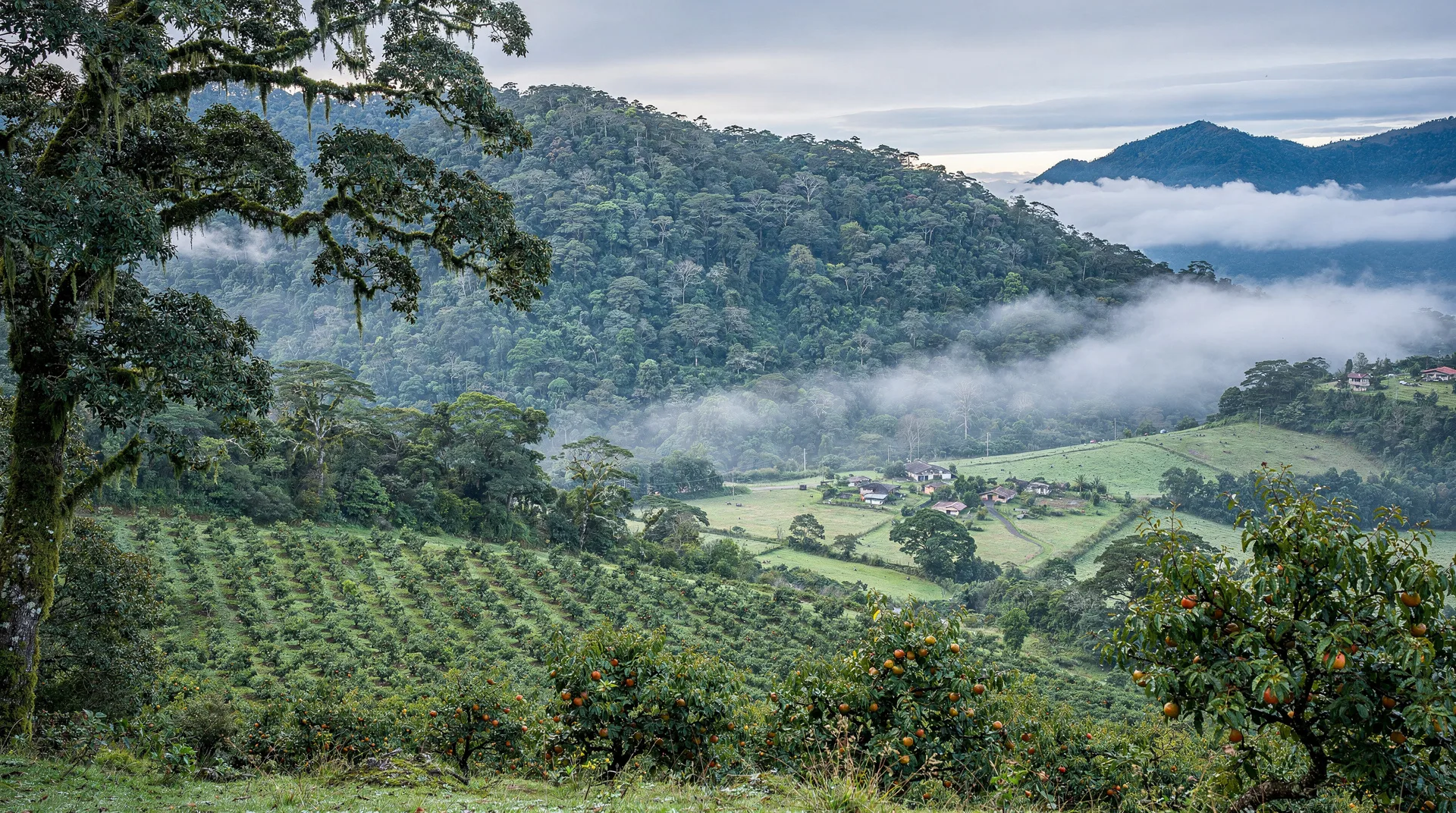
San Gerardo de Dota: quetzals and cloud forest in the Talamanca
Is San Gerardo de Dota worth a detour?
Yes for resplendent quetzals + colder Talamanca cloud forest with raging Savegre River.
Why San Gerardo de Dota is different from Monteverde
Costa Rica has two main cloud forest zones that attract serious wildlife travelers: Monteverde in the northwest, and the Dota Valley in the Talamanca mountain range southeast of San José. Most tourists visit Monteverde; fewer make the detour to San Gerardo de Dota. That asymmetry is, in the opinion of most ornithologists and dedicated naturalists, an error.
San Gerardo de Dota is a small agricultural valley at 2,200 metres above sea level, carved by the cold and powerful Savegre River deep into the Talamanca highlands. The surrounding forests — oak-dominated cloud forest at one of the highest elevations accessible to visitors in Costa Rica — hold the densest and most reliably observable population of resplendent quetzals in the country. Some birding guides who operate in both Monteverde and Dota will quietly tell you that for a guaranteed quetzal encounter, Dota wins.
| Where | Talamanca highlands, Km 80 off the Pan-American Highway |
| Best for | Resplendent quetzals, cold-climate cloud forest, real solitude |
| Peak season | February–June (quetzal nesting), March–May best |
| Getting there | Around 2.5 hrs from San José, paved road throughout |
| Where to stay | Family-run valley lodges, no conventional hotels |
The valley is cold by Costa Rican standards. Overnight temperatures regularly drop to 5-10°C in the dry season and the river mist and morning fog give the landscape a quality that feels more like highland Scotland than tropical Central America. Trout farms line the valley floor (the Savegre River is one of the few rivers in the country clean and cold enough for rainbow trout), and small family lodges offer accommodation that is rustic by luxury standards but extraordinary in setting.
The quetzal factor: when and where to look
The resplendent quetzal (Pharomachrus mocinno) is the defining species of Mesoamerican cloud forest. The male — emerald-green back, crimson belly, yellow bill, and tail feathers reaching 65 cm during breeding season — has been considered sacred by Mayan and Aztec civilizations and remains one of the most sought birds in the Western Hemisphere. In Costa Rica, it breeds at elevations between 1,500 and 3,000 metres in cloud forest and oak forest — which is precisely what San Gerardo de Dota provides.
Best time for quetzals
Quetzal nesting in the Dota valley runs from approximately February through June, with the most spectacular displays — males with full breeding plumage and long tail streamers — occurring March through May. During this period, pairs are reliably present near known nest holes (naturally occurring cavities in dead trees, particularly large oaks). In April and May, when chicks are in the nest, pairs are particularly visible as they make repeated feeding visits.
Outside breeding season (July-January), quetzals remain in the Dota valley but move more widely as they follow the fruiting of wild avocado trees (Lauraceae family), which are their primary food source. An experienced local guide can still locate them, but sightings require more active searching.
Best locations in the valley
Several farms and lodges along the Savegre River road have become well-known birding spots because of habituated quetzal pairs that return to the same nest trees year after year. The area around Trogon Lodge, Savegre Hotel, and the upper sections of the road toward Chirripó National Park all produce consistent sightings.
Local guides — most of them from the Chacón family, who have farmed and guided in the valley for generations — have knowledge of individual nest sites that is impossible to replicate through online research. A morning guided walk (approximately $35-50 per person, 3-4 hours starting at 6am) with one of these guides produces quetzal sightings on the vast majority of visits between February and June.
The broader bird list: world-class diversity
While the quetzal is the headliner, San Gerardo de Dota’s bird diversity extends well beyond it. The valley sits within the Savegre Important Bird Area, recognized by BirdLife International for its concentration of highland forest species. The bird list for the immediate area exceeds 170 species, a remarkable number for such a geographically limited zone.
Notable species regularly seen include:
- Resplendent quetzal — year-round, peak Feb-June
- Fiery-throated hummingbird — endemic to highland Costa Rica and western Panama; common feeders at valley lodges
- Volcano hummingbird — another highland endemic
- Black-and-yellow silky-flycatcher — highland specialist
- Flame-throated warbler — Talamanca highland endemic
- Large-footed finch — common in roadside hedgerows
- Barred parakeet — often in noisy flocks over the valley
- White-throated mountain-gem — hummingbird at feeders
- Black-faced solitaire — forest interior, beautiful song
- Collared trogon — forest trails near lodges
Several species in San Gerardo de Dota are found nowhere else in the world — high-altitude endemics of the Talamanca range that have evolved in isolation from lowland populations. For birders, this makes the valley among the highest-value birding destinations in Central America per hour invested.
For more on where to find the best bird watching across the country, see our bird watching by region guide.
The Savegre River: the cold heart of the valley
The Río Savegre is one of the few pristine rivers remaining in Costa Rica. Fed by rainfall and springs in the Chirripó massif, it runs cold (12-16°C in the upper valley), clear, and fast through the Dota landscape. The river is the source of the region’s trout farming industry — several families have operated trout farms along its banks for decades, and fresh rainbow trout appears on most lodge menus.
Beyond its ecological and gastronomic value, the Savegre has a visual quality that is unusual in the tropics. The combination of cold mountain water, mossy rocks, cloud forest overhead, and occasional quetzal flights crossing above the river valley creates an atmosphere that many visitors describe as the most beautiful they encountered in Costa Rica.
The upper Savegre and its tributaries are also significant for scientific monitoring — water quality and invertebrate diversity in the river system are used as indicators of forest health in the adjacent Chirripó National Park watershed.
Where to stay: the lodge options
San Gerardo de Dota has no hotels in the conventional sense — accommodation is in small family-run lodges along the valley road. Standards range from simple rooms at cabinas to genuinely comfortable nature lodges with fireplaces and gourmet kitchens.
Savegre Hotel Natural Reserve & Spa: The original family lodge in the valley, operated by the Chacón family who established the area as a birding destination. The property includes 50 hectares of protected forest, a spring-fed trout pond, an excellent dining room, and guided birding programs. Rates start at approximately $150/night double occupancy.
Trogon Lodge: A well-regarded birding lodge with comfortable cabins in the forest and excellent guided morning walks. The lodge name says everything about the target audience.
Paraíso Quetzal Lodge: A newer property higher up the valley with a focus on comfortable rooms and accessible quetzal-watching paths from the lodge grounds.
Most lodges include breakfast, offer packed lunches, and have dining rooms open for dinner. Advance booking is essential for the February-June peak season.
Getting there: the Km 80 turn
San Gerardo de Dota is accessed from the Pan-American Highway (Interamerican) at kilometer marker 80, approximately 80 km south of San José. The turn is well-signed. From the highway, a narrow paved road descends 9 km into the valley — steep, winding, and in good condition. A regular vehicle is sufficient; 4WD is useful in wet conditions but not strictly necessary.
From San José: Approximately 2.5 hours by vehicle via the Pan-American Highway. The drive south from San José through the mountains is scenic in its own right, passing through San Marcos de Tarrazú (coffee country) and climbing toward the Chirripó massif.
Public transport: A bus from San Isidro de El General to San Gerardo de Dota passes the Km 80 junction — confirm schedules locally. Taxi from San Isidro (~$25-35).
There is no GetYourGuide product specifically for San Gerardo de Dota at this writing, reflecting the valley’s primarily independent visitor base. For bird-watching itineraries that include the Dota valley as part of a broader Costa Rica circuit, see our bird watching by region guide.
The valley makes an excellent stopover between San José and the Osa Peninsula or Chirripó. A logical route: San José → 2-3 nights San Gerardo de Dota → continue south to San Isidro → Uvita or Drake Bay.
Day trips from San Gerardo de Dota
Chirripó National Park approach trail (informal)
The road from the Km 80 junction continues up the valley past the lodges and eventually connects — for those with appropriate vehicles — to the road toward the Chirripó trailhead (San Gerardo de Rivas, a different valley). The approach passes through extraordinary high-altitude oak forest. Day hiking in the national park requires a separate SINAC permit if you intend to go beyond the park boundary.
The Dota coffee zone
The Dota region is part of the Tarrazú coffee zone, home to some of Costa Rica’s most internationally acclaimed high-altitude arabica coffees. Several farms between San Gerardo de Dota and the highway offer informal visits and coffee tastings. The elevation (1,700-2,200 m) and volcanic soils produce beans with exceptional acidity and clarity. Ask at your lodge for current farm visit recommendations.
Miriam’s Bakery and local sodas
Miriam’s Bakery on the road into the valley has become something of a legend among birding visitors — freshly baked bread, empanadas, and Costa Rican pastries available from early morning. Local sodas in the valley serve casado and rice dishes with fresh trout as a regional specialty.
The trout farms: a regional specialty worth understanding
The Savegre River is one of the few rivers in Costa Rica cold and clean enough to support rainbow trout farming. Several families along the valley have operated trout ponds since the 1960s and 1970s, and fresh trout has become the defining culinary product of San Gerardo de Dota.
The trout served in valley restaurants and lodge dining rooms is typically killed to order — genuinely fresh in a way that fish at coastal restaurants rarely achieves. Standard preparations include whole grilled trout, fried trout with hearts of palm and yuca, and trout ceviche. Prices are reasonable — a full trout plate runs approximately $12-18 at local sodas.
Several farms allow casual visits during which you can see the ponds and observe the trout feeding. The Savegre Hotel family farm is the most tourist-accessible. This is a worthwhile stop for visitors curious about the farming system that has kept the valley’s families economically viable in the absence of major tourism infrastructure.
The coexistence of an active trout farming industry with the cloud forest conservation work — each family managing their agricultural land while protecting the forest above — is a practical example of the land-use compromise that conservation in populated mountain areas requires.
Coffee from the Dota valley: Tarrazú and its reputation
San Gerardo de Dota sits within the Tarrazú coffee-growing region, one of the most internationally recognised origins for specialty arabica coffee. Tarrazú coffees — grown at 1,500-2,200 metres on volcanic soils — are prized for their bright acidity, clean flavour profile, and cherry and citrus notes that distinguish them from lower-elevation Central American coffees.
The road between the Pan-American Highway and San Gerardo de Dota passes through the heart of Tarrazú production country — smaller farms visible on the hillsides are typically family operations selling their cherry to larger cooperatives. The COOPEDOTA cooperative, based in the town of Santa María de Dota (approximately 20 minutes from the Km 80 junction), is one of the most respected cooperatives in the country and offers farm visits and cupping sessions by appointment.
Buying coffee directly from a Dota valley producer is one of the more satisfying commercial decisions available to a Costa Rica traveler — you know the provenance, the elevation, and the farming system in a way that airport coffee shop purchases cannot approach. Your lodge can typically recommend which local farms are currently selling.
Combining San Gerardo de Dota with a southern itinerary
San Gerardo de Dota works best as part of a south-bound route rather than as a standalone detour from San José. The most logical combinations:
San José → Dota → Uvita route (3-4 days): 2 nights in San Gerardo de Dota for quetzals, then continue south on the Pan-American to San Isidro de El General, then west to Uvita and the Marino Ballena National Park whale-watching season. This covers two very different ecosystems (cloud forest + tropical Pacific coast) in a coherent geographic route.
San José → Dota → Chirripó route (4-5 days): Use San Gerardo de Dota as the acclimatization stop before the Chirripó ascent — birding in the Dota valley (1,800-2,200 m) for 2 nights partially prepares the body for the 3,820 m summit. Then drive 45 minutes south to San Isidro, then up to San Gerardo de Rivas for the trailhead. A logical athletic itinerary for fit visitors.
Monteverde → Dota cross-country (2+ days): This is a longer drive than it appears on a map — Monteverde to Dota requires returning to the Pan-American Highway via San José or via a gravel mountain road (feasible with 4WD, not for all vehicles). The comparison between the two cloud forest systems — Atlantic-facing Monteverde ridge vs Pacific-slope Talamanca oak forest at Dota — is scientifically and visually interesting for serious nature travelers.
If you do pair the two, Monteverde is the easier place to add a booked activity, since the valley around San Gerardo de Dota is mostly independent travel. A guided immersion walk through the cloud forest — from $55 gives you a guide-led contrast with the oak forest of Dota, and a cloud forest visit that includes a butterfly garden — from $95 suits travelers with children or anyone who wants a slower, lower-effort day. Our Monteverde destination page and the cloud forest vs rainforest guide help you decide how much time to give each. If you want a longer southern loop, the Chirripó national park guide, the Uvita destination page and the Marino Ballena guide fit naturally after the valley, and the San Gerardo de Dota destination page collects the practical basics in one place.
For full itinerary planning, our 12-day South Pacific deep itinerary covers the southern Pacific circuit that best incorporates the Dota region.
What to pack for the cold
San Gerardo de Dota surprises visitors who arrive expecting standard tropical Costa Rica. Overnight lows of 5-10°C in dry season mean you genuinely need warm layers: a fleece or light down jacket, a hat, and long trousers for evenings by the fireplace most lodges provide. Daytime birding walks start early and cold — bring a windproof outer layer for the 6am departures, which can be shed as the sun climbs and temperatures rise toward the 18-24°C daytime range. Sturdy closed shoes with grip matter more here than in lowland forest, since trails can be muddy and uneven regardless of season.
Responsible birding and photography etiquette
The valley’s quetzal population is habituated to observation but not to disturbance, and the local Chacón family guides enforce a code of conduct worth knowing before you arrive. Keep voices low near known nest trees, never use flash photography on a nesting pair, and maintain the distance your guide indicates even if it means a less frame-filling photo. A wildlife photography approach that prioritises the animal’s comfort over the shot is the norm here, and guides will end an encounter early if a pair shows stress signals. The broader principles are covered in our wildlife watching ethics guide, which applies as much to quetzals as to any other Costa Rican species.
Beyond quetzals: the valley’s other wildlife
While birders come for the quetzal, San Gerardo de Dota’s mammal list is worth noting too. Tayras (a large weasel relative), the occasional puma track on quiet trails, and several highland-adapted squirrel and rodent species round out a valley that rewards slow, attentive walking as much as active searching. Our monkey species of Costa Rica guide explains why, unlike most of the country’s forests, primates are largely absent here — the elevation and cold are simply beyond most Costa Rican monkey species’ range, part of what makes the Dota valley’s ecology so distinct.
Frequently asked questions about San Gerardo de Dota
Is San Gerardo de Dota worth the detour if I’m on a short trip?
If quetzal sightings are on your list and you’re traveling February-June, absolutely — this is the single best location in Costa Rica for a guaranteed quetzal experience. If you’re on a 7-day trip focused on beaches and Arenal, the detour adds 2 days and is harder to justify logistically. It works best as part of a southern route combining Chirripó, Uvita, or a San José based itinerary.
Can I see quetzals outside the main nesting season?
Yes, but with lower reliability. Experienced local guides can find quetzals year-round by knowing their seasonal fruit tree patterns. July-January sightings are possible but require more searching. December-January is actually a reasonable secondary window as quetzals return to higher elevations during fruiting events.
How cold does it get in San Gerardo de Dota?
Expect 5-12°C at night in the dry season (December-April), which is genuinely cold by Costa Rican standards. Pack warm layers — a fleece or light down jacket, and warm socks. Daytime temperatures rise to 18-24°C when the sun is out. The cold and mist are part of the charm.
Is there anything to do in the valley besides bird watching?
Trout fishing (licensed, through lodges), hiking on lodge forest trails, visiting the trout farms, cloud forest photography, and relaxing in an extraordinarily scenic valley that feels completely removed from the tourist circuit. For those who want the non-touristy Costa Rica, San Gerardo de Dota delivers it.
Are there ATMs or shops in the valley?
No ATMs. The nearest ATM is in San Isidro de El General (approximately 45 minutes) or at the intersection near the highway. Most lodges take credit cards but confirm in advance. Bring sufficient cash for tips, guide fees, and smaller local purchases. The valley has small general stores for basic supplies.
Is San Gerardo de Dota good for coffee lovers too?
Yes — it sits within the Tarrazú growing region, one of Costa Rica’s most celebrated coffee origins. Combining a quetzal morning with an afternoon coffee farm visit or cupping session at COOPEDOTA is a natural pairing. See our coffee tours comparison guide for how Dota’s offerings compare to the more commercial operations near San José.
What’s the best way to combine San Gerardo de Dota with the rest of my trip?
Most successful itineraries treat the valley as a stop on a southbound route rather than a there-and-back detour. Pairing 2 nights in the valley with a continuation to Uvita or the Osa Peninsula spreads the long drive south across multiple worthwhile stops rather than concentrating it into a single exhausting day, and it means the cold highland mornings give way naturally to warm Pacific afternoons later in the trip.
Can I visit as a day trip from San José?
Technically yes given the 2.5-hour drive each way, but it’s a poor use of the destination. Quetzal sightings are most reliable in the early morning, which means a day trip requires either a pre-dawn departure from San José or accepting a lower chance of success. Staying at least one night in the valley dramatically improves your odds and lets you experience the cold mornings and mist that define the place.
Related guides
For the complete picture of quetzal sightings across Costa Rica, read our quetzal watching guide. Our bird watching by region guide includes San Gerardo de Dota in its regional breakdown. For the comparison between the two main cloud forest zones, see our Monteverde vs Santa Elena reserve guide. Continuing south? Our Chirripó hiking guide covers the permit process and trail for Costa Rica’s highest peak.