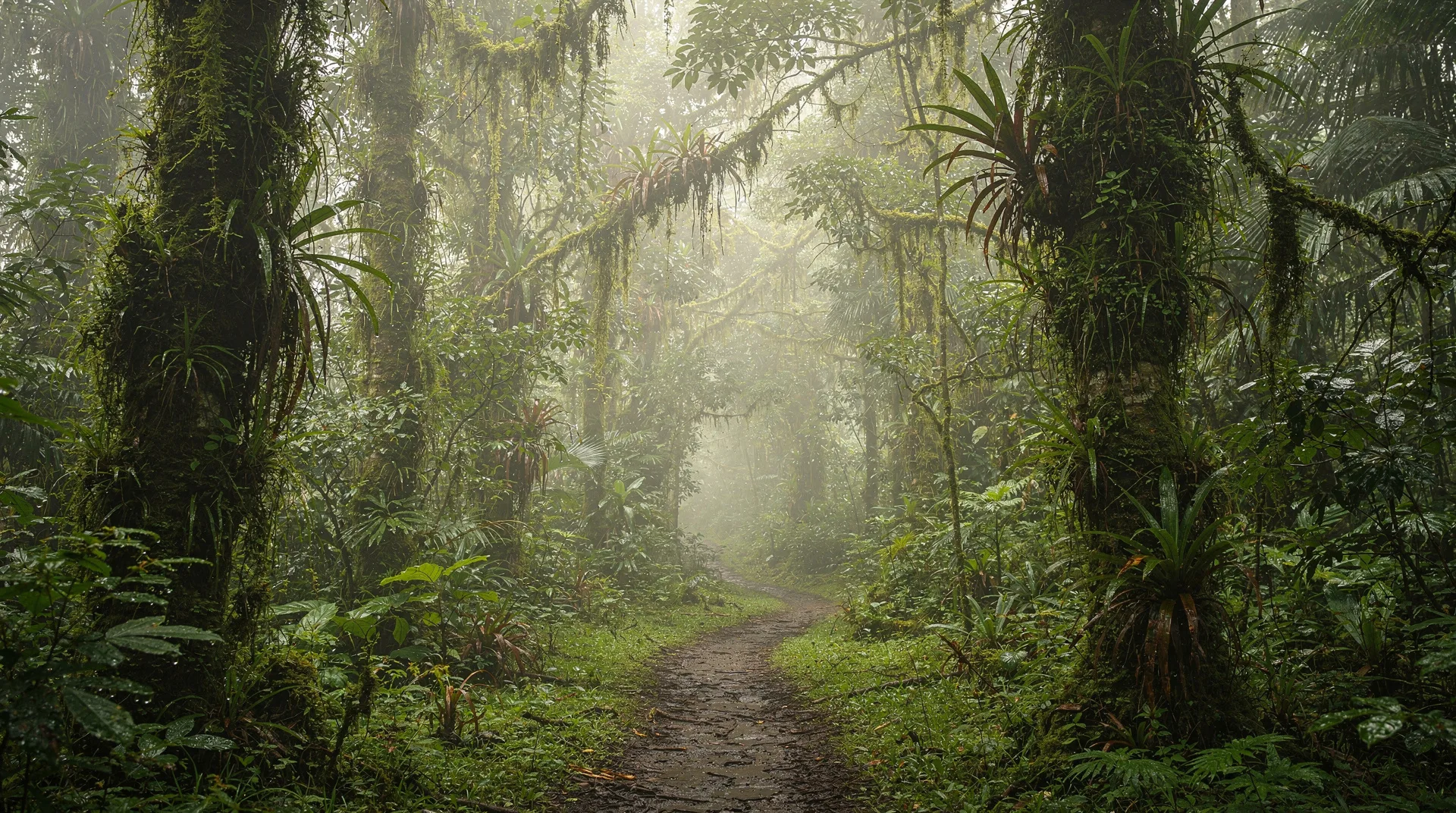
Children's Eternal Rainforest: the world's biggest kid-funded reserve
What is the Children's Eternal Rainforest?
22,000 ha — world's largest privately funded reserve, founded by Swedish schoolchildren in 1987.
The reserve that children built
The Bosque Eterno de los Niños — Children’s Eternal Rainforest — has one of the most remarkable origin stories in the history of conservation. In 1987, a 9-year-old Swedish boy named Roland Tiensuu raised 50 Swedish kronor selling drawings after hearing a presentation about Costa Rica’s endangered rainforests from visiting naturalist Eha Kern. That small sum became the seed money for an international children’s fundraising campaign that spread to 44 countries and raised enough to purchase thousands of hectares of forest in the Monteverde region.
Today the Children’s Eternal Rainforest protects approximately 22,000 hectares — making it the largest private nature reserve in Costa Rica and the largest reserve in the world to have been founded through children’s fundraising. It is managed by the Monteverde Conservation League, a Costa Rican non-profit established specifically to administer the land purchased through the international children’s campaign.
The story is an extraordinary case study in what grassroots conservation can accomplish. More than that, it provides a context for the biological value of the land it protects — because the reserve’s protection has been critical to maintaining wildlife corridors between the Pacific slope cloud forest and the Caribbean slope lowlands on the other side of the Tilarán mountain range.
What the reserve protects
Ecosystems and zones
The 22,000 hectares of the Children’s Eternal Rainforest span multiple altitude zones and ecosystem types. Unlike the Monteverde Cloud Forest Biological Reserve (which focuses primarily on cloud forest), the Bosque Eterno de los Niños encompasses:
- Lower montane rainforest (600-1,200 m): on the Caribbean slope, transitional between lowland rainforest and cloud forest, with high humidity and dense canopy
- Cloud forest (1,200-1,800 m): the Monteverde zone, the same habitat type as the famous reserve
- Pre-montane forest on the Pacific slope: drier, with different species composition
This altitudinal range makes the reserve critical as a wildlife corridor. Species that move seasonally between elevation zones — quetzals migrate to lower elevations outside breeding season, tapirs and pumas follow prey animals across the ridgeline — need intact forest at all altitudes. The Bosque Eterno de los Niños provides that continuity.
Wildlife
The reserve’s wildlife diversity reflects its ecological breadth. Confirmed species include tapir (a flagship large mammal that requires intact forest corridors), jaguar and puma, all four monkey species present in Costa Rica (howler, spider, white-faced capuchin, and squirrel monkey — one of the few reserves where all four occur), ocelot, kinkajou, and a rich community of forest raptors.
The bird list exceeds 400 species. The reserve’s Caribbean slope sector is particularly important for migratory species that winter in Costa Rica and for endemic cloud forest birds like the three-wattled bellbird and the black-faced solitaire. Resplendent quetzal, the cloud forest icon, nests within the reserve boundaries.
Herpetological diversity is high — the reserve’s range of altitude zones supports different frog communities at each elevation, including glass frogs (Centrolenidae), poison dart frogs (Dendrobatidae), and the tree frogs (Hylidae) that fill cloud forest evenings with sound.
If the wildlife is what draws you, a few of our other guides help you prepare. Our quetzal watching guide explains how to approach the cloud forest’s most famous bird, the monkey species guide helps you tell the four species apart, and the nocturnal wildlife guide covers what comes out after dark. Whatever you hope to see, our wildlife watching ethics guide is worth reading first, because a research reserve rewards quiet, patient visitors.
How to visit: the San Gerardo and Pocosol stations
The Children’s Eternal Rainforest is not a mainstream tourist destination in the same way as the Monteverde reserve, and that is by design. The Monteverde Conservation League manages two ranger stations that receive visitors:
San Gerardo Field Station (Caribbean slope)
San Gerardo is the more accessible and most visited entry point, located on the Caribbean slope below the Monteverde ridge. The station sits at approximately 900 metres elevation in lower montane forest — a very different environment from the cloud forest ridge. Trails here access humid forest with outstanding bird diversity including migratory species.
San Gerardo accepts day visitors and also operates as a field research station with rustic overnight accommodation for researchers and volunteer groups. Contact the Monteverde Conservation League (mclcostarica.org) to arrange visits and accommodation. The station is approximately 45 minutes by vehicle from Santa Elena on a rough road requiring 4WD.
Pocosol Field Station (northern lowland sector)
Pocosol station sits at lower elevation on the northern side of the reserve near Caño Negro — a very different ecosystem closer to lowland forest. It primarily serves researchers and conservation volunteers. Tourist visits are possible but require advance arrangement with the League.
What most visitors experience
For the majority of visitors to the Monteverde zone, the Children’s Eternal Rainforest is experienced indirectly — it forms the forest context visible from the ridge road and the Monteverde reserve’s border. The reserve’s role as a buffer zone and corridor for the more famous reserves around it is its primary conservation function.
The most meaningful way for most visitors to engage with the Bosque Eterno de los Niños is through the Monteverde Conservation League’s visitor center in Santa Elena town, which explains the reserve’s history and conservation work, and accepts donations.
Immerse yourself in the Monteverde Cloud Forest — from $55The origin story: from classroom to 22,000 hectares
The full story of how Roland Tiensuu’s 50 kronor became 22,000 hectares of protected rainforest is a case study in the power of children’s agency in conservation.
After Eha Kern’s presentation to the Swedish school in 1987, the children of Fagervik School began fundraising in earnest. They wrote letters to other schools. The campaign spread across Sweden, then to other Scandinavian countries, then to Australia, Japan, the United States, and dozens more. Children held bake sales, car washes, performances, and art auctions. Donations came in from individual children all over the world.
The Monteverde Conservation League — which had been established in 1986 by researchers and local community members to purchase land in the Monteverde zone — began receiving cheques from Swedish school accounts. As the campaign grew, the League received enough to purchase additional parcels, connecting the Monteverde reserve’s eastern boundary with the lowland forest on the Caribbean slope.
By the time the campaign wound down in the early 1990s, donations from children in 44 countries had funded the purchase and legal protection of more than 14,000 hectares (additional purchases since have expanded the reserve to its current 22,000 ha). The reserve was formally named the Children’s Eternal Rainforest — Bosque Eterno de los Niños — in honor of those who funded it.
The story remains relevant today. The Monteverde Conservation League continues to receive donations from children’s groups worldwide, and some schools structure annual fundraising campaigns around the reserve. The original campaign demonstrated that conservation outcomes are accessible to those without institutional wealth, and that children can be principal agents of environmental protection rather than passive inheritors of adult decisions.
Why the reserve matters ecologically: the corridor function
The most significant ecological contribution of the Children’s Eternal Rainforest is not just the land it protects directly — it is the wildlife corridor function it provides across the Tilarán mountain range.
Before the reserve’s establishment, the ridge above Santa Elena was being actively deforested for cattle pasture on both the Pacific and Caribbean slopes. A forest corridor connecting the cloud forest reserves on the Pacific side with the lowland forests of the Caribbean slope was at risk of being severed entirely.
The Bosque Eterno de los Niños, by protecting a continuous swath of forest from the ridge down both slopes, maintains the corridor that allows species requiring multiple altitude zones to persist. This matters most for:
- Resplendent quetzal, which breeds in cloud forest (1,500-2,000 m) but descends to lower elevations outside breeding season to feed on fruiting trees
- Tapir, which requires large home ranges and benefits from undisturbed forest across elevation zones
- Large cats (jaguar, puma), which need landscape-scale connectivity for gene flow between populations
- Migratory birds, which use the corridor as a north-south route through the mountains
Without this protected corridor, the Monteverde Cloud Forest Biological Reserve would be an ecological island — its populations of wide-ranging species cut off from the larger lowland ecosystems that sustain them.
Visiting with children: the perfect educational context
The Children’s Eternal Rainforest is self-evidently an excellent destination for families with children. The origin story — that children’s agency directly created and funded this 22,000-hectare reserve — is genuinely motivating, and many children who visit are deeply moved by the knowledge that peers their age were responsible for the protection of the forest they are walking through.
The Monteverde Conservation League’s educational programs for visiting school groups and families can be arranged in advance. These programs go beyond a standard nature walk to include conservation science, the history of the reserve, and current research being conducted within it.
Monteverde: cloud forest and butterfly farm full-day tour — from $95For families who are combining the Children’s Eternal Rainforest story with the nearby butterfly farm and hummingbird gardens, the Monteverde zone makes an outstanding 2-day educational destination. Our family-friendly Costa Rica guide covers age-appropriate activities across the country.
Planning around children also means thinking about the rest of the trip. Our family travel tips cover the practical side, and the activities for young children and activities for teens guides help you match the day to each age. For the wider setting, the Monteverde destination page shows how the reserve fits with everything else in the area, and the family-friendly sloth and beach itinerary shows one way to build Monteverde into a longer family route.
The Monteverde Conservation League: ongoing work
The Monteverde Conservation League has been active since 1986 and continues to manage the Children’s Eternal Rainforest alongside a broader program of conservation activities in the Monteverde region. Its work includes:
Land acquisition: The League continues to purchase additional parcels when they become available within or adjacent to the reserve’s boundaries. Private land adjacent to the reserve’s current perimeter represents one of the most significant ongoing threats — once converted to pasture or development, regrowth to functional forest takes decades.
Biological monitoring: Researchers affiliated with the League conduct long-term studies of bird populations, amphibian communities, and vegetation dynamics within the reserve. This research is particularly important for understanding the effects of climate change on cloud forest ecosystems.
Environmental education: The League runs the Bajo del Tigre children’s trail and education center in Santa Elena — a short, accessible trail specifically designed for school groups, with interpretive signage covering cloud forest ecology, conservation history, and the story of the Children’s Eternal Rainforest.
Community outreach: The League works with local landowners adjacent to the reserve to promote sustainable land use practices that buffer the reserve boundary from agricultural encroachment.
Donations to the League directly fund these programs. Individual donors can specify that their contribution go toward land purchase, education, or biological monitoring. Corporate and school group donations are welcomed with formal acknowledgment and updates on how funds are used.
What the golden toad taught the world
No discussion of the Children’s Eternal Rainforest is complete without acknowledging the golden toad (Bufo periglenes) — a species that was endemic to a small area of cloud forest near Monteverde and was declared extinct in 1989. The golden toad was last seen in 1989 by researcher Alan Pounds, and its disappearance became one of the most scientifically significant extinctions of the late 20th century.
The golden toad was striking — the male was vivid orange-gold, almost luminescent; the female was mottled brown with red spots. It bred in pools and puddles in the cloud forest during the brief rainy windows each year. Population collapse was rapid and total — from thousands of individuals to zero in less than a decade.
Research by Pounds and colleagues linked the extinction to climate-change-driven upward shift in the cloud base altitude, which left the toad’s breeding habitat too dry during critical periods. The golden toad is now cited in virtually every scientific discussion of climate-linked extinction as one of the clearest early examples of the phenomenon.
The extinction occurred within what is now the Children’s Eternal Rainforest boundary. The reserve protects the habitat where the species lived — though the species itself is gone. A memorial marker and information display exists at the Monteverde Conservation League’s visitor center. Understanding what the cloud forest lost, and why, gives the conservation work of the League a weight that goes beyond land management. Our microclimates guide explains why the mountains around Monteverde behave the way they do, which helps make sense of how a shift in cloud cover can reshape a whole habitat.
San Gerardo Field Station: the experience in detail
For those who arrange a visit to the San Gerardo Field Station, the experience is unlike any standard tourist reserve. The station sits in lower montane forest at approximately 900 metres on the Caribbean slope — a dramatically different environment from the cloud forest ridge above.
The descent from the ridge into the Caribbean watershed reveals ecological transition in real time: cloud forest gives way to warmer, more humid forest as elevation drops, with different tree species, different bird communities, and the auditory signature of the Caribbean — howlers are common here, and in the early morning the dawn chorus is extraordinarily loud.
The San Gerardo trails access primary forest that has been undisturbed since the League’s land acquisition — in some sections, this means old-growth Caribbean slope forest that has never been logged. Tree diameters at chest height exceed 2 metres in the mature sections. Buttress roots radiate 5-6 metres from the base of the largest specimens.
Wildlife at San Gerardo differs from the ridge. Expect more reptile diversity (boa constrictors, iguanas, and multiple snake species are more common at this elevation), and different bird species — the Caribbean slope hosts species like the keel-billed toucan and scarlet macaw that are less common on the Pacific side.
Overnight stays at the station are available for research groups and serious conservation volunteers. The accommodation is field-station basic — bunk rooms, shared facilities, cold water — but the forest access justifies it entirely for those with appropriate interests.
Frequently asked questions about the Children’s Eternal Rainforest
Can you visit the Children’s Eternal Rainforest as a standard tourist?
The most accessible visitor option is the San Gerardo Field Station, which accepts day visitors with advance arrangement. The reserve’s primary function is conservation and research rather than tourism — it does not have the same visitor infrastructure as the Monteverde or Santa Elena reserves. Most visitors experience it through the Monteverde Conservation League visitor center in Santa Elena and by knowing that much of the forest visible from the ridge road is part of the reserve.
Is it possible to volunteer in the reserve?
Yes. The Monteverde Conservation League accepts volunteers for trail maintenance, habitat monitoring, and educational programs. Minimum commitment is typically 2 weeks. Contact the League directly through mclcostarica.org for current volunteer programs. Some programs include accommodation at the field stations.
How has climate change affected the reserve?
Research conducted in the Monteverde zone — partly within the Children’s Eternal Rainforest — has documented significant shifts in cloud base elevation due to warming temperatures. The iconic golden toad (Bufo periglenes) went extinct in 1989 and is considered one of the first species to be lost due to climate-change-driven habitat shifts. The cloud forest ecosystem is particularly sensitive to these changes, and ongoing monitoring within the reserve is central to understanding regional impacts.
How much of the reserve is accessible on foot?
A limited portion is accessible via the San Gerardo and Pocosol trail systems. The majority of the 22,000 hectares is managed as wilderness reserve with no visitor access, which is appropriate for its conservation function. Wildlife corridors in the reserve interior are intentionally undisturbed.
Can I make a donation to the Children’s Eternal Rainforest?
Yes, directly through the Monteverde Conservation League at mclcostarica.org. Donations fund land protection, ranger stations, corridor maintenance, and educational programs. The League is a registered Costa Rican non-profit with a long track record of land stewardship.
Setting realistic expectations before you go
Because the Children’s Eternal Rainforest markets itself through its origin story rather than through resort-style visitor infrastructure, it is worth being direct about what a visit actually looks like. There is no visitor centre with cafeteria, no paved boardwalk network like the neighbouring Monteverde reserve, and no guaranteed wildlife checklist.
What you get instead is a genuinely undisturbed forest, a small number of dedicated rangers and researchers, and — if you arrange San Gerardo access in advance — a level of quiet and immersion that the more-visited reserves around Santa Elena rarely offer anymore. Visitors expecting a polished tourist attraction on the scale of Monteverde’s main reserve should recalibrate; visitors who want the forest itself, with minimal infrastructure between them and it, tend to leave the most moved.
Related guides
For a comparison of the other cloud forest reserves in the Monteverde zone, read our Monteverde vs Santa Elena reserve guide and Curi-Cancha Reserve guide. To understand the ecological context of cloud forest, our cloud forest vs rainforest guide explains the key environmental differences. Our wildlife overview for Costa Rica covers why the country’s conservation success story — of which the Children’s Eternal Rainforest is a key part — has made it one of the world’s most biodiverse places per square kilometer.