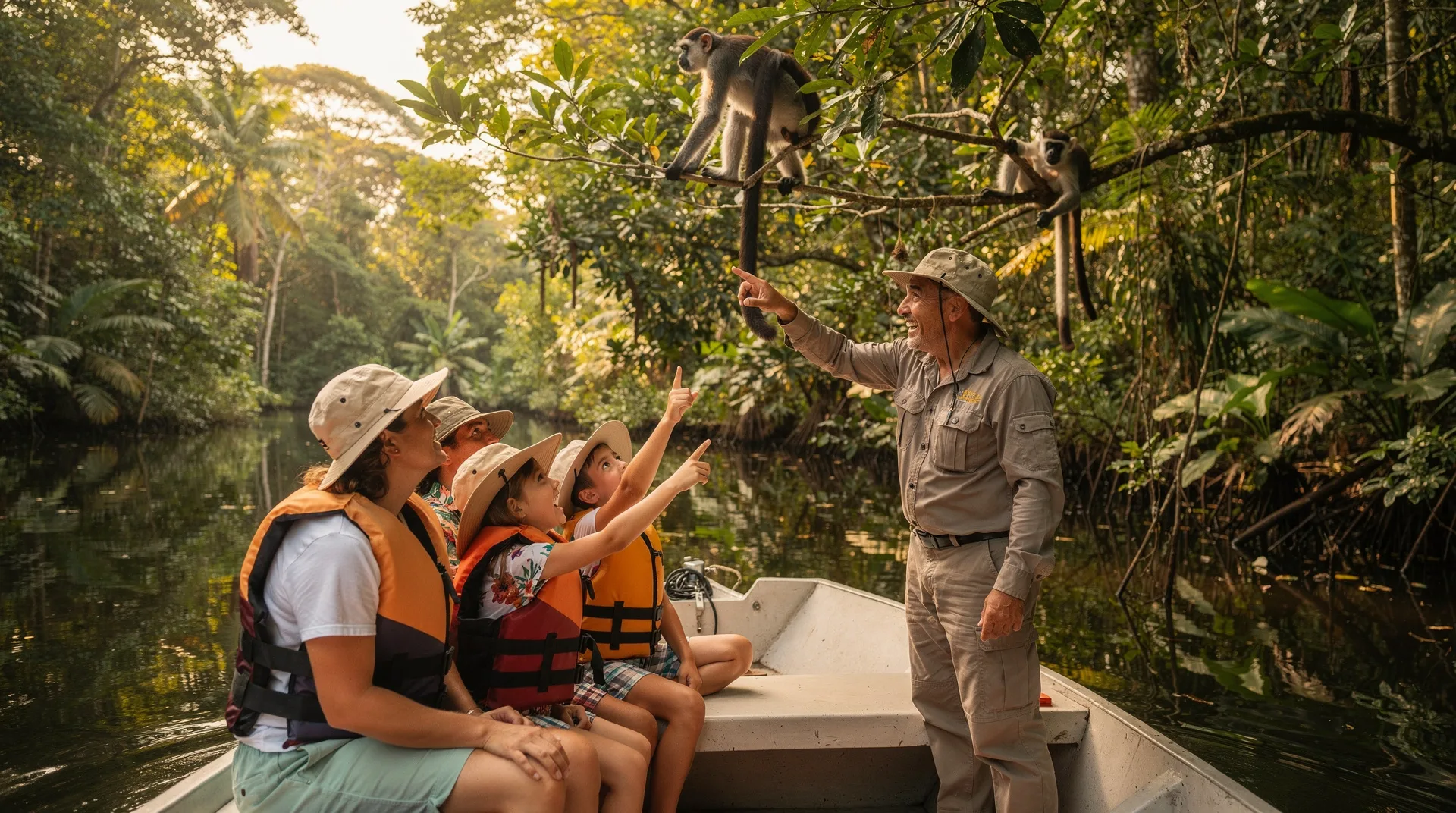
Family-friendly itinerary guide for Costa Rica
Best family itinerary for Costa Rica?
Arenal + Manuel Antonio 7-10 days — sloths, volcanos, beach, ziplines, no long drives.
Why Arenal plus Manuel Antonio is the gold standard for families
If you have seven to ten days and children aged four to sixteen, this circuit consistently outperforms every other combination. It delivers variety without exhausting anyone: two nights in the capital (optional), three to four nights in the Arenal area where the volcano looms over hot springs and hanging bridges, then three nights on the Pacific coast at Manuel Antonio where beach and national park share the same stretch of sand. Maximum wildlife encounters, manageable drive times, and zero need to brave unpaved mountain roads.
This guide lays out the full logistics — where to sleep, which activities to book first, what to skip with kids, and how to adjust for different age groups.
| Length | 7-10 days |
| Route | San José → La Fortuna (3-4 nights) → Manuel Antonio (3 nights) |
| Age range | Works well from around age 3 up |
| Cost driver | Rental car $35-100/day + activities $25-70/person |
| Best time | December-April (dry season) for reliable beach days |
Arrival and San José: day 1
Most international flights arrive at Juan Santamaría International Airport (SJO) in Alajuela, a 30-minute drive from downtown San José. If you land before noon, you have time to do a city half-day before heading north. If you arrive in the afternoon, base yourself near the airport for the night and leave early for Arenal the next morning.
Getting from SJO to La Fortuna
The drive takes roughly three hours on paved road via Ciudad Quesada. A 4WD is not strictly necessary for this leg but recommended for the whole trip — you’ll want it at Manuel Antonio if you explore any secondary roads. Rental cars from SJO: look at Adobe Rent A Car, Vamos, or Solid. Budget around $55–100 per day for an SUV in high season (December–April), $35–65 per day in the green season (May–November), plus approximately $25 per day for the mandatory basic insurance.
If you’d rather skip the wheel entirely, a shared shuttle from San José to La Fortuna costs around $55 per adult and takes about four hours. Children under twelve typically pay half-price. See our shuttle services overview for operator comparisons.
San José airport trap to avoid
Do not exchange currency at the airport kiosks — the rates are punishing. Use the BAC or Promerica ATMs inside the terminal. Fees run $5–10 per transaction but beat the exchange desk rates significantly.
La Fortuna and Arenal: days 2–4
La Fortuna is the most family-friendly base in Costa Rica. The town has excellent restaurants, well-maintained hotels at every price point, and a concentration of activities that rivals anywhere in Central America. Arenal Volcano provides the dramatic backdrop even on cloudy days.
Must-do: hanging bridges at Místico Park
The hanging bridges at Místico Arenal Hanging Bridges Park are the single best activity for families with children of any age. Eight bridges cross a primary rainforest canopy — no steep climbs, minimal elevation change, and excellent chances of spotting howler monkeys, toucans, and sloths from the safety of a railed walkway. The self-admission ticket costs $26. For families with younger children who may need animal-spotting help, a naturalist guide is worth every cent.
La Fortuna: Místico Arenal hanging bridges admission ticket — from $26Hot springs evening
After two days of hiking, a hot springs evening works perfectly for families. Baldí is the best choice for kids — it has waterslides alongside the thermal pools, and the children’s areas are shallow enough for toddlers. Tabacón Grand Spa is the luxury option if your family skews toward relaxation over splashing. Eco Termales limits guest numbers and suits families who prefer a quieter soak. All three charge day-pass rates ($55–$120 per adult).
Volcano and waterfall day
La Fortuna Waterfall requires a 500-step descent (and the same back up) — doable for children aged six and up, but toddlers will need carrying. The payoff is a 75-metre cascade into a clear pool. Combine it with a Arenal Volcano viewpoint stop and the Mistico bridges for a full day.
La Fortuna: Arenal Volcano, lunch & hot springs morning tour — from $120Skippable for families with young kids
Canyoning and rappelling tours are brilliant for teens but entirely inappropriate for under-tens. The same applies to white-water rafting above Class II — the Sarapiquí Class II-III is the floor for family rafting and only suits children aged eight and above who can swim.
La Fortuna to Monteverde (optional extension)
If you have ten days and your children are curious naturalists, add two nights in Monteverde before heading to the coast. The lake crossing transfer (van plus boat across Lake Arenal) takes three hours and is genuinely fun for kids — it breaks up the journey and avoids the longer road route. See our La Fortuna–Monteverde transfer guide for details.
Monteverde offers butterfly farms, the cloud forest hanging bridges at Selvatura, and night walks. For families with children aged eight and up who loved the Arenal bridges, Monteverde cloud forest tours are a worthy detour. For families with toddlers, skip it — the misty mountain climate means more sick days.
Manuel Antonio: days 5–7 (or 7–9 on a 10-day trip)
The drive from La Fortuna to Manuel Antonio takes approximately five hours via Quepos — or three hours from San José if you flew back down. This is the one long driving day; break it up with a lunch stop in Quepos.
Manuel Antonio National Park with a naturalist guide
Manuel Antonio National Park is the undisputed family highlight of the Pacific coast. Entry is quota-controlled (only 600 visitors allowed per day); book your ticket in advance, especially in the December–April high season. The park closes every Tuesday.
A certified naturalist guide costs $25–35 extra and is genuinely transformative with children — guides locate three-toed sloths sleeping in cecropia trees, identify poison dart frogs, and explain the monkey behaviour as capuchins raid bags on the beach. Without a guide, most families walk straight past a sleeping sloth at eye level.
Manuel Antonio Park: guided walking tour with a naturalist — from $65Manuel Antonio beach days
The main beach inside the park (Playa Manuel Antonio) has the calmest surf on the Pacific coast, protected by a headland on both sides. Outside the park, Playa Biesanz is nearly always flat and uncrowded. For families worried about rough surf, see our kid-safe beaches guide for full details on where to swim safely.
Watch for tourist traps at the park entrance
Unofficial “guides” solicit families at the park entrance and claim that hiring them is mandatory or that they have discounted tickets. Neither is true. Licensed guides will show ICT (Costa Rican Tourism Institute) certification. Always book your park entry online through the SINAC portal and arrange your naturalist guide through your hotel or a reputable operator.
Sample day-by-day schedule
Day 1: Arrive SJO, overnight near airport or drive to La Fortuna
Day 2: La Fortuna Waterfall morning + Místico Bridges afternoon
Day 3: Arenal day tour with lunch and hot springs evening
Day 4: Free morning (or Caño Negro day trip for birdwatching) + drive to coast or fly
Day 5: Drive to Manuel Antonio via Quepos (5 hours); beach afternoon
Day 6: Manuel Antonio National Park with naturalist guide
Day 7: Catamaran cruise or beach day; depart next morning
For a 10-day version, insert Monteverde as Days 4–5 after La Fortuna, then continue to the coast.
Accommodation choices by budget
Budget-friendly (under $120/night)
Hotel Si Como No in Manuel Antonio remains the best mid-range family option on the Pacific coast — two pools, wildlife bridge to the national park boundary, and family suites with bunks. Book early in high season; it fills weeks in advance.
Mid-range ($120–$250/night)
Selva Verde Lodge near Sarapiquí (ideal if adding the Caribbean leg) has family bungalows surrounded by primary forest, a resident naturalist, and a suspension bridge across a river. Nayara Resort in Arenal offers family-designated villas with private plunge pools — children love the resident sloths in the garden.
Eco-luxury ($300+/night)
Lapa Rios on the Osa Peninsula offers family bungalows with private decks overlooking the Corcovado buffer zone — best for families with teens who won’t be bored without a TV. For Arenal, the Tabacón Grand Spa and Thermal Resort includes hot springs access in the room rate.
See our family eco-lodges guide for a full comparison of properties.
Dining with children
Costa Rica is an easy country to feed children in. Sodas (family-run typical restaurants) serve rice and beans, chicken, plantain, and fresh juice for $6–10 per person — children almost universally accept the food. Avoid the tourist-trap restaurants that cluster around the Manuel Antonio park entrance and charge three times the soda price for half the quality. Ask your hotel reception for the nearest reliable soda; they always know.
Gallo pinto (rice and black beans with egg) at breakfast is universally popular with children. Ceviche at beachside sodas is an excellent light lunch. Avoid raw shellfish for younger children in the green season (May–November) when coastal temperatures accelerate bacterial growth.
Medical and sun considerations
Costa Rica has good private medical clinics in La Fortuna, Quepos, and San José. CIMA Hospital in San José is the best-equipped private hospital and treats international visitors routinely. Keep a note of the nearest clinic from each accommodation.
Pack reef-safe, mineral-based sunscreen — standard chemical sunscreens are banned in national parks due to coral reef protection regulations. Apply mosquito repellent with DEET on all exposed skin from dusk onward, especially in the Sarapiquí lowlands and Tortuguero if you extend to the Caribbean. Children’s formulation repellents (10–20% DEET) are widely available in pharmacies in La Fortuna and Quepos.
Extending the trip: Sarapiquí or the Caribbean
Families with more than ten days or a strong interest in wildlife over beach time sometimes swap or add Sarapiquí to the circuit. It sits roughly two hours from San José, making it an easy first or last stop rather than a detour, and its lowland rainforest lodges — Selva Verde Lodge is the benchmark, covered in full in our family eco-lodges guide — put wildlife literally on the property rather than requiring a guided excursion.
The trade-off is honest: Sarapiquí has no beach, and the humidity is higher than Arenal or the coast. For families prioritising ease over depth, sticking to the core Arenal-Manuel Antonio route remains the stronger choice; for families who’ve already done a first Costa Rica trip and want more rainforest immersion on a second visit, Sarapiquí is a genuine upgrade.
Frequently asked questions about family-friendly itinerary guide for Costa Rica
How old do children need to be for this itinerary?
The Arenal-Manuel Antonio circuit works for children from around age three upward. The Místico bridges have no age restriction. Hot springs pools have shallow areas for toddlers. Manuel Antonio beach suits all ages. Families with infants under 18 months may find the heat (30–35°C on the coast) challenging; time outdoor activities before 10am and after 4pm.
Is a rental car really necessary?
For the Arenal-Manuel Antonio circuit, a rental car gives you the most flexibility and is generally recommended. The alternative is a combination of shared shuttles: San José to La Fortuna ($55 per adult), La Fortuna to Quepos ($65–80 per adult), which works well but removes spontaneity. See our rent-a-car-or-not guide for the full breakdown.
When is the best time for this family itinerary?
December through April (dry season) gives the most reliable beach days and clearest national park conditions. Late November and May are excellent shoulder-season compromises — lower prices, fewer crowds, and typically only afternoon rain rather than all-day downpours. July and August work well too, thanks to the veranillo mini-dry-season around late June to early July.
Are the roads safe for driving with children?
The main Ruta 1 and Ruta 27 (San José to the Pacific) are four-lane paved highways. La Fortuna roads are paved and straightforward. The coast road between Quepos and Manuel Antonio has some hairpin bends but is paved. The only challenging segment for families is the La Fortuna to Monteverde road if you choose the road route rather than the lake crossing — see our road conditions guide for details.
What if my child gets sick?
La Fortuna has a 24-hour pharmacy (Farmacia Don Rodrigo) and a CCSS clinic. Quepos has a well-equipped public hospital and several private clinics. For anything serious, San José’s CIMA Hospital is the benchmark. Travel insurance that covers medical repatriation is strongly recommended — see our planning guides for insurance advice.
Do national parks require advance booking?
Manuel Antonio NP requires online reservation through the SINAC portal, especially in high season. Volcán Poás requires advance booking 4 weeks ahead. Arenal Volcano NP and Místico Park do not require advance booking but can be busy. Book your Manuel Antonio entry as soon as you have confirmed travel dates.
Is Costa Rica safe for families?
Yes — Costa Rica is significantly safer than most of Central America and has a well-established family tourism infrastructure. The main risks are ocean rip currents (swim only at lifeguarded beaches or in the national park), and vehicle break-ins (never leave bags visible in a parked car). See our family travel tips guide for a complete safety rundown.
Adjusting the pace for different age groups
The itinerary above assumes a family with children roughly aged five to twelve, but the same route flexes meaningfully for other ages. With toddlers (under four), plan for one activity per day rather than two — a morning at the Mistico bridges or Manuel Antonio, with the afternoon left unstructured for naps and pool time at the hotel. Toddlers also make the La Fortuna Waterfall’s 500-step descent impractical; skip it or plan for one adult carrying the child the full way.
With teenagers, the same circuit can absorb more adrenaline: swap or add canyoning and white-water rafting above Class II, both of which are genuinely enjoyable for confident teens but wasted on younger children who can’t fully engage with the risk and skill involved. Teenagers also tend to get more out of a longer, more challenging hike — the standard Manuel Antonio trails are gentle, so pairing the park with a half-day at Rincon de la Vieja or a more demanding Arenal trail rewards older kids who find the family-standard pace too slow.
Mixed-age groups — a common reality with cousins or friend groups travelling together — benefit most from the hanging bridges and hot springs days, which work at every age without requiring the itinerary to fork. Reserve the more polarising activities (canyoning for teens, gentler wildlife walks for the youngest) as optional add-ons rather than group activities, and expect one adult to split off with each age cluster on those specific days.
Related guides
The family circuit connects naturally with several deeper guides. Our kid-safe beaches guide covers every calm-water beach on the Pacific and Caribbean coasts. The activities for young children guide focuses specifically on under-sevens, while activities for teens covers ziplines, surfing, and adventure options. For accommodation, the family eco-lodges guide compares the best lodge options at every price point, and family travel tips handles packing lists, insurance, and health practicalities.