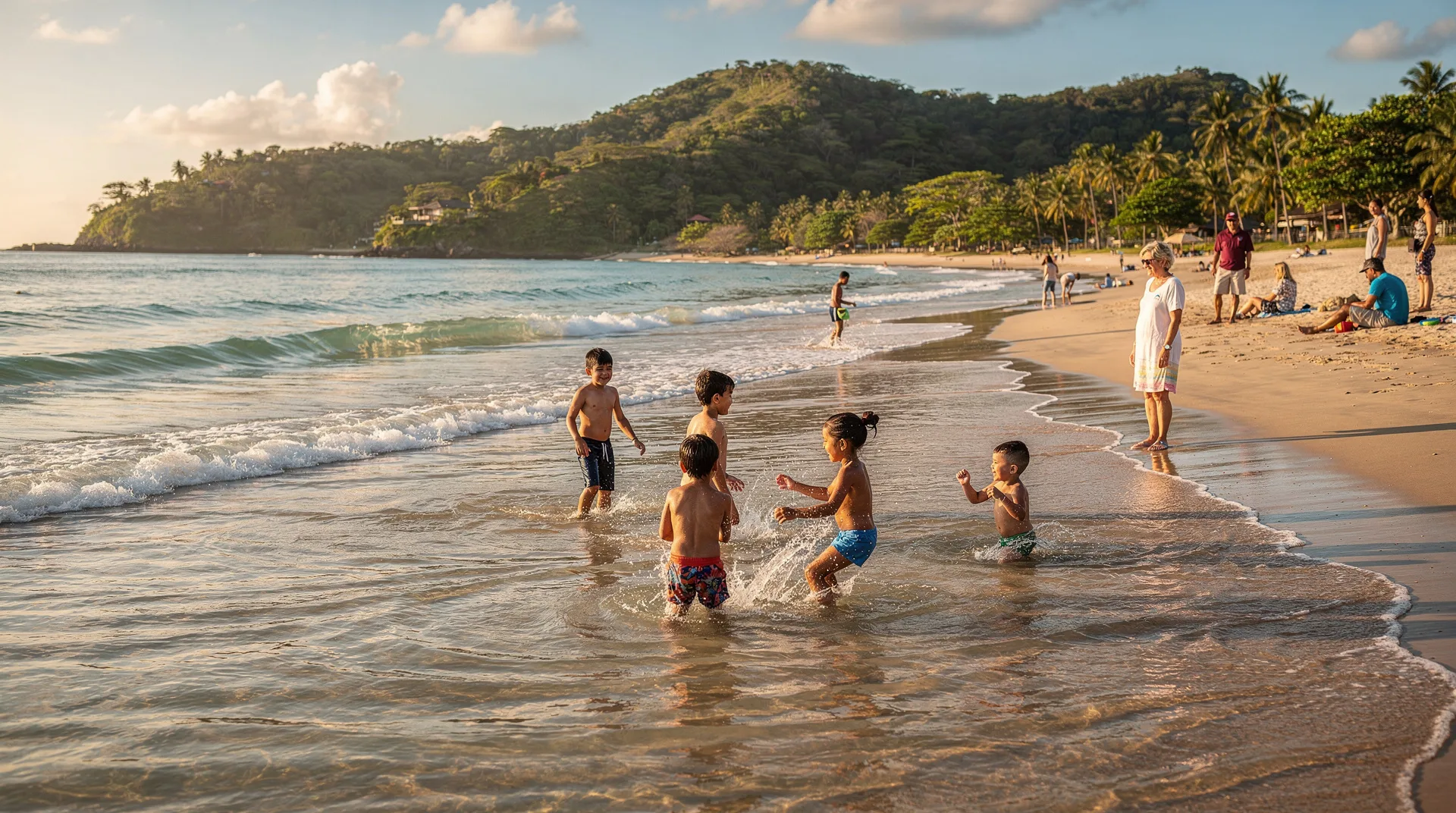
Kid-safe beaches in Costa Rica: the calmest options for families
Calmest swim beaches for kids?
Conchal, Hermosa Guanacaste, Sámara, Manuel Antonio main — protected bays, gentle surf, lifeguard presence.
Understanding Costa Rica’s surf before you pick a beach
Costa Rica’s Pacific coast generates some of the world’s most powerful beach break waves. That’s fantastic for surfers and genuinely dangerous for young swimmers. The country’s Pacific beaches face open ocean — swells arrive unbroken across thousands of kilometres of fetch — and rip currents run at every open-coast beach at some point during the tidal cycle. Approximately 80 percent of drowning deaths in Costa Rica involve tourists who underestimate the sea.
This guide focuses on the beaches where families can swim with confidence: protected bays, calm lagoons, or reef-sheltered shores where the surf stays manageable even for children who can’t yet read ocean conditions. None of these beaches are entirely without ocean risk — that responsibility never disappears — but they represent the lowest-risk swimming in Costa Rica.
| Top picks | Conchal, Sámara, Hermosa Guanacaste, Manuel Antonio main beach |
| Why calm | reef or headland protection breaks the Pacific swell |
| Entry fee | free for Guanacaste beaches; around $20/$10 adult/child at Manuel Antonio NP |
| Best swim window | 7-10am, before the afternoon onshore breeze builds |
| Avoid | Jacó, Playa Hermosa (near Jacó), Playa Grande, Dominical, Pavones |
Playa Conchal, Guanacaste
Playa Conchal sits just south of Brasilito in northern Guanacaste and is widely considered the most beautiful family beach in Costa Rica. The name comes from the millions of crushed shells that give the shoreline its distinctive pale-pink colour and soft texture underfoot — far more comfortable on small feet than coarse volcanic sand.
The bay curves in a wide arc sheltered from the dominant Pacific swell by a rocky headland. On most days from December through April, the water inside the bay is glass-flat. Even in the green season (May–November) when the outer coast gets rougher, the inner bay usually stays swimmable. Water visibility is excellent — you can see your children’s feet at waist depth.
What to do near Conchal
The nearest town is Brasilito, a 10-minute walk north, with several good sodas serving typical food at local prices. Flamingo (15 minutes by car) has supermarkets, pharmacies, and a medical clinic. The Westin Playa Conchal is the main resort here — its beach is adjacent and equally calm — but independent day visitors park at the public access point near Brasilito.
From Conchal, a horseback ride to the beach is one of the most memorable experiences for children who are old enough to ride (generally 8+). Operators depart from Tamarindo (30 minutes north) and ride through dry forest to reach the beach.
Tamarindo: horseback to Conchal Beach — from $70Getting there
From Liberia airport (LIR): 55 minutes south on Ruta 21. From Tamarindo: 25 minutes south. From San José: 4.5 hours via Ruta 1 north to Liberia then south.
Playa Hermosa, Guanacaste (not to confuse with Hermosa near Jacó)
There are two beaches named Playa Hermosa in Costa Rica — the Guanacaste one and the surf beach south of Jacó. They could not be more different. Playa Hermosa Guanacaste is one of the calmest family beaches in the country; Playa Hermosa Jacó is a big-wave surf spot unsuitable for children.
Playa Hermosa Guanacaste sits in a sheltered bay about 15 kilometres south of Playas del Coco. The bay is partially enclosed by volcanic headlands that block the worst of the Pacific swell. The beach is dark grey volcanic sand — not the prettiest in Guanacaste — but the swimming is consistently calm and the bay rarely generates meaningful surf. Shading palms line the upper beach, which helps during the brutal midday heat.
Family resort concentration
Several mid-range and luxury resorts cluster around Playa Hermosa Guanacaste, including the Hotel El Velero and Playa Hermosa Bosque del Mar, making it a convenient base for families who prefer resort infrastructure. The beach is quiet compared to Tamarindo and rarely overcrowded. Sunset snorkeling tours depart from nearby Playas del Coco if you want to add an activity.
Playas del Coco: sunset sailing and snorkeling tour — from $95Playa Sámara, Nicoya Peninsula
Sámara is the most universally praised family beach in Costa Rica — and the one most recommended by long-term expats with children. A coral reef runs parallel to the beach about 300 metres offshore, breaking most of the Pacific swell before it reaches the shore. The result is a beach where children wade in water that rarely rises above ankle-to-knee height waves for the first 50 metres.
The town of Sámara is charming and genuinely non-touristy by Costa Rica standards. There are good surf schools (the Sámara break is gentle enough for children aged 10+ who want to try surfing), a farmers’ market, several family-friendly restaurants, and a quiet main street. Accommodation ranges from backpacker hostels to decent mid-range hotels with pools.
How to reach Sámara
Sámara sits on the Nicoya Peninsula, which requires either a ferry crossing from Puntarenas (see our ferry routes guide) or a longer drive around the peninsula. From Liberia: 2.5 hours south through Nicoya town. From San José: 4 hours via the Tempisque Bridge. No paved road runs directly from Tamarindo to Sámara — the route goes inland.
Sámara for families with older children
Teenagers who want a little more action can take surfing lessons on the gentle inside break, join a kayaking tour of the estuary, or take a short boat tour to spot dolphins. The reef snorkeling is decent for calm conditions but does not compare to Caño Island or the Caribbean.
Manuel Antonio main beach (inside the national park)
The beach inside Manuel Antonio National Park is the best-protected swimming cove on the central Pacific coast. Two rocky headlands funnel swells away from the main sandy cove, leaving a bay where the surf rarely exceeds 30 centimetres even in the green season. The sand is white, the water is clear, and the park setting means no motorised watercraft within the swimming area.
The catch: you pay national park entry ($20 per adult, $10 per child, subject to change — check the SINAC website). The park closes on Tuesdays and limits daily visitors to 600, so advance booking is mandatory in high season. The main beach gets genuinely crowded by mid-morning in December through March. Arrive by 7:30am to claim shade under the trees.
Wildlife at the water’s edge
One of the genuinely special things about Manuel Antonio’s beach is that the wildlife doesn’t stop at the forest edge. Capuchin monkeys raid beachbags (secure your food and never feed them). Three-toed sloths sleep in the cecropia trees directly above the beach. Coatis trot along the sand at low tide. For children, this is zoo-level wildlife at no extra charge.
For a guided experience that combines the park and the beach, a naturalist tour is the most efficient way to ensure you find sloths and monkeys. See our family-friendly itinerary guide for how to integrate this into a 7-day circuit.
Playa Biesanz: the hidden alternative
If the national park quota is full or you want to avoid the entry fee, Playa Biesanz is a small, sheltered cove 10 minutes north of the park entrance by road. It is almost always flat-calm, rarely crowded, and shaded by mature trees. No facilities — bring food and water — but the swimming is as good as inside the park.
Caribbean coast beaches for families
The Caribbean coast operates on a different oceanographic system from the Pacific and deserves separate mention.
Punta Uva and Manzanillo
The southern Caribbean coast between Puerto Viejo and the Panamanian border has some of the calmest swimming in the country during the Caribbean dry season (September–October and March–April). Punta Uva is a protected cove with excellent snorkeling from shore — the reef is close in, the fish are vivid, and the waves are minimal on calm days. Manzanillo, 13 kilometres further south, sits at the edge of the Refugio Nacional de Vida Silvestre Gandoca-Manzanillo and is equally calm.
The caveat: Caribbean beaches flip to rough conditions quickly, and the reef means occasional strong surge even when the surface looks calm. Ask locals before letting children swim unsupervised.
Cahuita
Cahuita town beach (outside the national park) is generally calm and popular with local families. The national park beach near Puerto Vargas is patrolled and has slightly better reef snorkeling. Neither beach has consistently reliable surf for swimming — conditions change with the swell — but Cahuita is generally safer for children than the open-coast Caribbean beaches further north.
Beaches to avoid with young children
Several famous Costa Rica beaches are dangerous for children regardless of conditions:
- Playa Jacó: strong rip currents even at low tide; no reliably calm zones
- Playa Hermosa (near Jacó): big-wave surf beach; hazardous for all non-surfers
- Playa Grande (Las Baulas NP): leatherback turtle nesting beach; powerful shore break
- Dominical: heavy dumping shore break; experienced surfers only
- Pavones: one of the world’s longest left-hand waves; unsuitable for swimming
- Playa Tamarindo (main break): consistent beach break surf that looks calm from shore but punches hard in the shore pound
Reading the flag system at guarded beaches
A small number of Costa Rica’s tourist beaches have lifeguard stations and flag systems. Yellow flag means caution; red flag means no swimming. Unstaffed beaches have no flags — ask local vendors or hotel staff about current conditions before entering the water. The safest rule: if you can see waves breaking close to shore and the water looks churned, hold back regardless of what other tourists are doing.
Rip current basics every parent should know
Rip currents are the single biggest hazard at Costa Rica’s open Pacific beaches, and they are frequently invisible to an untrained eye — sometimes appearing as a deceptively calm, flat channel between areas of breaking waves. If a child gets caught in one, the current pulls away from shore, not under the water, so the instinct to fight straight back to the beach is exactly wrong.
The correct response — for adults and any child old enough to understand it — is to swim parallel to the shore until out of the current’s pull, then angle back in. Never attempt to swim directly against a rip current; it exhausts swimmers faster than the current itself endangers them. Our Costa Rica beach safety guide covers rip currents, jellyfish, and other coastal hazards in more depth, and is worth reading alongside this one before any beach-heavy family trip.
Choosing between the calm options
The right beach depends less on which one is “best” and more on what else your family wants from the day. If you want soft shell sand and an easy walk to lunch, the Playa Conchal destination page and the neighbouring village of Brasilito make a natural pair. If you would rather stay close to a resort base, Playa Hermosa Guanacaste and Playas del Coco sit within easy reach of each other, and our Guanacaste beach guide compares the wider northern coast.
For a relaxed town with a protected shoreline, read the Sámara destination page and the Nicoya Peninsula beaches guide before you commit to the drive. On the central Pacific, the Manuel Antonio destination page, the Manuel Antonio National Park guide and the nearby base town of Quepos cover logistics, timing and where to stay.
If you want to see how these picks compare with the rest of the country, the best family beaches guide ranks a wider list. And because swell and tides shift the picture hour by hour, the tide and surf conditions guide helps you plan the morning swim window.
Families tempted by the other coast should weigh the Caribbean versus Pacific beaches guide first. The Cahuita destination page and the Puerto Viejo destination page show what the southern Caribbean base towns offer, and the Cahuita National Park guide explains the park side of that stretch.
Building a family beach itinerary around these picks
Few families base an entire trip around a single beach — the calm-water options in this guide cluster naturally into two circuits. A Guanacaste-based trip can combine Conchal, Hermosa, and a Playas del Coco snorkelling day within an hour of each other. A Central/South Pacific trip pairs Manuel Antonio’s protected cove with the wildlife of the national park itself, then continues to Uvita for whale watching in season. Trying to combine both coasts in one trip usually means sacrificing beach time to driving; pick one region and go deep rather than spreading thin. The family-friendly itinerary guide maps out both circuits with day-by-day pacing.
Frequently asked questions about kid-safe beaches in Costa Rica
Are there any 100-percent safe beaches in Costa Rica?
No beach is entirely without risk, but the beaches in this guide — Conchal, Sámara, Hermosa Guanacaste, and Manuel Antonio main cove — have the lowest documented incident rates for families. The reef at Sámara is the single most reliable natural wave buffer in the country.
Which beach is best for toddlers who can’t swim?
Sámara wins for non-swimming toddlers — the reef protection means water stays knee-deep and calm for 40–50 metres from shore. Conchal is a close second for its soft shell-sand bottom and usually flat inner bay. Both are far superior to any open-coast Pacific beach for small children.
Do beaches inside national parks cost extra?
Yes — Manuel Antonio NP charges $20 per adult, $10 per child (as of 2026, subject to change). The Cahuita National Park Kelly Creek entrance operates on a voluntary donation basis ($5–10 suggested). Playa Conchal, Playa Hermosa Guanacaste, and Sámara are all public beaches with no entry fee.
Is the Caribbean coast safe for children to swim?
During the Caribbean’s relative dry windows (September–October and March–April), the southern Caribbean coast around Punta Uva and Manzanillo offers excellent calm-water swimming. Outside those windows, the Caribbean can be rough and unpredictable. The Pacific options in this guide are more reliably calm across a longer annual window.
What time of day is best for beach swimming with children?
Early morning (7–10am) offers the calmest surf, coolest temperatures, and lowest ultraviolet index. By mid-afternoon (1–4pm), the Pacific ocean breeze picks up and pushes wave energy onshore. If you can only do one swim, make it morning.
Is there beach gear to rent near these beaches?
All four main beaches in this guide have vendors renting beach chairs ($5–10 per chair per day), umbrellas ($10–15), and snorkel gear ($10–15). Sámara also has kayak rentals and paddleboards. Conchal has fewer vendors than the resort beaches — bring your own shade if you’re not staying at the Westin.
How do I teach a child to recognise a rip current?
Point out the visual clues together before swimming: a rip current often looks like a flatter, murkier channel of water moving steadily seaward between two areas of breaking waves, sometimes carrying foam or sediment out to sea. Practise the rule as a family — if caught, swim parallel to shore, never straight back against the pull — and reinforce that an adult should always be within arm’s reach of young children in open-coast water, even at the calmer beaches in this guide.
Related guides
Our family-friendly itinerary guide maps these beaches into a complete 7–10-day circuit. The Guanacaste beach guide covers all beaches in the northern province in detail. For children under seven who need activity inspiration beyond the beach, see our activities for young children guide. The family travel tips guide covers reef-safe sunscreen rules, first aid, and emergency contacts.