Family travel tips for Costa Rica: practical guide for parents
Costa Rica with kids: practical tips.
Pack reef-safe sunscreen, kids' mosquito repellent, allow 30% extra travel time, choose flat areas for toddlers, and pre-book park entries.
Honest expectations for family travel in Costa Rica
Costa Rica is an excellent family destination. The infrastructure is good, the wildlife is extraordinary, and the country’s safety profile is well ahead of its Central American neighbours. But it’s not a plug-and-play resort trip. Roads are rougher than Europe or North America. Heat and humidity are serious on the Pacific coast from November through April. Rain can be persistent in the green season (May–November). Planning with children requires more preparation than an adults-only trip.
This guide covers what experienced family travellers wish they’d known before arriving: the sunscreen rules, the realistic driving times, the health precautions, and the booking steps that prevent headaches once you’re on the ground.
| Best base for young kids | La Fortuna / Manuel Antonio circuit |
| Extra travel time | Add 30–40% to Google Maps estimates |
| Sunscreen | Reef-safe / mineral only, mandatory in parks |
| Medical costs (private, uninsured) | $3,000–10,000 for hospitalisation |
| Book ahead | Manuel Antonio NP entry, peak-season lodging |
Sunscreen: reef-safe is mandatory in national parks
Costa Rica prohibits chemical sunscreen formulations in national parks and marine protected areas. This is actively enforced at park entrances — rangers at Manuel Antonio NP turn away families with standard chemical sunscreen (oxybenzone, octinoxate) and direct them to the park shop, which sells reef-safe alternatives at inflated prices.
Pack reef-safe, mineral-based sunscreen before you travel. Look for formulations with zinc oxide or titanium dioxide as the active ingredient. SPF50 is the minimum appropriate for children in Costa Rica’s equatorial UV environment.
Practical sunscreen notes for families
Apply 20 minutes before going outside. Reapply every 90 minutes and immediately after swimming. For children in the water, every 45–60 minutes is more realistic. White mineral-oxide residue on children’s faces and shoulders is normal and harmless.
Brands widely available in Costa Rica pharmacies: Sun Buddy (local Costa Rican brand, reef-safe), Badger SPF30/50, Stream2Sea. International brands: Blue Lizard, Raw Elements. The La Fortuna and Quepos pharmacies both stock reef-safe options if you run out.
Mosquito repellent for children
The lowland rainforest areas — La Fortuna, Sarapiquí, Tortuguero, Caribbean coast, and the Osa Peninsula — have significant mosquito populations, particularly at dawn and dusk. Dengue fever is present in Costa Rica year-round; there is no vaccine for travellers. Zika risk is low but not zero.
Children’s repellent: DEET at 10–20% concentration is approved for children over two months of age by the US Centers for Disease Control. Picaridin (Saltidin) is an alternative that is equally effective and less irritating to skin — particularly good for children with sensitive skin. Never use DEET on infants under 2 months.
Apply repellent to all exposed skin after sunscreen has absorbed. Do not spray directly on a child’s face — spray on your hands and then apply to their face avoiding eyes and mouth.
Natural alternatives: Plant-based citronella and lemongrass repellents provide some protection but lose efficacy within 30–45 minutes. They are not adequate for the La Fortuna lowlands or Caribbean coast at dusk.
Mosquito net for infants
For families travelling with infants under 12 months, a portable mosquito net that fits over a travel cot or standard cot is a worthwhile investment. Eco-lodges in remote areas often provide nets as standard but it’s worth confirming when booking.
Building in extra travel time
The single biggest mistake families make in Costa Rica is underestimating travel times and overestimating how much ground they can cover with children.
The official driving time rule: Costa Rica’s rural road network is significantly slower than a GPS estimate suggests. Add 30–40% to any Google Maps estimate for routes involving secondary roads. Factor in:
- Stop for bathroom breaks every 60–90 minutes (children’s reality)
- Road quality deterioration after rain (green season)
- Single-lane bridge slowdowns (common on Ruta 32 and Nicoya Peninsula roads)
- Cattle on the road (genuinely common in rural Guanacaste)
Key realistic times with children:
| Route | Google Maps | With children |
|---|---|---|
| SJO → La Fortuna | 2h30 | 3h30–4h |
| La Fortuna → Monteverde (lake crossing) | 3h | 3h30–4h |
| SJO → Manuel Antonio | 3h | 4h–4h30 |
| SJO → Puerto Viejo | 4h | 5h–5h30 |
| Liberia → Tamarindo | 1h | 1h30 |
For families with children under 5, consider limiting driving days to a maximum of 3–4 hours in the car. Beyond that threshold, the experience degrades for everyone. See our driving in Costa Rica guide for route-specific advice.
Choosing flat areas and accessible activities
Not everything that looks good online is physically appropriate for families with young children. Some planning rules:
Suitable for pushchairs/strollers: La Paz Waterfall Gardens (paved path throughout), La Fortuna town centre, Arenal Observatory viewpoint, Manuel Antonio beach (compact pushchair only — sandy path), Quepos town.
Not suitable for pushchairs: Monteverde cloud forest reserve trails (muddy, steep), Místico Arenal bridges (can be done with a carrier for small children — the bridges are wide enough but pushchairs can’t be pushed across), Corcovado National Park (remote wilderness; no infrastructure).
Activities rated for different mobility:
- Low exertion (all ages): La Paz Waterfall Gardens, Toucan Rescue Ranch, Tabacón hot springs, beach days
- Moderate (age 4+, adults carrying or wearing toddlers): Místico bridges, La Fortuna waterfall viewpoint (top section only), Monteverde butterfly farm
- Demanding (age 6+, comfortable walking 45+ minutes): Manuel Antonio park trails, Monteverde cloud forest walks, Sarapiquí river trip
For families with children who swim confidently, calm Caribbean water can be a gentle introduction to the reef. A guided session such as a snorkelling trip over the Cahuita reef — from $60 keeps children with a guide who knows the conditions, and the Cahuita destination page explains how the town fits into a wider trip. Our best snorkel beaches guide compares other options, and the beach safety guide is worth reading before any child enters the water. Wherever you snorkel, the same reef-safe sunscreen rule applies.
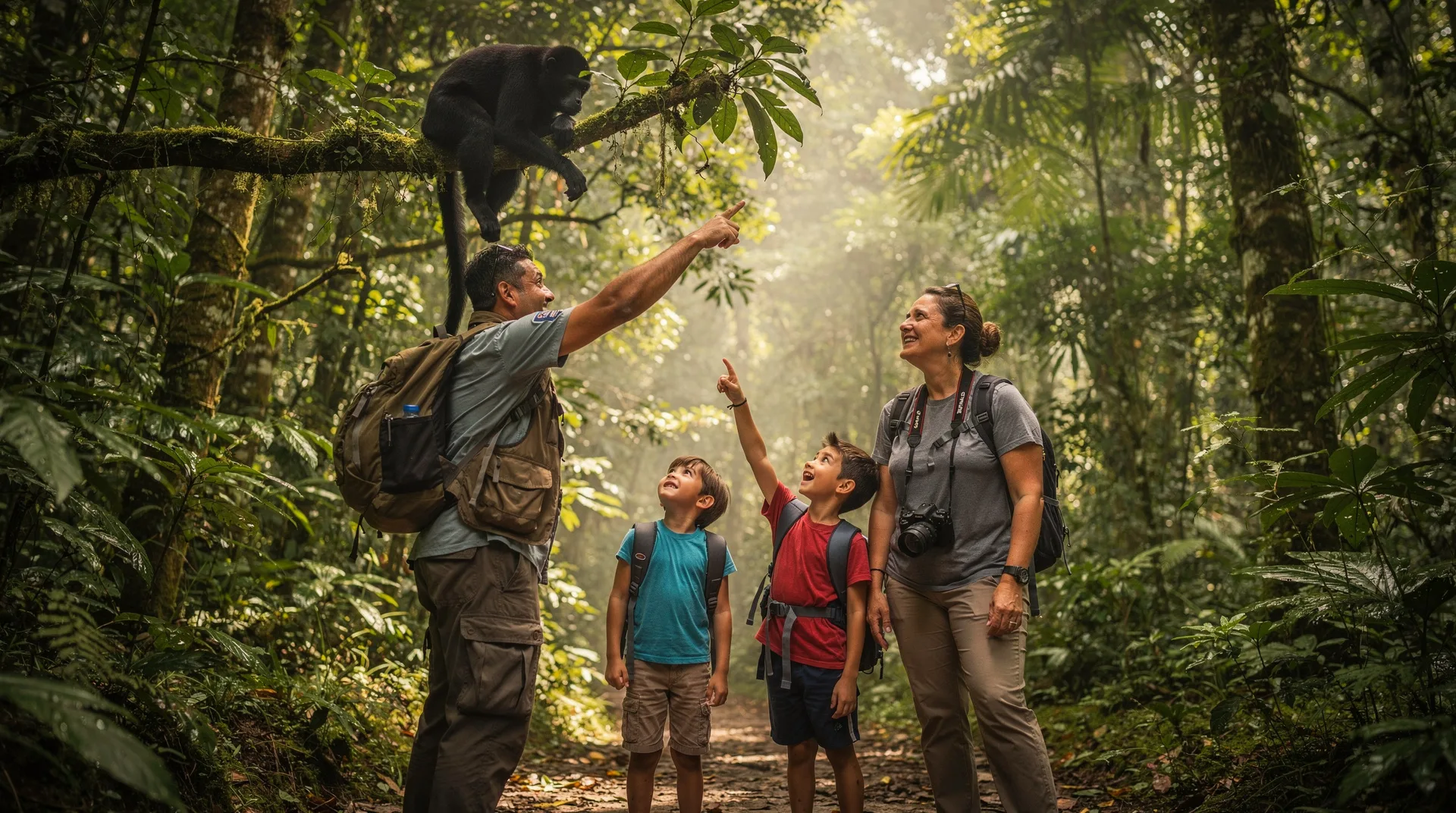
For wildlife with small children, the where to see sloths guide and the wildlife watching ethics guide help you choose calm, responsible encounters and explain to children why we keep our distance. Families heading to the volcano area will find more detail in the La Fortuna destination page and the Arenal Volcano National Park guide, while the Manuel Antonio destination page and the Manuel Antonio National Park guide cover the Pacific side.
Health precautions and medical access
Before departure
- Consult your travel medicine doctor 6–8 weeks before departure for routine vaccination review. Hepatitis A vaccination is recommended for Costa Rica.
- Confirm your travel insurance covers medical evacuation — standard travel insurance often excludes adventure activity injuries.
- Pack a comprehensive travel first aid kit: children’s paracetamol and ibuprofen (both formulations), antihistamine (cetirizine liquid for children), rehydration salts, antiseptic cream, bandages, blister plasters, tweezers for splinters.
Medical facilities
Costa Rica has a two-tier medical system: public CCSS (Caja Costarricense de Seguro Social) clinics and private clinics/hospitals. As a tourist family, private facilities are faster and better equipped. Key private hospitals:
- CIMA Hospital, San José (Escazú): Best-equipped private hospital; handles serious paediatric cases
- Clínica Bíblica, San José: Reputable private hospital with English-speaking staff
- Quepos Hospital: Public hospital; adequate for minor injuries and illness
- La Fortuna: CCSS clinic plus several 24-hour pharmacies
- Liberia: CIMA satellite clinic; adequate for Guanacaste families
The emergency number in Costa Rica is 911 — works for ambulance, police, and fire.
Packing checklist for families with children
Clothing
- Lightweight quick-dry long-sleeved shirts (UV and mosquito protection in one)
- Swimwear (two sets per child — one always drying)
- Light rain jacket (green season essential; useful even in dry season for cold Monteverde)
- Sandals with back strap (thongs/flip-flops are inadequate for trails)
- Warm layer for Monteverde (cloud forest temperature drops to 12°C at night)
Health and safety
- Reef-safe SPF50 mineral sunscreen (large quantity — children use it fast)
- Children’s mosquito repellent (DEET 10–20% or Picaridin)
- Water shoes (for river crossings and rocky beach approaches)
- Personal water bottles (reduce plastic, stay hydrated)
- Children’s medication (paracetamol, ibuprofen, antihistamine, diarrhoea treatment)
Documents
- Passport validity: must be valid for at least 6 months beyond entry date
- Onward ticket: Costa Rica immigration requires proof of departure booking
- Travel insurance documents (physical copy, not only digital)
- Emergency contact card for each child (laminated; in English and Spanish)
Pre-booking essentials
Families who leave these to chance frequently face disappointment in high season (December–April):
Book in advance:
- Manuel Antonio NP entry (SINAC portal; opens 30 days ahead)
- La Fortuna and Manuel Antonio accommodation (peaks fill 3–4 months ahead)
- Monteverde cloud forest tour reservations (limited daily capacity)
- Airport transfers or rental car (high season inventory shrinks quickly)
The family-friendly itinerary guide includes a suggested booking timeline.
For accessible adventure activities, the Místico Hanging Bridges Park does not require advance booking but can be busy in the late morning; aim for a 7:30–8am start.
La Fortuna: Místico Arenal hanging bridges admission ticket — from $26Food and water safety with children
Water: Tap water in San José, La Fortuna, and Manuel Antonio is potable and tested. In rural areas and the Caribbean coast, stick to bottled water for children under 5. Ice in tourist restaurants is made from purified water and is safe.
Food: Standard caution applies: well-cooked foods at reputable sodas are safe. Raw shellfish (ceviche de mariscos) carries higher risk in green season — stick to fish ceviche. Street food from clean vendors (look for high turnover and hot preparation) is generally safe.
Dehydration: Children in tropical heat dehydrate faster than adults recognise. Enforce regular water breaks every 30–45 minutes during outdoor activities regardless of whether children say they’re thirsty.
For picky eaters, the gallo pinto and traditional dishes guide shows how simple and child-friendly much of the local food is, and the sodas guide points to relaxed, affordable places where families are always welcome. The Costa Rica food overview gives broader context.
Language and cultural notes for families
Spanish is the official language; English is widely spoken in tourist areas (La Fortuna, Manuel Antonio, Tamarindo, Monteverde). Outside tourist areas, Spanish-only is common. A few phrases children enjoy learning:
- Pura Vida — the national expression (literally “pure life”) used as hello, goodbye, you’re welcome, and everything is fine
- Mono — monkey (universally recognised by children)
- Perezoso — sloth
- Rana — frog
- Gracias — thank you
Costa Rican culture is warm toward children. Restaurant staff will make genuine efforts to help with children’s food needs. Bringing your child’s favourite snack from home for the first day or two prevents meltdowns while they adjust to unfamiliar food.
Frequently asked questions about family travel tips for Costa Rica
Do I need travel insurance for Costa Rica?
It is strongly recommended and, in practice, essential for families. Costa Rica’s private hospitals charge international rates — a hospitalised child with dengue fever or a broken bone could cost $3,000–10,000 in private care. Look for policies that include medical evacuation, adventure activities, and trip cancellation. World Nomads and Allianz Travel are commonly used by families visiting Costa Rica.
Is Costa Rica safe for families?
Yes, significantly safer than neighbouring Central American countries. The primary risks are ocean rip currents (swim only at guarded beaches or calm bays), vehicle break-ins (never leave bags visible in a rental car), and wildlife encounters (teach children to never feed or approach wildlife). General crime targeting tourists in the main tourist areas is low. See our safety in Costa Rica guide for regional detail.
What is the best age to take children to Costa Rica?
There’s no bad age, but the optimal age window for the widest range of activities is 6–14. Under-threes require more infrastructure support (cots, purified water, AC accommodation) but Costa Rica is manageable. Teenagers thrive with the adventure activity menu. Families with toddlers should focus on the La Fortuna and Manuel Antonio circuit rather than remote destinations like Corcovado.
How do we handle the heat with children?
The Pacific coast reaches 33–36°C in dry season. Plan outdoor activities for 7–10am and 4–6pm; use midday for air-conditioned accommodation, pools, or lunch breaks. Light-coloured, loose-fitting clothing with UV protection reduces heat load. A cool shower upon returning to the hotel refreshes children for the afternoon. Don’t plan full-day hiking tours in peak season — alternate high-activity mornings with restful afternoons.
Is it safe to drink tap water?
In San José, La Fortuna, Quepos, and most tourist infrastructure areas: yes. The tap water meets WHO standards in these areas. In rural areas, the Caribbean coast, and the Osa Peninsula: use bottled water for children under 5, who are more vulnerable to gastrointestinal impact from bacterial variation even in technically safe water.
How do we handle laundry on a 10-day family trip?
Most mid-range hotels and eco-lodges offer laundry service at $1–3 per item or $15–25 for a full bag. A better option for families staying 3+ nights in one location: use the hotel laundry. Pack half the clothing you think you need and use the service. Quick-dry clothing can be hand-washed and dried overnight in a hotel bathroom.
Do children need a visa or special documents for Costa Rica?
Most nationalities do not need a visa for tourist stays, but every child needs their own valid passport (six months’ validity beyond entry) and proof of onward travel, same as adults. If a child is travelling with only one parent, Costa Rican immigration can ask for a notarised consent letter from the absent parent — carry a printed copy even if it is rarely checked.
How many destinations should a first family trip include?
Two, or at most three. A common mistake is treating Costa Rica like a checklist and cramming in Arenal, Monteverde, Manuel Antonio, and Guanacaste in ten days. With children, two well-chosen bases (for example La Fortuna and Manuel Antonio) with 3–4 nights each leave enough slack for rest days, sick days, and the inevitable slower pace that comes with kids.
Choosing a base by the age of your children
Not every region suits every family stage equally. This is the honest breakdown by age group:
| Age group | Best regions | Why | Regions to avoid or delay |
|---|---|---|---|
| Toddlers (0–3) | La Fortuna, Manuel Antonio | Flat paths, short drives, AC accommodation, purified water | Corcovado, Osa Peninsula (no infrastructure) |
| Young children (4–7) | La Fortuna, Monteverde, Manuel Antonio | Wildlife encounters at an accessible pace; see the activities for young children guide | Chirripó, remote Caribbean canals |
| Older kids (8–12) | Arenal, Monteverde, Guanacaste beaches | Ziplines, hanging bridges, and surf lessons become genuinely fun rather than frightening | — |
| Teens (13+) | Guanacaste, Tamarindo, Pacuare rafting | Surf, adventure sports, and independence work well; see the activities for teens guide | — |
For most first-time family trips, the safest structural choice is the La Fortuna–Monteverde–Manuel Antonio triangle, which the family-friendly itinerary guide builds out day by day. Families who try to add Corcovado or the deep south on a first trip with young children often find the extra travel time erodes the benefit.
Choosing accommodation that reduces stress
Not all family-friendly listings are equal. The features that actually matter with young children, in order of impact: a pool with a shallow end, air conditioning (especially on the Pacific coast), a kitchenette or fridge for snacks and bottles, ground-floor or elevator access, and proximity (under 15 minutes) to a supermarket. Properties advertising “family-friendly” without these basics usually mean they simply allow children, not that they are set up for them. The family eco-lodges guide filters specifically for these features across price points.
Related guides
The foundation for any family trip is the family-friendly itinerary guide, which maps a complete 7–10 day circuit. For beach planning, our kid-safe beaches guide identifies where children can swim safely. For transport decisions, our rent-a-car-or-not guide helps families decide whether to drive or use shuttle services. The family eco-lodges guide covers the best accommodation at each price point.
Timing matters as much as destination: the best time to visit guide and the green season pros and cons help you weigh crowds against rain, while the packing list and travel insurance guide round out preparation. For a ready-made plan, see the 10 days family sloths and beaches itinerary, and the visa and entry requirements guide for paperwork.