Safety in Costa Rica: honest risks and smart habits
Is Costa Rica safe?
Yes overall. Main risks are theft from rental cars, riptides at Pacific beaches, and motorbike accidents in surf towns. Far safer than most Central American neighbours.
A frank look at safety in Costa Rica
Costa Rica is one of the safest countries in Latin America for tourists. It has no recent history of civil conflict, a functioning democracy with stable institutions, and a well-established tourism infrastructure that has been built for decades. The country ranked significantly better than its Central American neighbours — Honduras, Guatemala, El Salvador — on every standard safety index, and it consistently appears in “most liveable” and “best for expats” rankings.
That said, Costa Rica is not without risks. Downplaying them would be dishonest, and pretending they do not exist serves no one. This guide gives you a factual picture of what actually goes wrong for tourists, and what habits meaningfully reduce your risk.
| Overall risk level | Low-to-moderate, mostly property crime |
| Biggest real risk | Rental car break-ins and riptides |
| Emergency number | 911 (police, ambulance, fire, tourist police) |
| Safest for solo travel | Yes, with ordinary city-travel precautions |
| Vaccinations required | None, unless arriving from a yellow-fever country |
Risk 1: theft from rental cars (the most common problem)
This is the single most reported property crime affecting tourists in Costa Rica, and the good news is it is almost entirely preventable.
Thieves target rental cars — particularly those with visible luggage, bags, cameras, or electronics — at beach parking lots, national park trailhead parking areas, roadside stops, and scenic viewpoints. The typical method is a smash-and-grab: breaking a window in less than 30 seconds while you are walking to the beach or on a trail. You lose your camera bag, laptop, passport, and wallet. The car is then your liability through the rental company.
How to eliminate this risk
Never leave valuables in a parked car. Ever. This is not an exaggeration. There is no safe location in Costa Rica to leave a visible bag in a rental car — not in daylight, not in a busy lot, not for five minutes while you buy water.
Practical habits:
- Take your bag to the beach or trail with you, or leave valuables locked in your hotel safe
- If the item is too big or heavy to bring, do not bring it on that day trip
- Use a dry bag (essential for beach visits) so your electronics can come with you safely
- Cover the trunk before stopping anywhere — if the back seat is clearly empty, you are a less attractive target
- Park in attended lots where they exist (common near Manuel Antonio and some Guanacaste beaches)
Rental car companies’ basic insurance typically does not cover theft of personal belongings. Travel insurance that covers valuables is strongly recommended. See the travel insurance guide for what to look for in a policy.
Risk 2: ocean riptides (a genuine danger)
Approximately 80% of drowning deaths in Costa Rica involve tourists, and riptides are the primary cause. The Pacific coast has some of the most powerful surf in the Americas, and the waves that create that surf also create rip currents that can overwhelm a strong swimmer without warning.
Riptides are most dangerous at:
- Open beach breaks without a reef to diffuse wave energy: Jacó, Dominical, Tamarindo’s outer break, many Guanacaste beaches during swell
- Beaches without lifeguards (most beaches in Costa Rica have no lifeguard)
- Beaches during rainy season when freshwater runoff increases current strength
- Beaches with sandbar formations that concentrate current
Flag system and safe swimming
Some popular beaches (Manuel Antonio main beach, some Guanacaste resort beaches) post flag systems:
- Green: safe to swim
- Yellow: caution, currents present
- Red: do not enter the water
Where no flags are posted, ask locals or surf school staff before swimming. The question “¿Se puede nadar aquí?” (Can I swim here?) is understood everywhere and locals will tell you honestly.
If caught in a riptide: do not swim against it directly back to shore. Swim parallel to the beach until you are out of the current, then swim back in at an angle. Riptides are narrow channels — swimming across them is achievable where swimming against them is not.
The calmest swimming beaches for families and non-swimmers: Manuel Antonio main beach (park side), Sámara, Playa Conchal, Playa Hermosa Guanacaste, and most enclosed bays in the Papagayo Gulf area. See the kid-safe beaches guide for more detail.
Risk 3: road and motorbike accidents
Costa Rica’s roads have a challenging safety record, and motorbike accidents are particularly common in surf towns like Tamarindo, Santa Teresa, and Nosara. Factors:
Roads: Many secondary roads are unpaved, potholed, or flooded during rainy season. River crossings with no bridges exist on routes to popular destinations (Osa Peninsula, remote Caribbean). Steep mountain roads in Monteverde and the Talamanca approach have no guard rails on significant sections.
Driving culture: Overtaking on blind curves, driving without lights, and ignoring lane markings are common. Night driving on unfamiliar secondary roads is risky and best avoided.
Motorbike and quad rentals: Rental motorbikes are aggressively marketed in surf towns. Helmet use has historically been inconsistent, and many rental operators provide minimal safety instruction. If you are not an experienced motorcyclist, the risk-reward calculation for renting a motorbike in Costa Rica is poor.
Practical road safety habits
- Drive slowly on unpaved roads — a burst tire at speed on a gravel track is a real risk
- Do not drive after dark on unfamiliar secondary roads
- Use Waze for current road conditions, including flooding alerts and landslide warnings
- If renting a 4WD, verify how to engage it before leaving the lot — most paved roads don’t need it, but the moment you encounter a muddy river crossing you will need it immediately
- Book a private transfer for long routes (San José to Manuel Antonio, San José to Drake Bay) if you prefer not to drive
Petty theft in cities
Downtown San José — particularly around the Coca-Cola bus terminal, the Mercado Central, and along Avenida Central at night — has a pickpocket problem. Thieves work in pairs or groups, often around crowded bus stops. The Barrio Amón and Barrio Otoya areas are more tourist-oriented and safer, but no part of the city centre is without some risk after dark.
Standard precautions:
- Front pockets or a money belt for cash and cards
- Leave expensive jewellery at the hotel
- Do not display cameras or phones while walking
- Use licensed airport taxis (orange) or Uber rather than unofficial taxis at night
Scams and tourist traps to know about
Costa Rica has a number of well-documented tourist traps. Being aware of them is the best protection:
Fake park guides: At the entrance to Manuel Antonio National Park, individuals position themselves as “required” tour guides and charge high fees. The park does not require you to hire an external guide to enter. Certified SINAC guides are available inside the park for a reasonable fee, or you can book in advance through a verified operator, for example a guided walk in the park to look for sloths — from $60 . See the Manuel Antonio National Park guide for how a visit works.
Airport currency exchange: Desks at SJO and LIR airports consistently offer 10-15% below the real exchange rate. Always use an ATM.
“Free coffee tour” with hard sell: Some coffee tour operators advertise a free experience that turns into a high-pressure sales pitch for expensive coffee products. Established operators like Doka Estate, Café Britt, and Hacienda Alsacia are transparent about their pricing and are safe choices. See the coffee tours comparison guide for vetted options.
Fake ICT certification for adventure tours: Some operators advertise ziplines, ATV tours, and canyoning without valid ICT (Instituto Costarricense de Turismo) certification. Always verify operator credentials before booking adventure activities. GYG-listed operators have been vetted.
“All-inclusive Caribbean”: Marketing that says “all-inclusive Caribbean resort, Costa Rica” sometimes refers to resorts that are not on the Caribbean coast at all, or to a limited definition of all-inclusive. Read what is and is not included carefully.
Fake police officers: Though rare, reports of individuals posing as plainclothes police officers and demanding to see wallets or passports exist in San José and Jacó. Real Costa Rican police wear uniforms. If someone in plain clothes claims to be a police officer and wants to inspect your belongings, ask to go to the nearest police station. Legitimate officers will have no problem with this.
Natural hazards
Snakes: Costa Rica has venomous snakes including the fer-de-lance (terciopelo), the most dangerous. Incidents are rare in tourist areas and extremely rare on maintained trails. Wearing closed shoes on forest trails and watching where you step is sufficient precaution.
Wildlife in general: Do not feed or approach wildlife. Monkeys can bite if approached with food. Coatis (pizotes) at popular beaches are bold and will steal food — keep bags closed.
Sun and heat: Lowland Costa Rica sits between 26-32°C year-round. Heat exhaustion and sunburn are real risks for visitors from cooler climates. Drink water constantly, use reef-safe sunscreen (Stream2Sea and similar brands available at pharmacies), and avoid heavy activity in the midday heat.
Landslides: During heavy rainy season rain, roads in mountainous areas (Monteverde road, Chirripó approach, Osa Peninsula tracks) can be blocked or damaged by landslides. Check Waze and local news if driving in the mountains during sustained rain.
Medical care
San José has several private hospitals with good standards: Clínica Bíblica, CIMA Hospital, and Clínica Católica are the most commonly used by tourists. Emergency care is available at public hospitals (CCSS), though with longer wait times.
Outside San José, medical facilities drop in quality. The Nicoya Peninsula, Osa Peninsula, and remote Caribbean areas have only basic clinics. Travel insurance with medical evacuation coverage is essential if you are spending significant time in remote areas. See the travel insurance guide.
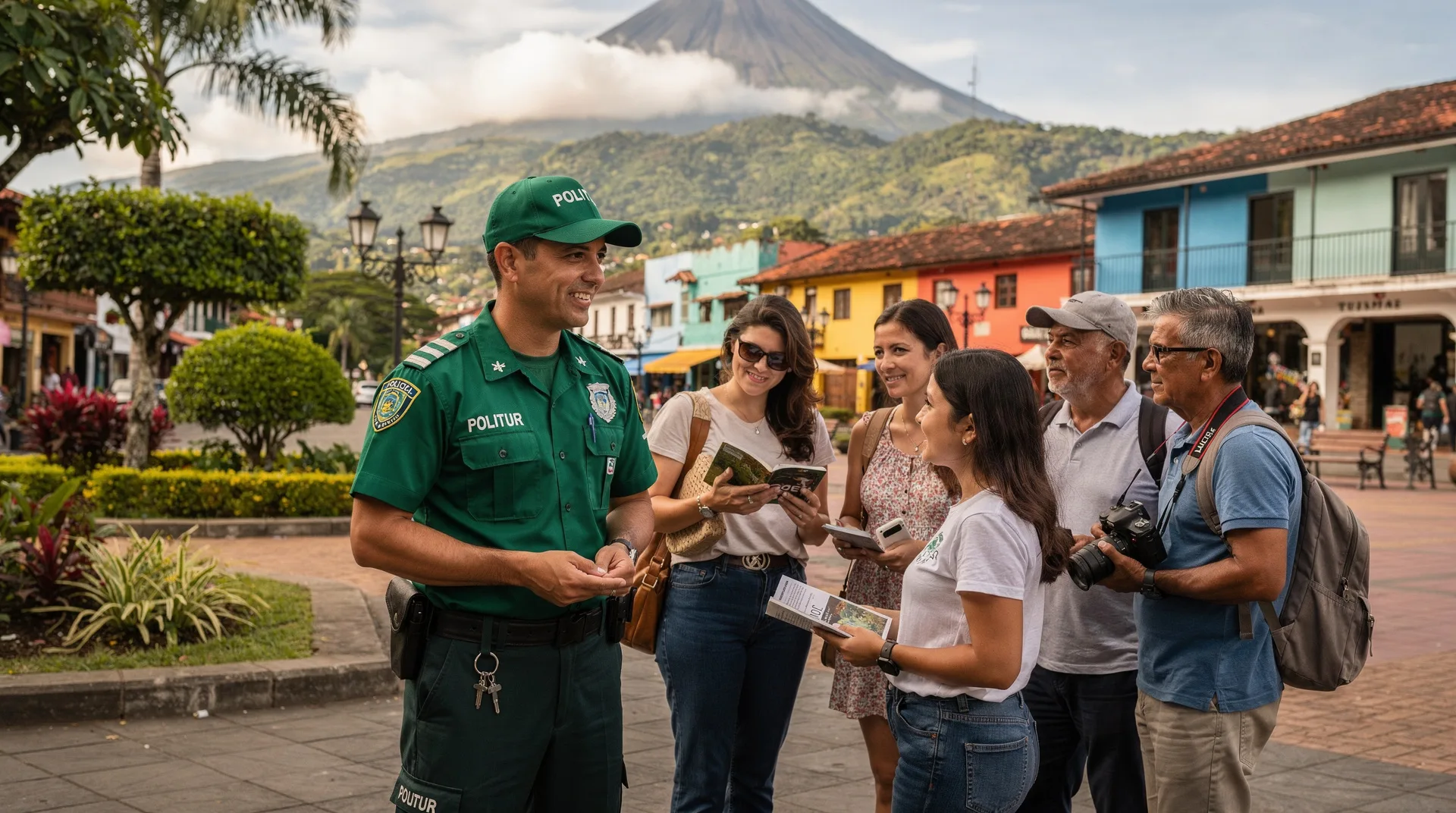
Emergency number: 911 (police, ambulance, fire). Tourist police (Politur) also reachable at 911.
Money, cards, and digital safety
Card skimming and ATM fraud are a smaller but real risk. Use ATMs attached to banks in daylight rather than freestanding street machines, and cover the keypad when entering your PIN. Notify your bank of your travel dates before departure so legitimate transactions aren’t flagged and blocked at an inconvenient moment. The ATM and cash tips guide and money and currency guide cover the mechanics of getting cash safely and avoiding fees.
Public wifi at hotels and cafes is generally fine for browsing but avoid logging into banking apps on unsecured networks. A local eSIM with data (see the eSIM and internet guide) is both more convenient and marginally safer than relying on open wifi throughout your trip, and it means you can call for help or check Waze even where wifi doesn’t reach.
Water and food safety
Tap water in San José and most established tourist towns is safe to drink — Costa Rica’s water treatment standards are among the best in Latin America. In more remote areas (deep Osa Peninsula, some Caribbean back roads), bottled or filtered water is the safer default; ask your accommodation if you’re unsure. Street food and soda (local diner) fare are generally very safe given how central fresh food is to Costa Rican cuisine, but use the same common sense you would anywhere: busy stalls with high turnover are safer than food that has been sitting out.
Beach safety beyond riptides
Riptides are the headline risk, but a few other beach habits matter. Check for posted warnings about strong currents near river mouths, where fresh water meeting the ocean can create unpredictable rip channels even on calm-looking days. Jellyfish and occasional stingray presence are seasonal nuisances rather than serious hazards — shuffle your feet when wading into sandy shallows to avoid a stingray sting. The Costa Rica beach safety guide goes deeper into flag systems, lifeguard coverage, and which specific beaches carry which risks.
The overall picture
Costa Rica’s safety profile for tourists is considerably better than many popular destinations. The risks are manageable with ordinary common sense, the same habits you would use in any unfamiliar environment. The vast majority of visitors complete their trips without incident. The country’s Pura Vida culture — an ethos of relaxed friendliness that permeates daily life — is not marketing fiction; most interactions with Ticos are genuinely warm.
The practical summary: protect your car, read the ocean, stay alert in cities, and book activities through credible operators. Do these four things and Costa Rica is as safe as most European destinations.
Manuel Antonio NP: guided tour with entrance fee included — from $60Frequently asked questions about safety in Costa Rica
Is Costa Rica safer than Mexico?
Costa Rica consistently ranks safer than Mexico on standard indices. Its homicide rate is significantly lower. Tourist areas in Costa Rica have a more established safety infrastructure, and petty crime tends to be opportunistic rather than organised.
Is it safe to drive in Costa Rica at night?
Not recommended on unfamiliar secondary roads. The combination of unpaved surfaces, no road lighting, wildlife crossings, and local driving behaviour makes night driving genuinely risky. If your accommodation requires arriving after dark, arrange a local transfer rather than driving yourself.
Are Costa Rican beaches safe to swim?
Some are very safe, others are dangerous. The safest are in protected bays or with lifeguards: Sámara, Manuel Antonio main beach (park side), Playa Conchal, and resort beaches in the Papagayo Gulf. Open-ocean beaches during swell need caution regardless of location.
Is Jacó safe?
Jacó has a reputation as a rowdier party destination, and petty theft and drug-related activity are more common there than in quieter beach towns. It is not dangerous by any objective measure, but it requires more street awareness than Sámara or Nosara. Keep valuables secured, avoid walking alone on the beach at night.
Is San José safe for tourists?
The tourist districts (Barrio Amón, Escalante, the National Theater area) are generally fine during the day. Downtown streets around the Mercado Central and Coca-Cola bus terminal require more care at night. A reasonable rule: if a place feels uncomfortable, trust that feeling and leave.
Do I need a yellow fever vaccination for Costa Rica?
Only if you are arriving directly from a yellow fever endemic country. The vaccination is not required for travellers arriving from North America, Europe, Australia, or most of Asia. Check the WHO’s current yellow fever country list if your routing is unusual.
What should I do if something is stolen?
Report to the Organismo de Investigación Judicial (OIJ) or the nearest police station to get a report for insurance purposes. Call your bank immediately if cards are stolen. Your embassy or consulate can issue an emergency travel document if your passport is stolen.
Do I need specific documents to enter safely and avoid issues at the border?
Bring a passport valid at least through your departure date and be ready to show proof of onward travel if asked. The visa and entry requirements guide covers the full entry process, and having your documents organised (digital and paper copies) reduces one common source of traveller stress that has nothing to do with crime but plenty to do with a smooth trip.
Is it safe to hike alone in national parks?
Solo hiking on well-marked, popular trails (Manuel Antonio, Arenal, most Monteverde trails) is generally fine and common. For remote parks — Corcovado especially — a licensed guide is legally required for the more remote stations and strongly recommended everywhere else: trails are less marked, wildlife encounters (including venomous snakes) are more likely, and help is far away if something goes wrong.
Related guides
Safety connects to several other practical considerations. The travel insurance guide explains which types of coverage actually matter in Costa Rica. The money and currency guide covers safe ATM use. For families, the family travel tips guide addresses age-specific safety considerations for travelling with children. The packing list guide covers what to bring to stay comfortable and prepared, including items that support the safety habits described above.