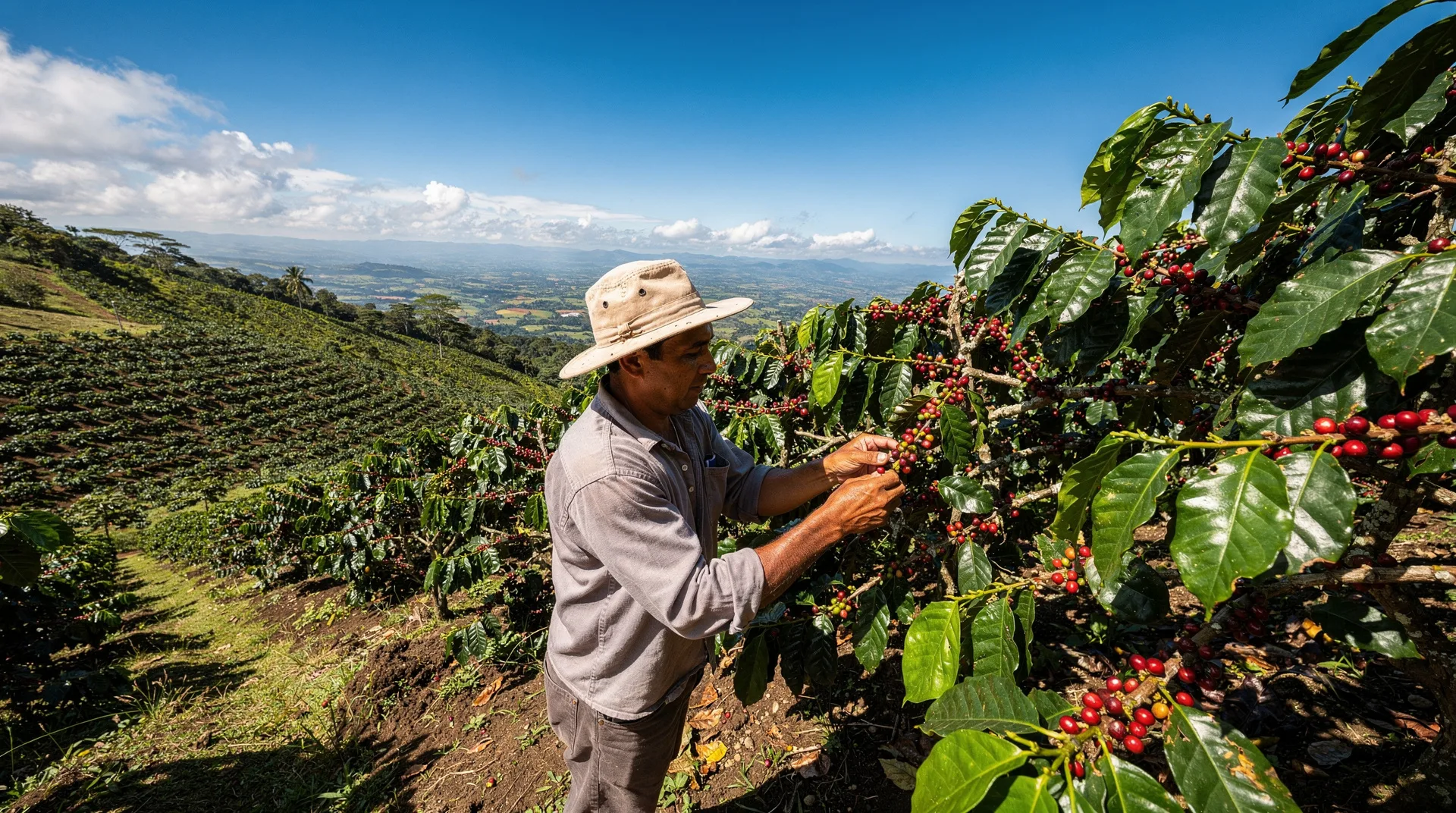
Coffee tours comparison: Doka vs Britt vs Hacienda Alsacia
Best coffee tours: Doka vs Britt vs Hacienda Alsacia?
Doka = oldest historic ($60), Britt = polished gift-shop heavy ($45), Hacienda Alsacia = Starbucks farm ($30).
Costa Rica’s coffee tourism scene has three genuinely different anchors — a historic working farm, a theatrical showcase, and a corporate research estate — and each attracts a different kind of visitor. This guide compares them honestly, adds the smaller alternatives worth knowing about, and tells you when to go for the most interesting visit.
| Where | Central Valley, Alajuela/Heredia provinces, 20–45 min from San José |
| Cost | Around $30–60 per person depending on estate |
| Time needed | 1.5–3 hours per tour |
| Best time | October–February for live harvest and processing |
| Getting there | Rental car easiest; Britt offers hotel shuttle |
Why Costa Rican coffee matters
Costa Rica’s coffee story begins in 1779, when the first coffee seeds were planted in the Meseta Central. By the mid-nineteenth century, coffee was the country’s primary export and the economic foundation of the landed upper class — the “coffee barons” who funded San José’s iconic National Theater with a levy on every bag exported. Today, Costa Rica produces about 90,000 metric tonnes annually, overwhelmingly arabica, and is the only coffee-producing country in the world that legally prohibits cultivation of lower-quality robusta varieties.
The Central Valley — particularly the highlands around Alajuela, Heredia, and Cartago — produces the country’s most prized beans. The altitude (1,000–1,700m), volcanic soil, and distinct wet-dry seasons create ideal growing conditions. Costa Rican coffee is characterised by bright acidity, clean flavour, and notes of honey, citrus, and stone fruit depending on the microclimate and processing method.
Three estates dominate the organised coffee tour market: Doka Estate, Café Britt, and Hacienda Alsacia (the Starbucks-owned farm). Each offers a genuinely different experience, and the right choice depends on what you are looking for.
Doka Estate — the historic original
Location: Alajuela Province, near Poasito, about 45 minutes from San José
Price: $60 per person (guided tour with tasting, transport available separately)
Duration: Approximately 3 hours
Book via: GetYourGuide or directly at dokaestate.com
Doka Estate (Hacienda San Isidro de Dota) has been producing coffee since 1929. The estate is a genuine, working, family-owned coffee farm — not a purpose-built tourism attraction with production tacked on. This distinction matters.
What makes Doka genuinely special is its beneficio: the wet processing mill, which has been operating since the 1930s, is one of the few remaining traditional facilities in the country that processes coffee the old-fashioned way — using water-powered machinery and traditional stone-grinding equipment. The SCAA (Specialty Coffee Association of America) awarded Doka second place in the “Coffee of the Year” competition in 2011. The tour includes seeing the actual processing facility in operation during harvest season (October through March), a walk through the coffee groves, an explanation of the biological cycle from flower to cup, and a cupping (tasting) session at the end.
Honest assessment: Doka is the best tour for people who want to understand how coffee is actually grown and processed on a working farm. The guides have generational knowledge of the estate. The gift shop is present but not overwhelming. The downside: the estate is slightly harder to reach than Britt (requiring a car or extra transfer), and the presentation is less theatrical than Britt’s polished production.
Harvest season timing: The tour is most interesting October–March when cherry-picking and processing are active. In April–September, you will see the plants but not the live processing.
Alajuela: coffee plantation guided tour with tasting — from $60Café Britt — the polished, theatrical choice
Location: Heredia Province, north of San José, about 20 minutes
Price: $45 per person (standard tour)
Duration: Approximately 2 hours
Book via: GetYourGuide or cafebritt.com
Café Britt is the most commercially developed of the three options and the one with the heaviest tourism infrastructure. The company was founded in 1985 specifically to bring specialty coffee to the export market, and the tour experience reflects that marketing-first DNA.
The Britt tour is performed — literally — with guides who are trained actors presenting the coffee story as an entertaining show, complete with skits, humour, and audience participation. This is either charming or gimmicky depending on your tolerance for performance-based tourism. For families and first-time tourists, the theatrical presentation makes complex agricultural processes accessible. For serious coffee enthusiasts, it can feel like education wrapped in entertainment that somewhat trivialises the depth of the subject.
The coffee quality is not in question — Britt produces genuinely good coffee and ships internationally. But the tour prioritises the experience over the depth, and the gift shop is large, prominent, and clearly central to the business model. You will be funnelled through it at the end.
Honest assessment: Best for families, groups, and visitors who want an entertaining, accessible introduction to coffee with minimal complexity. Not ideal for serious coffee enthusiasts seeking agricultural depth. Excellent logistics (shuttle from most San José hotels available).
What they do better than competitors: The theatrical presentation is genuinely well done. The grounds are immaculate. Coffee quality is high and the gift shop selection is the broadest.
San José: coffee production tour and tasting — from $75Hacienda Alsacia — the Starbucks connection
Location: Alajuela Province, on the slopes of Poás Volcano, about 40 minutes from San José
Price: $30 per person (basic tour), also combinable with Poás Volcano and La Paz Waterfall tours
Duration: 1.5–2 hours
Book via: GetYourGuide, often included in combined day trips from San José
Hacienda Alsacia was purchased by Starbucks in 2013 and serves as the company’s only company-owned farm worldwide — used primarily as an R&D facility for developing disease-resistant varieties and sustainable farming practices. The tour is operated openly by Starbucks and branded accordingly.
The coffee tour here is shorter and less theatrically produced than Britt, but genuinely informative about modern coffee agronomy — particularly the research Starbucks conducts on rust-resistant cultivars (a serious disease threatening coffee globally). The farm occupies a dramatic location on the Poás volcano slopes, and the views are exceptional on clear days.
Honest assessment: Starbucks ownership is either a draw (for fans of the brand wanting to see the “origin” story) or a reason to look elsewhere (for those who prefer independent family farming). The price is the lowest of the three main options, and it combines efficiently with the Poás Volcano National Park visit, which is 20 minutes further up the road. The coffee served at the tour tasting is, of course, Starbucks product rather than a specialty single-origin from the farm itself.
Who should choose this: Visitors combining a Poás volcano day trip with coffee, travellers on a tighter budget, and anyone specifically curious about sustainable agriculture research.
Poás Volcano, coffee plantation & La Paz Waterfall Gardens — from $130Beyond the big three: other coffee experiences
La Paz Waterfall Gardens (with coffee component)
The La Paz complex includes a coffee component alongside its wildlife exhibits, butterfly farm, and hummingbird garden. It is not a specialist coffee destination — the tour is brief — but if you are already visiting La Paz (one of the most popular day trips from San José), the coffee element adds context without requiring separate travel.
Coffee farm tour, Poás Volcano Park and La Paz Waterfall — from $130Bitzu Coffee Tour
A smaller, independent coffee experience outside the Big Three, Bitzu offers a more intimate farm visit with personalised attention and a focus on the cupping experience over theatrical presentation. Fewer visitors, deeper conversation, and the kind of honest small-producer story that the larger estates cannot really offer.
Bitzu coffee tour: an authentic Costa Rican experience — from $65Specialty coffee in San José
The urban specialty coffee scene in San José deserves mention. Cafes like Cafeoteca (Barrio Escalante), Café 1820 (various locations), and Barrio Bird operate with direct relationships to small-farm producers and offer single-origin tasting flights that rival anything in a European specialty coffee capital. A cupping session at a specialty café in San José can be as educational as a plantation tour — and considerably cheaper.
Costa Rica’s cooperative model, briefly
Much of what makes Costa Rican coffee distinctive is structural rather than climatic: the country has a long-standing network of small-farmer cooperatives (cooperativas) that jointly own processing mills, share agronomic knowledge, and negotiate export prices collectively rather than leaving individual smallholders exposed to commodity swings.
Several cooperatives in the Tarrazú and West Valley regions — outside the range of a typical day trip from San José but worth knowing about if coffee sourcing genuinely interests you — sell direct-trade lots that never pass through a tourist-facing estate at all. None of the Big Three tours dwells much on this cooperative structure, but asking your guide about it is one of the more interesting questions you can pose, and it explains why Costa Rican coffee has avoided some of the worst boom-bust cycles seen in less organised producing countries.
La Fortuna: Don Juan coffee and chocolate tour
Coffee tours in the Arenal area are typically combined with cacao production — the warm wet northern foothills are at the lower end of viable coffee elevation but ideal for cacao. The Don Juan operator runs a working farm tour that explains the bean-to-cup process for both crops in parallel, with a tasting that covers Costa Rican coffee, drinking chocolate, and farm-grown vanilla and tropical fruit. It is the most informative coffee experience available outside the Central Valley.
the Don Juan coffee and chocolate tour from La Fortuna — from $48 — $44 for 2 hours on a working farm, including transport from La Fortuna hotels. A practical add-on for travellers in the Arenal area who do not have time to swing through the Central Valley plantations.
Comparing the three estates: summary table
| Doka Estate | Café Britt | Hacienda Alsacia | |
|---|---|---|---|
| Price | $60 | $45 | $30 |
| Duration | 3 hours | 2 hours | 1.5 hours |
| Working farm? | Yes | Primarily | Yes (R&D) |
| Production active? | Oct–Mar only | Limited | Yes (R&D) |
| Group size | Small | Large | Medium |
| Gift shop emphasis | Moderate | High | Moderate |
| Theatrical element | Low | High | Low |
| Ownership | Family-owned | Private | Starbucks |
| Best for | Depth + authenticity | Families + entertainment | Budget + Poás combo |
Choosing based on your trip style
If you are staying in San José or the Central Valley and want the deepest agricultural experience, Doka is the clear pick — budget half a morning and pair it with a walk through Alajuela province afterward. If you are travelling with kids or a mixed group who want an easy, entertaining hour, Britt’s shuttle-friendly, theatrical format removes the friction. If your itinerary already includes Poás Volcano, Hacienda Alsacia is the efficient add-on rather than a special trip in its own right. And if you are based in La Fortuna/Arenal and never plan to reach the Central Valley, the Don Juan coffee-and-chocolate tour is a genuinely worthwhile substitute rather than a consolation prize.
Building a coffee day around your base
Which estate fits depends largely on where you sleep. Travellers staying in San José can reach any of the three without changing hotels, and those who prefer not to drive can look at the shuttle services overview for pre-arranged transfers. If your evenings are spent in Alajuela province, Doka and Hacienda Alsacia are the natural choices, and the Poás Volcano guide explains how to fit the crater visit into the same outing. Visitors based in Heredia province will find Britt the easiest to reach, and a stop at one of the local sodas afterwards makes a good, unpretentious lunch.
Those heading north to La Fortuna can treat the Don Juan farm visit as their coffee stop and spend the rest of the time on the Arenal volcano. Whichever route you take, remember that a tour is a snapshot: the cupping at the end is the part to savour, so ask questions, taste slowly and compare what you are served with the specialty cafés mentioned above.
When to go for the best experience
The coffee harvest in Costa Rica runs October through February (with some microclimate variation — farms at higher altitude harvest later). Visiting during harvest means you can witness cherry picking, witness wet processing in operation at Doka’s beneficio, and taste freshly processed coffee.
Visiting in the off-season (March–September) still produces a good tour, but the plants are either in flower (March–April, which is beautiful) or in the long growth phase before cherries develop. The educational content remains valid year-round; the live agricultural activity is seasonal.
Practical logistics
All three estates are within 40–60 minutes of San José and within 30 minutes of Alajuela’s city centre. Rental car makes access easiest. Café Britt offers hotel pickup from San José as standard. Doka requires a car or a pre-arranged transfer (some San José tour operators include it). Hacienda Alsacia is most commonly visited as part of a guided day trip combining Poás Volcano and La Paz Waterfall.
The transport guide covers whether renting a car makes sense for your overall itinerary.
What to wear: closed shoes are sensible on any of the three farm walks, since the ground is often uneven and slightly muddy in the wet season (May–November). Bring sun protection — the exposed rows between coffee bushes offer little shade at midday. A light rain jacket is worth packing at any estate above 1,000m, where afternoon showers arrive quickly even in the “dry” months.
Combining with other Central Valley stops: Doka and Hacienda Alsacia both sit close enough to Poás Volcano to combine into a single day without excessive driving, while Britt’s Heredia location works better alongside a Barva Volcano or Sarapiquí day. Trying to fit all three estates into one day is technically possible but rushes each visit — one estate, done properly, beats a rushed tour of three.
Frequently asked questions about coffee tours in Costa Rica
Is the coffee I drink on the tour freshly roasted?
At Doka, the coffee served during the tasting is from the estate’s own roastery. At Britt, it is Britt’s own product (which is commercially roasted in large quantities). At Hacienda Alsacia, it is Starbucks product. None of these is bad — they are simply different in origin and character. If you want to taste the absolute freshest possible roast, visit a San José specialty café and ask for a coffee roasted within the last two weeks.
Can I buy coffee at the farm to take home?
Yes at all three. Doka sells their estate coffee in retail bags at the end of the tour ($15–20 for 340g). Britt sells a wide range of blends, flavoured coffees, and gifts — this is a significant part of their revenue model. Hacienda Alsacia sells Starbucks-branded product from the farm.
What is a “wet process” vs “honey process” vs “natural process”?
These refer to how the coffee cherry is processed after picking. Wet (washed): cherry pulp is removed immediately and beans dry without fruit contact, producing the cleanest, brightest flavour typical of Costa Rica. Honey: pulp removed but some sticky mucilage left on the bean during drying, producing more sweetness. Natural: entire cherry dried whole, producing the most fruit-forward, complex profile. Doka primarily uses wet processing; you can ask any tour guide for more detail.
Is it worth combining a coffee tour with a volcano visit?
The Hacienda Alsacia + Poás combination is the most logical pairing — both are on the Poás slopes and the elevation change gives you dramatically different landscapes within 20 minutes. Doka + Poás also works well. Britt is closer to Heredia and pairs better with a Barva Volcano or Sarapiquí trip.
How different is Costa Rican coffee from what I buy at home?
Significantly different if you are comparing to supermarket blends, which typically use lower-quality beans from multiple origins. Costa Rican arabica from the Central Valley is high-altitude grown, carefully processed, and sold as a single-origin specialty product. The clarity of flavour — the way you can taste honey, orange peel, or jasmine without a complicated extraction process — is the defining characteristic.
Are children welcome on coffee tours?
Yes at all three estates. Café Britt’s theatrical presentation is particularly suitable for children 8 and above. Doka and Hacienda Alsacia have walking components through the farm grounds. There is no minimum age requirement, though the cupping session may hold limited interest for young children.
Related guides
If coffee is your primary Costa Rica interest, pair the plantation tour with a visit to the Mercado Central in San José where you can see how coffee is consumed at the local level — strong, often sweetened, and drunk as an espresso-equivalent throughout the day. The food overview guide puts coffee in the broader context of Costa Rica’s culinary culture. And for those interested in the other artisan food tradition — cacao — the chocolate tours guide covers the best experiences across the country.