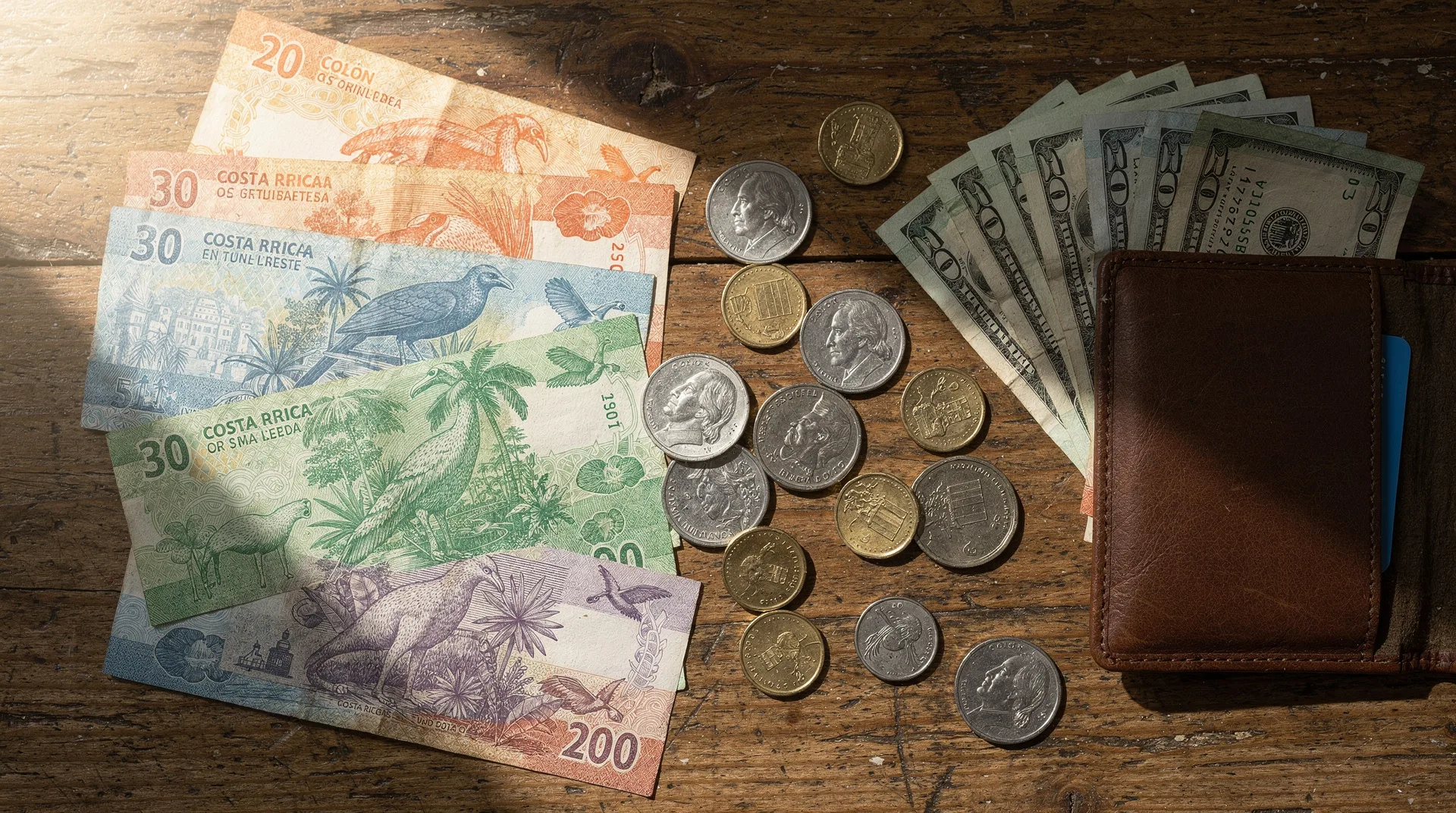
Money and currency in Costa Rica
Costa Rica colón or USD?
Both are accepted in tourist areas. Rural areas require colones for small purchases. BAC and Promerica ATMs are most foreign-card-friendly with $5-10 fees per withdrawal.
Understanding Costa Rica’s dual-currency reality
Costa Rica is one of the few countries in Latin America where two currencies circulate simultaneously and comfortably: the Costa Rican colón (CRC) and the US dollar (USD). For travellers arriving with dollars, this is genuinely convenient. For those arriving with euros, British pounds, or other currencies, the strategy matters.
This guide covers what you need to know before you land: exchange rates, which ATMs work best with foreign cards, when to use dollars versus colones, and the traps that consistently catch visitors off guard.
| Currency | Costa Rican colón (CRC); USD widely accepted |
| Rate | ~520 CRC per 1 USD (check live rate before travel) |
| Best ATMs | BAC San José, Promerica |
| ATM fee | Around $5-10 per withdrawal |
| Cards | Widely accepted in cities; carry cash in rural areas |
Money questions are easier to answer once the rest of the trip takes shape. Entry rules are covered in the visa and entry requirements guide, and a sensible travel insurance policy is worth sorting out at the same time as your cash plan.
The Costa Rican colón (CRC)
The colón (plural: colones) is the official currency of Costa Rica. Notes come in denominations of 1,000, 2,000, 5,000, 10,000, 20,000, and 50,000 colones. Coins exist in smaller denominations (5, 10, 25, 50, 100, and 500 colones) but are becoming less common in everyday transactions as the country moves toward cashless payments.
As of April 2026, the approximate exchange rate is ~520 CRC per 1 USD. Rates fluctuate, and this figure is intended as a planning reference — always check a live rate before you travel.
A useful rule of thumb: divide any colón price by 500 to get a rough dollar equivalent. A 2,500 colón meal at a soda is roughly $5. A 35,000 colón hotel room is roughly $67.
Where USD is accepted and where it isn’t
Dollars are accepted everywhere in the tourist circuit — hotels, tour operators, activity booking counters, airport shops, and most restaurants in Tamarindo, La Fortuna, Manuel Antonio, Monteverde, and similar destinations. Tour companies and GYG-listed experiences routinely price in USD.
However, dollars are less useful in:
- Local sodas (family-run restaurants) in smaller towns
- Public buses and shared shuttles
- Rural markets, pulperías (corner shops), and vegetable stalls
- Taxis in smaller cities or off the main tourist trail
- Government fees, national park entrance counters (though many now accept cards)
When a vendor accepts dollars, they typically give change in colones at a rounded-down exchange rate that is slightly unfavourable to you. For any purchase under $10, paying in colones avoids this minor but cumulative loss.
If you are driving between regions, the rent a car or not guide helps you decide how much cash to keep for fuel, tolls, and roadside stops, while the shuttle services overview explains what to expect when paying for shared transfers.
ATMs: which banks work best with foreign cards
This is the single most practical piece of financial advice for visiting Costa Rica. Not all ATMs here handle foreign Visa/Mastercard/Maestro cards reliably, and some charge higher-than-average fees or refuse certain card types entirely.
BAC San José
The most reliable ATM network for foreign cardholders. BAC ATMs accept a wide range of international cards including Visa, Mastercard, Maestro, and Cirrus. Machines are plentiful in major cities, airports, and tourist areas. Transaction fee: approximately $5 USD per withdrawal.
BAC ATMs typically allow withdrawals of up to $400-600 per transaction, which is on the higher end — useful if you want to limit the number of fee-bearing transactions.
Promerica
Second most reliable for foreign cards. Similar fee structure to BAC ($5-10 per transaction). Less widespread than BAC but found in most city centres and larger towns.
Banco Nacional and Banco de Costa Rica (BCR)
State-owned banks with the most ATMs nationwide. However, their machines are less reliably compatible with foreign-issued cards — particularly non-US cards — and card skimming has been reported more frequently at their machines. Not the first choice if a BAC or Promerica ATM is nearby.
Scotiabank and BNCR
Scotiabank machines work reasonably well with international cards, particularly those on the Visa network. Worth using if BAC is unavailable.
ATM fees explained
There are two layers of ATM fees:
1. Local bank fee: The Costa Rican ATM charges a transaction fee of $5-10 (sometimes deducted from the dispenses amount, sometimes billed separately). BAC and Promerica tend to be at the lower end.
2. Your home bank’s foreign transaction fee: Your own bank may charge an additional fee (typically 1-3% of the transaction) and/or a currency conversion markup. Cards with no foreign transaction fees — such as Charles Schwab (US), Starling or Wise (UK/EU), or Revolut — eliminate this second layer entirely. If you travel regularly, a no-fee card is worth getting before you go.
Maximum efficient withdrawal strategy
To minimise fees, withdraw larger amounts less frequently rather than small amounts daily. A single $400 withdrawal at BAC incurring a $7 fee costs you 1.75% — comparable to most money exchanges. Withdrawing $50 six times at the same fee costs 14% in fees.
Currency exchange: what to use and what to avoid
Airport exchange counters
The exchange desks at SJO and LIR airports consistently offer the worst rates in the country — sometimes 10-15% below the real exchange rate. Unless you are completely out of colones for a taxi or coffee, skip the airport exchange on arrival. The ATMs inside and just outside the terminal (BAC has an ATM in the SJO arrivals area) give you a far better rate.
Bank branches
Exchange at a bank branch during business hours if you prefer over-the-counter service. You will need your passport. Rates are better than airport counters but involve queuing. The main advantage is security — you are in a controlled environment.
USD to colones: at hotels
Many hotels will exchange dollars to colones for guests, typically at a slightly unfavourable rate. Convenient for getting small-denomination colones without finding an ATM, but not the best rate.
Currency apps and Wise
Sending money via Wise (formerly TransferWise) to a local Colón account is an option for long-term visitors, but for a typical tourist trip it adds more complexity than it saves.
Paying by card: where it works and where it doesn’t
Credit and debit cards (Visa and Mastercard) are accepted at nearly all hotels with more than a few rooms, major supermarkets (Mas x Menos, Mega Super, Auto Mercado), mid-range and upscale restaurants, and tour operators. American Express is accepted at many upscale hotels but less reliably elsewhere.
Contactless payments are available at Auto Mercado supermarkets and larger retailers. Apple Pay and Google Pay work at some POS terminals but not universally.
Do not count on cards at:
- Small sodas and pulperías
- Local farmers’ markets
- Rural guesthouses and some smaller B&Bs
- Shared shuttle drivers
- Roadside fruit stands
Always have some colones on you when leaving the main tourist zones, particularly on the Osa Peninsula, the Talamanca Caribbean coast, and smaller Guanacaste towns away from the resort strip.
One way to keep cash worries out of a busy day is to prepay the big-ticket items online. A visit to Manuel Antonio, for example, can be handled with a guided park tour with the entrance tickets already included — from $68 , so you are not queuing at the booth hoping the card reader works. Our Manuel Antonio National Park guide explains how the day unfolds.
Budgeting by travel style
Your budget will shift with the places you choose and the season you travel. Eating locally is one of the easiest ways to stretch it, and the best local sodas are a good place to start. Travelling outside peak months can also help, as the shoulder season deals guide explains.
Prices below are per person per day, based on April 2026 rates:
Backpacker budget ($40-65/day): Hostel dorm or basic guesthouse, eating at sodas (gallo pinto, rice, beans, chicken for ~3,000-4,500 CRC per meal), public buses, and cooking some meals from supermarket ingredients.
Mid-range ($90-150/day): Private room in a mid-range hotel or eco-lodge, restaurant meals, car rental split across a group, some activities (guided hike, surf lesson).
Comfortable ($150-250/day): Boutique hotels, most restaurant meals with drinks, private transfers between a couple of destinations, one or two daily activities.
Luxury ($300-700+/day): Eco-lodges like Lapa Rios (starting around $400/night all-inclusive), Nayara Springs (from $450/night), Pacuare Lodge (~$500/night); private guides, premium itineraries, domestic flights instead of driving.
Activities are where a budget most often drifts, so it helps to decide in advance which experiences are worth paying for. A walk across the canopy on a guided hanging bridges tour near Arenal — from $70 is a gentler option than a zipline, and the zip-lining vs canyoning vs bridges comparison shows how the choices differ. For a broader sense of what activities cost, see the adventure tour pricing guide.
Tipping and the servicio incluido
Restaurants in Costa Rica include a mandatory 10% service charge (servicio incluido) on all bills. This is a legal requirement, not optional. Some menus also add a 13% sales tax (IVA). Always check your bill — the total will show both charges. You are not obligated to tip additional amounts, though rounding up or leaving small change is appreciated. See the full tipping culture guide for complete guidance on guides, taxis, and hotel staff.
Carrying cash safely
Theft from rental cars is the most common property crime affecting tourists. Never leave wallets, cash, or electronics visible in a parked vehicle. Keep your daily cash in a front pocket or money belt rather than a backpack when walking in crowded areas like downtown San José, the Mercado Central, or busy beach towns. See the safety in Costa Rica guide for full context.
Getting started with guided experiences
Many of the best activities in Costa Rica — park tours, coffee tastings, sunset catamaran cruises — can be booked in advance and paid in USD. Booking online through a platform like GetYourGuide avoids the on-the-ground negotiation and ensures your money goes to a vetted operator. A San José coffee tour is an excellent use of your first day before heading to your main destination.
San José: coffee production tour and tasting — from $75Frequently asked questions about money in Costa Rica
Can I use euros in Costa Rica?
Euros are not widely accepted as a payment currency in shops or restaurants. You will need to exchange them at a bank or ATM for colones or dollars. The ATM process — withdraw colones directly from your euro account — gives you a competitive rate without the hassle of over-the-counter exchange.
Is Costa Rica cash-only or card-friendly?
Major tourist areas are increasingly card-friendly. However, smaller towns, rural areas, markets, sodas, and public transport remain largely cash-based. A sensible approach: carry $60-80 equivalent in colones at all times, more if you are heading somewhere remote.
How much cash should I bring to Costa Rica?
You do not need to bring significant foreign currency. ATMs are well distributed in tourist areas and work well. If arriving in San José, the BAC ATM in the arrivals hall is your friend. Having $50-100 in USD for the first few hours (taxi from the airport, first meal) is useful as a backup.
Are there ATMs in national parks and remote areas?
No. Tortuguero, Drake Bay, the Osa Peninsula, and many smaller national parks have no ATMs. Withdraw enough cash before you leave the nearest city. Drake Bay operators and guesthouses accept card but often add a 3-5% surcharge; cash avoids this.
What is the best card for Costa Rica travel?
Cards with zero foreign transaction fees and competitive exchange rates are ideal. Popular options: Charles Schwab debit (US, reimburses ATM fees), Wise debit (UK/EU/worldwide), Revolut (UK/EU). Check your card’s foreign fee structure before you travel.
Can I pay park entrance fees by card?
Many SINAC national parks now accept Visa and Mastercard at the entrance booth. However, it is not guaranteed — particularly at smaller or more remote parks. Always have colones available as backup. The current national park entrance fee for foreigners is around $18-20 per adult for most parks (higher for Corcovado).
What if my card is lost or stolen in Costa Rica?
Contact your bank’s international emergency line immediately (save it before you travel — it will not work once your card is blocked and you have no other card). Keep a backup card in a separate bag from your primary wallet. Most mid-range and upscale hotels can advance small amounts of cash against a card in a genuine emergency, and Western Union has branches in most sizeable towns for receiving an emergency transfer.
Is tipping expected in Costa Rica?
At restaurants the 10% servicio incluido is already added. For tour guides, tipping $10-15 per person for a half-day tour is standard. For private guides, $15-20 per person per day is appropriate. See the tipping culture guide for a full breakdown.
Related guides
Money management is closely linked to the cash strategy at ATMs — read the ATM and cash tips guide for additional practical detail. For understanding how much a trip costs overall, the dry season vs green season guides cover how timing your visit affects hotel prices by 30-40%. Once you have your budget sorted, the packing list covers what gear to bring so you don’t spend more than you need to once you arrive.