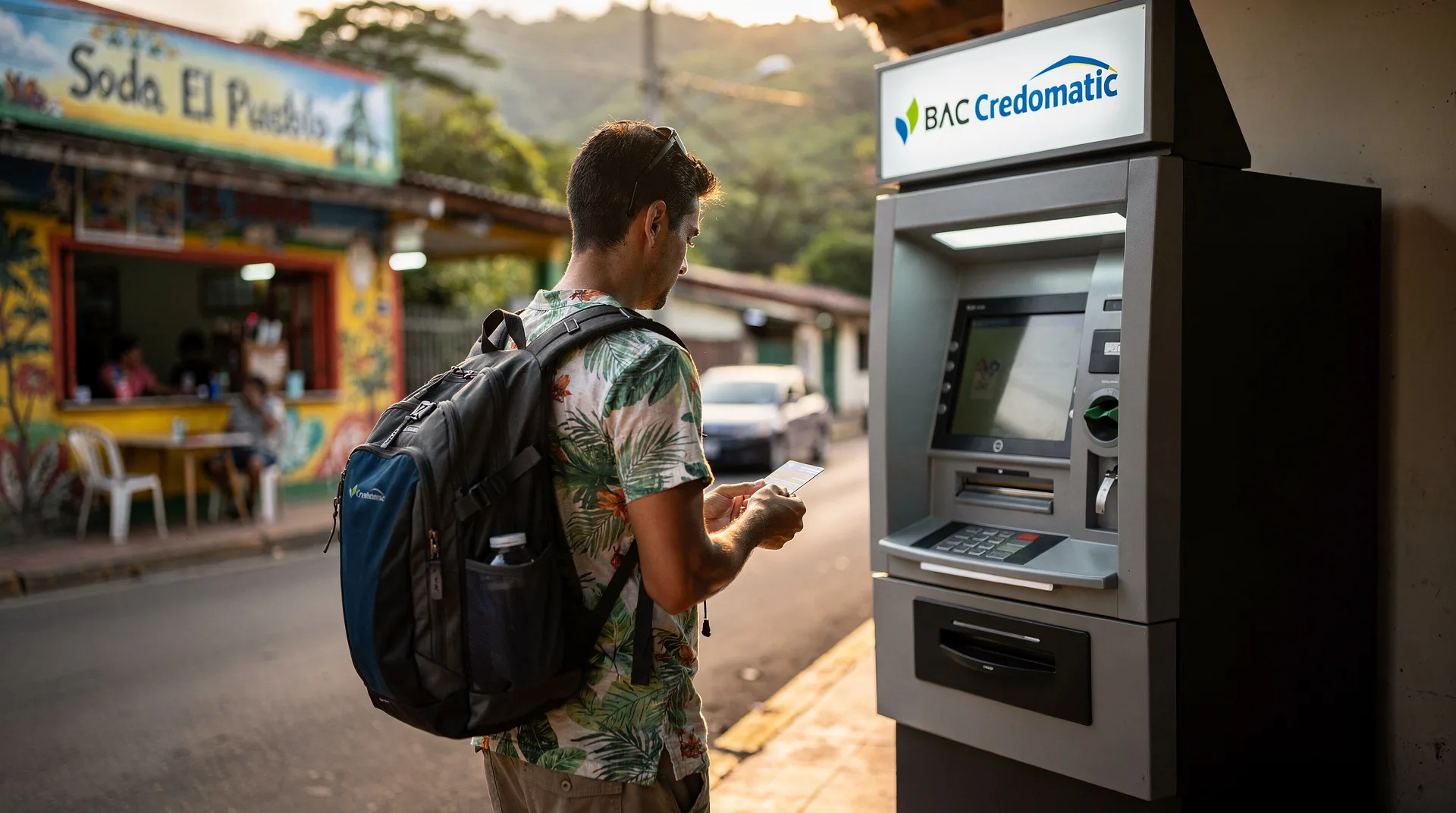
ATM and cash tips for Costa Rica
ATM fees in Costa Rica?
BAC and Promerica are most foreign-card-friendly with $5-10 fees per transaction. Avoid airport exchange counters — rates are 10-15% below real. Withdraw larger amounts less often.
Getting cash in Costa Rica: the practical breakdown
Knowing which ATM to use in Costa Rica is not a minor detail — it can mean the difference between paying a $7 transaction fee and paying $15, or between successfully withdrawing cash and standing at a machine that refuses your card entirely. This guide covers the specific banks, fee structures, and cash strategy that experienced travellers use.
| Best bank | BAC San José (around $5–7/transaction) |
| Avoid | Airport exchange counters (10–15% below market) |
| Withdrawal strategy | Fewer, larger withdrawals |
| No-ATM towns | Drake Bay (none); Tortuguero (limited) |
| Emergency backup | $100–200 USD cash, Wise/Schwab card |
The ATM network: which banks to use
BAC San José — the first choice
BAC (Banco BCT before rebranding) is the most reliably foreigner-friendly ATM network in Costa Rica. Their machines:
- Accept Visa, Mastercard, Maestro, Cirrus, and most international debit cards
- Allow withdrawals of up to $400-600 per transaction (among the highest limits nationally)
- Charge a flat transaction fee of approximately $5-7 USD (or CRC equivalent)
- Are located in all major tourist areas, most shopping centres, and airports
BAC ATMs have a blue-and-gold livery. In San José there are multiple branches on Paseo Colón and in the Multiplaza and San Pedro malls. In tourist areas, BAC machines are typically found at Banco BAC branches, select supermarkets, and standalone ATM units.
The SJO airport has a BAC ATM in the arrivals hall, accessible after clearing customs. This is your best first stop for colones on arrival.
Promerica — strong second option
Promerica (now part of regional banking group Grupo Promerica) handles foreign cards nearly as well as BAC. Transaction fees run similarly at $5-10 per withdrawal. Less widespread than BAC but found in major cities and tourist towns.
Scotiabank
Canadian-headquartered Scotiabank has a solid Costa Rica presence and handles Visa and Mastercard foreign cards reliably. A reasonable choice if BAC or Promerica is not nearby. Some Scotiabank customers report their home bank’s relationship with Scotiabank reduces foreign fees — check with your bank.
Banco Nacional de Costa Rica (BNCR) — use with caution
BNCR is the largest state bank and has the most ATMs nationwide. However, their machines have a variable record with foreign cards:
- Visa-branded foreign cards often work
- Maestro and some Mastercard debit cards are more frequently rejected
- Card skimming incidents have been reported more often at BNCR machines than at BAC or Promerica
Not the ideal first choice, but a reasonable fallback if others are unavailable.
Banco de Costa Rica (BCR)
Similar situation to BNCR — many machines, mixed foreign card compatibility. The orange BCR ATMs are ubiquitous in smaller towns where BAC has no presence, making them useful as a last resort.
ATMs to avoid entirely
Currency exchange kiosks disguised as ATMs — particularly at tourist areas like La Fortuna, Tamarindo beach, and some shopping complexes — operate with unofficial exchange rates and high fees. They are not bank ATMs. If the machine looks generic or branded without a known bank name, avoid it.
Airport exchange counters: the classic tourist trap
Both SJO (Juan Santamaría) and LIR (Daniel Oduber) airports have currency exchange desks prominently positioned in the arrivals area. These counters consistently offer exchange rates 10-15% below the real mid-market rate.
On a $500 exchange, that 12% gap costs you $60 — enough for a full day of activities, a nice dinner, or two park entrance fees.
What to do instead:
- Before your flight, use the BAC or Promerica ATM in the arrivals hall (at SJO, it is just past the customs exit)
- Withdraw 15,000-25,000 CRC (roughly $30-50) for immediate needs: taxi, airport coffee, first meal
- Get a larger withdrawal at a BAC branch in San José city or your first destination
The airport exchange desk will still be there if your card is not working and you have an emergency. Otherwise, treat it as a last resort.
Fee minimisation strategy
The goal is to pay as few transaction fees as possible. Here is a practical framework:
For a 1-week trip:
- Withdraw twice — once on arrival and once mid-trip
- Each withdrawal: $200-300 equivalent in colones
- Total fees at BAC: approximately $12-16 (2 x $6-8)
For a 2-week trip:
- Withdraw three times maximum
- Each withdrawal: $250-350
- Total fees: approximately $18-24
The wrong approach: Withdrawing $50 daily at the closest ATM. At $7/transaction, $50/day for 14 days costs $98 in transaction fees alone — nearly 14% of your cash.
Cards that eliminate home bank fees: Some cards reimburse or waive foreign ATM fees. In the US: Charles Schwab debit card (reimburses all foreign ATM fees worldwide). In the UK and EU: Starling Bank, Wise (TransferWise), and Monzo offer competitive or zero foreign transaction fees. If you travel more than twice a year, opening a Schwab or Wise account before a Costa Rica trip is worth the 15-minute setup.
Where to find ATMs in specific destinations
San José: Multiple BAC and Promerica branches throughout the city, Multiplaza mall, La Colonia supermarket chain.
La Fortuna: BAC branch on the main road. Withdraw here before heading to remote lodges on the Arenal lake perimeter.
Monteverde: BAC and BCR in Santa Elena village (town centre). ATMs sometimes queue in high season — withdraw before arriving if you can.
Tamarindo: BAC on the main strip, BCR in town centre. Withdraw here for the surrounding Guanacaste coast — Sámara, Playa Flamingo, Conchal.
Manuel Antonio / Quepos: Multiple ATMs in Quepos town. Withdraw before heading to lodges outside town — beach-strip restaurants often add a credit card surcharge.
Puerto Viejo: A BCR ATM exists in town. No BAC presence. Withdraw extra before leaving San José for the Caribbean if you plan extended time in Manzanillo.
Drake Bay: No ATM. Withdraw before leaving San Isidro de General or Palmar Norte. Lodges accept cards but add surcharges.
Tortuguero: One basic ATM in the village, occasionally out of service. Bring sufficient cash from San José.
Liberia: BAC and BCR in city centre. The main service point before heading to Rincón de la Vieja or Tamarindo if flying into LIR.
Paying by card at tours and activities
Most GYG-listed tour operators accept cards. Some smaller local operators add a 3-5% credit card surcharge — ask before charging. Paying in cash avoids this surcharge if you have colones or dollars in hand.
National park entrance fees are increasingly accepting Visa and Mastercard at SINAC booths, but this is not universal. Always carry colones as backup for park fees.
San José: coffee production tour and tasting — from $75Safety at ATMs
Use ATMs inside bank branches or in lit, supervised locations. Standalone outdoor ATMs on quiet streets late at night carry the most risk of shoulder surfing or skimming. Malls and supermarket ATMs are a reasonable middle ground.
Cover the keypad when entering your PIN. This is standard practice everywhere and dramatically reduces skimming risk.
Do not accept help from strangers at ATMs. Distraction-based theft at ATMs follows a pattern: a friendly stranger “helps” while an accomplice captures your PIN or swaps your card. If someone approaches, finish your transaction, pocket everything, and walk away.
Check for skimming devices: Give the card reader a slight tug before inserting your card. Skimming overlay devices are slightly loose compared to the genuine reader. If it feels loose or looks misaligned, do not use the machine.
Emergency cash options
Wire transfer via Western Union or MoneyGram: Both operate in Costa Rica through pharmacies and supermarkets. A practical emergency option if your card is stolen or stops working. Western Union has the wider presence, including in some small towns.
Your bank’s emergency card replacement: Most major banks (Chase, Bank of America, Barclays, HSBC) can courier a replacement card to a Costa Rican address within 3-5 business days for a fee. Your embassy can sometimes facilitate this process.
USD cash from home as emergency backup: Carrying $100-200 in USD as emergency funds is a sensible precaution. Dollars are widely accepted in tourist areas and useful if all ATM options fail.
Frequently asked questions about ATMs and cash in Costa Rica
Which ATM in Costa Rica has the lowest fees?
BAC San José consistently charges the lowest local fees among the major banks — approximately $5-7 per transaction. Promerica is comparable. BNCR and BCR tend to be slightly higher.
Can I use Apple Pay or Google Pay in Costa Rica?
At some POS terminals, yes — particularly Auto Mercado supermarkets and international chain restaurants. Not reliably across small restaurants, sodas, or markets. Do not count on contactless payment as your primary method.
Is it safe to use my credit card in Costa Rica?
Yes, with normal precautions. Keep your card in sight at restaurants (never hand it to a server who walks away with it). Check your statement regularly during the trip. Notify your bank before travelling to avoid fraud holds on your card.
Do Costa Rican ATMs dispense USD?
Some BAC ATMs offer a choice of colones or USD. This is not universal. Most machines default to colones, which is what you want for daily spending anyway.
How much local cash should I carry day to day?
On a standard tourist itinerary, $30-50 equivalent in colones is comfortable for a full day — sodas, local transport, markets, small purchases. Days involving long drives to remote areas or overnight trips to places without ATMs justify carrying more.
What happens if an ATM eats my card?
Contact your bank immediately via their international phone line or app. The bank can remotely block the card and arrange replacement. In the meantime, your travel partner’s card, a Western Union transfer, or USD cash covers you while you wait.
Bank comparison at a glance
| Bank | Foreign card reliability | Typical fee | Notes |
|---|---|---|---|
| BAC San José | Excellent | around $5–7 | First choice, widest tourist-area coverage |
| Promerica | Very good | around $5–10 | Strong second option, less widespread |
| Scotiabank | Good | Varies | Worth checking your home bank’s relationship |
| BNCR | Mixed | Varies | Maestro/some Mastercard often rejected |
| BCR | Mixed | Varies | Useful fallback in smaller towns |
Cash and your route
How much cash you need depends on where you sleep and how you move. If you plan a long drive, read the driving in Costa Rica guide and the rent a car or not comparison first, because fuel stops, parking and small tolls on quieter roads are easier to pay in colones. If you would rather skip the wheel, the shuttle services overview and the airport transfers guide explain what is usually prepaid and what is paid on the spot. Ask the operator before you travel, so you know whether to arrive with cash.
Remote stretches deserve their own plan. The La Fortuna and Monteverde areas are well served, while Drake Bay and Tortuguero reward travellers who arrive with cash already in their pocket. The internal flights guide is worth a look if you are heading to one of those places, since luggage and timing limit how often you can double back to a bank.
Small purchases that are easier with cash
Cash is the easiest way to pay for small, everyday things: a bus ticket, a market snack, a tip for a driver or guide. The sodas guide covers the casual local restaurants where many of these small bills end up. For the etiquette side of handing over that cash, the tipping culture guide is the companion read. A relaxed morning on a coffee plantation is also a good moment to have a few small bills ready, and a coffee tasting experience near San José — from $75 is an easy first-day stop once you have withdrawn your first colones. The coffee tours comparison helps you pick between options.
Before you leave home
Cards work best when your bank knows you are travelling, so sort that out early. The travel insurance guide covers what to do when a card or wallet goes missing, and the packing list is a good place to remember a small zip pouch for spare cash and a backup card, kept apart from your main wallet. For a wider view of what a trip really costs, see the 2026 pricing update, and for the traps worth dodging beyond ATMs, read our honest look at tourist traps. Our safety guide adds the wider context on keeping valuables secure.
Related guides
ATM strategy is part of a broader money approach. The money and currency guide covers the broader picture of colones versus dollars, budgeting by travel style, and where cards work versus cash. For what you will actually be spending money on, the tipping culture guide covers the mandatory service charge, when additional tipping is expected, and appropriate amounts for guides and drivers.