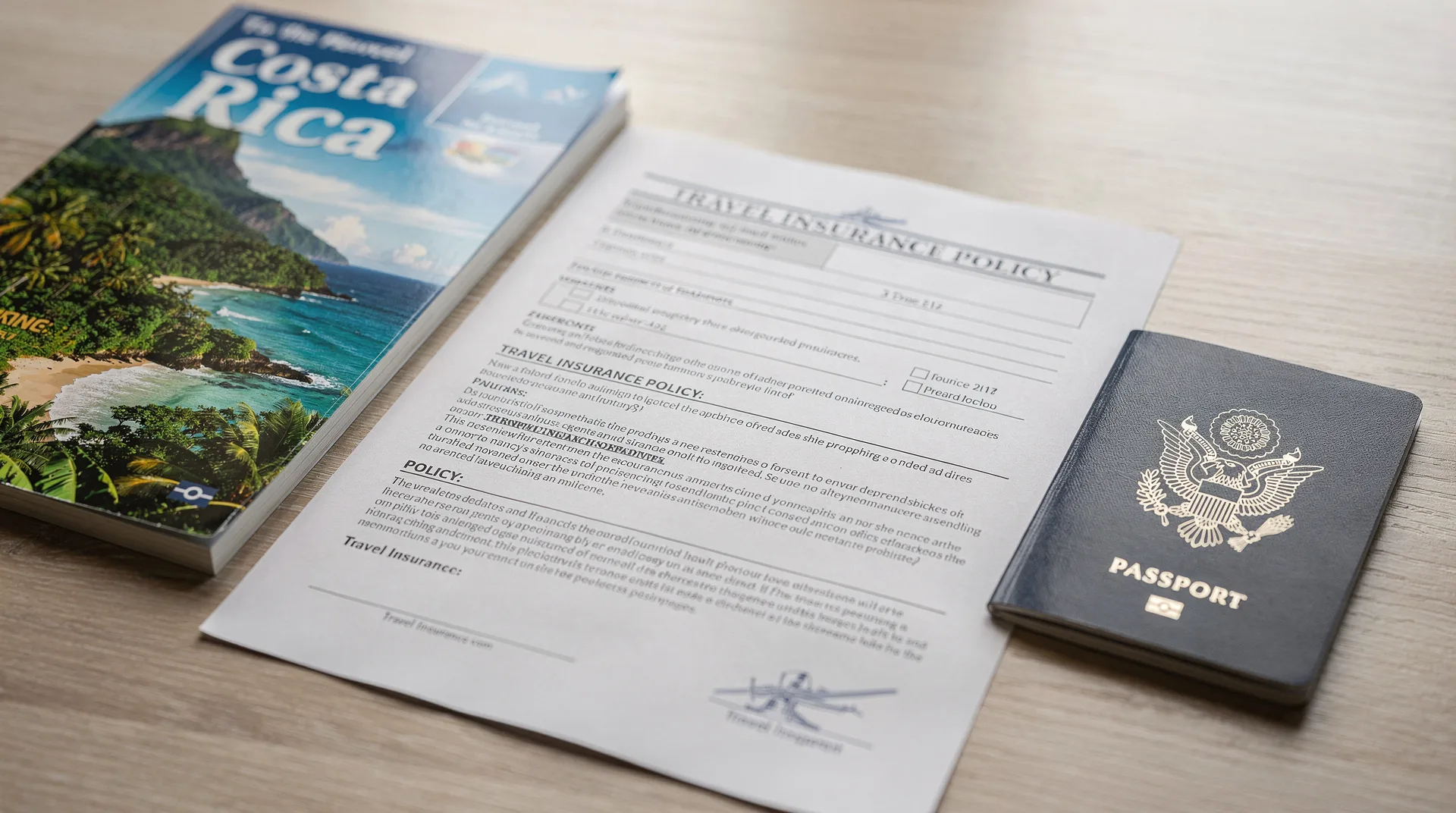
Travel insurance for Costa Rica: what you actually need
Is travel insurance required for Costa Rica?
Not mandatory for tourists (only required for Galapagos cruises, unrelated to Costa Rica). Strongly recommended due to adventure activities, remote medical access, and rental car risks.
| Required to enter? | No — not a condition of Costa Rica entry |
| Recommended for | Adventure activities, remote areas, rental car break-ins |
| Typical cost (2 weeks) | Around $80–200 depending on provider and age |
| Minimum evacuation cover | $100,000; $200,000+ for Osa Peninsula / Corcovado |
| Top picks | World Nomads (adventure), SafetyWing (long-term), IMG (older travellers) |
Do you legally need travel insurance for Costa Rica?
The short answer: no. Costa Rica does not require tourists to have travel insurance as a condition of entry. You can land at SJO or LIR with a valid passport, your onward ticket, and no insurance policy whatsoever, and immigration will let you in without comment. (The insurance requirement commonly associated with some destinations is a confusion with the Galapagos Islands in Ecuador, which require specific insurance for cruise passengers — unrelated to Costa Rica.)
The longer, more honest answer: not having travel insurance in Costa Rica is a meaningful financial risk. Here is why.
Since nobody at SJO or LIR will ask for a policy, the choice is yours, so make it before the trip rather than from a clinic bed. Check that the cover matches what you plan to do in Costa Rica, such as zip-lining or surf lessons, and read the medical and evacuation limits before you pay. If you want a quote for your own dates, you can request a policy through EKTA travel insurance before you fly.
Why travel insurance matters specifically in Costa Rica
Adventure activities and medical evacuations
Costa Rica is one of the world’s leading adventure travel destinations. Whitewater rafting the Pacuare, rappelling in Arenal, surfing at Pavones, ATV tours through Guanacaste’s dry forest, canyoning at Lost Canyon, and hiking in Corcovado are all popular — and all carry injury risk. Standard travel insurance often excludes adventure activities or imposes sub-limits. Policies that specifically cover adventure travel can pay for:
- Emergency evacuation from a remote location (Drake Bay, Tortuguero, the Osa Peninsula — areas 45+ minutes from the nearest hospital)
- Surgery at a private hospital (Clínica Bíblica or CIMA in San José cost $5,000–30,000+ for serious procedures)
- Air evacuation to the US or home country if treatment is not available locally
Without insurance, a helicopter evacuation from Corcovado to San José alone costs approximately $5,000–8,000 USD. Serious orthopaedic surgery (a broken ankle from a surf wipeout or a canyoning rappel gone wrong) at a private hospital runs $15,000–40,000 depending on complexity.
Remote medical access
Costa Rica’s public health system (CCSS — Caja Costarricense de Seguro Social) is available to all, including tourists, in emergencies. Public hospitals are free to use. However, wait times are long, English speakers are limited, and the quality of care drops significantly outside San José and the main urban centres.
Private hospitals in San José — Clínica Bíblica, CIMA Hospital, and Clínica Católica — are excellent by regional standards, comparable to a mid-tier hospital in the US. But they require payment or insurance before admission for non-emergency procedures. Travel insurance with direct billing capability to these hospitals simplifies the process considerably.
In popular rural tourist destinations (Manuel Antonio, La Fortuna, Monteverde, Tamarindo), small clinics exist but serious cases require transfer to San José. In truly remote areas (Osa Peninsula, Tortuguero, Río Celeste), medical facilities are limited to basic first aid.
Rental car coverage gap
This is specific to Costa Rica and frequently overlooked. Most travel insurance policies include some rental car coverage, but:
- The mandatory minimum insurance (SLI — Seguro de Ley de Tránsito) is included in your rental rate and covers only third-party liability in Costa Rica.
- Collision Damage Waiver (CDW) from the rental agency costs $20–30 per day and covers vehicle damage.
- Personal belongings left in the vehicle are not covered by any rental agency insurance — only by a travel insurance policy that covers personal effects.
With rental car break-ins common (this is the #1 crime affecting tourists — see the safety guide), travel insurance that covers personal effects stolen from a vehicle is directly relevant.
Trip cancellation and disruption
Costa Rica is also prone to specific disruption events that affect trip plans:
- Volcanic eruptions: Poás and Rincón de la Vieja occasionally close temporarily with short notice. Turrialba periodically restricts access.
- Road closures: Landslides on Ruta 32 (Atlantic Highway) and flooding on the Osa Peninsula can strand travellers for 24–72 hours.
- Domestic flight cancellations: Sansa cancellations due to weather (particularly at Drake Bay and Tortuguero) are common in rainy season.
- Hurricane season: The Caribbean coast is affected by Atlantic hurricane season (June–November), occasionally causing significant disruptions.
Trip cancellation coverage is primarily useful for the outbound international flight (if you cannot travel due to illness or a covered event). Trip interruption coverage handles the in-country disruptions.
The three main providers for Costa Rica travellers
World Nomads
World Nomads has become the default recommendation for adventure travellers to Costa Rica, and for good reason. Their Standard and Explorer plans specifically cover a comprehensive list of adventure activities — whitewater rafting, ziplines, surfing, canyoning, scuba diving, hiking at altitude — that many standard travel insurance policies exclude.
World Nomads coverage highlights:
- Emergency medical: $100,000–$500,000 depending on plan
- Medical evacuation: $300,000+
- Adventure activities: explicitly listed and covered (Standard covers ~150 activities, Explorer covers 200+)
- Trip cancellation: up to the insured trip cost (purchase shortly after booking)
- Baggage and personal effects: $3,000–$10,000
- 24-hour emergency assistance line: yes, with Spanish-speaking staff
Pricing (approximate, 2-week US-resident policy):
- Standard plan: $80–130 for 2 weeks
- Explorer plan: $120–200 for 2 weeks
World Nomads is best for: independent travellers doing adventure activities, backpackers, anyone planning Pacuare rafting, Corcovado trekking, or extended surfing.
Note: World Nomads policies are purchased online and available to residents of most countries. Coverage terms vary by country of residence — read your specific policy document carefully.
SafetyWing
SafetyWing’s Nomad Insurance is a subscription-based travel medical insurance designed for long-term travellers and digital nomads. It bills monthly, can be purchased after travel begins, and provides continuous medical coverage.
SafetyWing coverage highlights:
- Emergency medical: $250,000 per accident/illness
- Medical evacuation: $100,000
- Coverage in home country: 15 days per 90-day period
- Adventure activities: basic coverage included (extreme sports excluded — read the list carefully)
- Monthly pricing: approximately $45–68 per month depending on age
SafetyWing is best for: long-term travellers, digital nomads, travellers staying in Costa Rica 3+ weeks, or anyone already travelling who forgot to buy insurance before leaving.
Limitations: SafetyWing does not cover trip cancellation (medical only). It has lower limits than World Nomads on adventure activities. For a focused 10-day active adventure trip, World Nomads offers more relevant coverage.
IMG (International Medical Group)
IMG’s iTravelInsured and Patriot Travel plans are popular among travellers who prioritise medical coverage with higher limits and comprehensive policy structure.
IMG coverage highlights:
- Emergency medical: up to $500,000 (Patriot Platinum plan)
- Medical evacuation: $500,000+
- Pre-existing conditions: coverage available with “acute onset” or waiver provisions
- Adventure activities: covered under most plans with rider
- Trip cancellation: comprehensive with reasonable limits
IMG is best for: older travellers (60+) concerned about pre-existing condition coverage, travellers with significant pre-existing conditions, those wanting maximum medical limits.
Pricing: Varies significantly by age. A 60-year-old US resident covering a 14-day Costa Rica trip pays approximately $180–280 for a comprehensive IMG plan versus $100–150 for World Nomads. For travellers over 70, IMG often offers better coverage at competitive prices.
Provider comparison at a glance
| Provider | Best for | Adventure activities | Approx. cost (2 weeks) |
|---|---|---|---|
| World Nomads | Independent/adventure travellers | Explicitly listed, 150–200+ activities | $80–200 |
| SafetyWing | Long-term travellers, digital nomads | Basic only, extreme sports excluded | ~$45–68/month |
| IMG | Older travellers, pre-existing conditions | Covered with rider | $90–280 (age-dependent) |
What to look for in any policy
Before purchasing any policy for Costa Rica, verify these specific points:
Adventure activity coverage list
Does the policy list the specific activities you plan? Pacuare River rafting (Class IV) is different from a gentle float. Corcovado hiking with river crossings is different from a beachside walk. Surfing, canyoning, zip-lining, scuba diving, ATV tours, and paragliding should each be explicitly listed as covered.
Medical evacuation limits
A minimum of $100,000 medical evacuation coverage is needed for Costa Rica. Remote destinations (Osa Peninsula, Tortuguero, Drake Bay) may require helicopter evacuation — this is expensive. $300,000+ is better for travellers in truly remote areas.
Emergency dental
Dental injuries from water sports, cycling, and adventure activities are more common than most travellers expect. Emergency dental coverage (typically $250–500) is worth having.
Rental car coverage
If you are renting a car, check whether the policy covers theft of personal belongings from the vehicle. Most policies cover baggage theft whether from a hotel room or a vehicle, but read the exclusions. “Theft from an unattended vehicle” may be excluded if the items were visible.
Pre-existing condition exclusions
If you have a managed chronic condition (diabetes, asthma, hypertension), check whether the policy provides “acute onset” coverage — meaning an unexpected episode of a pre-existing condition would be covered in an emergency. Some policies exclude all treatment related to a pre-existing condition.
Your credit card’s travel insurance: what it actually covers
Many premium credit cards (Visa Signature, Mastercard World Elite, American Express Gold, American Express Platinum) include travel insurance benefits that are relevant to Costa Rica:
Typically included:
- Trip cancellation/interruption: usually up to $10,000 when the trip is charged to the card
- Baggage delay: $100–500 for essentials after a 6-hour delay
- Rental car CDW: collision damage waiver for the rental car (not personal liability)
- Travel accident insurance
Typically excluded:
- Medical expenses
- Medical evacuation
- Adventure activities
- Rental car exclusions for 4WD over a certain value in some policies
For Costa Rica specifically, the critical gap in credit card coverage is medical. The Clínica Bíblica visit that costs $5,000, the helicopter evacuation from Drake Bay, or the orthopedic surgery after a surfing accident — these are not covered by credit card insurance. Supplementing your credit card’s coverage with a dedicated medical travel insurance policy (even a basic SafetyWing subscription) is strongly advisable.
The INS (Instituto Nacional de Seguros) option
Costa Rica has its own national insurance body, INS (Instituto Nacional de Seguros). INS sells travel insurance to tourists at the airport and online. Their products are legitimate and regulated, but typically offer lower limits than international policies at similar prices. For Costa Rican residents returning from abroad, INS is practical. For international tourists, the international providers (World Nomads, SafetyWing, IMG) offer more comprehensive coverage.
Practical tips for using your insurance in Costa Rica
Keep all receipts
If you visit a clinic or hospital, collect every document: the consultation invoice, prescription receipts, any ambulance bill. Insurance claims require itemised receipts. Costa Rican private hospitals issue detailed invoices in Spanish — photograph everything.
Call the emergency line before any major treatment
Most travel insurance policies require you to notify the insurer’s emergency assistance line before any non-emergency surgery or expensive procedure. This is a condition of coverage in many policies. The line is 24/7 and typically has Spanish-speaking staff who can liaise directly with the hospital.
Document theft or loss immediately
If your belongings are stolen — from a vehicle, hotel room, or on the street — you need a police report (denuncia) to file an insurance claim. The OIJ (Organismo de Investigación Judicial) and any police station can issue a denuncia. Ask specifically for a written report with a case number.
Know your policy’s deductible
Most travel insurance policies have a deductible (the amount you pay before insurance kicks in). World Nomads’ Standard plan has a $0 deductible. Others range from $100–$250. For small medical expenses (a minor cut requiring stitches, a pharmacy antibiotic), paying out of pocket may be simpler than claiming through insurance.
Frequently asked questions about travel insurance
Do I need insurance to buy a Costa Rica tour or activity?
No, tour operators do not require proof of insurance. Some adventure operators require participants to sign a liability waiver — this is standard in Costa Rica and covers the operator’s exposure, not your own medical risk.
Can I buy travel insurance after arriving in Costa Rica?
Yes. SafetyWing can be purchased after departure and even after arrival. World Nomads can also be purchased during travel, but trip cancellation coverage only applies to portions of the trip not yet taken. For medical coverage, purchasing after arrival (but before any incident occurs) is valid with both providers.
Is the CCSS (public health system) free for tourists?
Emergency treatment at public hospitals is provided regardless of insurance. However, follow-up care, specialist treatment, and elective procedures are handled differently for non-residents. In practice, most tourists who need serious care go to private hospitals, where insurance is essential.
Does travel insurance cover COVID-related cancellations?
Most current policies (2025–2026) treat COVID like any other illness — covered if it prevents travel or requires medical treatment. Pure travel disruption due to government restrictions (country closures, quarantine mandates) has been more variable in coverage terms. Read the specific policy language on epidemic/pandemic coverage.
How much should a good policy cost for Costa Rica?
For a 2-week trip with adventure activity coverage, expect to pay $80–150 USD for a World Nomads Standard plan, $90–180 for a World Nomads Explorer plan, or approximately $90–130 for an IMG plan. These are rough ranges for a 30-year-old US resident — older travellers pay more, UK and EU residents may pay less depending on their home country’s policy.
What if I get in an accident in a rental car?
The rental car’s CDW (Collision Damage Waiver) covers vehicle damage. Your travel insurance covers your medical expenses. Third-party liability (damage to other vehicles or injury to others) is covered by the mandatory SLI included in your rental rate. These three coverage layers work together — you should not have a gap if you have all three.
Is annual multi-trip insurance worth it for repeat Costa Rica visitors?
If you visit Costa Rica or travel internationally more than twice a year, an annual multi-trip policy from a provider like World Nomads or a home-country insurer can work out cheaper than buying single-trip cover each time. Check the adventure activity list applies per-trip rather than being a blanket annual exclusion, since some annual policies cap adventure sports coverage more tightly than single-trip plans.
Insurance for specific Costa Rica scenarios
Corcovado and the Osa Peninsula
The Osa Peninsula is the most remote major tourist destination in Costa Rica. Corcovado National Park has no hospital within 2 hours — the nearest facility is in Puerto Jiménez, a clinic with limited capabilities. Serious injuries require evacuation to San José (3–4 hours by ground, 50 minutes by air). Medical evacuation coverage of at least $200,000 is essential for anyone visiting Drake Bay, spending time at Osa Peninsula eco-lodges, or doing multi-day Corcovado treks.
Whitewater rafting the Pacuare
Class IV whitewater on the Pacuare River is one of Costa Rica’s premier adventure experiences, and it carries real risk. Professional operators (Exploradores Outdoors, Ríos Tropicales, Aventuras Naturales) use certified guides and equipment — but even with professional operators, injuries do occur. Verify that your insurance policy specifically lists Class IV rafting as covered (some policies cap at Class III). Multi-day Pacuare expeditions that involve camping add remote location risk.
Scuba diving: Cocos Island and Catalinas
Serious divers visiting Cocos Island (a liveaboard destination accessible by a 36-hour boat ride from Puntarenas) need dive-specific insurance. Standard travel insurance from World Nomads and IMG covers recreational scuba diving to standard depths (typically 40m). Decompression illness treatment in Costa Rica is handled at the hyperbaric chamber at Clínica Bíblica in San José — expensive without insurance.
Las Catalinas diving (accessed from Tamarindo or Playas del Coco) is less remote but involves advanced dive conditions — manta rays and current-driven visibility. Dive-specific coverage from DAN (Divers Alert Network) is worth adding for serious divers visiting either location.
Surfing injuries
Surfing is the activity that generates the most insurance claims in the Costa Rica context — not because it is more dangerous than canyoning or rafting, but because far more tourists attempt surfing. Reef breaks (Witch’s Rock, Ollies Point, Pavones) produce the most serious injuries. Most standard travel insurance policies cover recreational surfing. Confirm this explicitly if surfing is a primary reason for your trip.
Trip disruption during Semana Santa
Easter week (Semana Santa) in Costa Rica sees the entire country effectively shut down for 4–5 days. Beaches are packed, the Puntarenas-Paquera ferry runs at maximum capacity with queues, and domestic flights are fully booked weeks ahead. Semana Santa-related travel disruptions are not typically covered as a “trip disruption” event under most insurance policies (since it is a predictable annual event). Plan around it rather than relying on insurance.
Matching cover to your itinerary
The right policy depends on where you spend your days. A trip built around the beach resorts of Guanacaste, as in the 5 days Guanacaste resort itinerary, carries far less medical risk than the 12 days adventure Corcovado and Pacuare itinerary. Read your route through before choosing a plan, and size the evacuation limit to the most remote stop rather than the easiest one.
Canopy tours are a good example of an activity to check on the policy’s list. If you plan a day on the cables, such as a canopy adventure in the cloud forest — from $75 , confirm that zip-lining is named as covered. The zip line safety and pricing guide explains what operators do on their side, and the Monteverde destination page helps you plan the nearest medical options.
Water-based days deserve the same check. A boat outing from the Pacific coast, for instance a catamaran sailing day with snorkelling stops — from $105 , usually involves swimming in open water. Read the beach safety guide before you go, and look at the snorkelling and diving guide if in-water time is central to your plans.
Insurance and the rest of your planning
Insurance fits best into a wider preparation routine. The packing list should include a printed copy of your policy number and the emergency assistance line, alongside any prescription medication. If you plan to drive, the driving in Costa Rica guide and the road conditions by region guide show where a breakdown or accident would leave you far from help. Families should also read the family travel tips, since children’s cover and pediatric care are worth confirming before you buy.
Related guides
Insurance is one layer of travel safety. The safety in Costa Rica guide covers the practical daily risks — rental car theft, riptides, road accidents — that generate most insurance claims. The rent a car or not guide explains the rental car insurance structure and the difference between CDW, SLI, and what credit cards cover. For the financial logistics of the trip, the money and currency guide and ATM and cash tips guide cover how to manage money day-to-day. The visa and entry requirements guide confirms that insurance is not a condition of entry.
Manuel Antonio NP: guided tour with entrance fee included — from $60