Visa and entry requirements for Costa Rica
Do I need a visa for Costa Rica?
90 days visa-free for US, EU, UK, Canada, Australia, Brazil, Japan. Valid passport plus proof of onward travel are required. No tourist visa fee.
| Visa-free stay | 90 days for most EU, US, UK, Canada, Australia passports |
| Cost | No tourist visa fee |
| Must show | Valid passport + proof of onward travel |
| Departure tax | Included in your airline ticket since 2017 |
| Extending | Border run, migration office extension, or residency |
Who can enter Costa Rica without a visa
Costa Rica is one of the most welcoming countries in Central America for international tourists. Citizens of over 90 countries — including all EU member states, the United States, the United Kingdom, Canada, Australia, New Zealand, Japan, South Korea, and Brazil — may enter without applying for a visa in advance. The standard allowance is 90 days from the date of entry.
This guide covers exactly what you need to have in hand when you land at Juan Santamaría International Airport (SJO) in San José or Daniel Oduber Quirós International Airport (LIR) in Liberia, what immigration officers actually look for, and the edge cases where things go wrong for travellers who didn’t prepare.
Which nationalities get 90 days, 30 days, or need a visa
90-day visa-free countries
The following nationalities consistently receive a 90-day tourist stamp on arrival:
- All EU member states (including post-Brexit UK with a British passport)
- United States
- Canada
- Australia and New Zealand
- Japan, South Korea, Taiwan
- Brazil, Argentina, Chile, Colombia, Mexico
- Israel, Norway, Switzerland, Iceland
30-day entry — some nationalities
Nationals of several other countries receive only a 30-day stamp on arrival. These include some Caribbean, African, and Eastern European countries. Always check the current rules via the official Costa Rican immigration authority (Dirección General de Migración y Extranjería at migracion.go.cr) before you travel, as this list changes.
Countries requiring a visa in advance
Citizens of countries such as China, Vietnam, India, and Russia currently require a tourist visa obtained through a Costa Rican consulate before travel. As of April 2026, nationals of some countries may qualify for an e-visa pilot. Verify your specific nationality at the consulate well ahead of departure.
Whichever group you fall into, the rules matter most for how you shape the rest of your plan. If you are still deciding when to travel, the best time to visit Costa Rica guide helps you pick dates, and the Costa Rica vs Panama comparison is useful if you are weighing a second country, since that affects your onward ticket and your exit route.
What you must have at the immigration desk
Even if your passport gives you 90 days visa-free, immigration officers can — and sometimes do — ask for additional documentation. Being prepared avoids delays and avoids the small but real risk of being turned back at the border.
1. A valid passport
Your passport must be valid for the entirety of your planned stay. Most sources recommend at least six months of remaining validity beyond your intended departure date, though the legal minimum is just validity through your planned exit date. The safest approach: make sure your passport has at least six months left when you fly.
2. Proof of onward travel
This is the most common reason tourists are questioned or delayed. Costa Rican immigration requires that you hold a ticket showing you will leave the country before your permitted stay expires. This means:
- A return flight to your home country
- A connecting flight out to another destination (Panama, Colombia, Mexico, etc.)
- A bus or ferry ticket to a neighbouring country (Nicaragua, Panama)
Many airlines will actually refuse to board you for Costa Rica if you cannot show an onward ticket at check-in. If you are a long-term traveller or genuinely uncertain of your exit date, the cheapest solution is a refundable flight or a bus ticket to Panama City (Trans Nica or Tica Bus offer affordable options, typically $20-40 one-way).
3. Proof of funds (less common but possible)
Immigration officers can ask you to show that you have sufficient funds to cover your stay. The informal guideline used by some officers is roughly $100-$150 per day of intended stay. In practice, this is rarely enforced against visitors from wealthier countries, but budget travellers crossing into Costa Rica from Nicaragua overland should be prepared to show bank cards or cash if asked.
4. An accommodation address
You will fill in a migration card (tarjeta de ingreso) on arrival listing your first accommodation address. Have your hotel name and address ready — it does not need to be a full multi-week booking if you are planning to move around.
Keep digital and printed copies of your onward ticket, your first night’s booking and your passport page together in one easy-to-reach place. Phone batteries die and airport wifi is unreliable, so a paper backup saves stress at the desk. If you need mobile data the moment you land, see the eSIM and internet guide before you fly.
The departure tax — no longer a surprise
Until 2017, Costa Rica charged a $29 departure tax that had to be paid separately, sometimes in cash, at the airport before boarding. This tax has been included in the cost of your airline ticket since January 2017. If you bought your ticket after that date from any major carrier, you have already paid it. There is nothing to do at the airport except check in.
Extending your stay beyond 90 days
If you want to stay longer than 90 days, you have three options:
1. Border run. Exit Costa Rica — most commonly via the Peñas Blancas crossing to Nicaragua or the Paso Canoas crossing to Panama — spend at least 72 hours outside the country, and re-enter. Whether you receive another 90 days is at the discretion of the immigration officer and is increasingly being questioned as a long-term strategy. Do not rely on this as a permanent arrangement.
2. Apply for an extension. The migration office in San José allows extensions of up to 90 additional days in some cases. This requires documentation, a fee, and in-person visits. It is not a quick process.
3. Apply for residency. Costa Rica offers pensionado residency (from $1,000 monthly pension income), rentista residency ($2,500 monthly income guaranteed), and investor residency ($150,000 investment). A digital nomad visa was introduced in 2021 and is available to remote workers earning at least $3,000 per month.
Extension options compared
| Option | Extra time | Effort | Reliability |
|---|---|---|---|
| Border run (72+ hrs out) | Another 90 days (usually) | Low — a bus/flight trip | At officer’s discretion, increasingly scrutinised |
| Migration office extension | Up to 90 extra days | Medium — documentation, fee, in-person | Reliable if paperwork is complete |
| Residency (pensionado, rentista, digital nomad) | Long-term/indefinite | High — income proof, legal process | Reliable once approved |
Travelling with children
Children travelling with one parent or without their parents require an authorisation letter from the absent parent(s), notarised and apostilled. This rule is enforced, and families have been turned away at immigration without the correct documentation. The requirement applies to children holding Costa Rican nationality who are travelling abroad, and to foreign children entering Costa Rica with only one parent.
Health and vaccination requirements
There are no mandatory vaccination requirements to enter Costa Rica, with one exception: travellers arriving from a country with active yellow fever transmission (certain African and South American countries) must show proof of yellow fever vaccination. This applies to countries like Kenya, Uganda, Nigeria, Brazil’s Amazon region, and Peru. Check the current WHO list if you are transiting through those regions.
Border crossings by land and sea
If you are entering overland from Panama or Nicaragua, the main crossings are:
Nicaragua border: Peñas Blancas (on the Pan-American Highway). Open daily, often crowded. Expect 1-3 hours processing time. Shuttle services from Liberia and San José handle the paperwork efficiently.
Panama border: Paso Canoas (on the Pan-American Highway) or Sixaola-Guabito (Caribbean side). Both are manageable in a day from San José.
Once you are across, onward movement is easier than the border itself. The shuttle services overview explains the main shared options, while the rent a car or not guide helps you decide whether to drive. If you do, read driving in Costa Rica first.
Sea entry: Some cruise ships dock at Puntarenas, Golfito, and Puerto Limón. Cruise passengers receive a temporary shore pass rather than a full tourist entry stamp, and their departure is controlled by the ship’s schedule.
Common mistakes and how to avoid them
Forgetting the onward ticket. The most common entry problem. Purchase a refundable ticket or bus ticket before you fly if your plans are open-ended.
Expired passport. Embarrassingly common. Check the expiry date before you leave home, not at the airport.
Wrong passport. Some dual nationals make the mistake of entering on a passport other than the one they used to purchase their ticket. Use the same document throughout.
Overstaying. Staying beyond your permitted period results in fines of roughly $100 per month of overstay, and potentially a ban from re-entry. Even one day over the limit is noted in the system.
Name discrepancy between ticket and passport. Minor discrepancies (initials vs full name) can sometimes cause problems with check-in. Make sure the name on your booking matches your passport exactly.
Planning your first days after arrival
Arriving after a long flight, it pays to keep day one simple. Many first-time visitors base themselves in San José for a night, then head to La Fortuna or Manuel Antonio. If you would rather see how the pieces fit together, the 7 days Arenal and Manuel Antonio itinerary is a good template. Have some local currency ready too, and read the ATM and cash tips before your first withdrawal.
Choosing your arrival airport and first stop
Your entry airport shapes your first days more than the paperwork does. Landing at Liberia puts you close to the beaches of Guanacaste, including Tamarindo and Playas del Coco, while San José suits itineraries that start in the highlands or head toward the Pacific coast. The Guanacaste beach guide is a good place to start if you are leaning north, and best time to visit Costa Rica helps you match dates to the weather.
If you arrive in the north and want to see the mountains early, a guided hike in the cloud forest, such as a guided hike in the Monteverde cloud forest reserve — from $110 , is one way to start the trip. For more on that area, see the Monteverde destination page and the cloud forest vs rainforest explainer.
If your route heads for the Pacific coast, a guided tour of Manuel Antonio National Park — from $60 pairs well with the Manuel Antonio National Park guide. Whatever you choose, keep your passport and onward ticket handy until you are through immigration, and read safety in Costa Rica and the Arenal and Manuel Antonio itinerary for ideas on how to link your first stops. Travellers on a tighter budget may also like the 21 days backpacker itinerary without a rental car, and families can look at the family travel tips.
What happens when you land
The arrival process at SJO or LIR is straightforward. After the plane doors open, follow signs for Immigration (Migración). You will:
- Queue at a staffed booth (or e-gate if available for your nationality)
- Hand over your passport and completed migration card
- Answer a brief question or two — destination in Costa Rica, length of stay, purpose of visit
- Have your fingerprints and photo taken (standard since 2014)
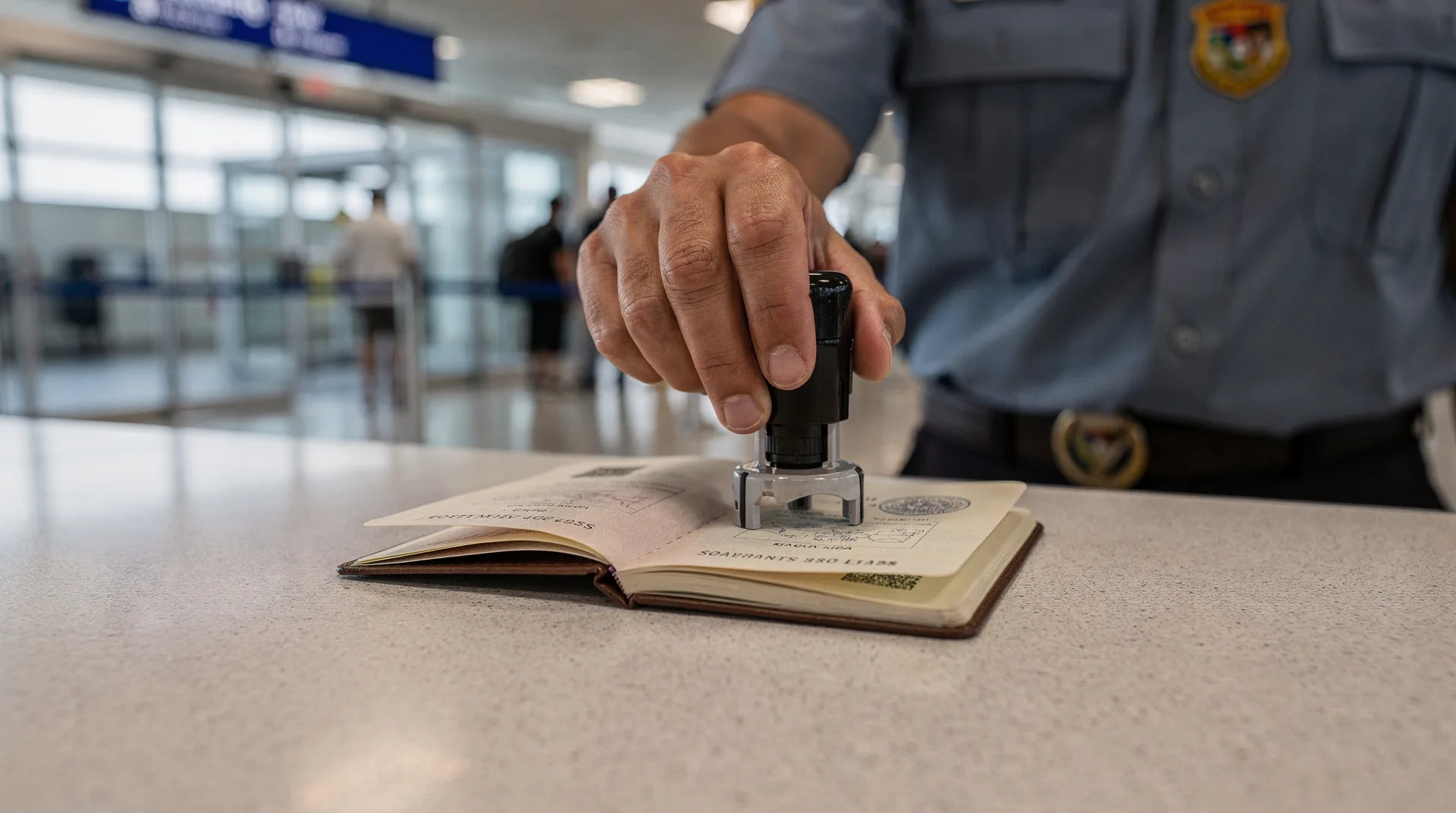
- Receive your passport back with a stamp showing your permitted days
After immigration, collect your luggage and pass through customs. Customs in Costa Rica operates a random button system — you press a button, and if it lights green you walk through; red means a bag inspection. Most arrivals pass through green.
Linking up with a tour on arrival
If you have arranged a private airport transfer or are joining a guided tour from day one, the pickup point at SJO is just beyond the customs exit, in the arrivals hall. See our guide to airport to destination transfers for full options on getting from SJO to La Fortuna, Manuel Antonio, or Tamarindo on day one.
A San José historical and city tour is a practical way to use your first half-day while waiting for the rest of your group or settling into the capital before heading to your main destination.
Costa Rica historical tour in San José — from $55Frequently asked questions about Costa Rica visa and entry
Do US citizens need a visa for Costa Rica?
No. US citizens receive a 90-day tourist stamp at the airport with no advance visa required. You need a valid passport and proof of an onward or return ticket.
Can I extend my 90-day stay in Costa Rica?
You can apply for an extension at the Dirección General de Migración y Extranjería in San José. The process takes several weeks and requires documentation. Alternatively, exiting to Panama or Nicaragua and re-entering is widely practiced, though immigration officers have discretion over how many days to grant on re-entry.
What documents prove onward travel?
A printed or digital copy of a return flight, a connecting flight, or a bus ticket to Nicaragua or Panama. The immigration officer wants to see that you have a confirmed exit from Costa Rica before your permitted stay expires.
Is the $29 departure tax still charged separately?
No. Since January 2017, the $29 departure tax has been included in the price of all airline tickets to Costa Rica. You pay nothing extra at the airport.
Can I enter Costa Rica without vaccinations?
Yes, with one exception: proof of yellow fever vaccination is required if you are arriving directly from a yellow fever endemic country. Check the current WHO list. No other vaccines are mandatory, though hepatitis A, typhoid, and up-to-date routine vaccines are recommended.
What is the youngest age children can travel to Costa Rica without both parents?
There is no minimum age, but children travelling with only one parent or without their parents require a notarised authorisation letter from the absent parent(s). Without it, they may be denied entry.
Can I work in Costa Rica on a tourist visa?
No. A tourist entry stamp explicitly prohibits paid employment. Remote work for foreign companies is a grey area that was partially addressed by the 2021 digital nomad visa — see the digital nomad visa blog post for details.
What if I overstay my Costa Rica visa?
Overstaying results in a fine of approximately $100 per month and a note in the immigration database. Repeat overstays can result in entry bans. Always leave before your stamp expiry date.
Do I need to show a hotel booking for every night of my trip?
No. The migration card asks for your first accommodation address only. If you plan to move between destinations, you don’t need every booking confirmed in advance — just be ready to give your first night’s address clearly.
What happens if my flight home changes and I end up staying longer than planned?
As long as the new departure date is still within your original 90-day stamp, there’s no issue — you don’t need to notify immigration of flight changes within your permitted stay. If the change pushes you past your 90 days, you’ll need one of the extension options above before your stamp expires.
Related guides
Entry and visa requirements are just the start of planning a Costa Rica trip. Once you have confirmed your eligibility to enter, the practical next steps are sorting your money (money and currency guide), setting up connectivity (eSIM and internet guide), and understanding what to pack for the climate you will encounter (packing list guide). For first-time visitors uncertain about safety, our safety in Costa Rica guide provides a frank assessment of the real risks and how to stay comfortable throughout your trip.