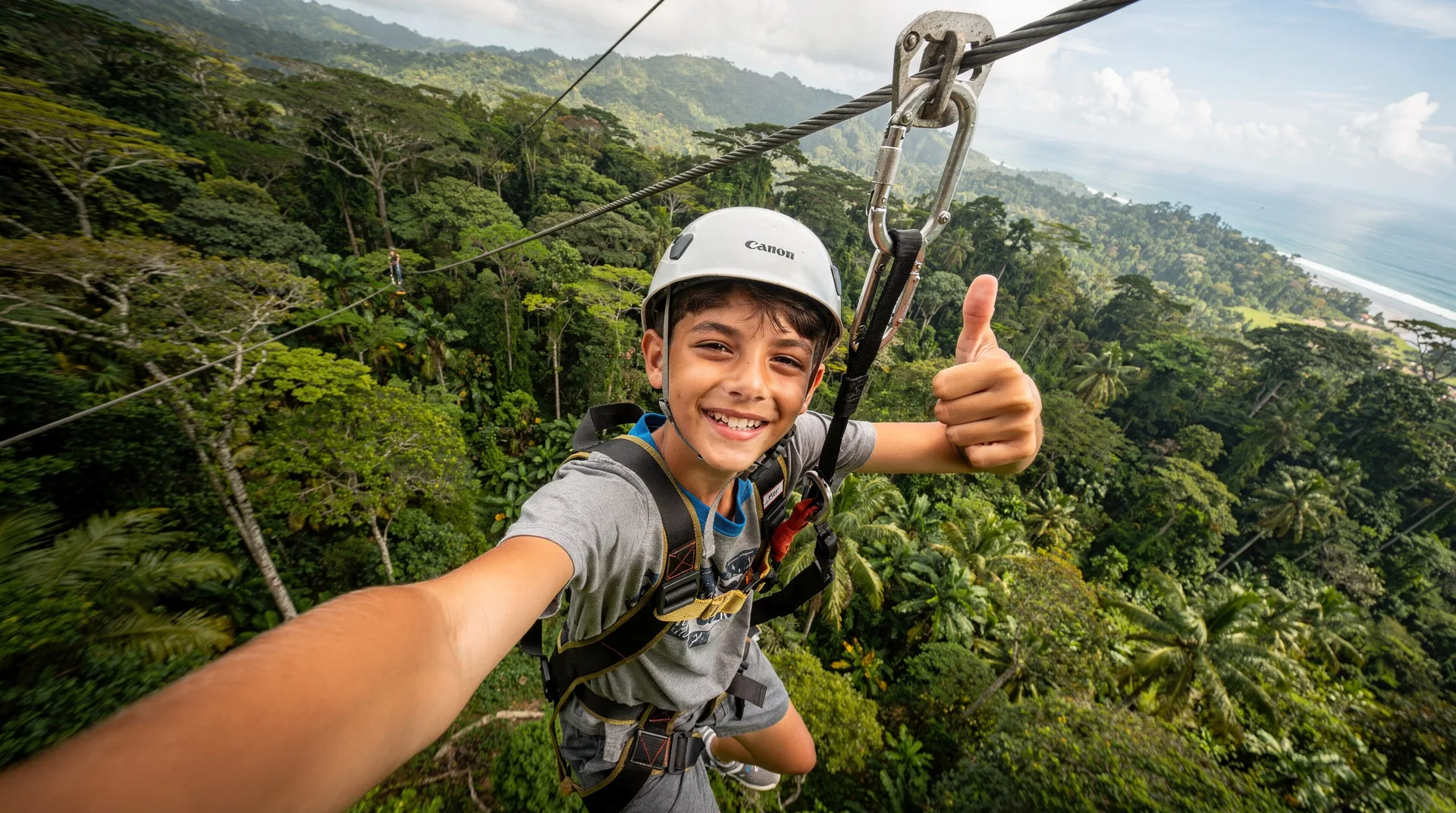
Costa Rica activities for teenagers: adrenaline, surf, and wildlife
What can teens do?
Ziplines, surf school, ATV, rafting Class II-III, snorkeling, night tours — Costa Rica is genuinely excellent for older kids.
Why Costa Rica is outstanding for teenage travellers
Most family destinations struggle with the teenager problem: once children hit eleven or twelve, they disengage from butterfly gardens and guided sloth walks and start wanting something that makes their heart rate climb. Costa Rica doesn’t have this problem. It has dozens of world-class adrenaline activities with realistic minimum age requirements, surf schools that routinely teach first-timers to stand up in two hours, and a night tour ecosystem that actually impresses young people who have seen everything on a screen.
This guide covers every major activity category appropriate for teenagers, with honest minimum ages, real prices as of 2026, and operator recommendations. We’ve also flagged the activities that look good on a brochure but disappoint in practice.
| Best regions | La Fortuna/Arenal, Monteverde, Jacó, Sarapiquí |
| Typical cost per activity | around $50–95 per teen |
| Minimum ages | mostly 8–14 depending on activity |
| Best combo | surf morning + zipline midday + bioluminescence evening (Jacó) |
| Booking window | 24–48 hrs ahead in high season |
Ziplines and canopy tours
Monteverde: the benchmark experience
Monteverde has the best zipline infrastructure in Costa Rica. The Sky Adventures Monteverde park offers cables running through primary cloud forest canopy — the longest line exceeds 1.5 kilometres — with views that alternate between cloud forest and the Gulf of Nicoya. The thrilling zipline canopy tour here runs on a separate track from the more sedate tourist lines, and the faster cables demand real focus from teenagers who think they’ve seen everything.
Most Monteverde zipline operators set a minimum age of 10–12 and a minimum weight of 30 kilograms. Teenagers have no restrictions. The cost runs $60–80 per person depending on the operator and the combination (bridges-only versus zip-and-bridges).
Monteverde: thrilling zip line canopy tour — from $60Jacó: accessible and well-run
If your family is based on the central Pacific coast rather than Monteverde, the Jacó zipline canopy tour offers a shorter but still impressive circuit through secondary rainforest above the beach town. Lines are faster and lower than Monteverde — more focused on speed than the tree canopy experience — which tends to appeal to teenagers who prioritise the adrenaline over the scenery.
Jacó Beach: zipline canopy tour — from $75Age and weight reality check
Most operators accept ages 8–10 for shorter lines and 12+ for full canopy circuits. Weight minimums (25–30 kg) are enforced because lighter riders don’t generate enough momentum to reach the next platform safely — this is a physical requirement, not arbitrary restriction.
Surfing
Learn-to-surf schools
Surfing is the activity that Costa Rica does better for beginners than almost anywhere on Earth. The Pacific coast has multiple beach breaks where gentle, clean reform waves provide exactly the right conditions for a first stand-up — and Jacó, Sámara, and Tamarindo all have professional surf schools with foam boards, rash guards, and patient instructors.
For teenagers with no previous experience, a two-hour beginner lesson ($50–55) typically ends with multiple successful stand-ups. By the third session, most teens are catching waves independently. The family surf lesson format at Jacó specifically caters to mixed-age groups and is among the best-reviewed beginner experiences in the country.
Jacó: surf lesson with certified instructor — from $50Which beach for which teenager
Tamarindo suits teenagers who want beach culture alongside the surfing — the town is lively with restaurants, other young travellers, and sunset activities. The main break can be a little fast for absolute beginners but is manageable with a good instructor.
Jacó is the most convenient option from San José (1.5 hours) and has the widest range of surf schools. The break is reliable and forgiving. The town is rougher than Tamarindo — better for teenagers who don’t mind a grittier atmosphere.
Sámara is the gentlest option — the reef protection creates a very slow, rolling wave ideal for nervous first-timers or younger teenagers (10+).
White-water rafting
Class II-III: suitable from age 8-10
The Sarapiquí River offers the most accessible family-friendly rafting in Costa Rica. The Class II-III section is genuinely exciting — proper rapids, real spray, moments of controlled chaos — without the commitment of the Pacuare’s Class III-IV canyons. Most operators accept children aged 8 and above with adult supervision for Class II-III. Teenagers need no special permission.
Arenal: rafting Sarapiqui River day tour Class II-III — from $85Pacuare River: the full experience for older teens (12+)
The Pacuare River is routinely ranked among the world’s top-ten white-water rivers. The canyon section combines Class III and IV rapids with pristine primary rainforest, waterfalls dropping directly into the river, and occasional jaguar tracks on the sandbanks. The minimum age for most Pacuare operators is 12, with a minimum weight of 40 kilograms. This is the right call — the hydraulics in certain rapids can briefly submerge a small person.
For teenagers aged 14 and above who have previous rafting experience, the two-day Pacuare expedition with overnight lodge stay is one of the most extraordinary experiences in Central America. See our multi-day Pacuare expeditions guide for details.
ATV tours
ATV tours appeal to teenagers who want motorised speed in a natural setting. The best options by region:
La Fortuna: The Arenal ATV tour runs through primary forest, past the volcano, and across a river ford — 3 hours, $95 per ATV. Minimum age is typically 16 to drive solo; younger teens ride as passenger.
Guanacaste dry forest: The La Cruz ATV tour traverses the tropical dry forest near Rincón de la Vieja — good for families based in the Guanacaste resort zone.
Brasilito / Las Catalinas (Guanacaste): The combined ATV and zipline adventure with beach hopping is a full 5-hour day that satisfies teens who want variety in a single activity.
Most operators require a driving licence or age 16 to operate an ATV solo. Passengers can generally be younger (8+). Helmet and protective gear are included in the price.
Snorkeling and marine wildlife
Caño Island: the premium option
Caño Island Biological Reserve, reached by boat from Drake Bay or Uvita, has the best snorkeling in mainland Costa Rica waters. Reef sharks, sea turtles, and enormous schools of tropical fish are consistent sightings. The 2-hour boat ride each way and 8-hour day means teenagers need to have reasonable sea legs, but the underwater experience justifies the commitment. Age minimum: generally 8+ for snorkeling, but teenagers swim independently.
Conchal and Coco (Guanacaste coast)
For families based in Guanacaste who want a shorter snorkeling excursion, the sunset sailing and snorkeling tour from Playas del Coco visits a protected cove with reasonable visibility. This is not Caño Island — reef quality is lower — but it’s a viable half-day option for teens who want water time without a long boat journey.
Playas del Coco: sunset sailing and snorkeling tour — from $95Night tours: the hidden gem for teens
Night tours consistently surprise teenagers who expect them to be boring. Costa Rica’s nocturnal wildlife is genuinely extraordinary: red-eyed tree frogs, glass frogs, kinkajous, boa constrictors, porcupines, and sleeping birds that glow slightly in torchlight. The Monteverde night walk is particularly rich — cloud forest mammals are dramatically more active at night than during the day.
For teenagers who were bored by the daytime forest walk, the night version of the same trail is categorically different. The darkness removes the scale and grandiosity of the forest and replaces it with intimacy — every animal is close.
Arenal night walk: The Arenal Volcano rainforest night tour focuses on amphibians and nocturnal mammals. Guides use red-light torches that don’t disturb wildlife.
Monteverde night walk: Cloud forest species including the rare silky anteater and a range of frogs that are invisible by day.
Caribbean night tour (Puerto Viejo): The most species-rich option if your family visits the Caribbean coast.
Mountain biking and horseback riding
Monteverde mountain biking
Mountain biking trails around Monteverde connect cloud forest reserves and viewpoints. Several operators rent full-suspension bikes and guide groups — the descents through cloud forest are steep enough to challenge confident riders without being dangerous. Age minimum: 12 for most guided routes.
Horseback riding to hot springs (La Fortuna)
The horseback ride between La Fortuna and Monteverde (via the Río Chiquito route) is a half-day horse journey through open farmland and forest. It’s sedate — this is working-ranch pace, not trail running — but teenagers who enjoy horses find it a genuinely memorable way to cover terrain. Most operators accept riders aged 8+ with adult supervision.
Wildlife experiences that resonate with teens
While younger children respond to butterfly gardens and gentle sloth encounters, teenagers tend to engage more with active wildlife experiences:
Night kayaking at Tortuguero: Paddling the dark canals listening for tapirs and crocodiles is more compelling for teenagers than a guided daytime canal tour.
Sea turtle nesting at Tortuguero or Playa Grande: July through October at Tortuguero, October through February at Playa Grande for leatherbacks. Nighttime beach walks to observe nesting require silence and patience but are among the most affecting wildlife experiences available anywhere. Minimum age is typically 5–6 for tour access, but teenagers are the right audience.
Bioluminescence tour from Jacó: A boat tour at night watching the sea glow blue-green with dinoflagellates is genuinely magical and technologically interesting for science-oriented teenagers.
Activities that disappoint teenagers (honest assessment)
Coffee and chocolate tours: Adults love them; teenagers rarely do unless they’re already passionate about food production. Don’t book these without consulting the teenager first.
Catamarans with snorkel stop (Manuel Antonio): The snorkel portion excites teens; the buffet lunch and sunset cruise portion often bores them.
Guided museum-style city tours of San José: Genuinely interesting for adults with historical curiosity; usually tedious for teenagers unless they have a specific interest in pre-Columbian culture.
Butterfly gardens as standalone activity: Excellent for under-sevens; typically a 10-minute experience for teenagers who walk through quickly without the emotional reaction of younger children.
Quick-compare: top adrenaline picks for teens
| Activity | Around | Min age | Thrill level | Region |
|---|---|---|---|---|
| Monteverde thrilling zipline | $60–80 | 10–12 | High | Monteverde |
| Sarapiquí Class II-III rafting | $70–90 | 8–10 | Medium | Sarapiquí |
| Pacuare Class III-IV rafting | $110–150 | 12–14 | High | Turrialba/Sarapiquí |
| Jacó surf lesson (beginner) | $50–55 | none | Medium | Jacó |
| Arenal ATV tour | $95 | 16 to drive solo | Medium-High | La Fortuna |
| Bioluminescence night boat | $60–75 | none | Low-Medium | Jacó |
Budgeting a full teen-activity day
A single high-adrenaline activity (zipline, rafting, ATV) runs $60–95 per teen. Families building a “fail-safe” day — surf lesson, zipline, and an evening boat tour — should budget roughly $180–220 per teen for the full day, plus transport if not staying within walking distance of the operators. Multi-day discounts and combo tickets (bridges-plus-zipline, gondola-plus-canopy) typically save 15–25% over booking each activity separately; see the Monteverde ziplines guide for combo specifics.
Frequently asked questions about Costa Rica activities for teenagers
What is the minimum age for ziplines in Costa Rica?
Most operators use a minimum age of 10–12 for standard zipline circuits and a minimum weight of 30 kg. Some shorter tourist-park lines accept children from age 5. Sky Adventures Monteverde, which has the country’s best lines, accepts ages 10+. Diamante Eco Adventure Park in Guanacaste accepts ages 5+. Always confirm with the specific operator before booking.
Can teenagers surf if they’ve never tried before?
Absolutely. Costa Rica’s beginner beaches — particularly Jacó, Sámara, and Tamarindo — are among the best learn-to-surf environments on Earth. Two-hour beginner lessons consistently produce first stand-ups. Instructors provide foam boards, which are stable and forgiving. Surfing requires swimming competence but no prior board sport experience.
Is ATV riding safe for teenagers?
ICT-certified operators run ATVs on marked trails at controlled speeds. Solo driving requires a licence (typically age 16+); pillion riding is generally open from age 8–10. The forest tracks are not public roads — typical top speeds are 30–40 km/h. Helmets and elbow pads are mandatory at reputable operators. Check ICT certification before booking any ATV tour.
What river grade is appropriate for teenagers with no rafting experience?
Class II-III (Sarapiquí) is the right starting point. Teenagers aged 10+ who can swim are appropriate passengers. Class III-IV (Pacuare) is suitable for teenagers 14+ who have previous rafting experience or a high tolerance for controlled fear. Class IV-V water (Pacuare canyon specific sections) should wait until adulthood.
Are there surfing camps specifically for teenagers?
Several surf camps in Costa Rica operate teen-specific weeks. Drift Bay Camp (Playa Negra, Caribbean), Surf Synergy (Jacó), and Iguanas Surf Camp (Dominical) all run programmes catering to teenagers travelling with parents or in organised groups. Week-long camps include accommodation, meals, daily lessons, and cultural activities.
How do we keep a teenager engaged if they hate the activities we chose?
Costa Rica’s combination of surf, adventure, and wildlife usually prevents complete disengagement. The fail-safe is the Jacó one-day combination: surfing lesson in the morning, zipline at midday, bioluminescence boat tour in the evening. This combination appeals to nearly every teenager regardless of their default attitude toward travel.
Related guides
Our family-friendly itinerary guide builds a complete circuit incorporating many of these activities. The Monteverde ziplines guide covers the cloud forest canopy options in depth. For younger siblings sharing the trip, activities for young children shows how to keep the whole family engaged. And our family travel tips guide covers logistics, safety, and packing for a multi-age family trip.
Building the trip around your teenager
The activities above are easiest to enjoy when the base fits the teenager too. La Fortuna and Monteverde pack adventure into short distances, while Jacó and Tamarindo add beach life and a social scene that older kids tend to appreciate. Sarapiquí is the natural base for river days.
If surf is the draw, the beginner surf spots guide explains which breaks forgive mistakes, and the surf camps guide is worth reading if your teenager wants more than a single lesson. The Jacó surf guide goes deeper on that particular town.
For the water days beyond surfing, compare rafting classes before choosing a river, and read zip-line safety and pricing so you know what a reputable operator looks like. If the group cannot decide between canopy options, zip-lining versus canyoning versus bridges helps settle the argument.
Teenagers who like animals but not slow walks often respond to the nocturnal wildlife guide, and the Tortuguero turtle nesting guide covers one of the most memorable evenings the country offers. Finally, the 10-day family itinerary with sloths and beaches shows how to string several of these days together without exhausting anyone.