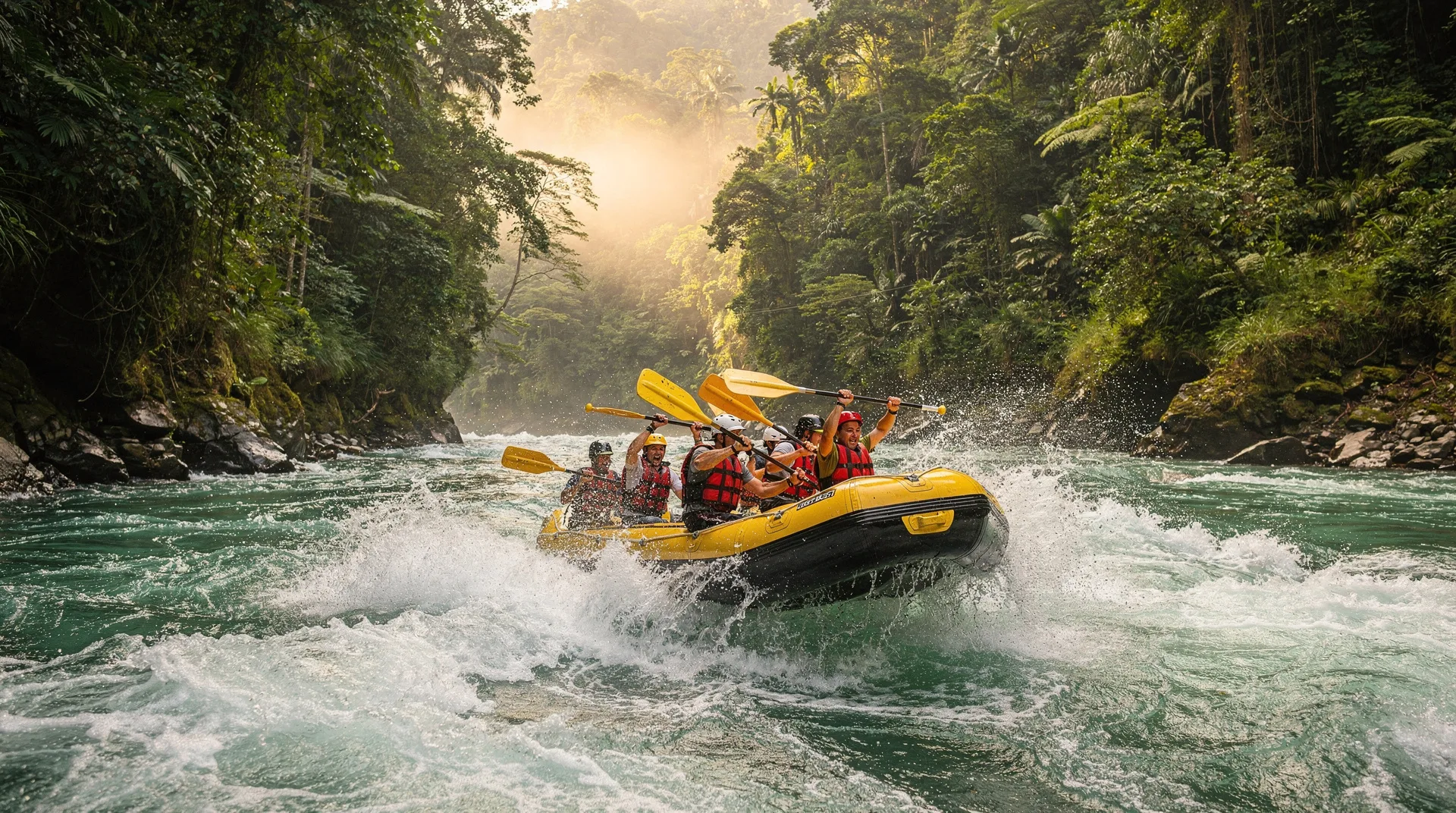
Pacuare River rafting: the complete guide to Costa Rica's best whitewater
Why is the Pacuare famous?
The Pacuare is rated one of the top 10 whitewater rivers in the world by National Geographic. 28 km of Class III-IV rapids through a roadless jungle canyon, with rapids named Pipeline, Terminator, and Double Drop.
The Pacuare: why this river has a global reputation
In 2006, National Geographic Adventure listed the Río Pacuare among the top ten rivers in the world for whitewater rafting. That ranking was not arbitrary. The Pacuare combines Class III-IV technical difficulty with one of the most dramatic river canyons in Central America — 28 kilometres of whitewater through a pristine jungle gorge where no road reaches the river for the vast majority of its length.
The experience is immersive in a way that no roadside rafting can replicate. You enter the canyon from the put-in at Tres Equis and the outside world — traffic, wifi, development — disappears. The walls of the gorge rise 200-400 meters on both sides, covered in unbroken primary and secondary forest. Waterfalls drop directly into the river at multiple points. The noise of rapids is constant, interrupted only by the calls of toucans and the occasional howler monkey.
This guide covers everything you need to plan a Pacuare trip: rapids, operators, prices, the single-day vs multi-day decision, seasonal conditions, and how to combine the river with a broader Costa Rica itinerary.
| Where | Turrialba area, Caribbean slope, put-in at Tres Equis |
| Difficulty | Class III–IV (up to V in peak wet season) |
| Duration | Single-day (5–6hrs on water) or 2-day expedition |
| Minimum age | Typically 12, some operators allow 10 |
| Getting there | 2.5–3hrs from San José, 45min from Turrialba |
The rapids: what you will encounter
The Pacuare’s character changes as you descend the canyon. The upper section from Tres Equis is the most technical; the lower section opens into longer pools with breathable moments between rapids. Key rapids to know:
Dos Locos (Upper section): First significant rapid after put-in. Class III, good warm-up. The guide will walk you through your paddle commands here before more demanding water.
Pipeline (Upper section): Class IV. A narrow channel between two rock walls with a powerful hydraulic at the bottom. This is the rapid most often photographed from the bank by guides with waterproof cameras.
Terminator (Upper section): Class IV, the most technically demanding on a standard tour. A multi-stage drop with a strong recirculating wave at the foot of the final step. Most guides run a clean line left of centre; the right wall carries a pinning risk.
Double Drop: Class III-IV transition rapid in the middle section. A fun sequence of two drops in quick succession that allows the raft to build speed between them.
Pinball (Lower section): Class III, named for the way the raft bounces between rocks in the narrow channel. Less demanding technically but high fun factor — the confined space means more splashing.
There are over 50 named rapids on the full commercial section, of which perhaps 15 are genuinely demanding. The remainder are Class II-III water — significant enough to stay alert but not requiring maximum paddle effort.
Operators: who to raft with
Ríos Tropicales
Costa Rica’s largest and oldest dedicated rafting operator, founded in 1985 by Rafael Gallo, one of the pioneers of commercial rafting in Central America. Ríos Tropicales runs both single-day Pacuare trips and the multi-day expedition with their own riverside lodge. Their guide team is the most experienced on the river — many guides have been leading Pacuare sections for over a decade.
They operate sustainable tourism practices including river cleanup programs and community partnerships with the Cabecar indigenous communities that live in the Pacuare canyon. Booking through Ríos Tropicales directly or via major platforms gives you access to the strongest guide team on the river.
Desafio Adventure Company
Desafio is La Fortuna-based but runs Pacuare trips with their own staff. Their Pacuare shuttle package — raft the river and transfer to your next destination (San José, La Fortuna, or Puerto Viejo) — is a genuinely efficient way to use the river as both an adventure and a transport leg of your itinerary.
La Fortuna: rafting Pacuare & shuttle to SJO or Puerto Viejo — from $140The shuttle package is one of the best-value options if you are travelling between the Caribbean coast and La Fortuna: instead of a 5-6 hour bus journey, you spend the day on the river.
From San José and from Turrialba
Multiple operators run Pacuare day trips from San José. The drive to put-in is 2.5-3 hours from the capital, making for a long day (typical depart 5:30am, return 7-8pm), but the river is worth it.
From San José: Pacuare River white water rafting day trip — from $130From Turrialba, which is the closest city to the Pacuare put-in, the logistics are simpler — 45 minutes to the river rather than 2.5 hours. If you are already in the Turrialba area, this is the cleanest single-day option.
Pacuare River rafting (from Turrialba) — from $120The Turrialba-based operators include Loco’s Aventura and Costa Rica Ríos, both with strong safety records.
Pacuare River full-day rafting adventure from San José — from $135Single day vs multi-day: the critical decision
This is the most important choice you will make about the Pacuare.
The single-day trip (from San José or Turrialba): You raft the full commercial section from Tres Equis to Siquirres in 5-6 hours on the water. This covers all the major rapids including Pipeline and Terminator. The experience is outstanding by any measure — on a single-day trip, the Pacuare remains one of the best river days in Central America. The limitation is that you exit the canyon at 4pm and are back in a hotel by 7pm. The canyon’s magic — dawn birdwatching, the river at dusk, sleeping to waterfall sounds — is not part of the experience.
The 2-day expedition: You raft from Tres Equis to a riverside camp or lodge on day one, spend the night inside the canyon, and complete the lower section the following day. This is, without any qualification, a transformatively better experience. The dawn light inside the gorge is something most people describe as one of the most beautiful things they have seen in Costa Rica. See our full multi-day Pacuare expedition guide for lodges, pricing, and details.
For the majority of visitors who have one full day to dedicate, the single-day trip is excellent and not a compromise — just incomplete.
Seasonal conditions on the Pacuare
The Pacuare flows year-round, but water levels change dramatically with rainfall:
December-March (low water): Cleaner lines through technical rapids, more rocks exposed, some surfing waves at specific features. Class III-IV throughout. Recommended for first-timers or those uncertain about intensity. Rivers are typically clearer and more photogenic.
April-May (rising water): Transitional period as the wet season begins in the Caribbean watershed. Some rapids step up to solid Class IV. Guide judgment on which lines to take becomes more important.
June-October (high water): Peak rainy season. The Pacuare can run Class IV-V in September and October with significantly more powerful hydraulics and fewer safe eddies. Some of these high-water runs are the most technically demanding in Central America. Experienced operators continue to run but adjust routes and increase guide oversight. Not recommended for first-timers.
November (falling water): Water levels dropping from October peak. Often a good compromise — water volume still elevated (full-looking rapids) but manageable conditions. Lower tourist crowds.
What is included in a standard day trip
- Hotel pickup (San José or Turrialba depending on operator)
- All safety equipment: paddle, helmet, life jacket, wetsuit jacket optional
- Professional certified guide
- Pre-trip safety briefing and paddling instruction
- Riverside lunch (typically rice, beans, fresh fruit, and protein)
- Return transport to drop-off point
- Dry bag for cameras and valuables (always bring this to confirm before booking)
Not typically included: Gratuity for guides ($20-25 per person per day is standard), alcoholic drinks at riverside lunch stop (some operators serve one beer), waterproof camera (bring a GoPro in a helmet mount if you want footage).
Safety standards and certifications
The Pacuare’s commercial section has a strong safety record when rafted with certified operators. Key standards to verify:
ICT (Instituto Costarricense de Turismo) certification: All legitimate Pacuare operators hold ICT adventure tourism certification. Ask to see the certificate or check the operator’s website.
ORCA or WRSi certifications: Advanced international swiftwater rescue certifications held by senior guides. Ríos Tropicales and Desafio both train their senior guides to international swiftwater rescue standards.
Medical support: Day-trip operators have first aid kits on the river. Multi-day expeditions with reputable operators carry more substantial medical supplies. The evacuation point from the lower canyon is approximately 1.5 hours by raft to the takeout at Siquirres.
Throwbag and rescue hardware: Every commercial raft on the Pacuare should carry throwbags, a boat knife, and foot entrapment avoidance training. Verify these are present at equipment check.
Getting there and logistics
From San José: Route 10 east toward Turrialba. The Pacuare put-in at Tres Equis is clearly signposted from the main highway. Most operators handle transport from San José hotels.
From La Fortuna: Desafio’s shuttle package puts the river between La Fortuna and San José or Puerto Viejo. Drive La Fortuna to Turrialba (3.5 hours) is the alternative.
Nearest airport: Juan Santamaría International (San José, SJO), approximately 2.5 hours from put-in.
Without a car: Most operators include transport from San José or Turrialba. Independent travel to the put-in by public bus is possible but complex — the shared shuttle from San José to Turrialba ($10-15 on Interbus or Caribe Shuttle) followed by a local taxi to Tres Equis is the cleanest non-car option.
Frequently asked questions about Pacuare River rafting
Is Class IV too difficult for beginners?
The Pacuare’s Class IV sections are challenging but do not require prior rafting experience. The guide team handles navigation; your job is to follow paddle commands and hold on. Most first-time rafters find the experience exhilarating rather than overwhelming. If you are physically fit and comfortable being around fast water, the Pacuare is accessible.
What is the minimum age for Pacuare rafting?
Most operators set a minimum age of 12 years. A few allow 10-year-olds with parental discretion. The Class IV difficulty is the limiting factor — young children lack the strength and reaction time to paddle effectively and hold their position in the raft.
Can I do the Pacuare if I cannot swim?
Yes, with caveats. The life jacket provides significant buoyancy. Guides train you to float on your back feet-first (the defensive swimming position) if you exit the raft. Most swims on the Pacuare are short — the pace of the water quickly delivers you to an eddy. Non-swimmers have successfully completed the Pacuare with competent guides. Inform your operator at booking.
How cold is the water?
The Pacuare runs at around 22-24°C year-round — refreshing but not cold. Wetsuit jackets are typically offered and worth accepting for full-day comfort, especially at dawn put-ins.
What should I bring?
Swimsuit (worn under any clothes), quick-dry trousers or shorts, secure water shoes (sport sandals with heel straps, or old trainers), sunscreen (apply before arrival), and a change of dry clothes for the return drive. Leave anything breakable at the hotel.
Is the river safe from a wildlife perspective?
Yes. Crocodiles do not inhabit the upper Pacuare canyon (they are present in the lower Reventazón and the coastal estuary, not the mountain river section). Snakes are occasionally seen on riverbanks but avoid the water. Aggressive wildlife encounters on the river itself are not documented.
What happens if I fall out of the raft?
Flipping and swimming are expected possibilities that guides prepare you for extensively in the pre-trip briefing. The defensive position (on your back, feet downstream, arms out) keeps you safe while the current takes you to an eddy. Guides with throwbags position themselves at key rapids. In 40+ years of commercial Pacuare rafting, the number of serious injuries is very low.
The Cabecar people of the Pacuare canyon
The roadless Pacuare canyon is not empty wilderness — it is the traditional territory of the Cabecar indigenous people, one of Costa Rica’s 24 legally recognised indigenous groups. Small Cabecar communities live inside the canyon without road access, maintaining a subsistence economy that combines traditional agriculture (peach palm, yuca, maize), hunting, and increasingly some involvement with the river tourism economy.
The Cabecar are the largest indigenous group in Costa Rica (approximately 17,000 people) and one of the most culturally intact — the isolation of the canyon communities has preserved language, traditional knowledge, and social structures that have been lost in more accessible indigenous communities.
The relationship between Cabecar communities and the rafting operators is nuanced. Ríos Tropicales has developed a community partnership that includes cultural visits (arranged with community consent), employment of community members as support staff, and a revenue-sharing arrangement. This model has been cited as an example of relatively responsible tourism-community engagement, though it remains imperfect — the community’s economic leverage in the relationship is limited by the lack of alternatives.
Visiting cultural sites in the canyon should only happen through operators who have established community-sanctioned arrangements. Uninvited visits to private community land are legally problematic and socially disrespectful.
Pacuare wildlife: what you might see on the river
The Pacuare corridor is one of the most intact lowland-to-montane wildlife corridors in Costa Rica — the canyon’s inaccessibility has protected it from hunting and habitat clearance that has degraded similar riverine habitats elsewhere.
Mammals: Baird’s tapir (Costa Rica’s largest native land mammal) is regularly seen on river beaches at dawn. River otters (lontra longicaudis) fish in calm side-pools. White-faced capuchin monkeys, howler monkeys, and spider monkeys all use the riparian forest. Peccaries cross at river fords. Jaguar, puma, and ocelot use the canyon as a travel corridor — sightings from the river are rare but documented.
Birds: The great green macaw uses the Pacuare corridor. Sunbittern (one of the most dramatic and unusual riverside birds in the Americas) is consistently seen on rocky sections. Torrent duck (a specialist of fast-moving mountain rivers) occupies the upper canyon. Harpy eagle, though extremely rare, has been recorded in the canyon. The river guide’s wildlife knowledge varies significantly — experienced guides who know the Pacuare ecosystem will point out species that a less experienced guide walking the same section would miss.
Reptiles: Spectacled caiman in the lower river section below the confluence with gentler water. Green basilisk lizards on every sunny boulder in the canyon. American crocodiles are present only below the takeout point at Siquirres — not in the rafting section.
Pacuare River conservation: the dam threat
The Pacuare has been the subject of proposed dam development since the 1990s. Costa Rica’s ICE (national electricity company) has identified the Pacuare as a potential hydroelectric site that could generate significant renewable energy. Conservationists, operators like Ríos Tropicales, and indigenous Cabecar communities have consistently opposed the project.
The tension is genuine and unresolved as of 2026. Costa Rica needs to expand its renewable electricity capacity to meet growing demand and maintain its near-100% renewable electricity target. The Pacuare’s hydroelectric potential is real. But the ecological, cultural, and economic value of the free-flowing river — as demonstrated by the Reventazón’s fate (see our Reventazón guide) — is also well-documented.
Ríos Tropicales dedicates a portion of their revenue to Pacuare protection advocacy and funds ecological monitoring in the canyon. When you book with them specifically, some of that spend goes toward keeping this river flowing free.
Fitting the Pacuare into the rest of your trip
The river works best when it is planned around your route rather than squeezed in at the last minute. Because the put-in sits on the Caribbean slope, it pairs naturally with the base town of Turrialba and with the wider Cartago province, where you can add a quieter day before or after the river. If you are starting in the capital, San José is the usual launch point, and our guide to airport to destination transfers helps you line up your arrival with an early river departure.
Travellers heading on to the coast can treat the river as a stepping stone toward Puerto Viejo or Tortuguero. If you are weighing that side of the country against the Pacific, the Caribbean vs Pacific coast trip guide lays out the trade-offs. The shuttle services overview explains how to connect the river day with your next hotel, and driving in Costa Rica is worth reading if you plan to reach Turrialba in your own vehicle.
Whichever way you arrive, timing matters. The best time to visit Costa Rica and our notes on microclimates help you understand why the Caribbean watershed behaves differently from the Pacific side, which in turn shapes how the river feels on the day. If the Pacuare is the centrepiece of a longer plan, the 12-day adventure itinerary with Corcovado and Pacuare shows one way to build the trip around it, while the eco-luxury Pacuare, Osa and Arenal itinerary suits those who want a more comfortable overnight on the river. Before you commit, a look at travel insurance for Costa Rica and the packing list will cover the practical details that make the day go smoothly.
Related guides
For the overnight lodge experience on the Pacuare, see multi-day Pacuare expeditions. The rafting class comparison guide explains the International Whitewater Scale in full. For visitors comparing the Pacuare against Costa Rica’s other rivers, our Sarapiquí River guide covers the easier alternative. Full adventure pricing is in how much do adventure tours cost.