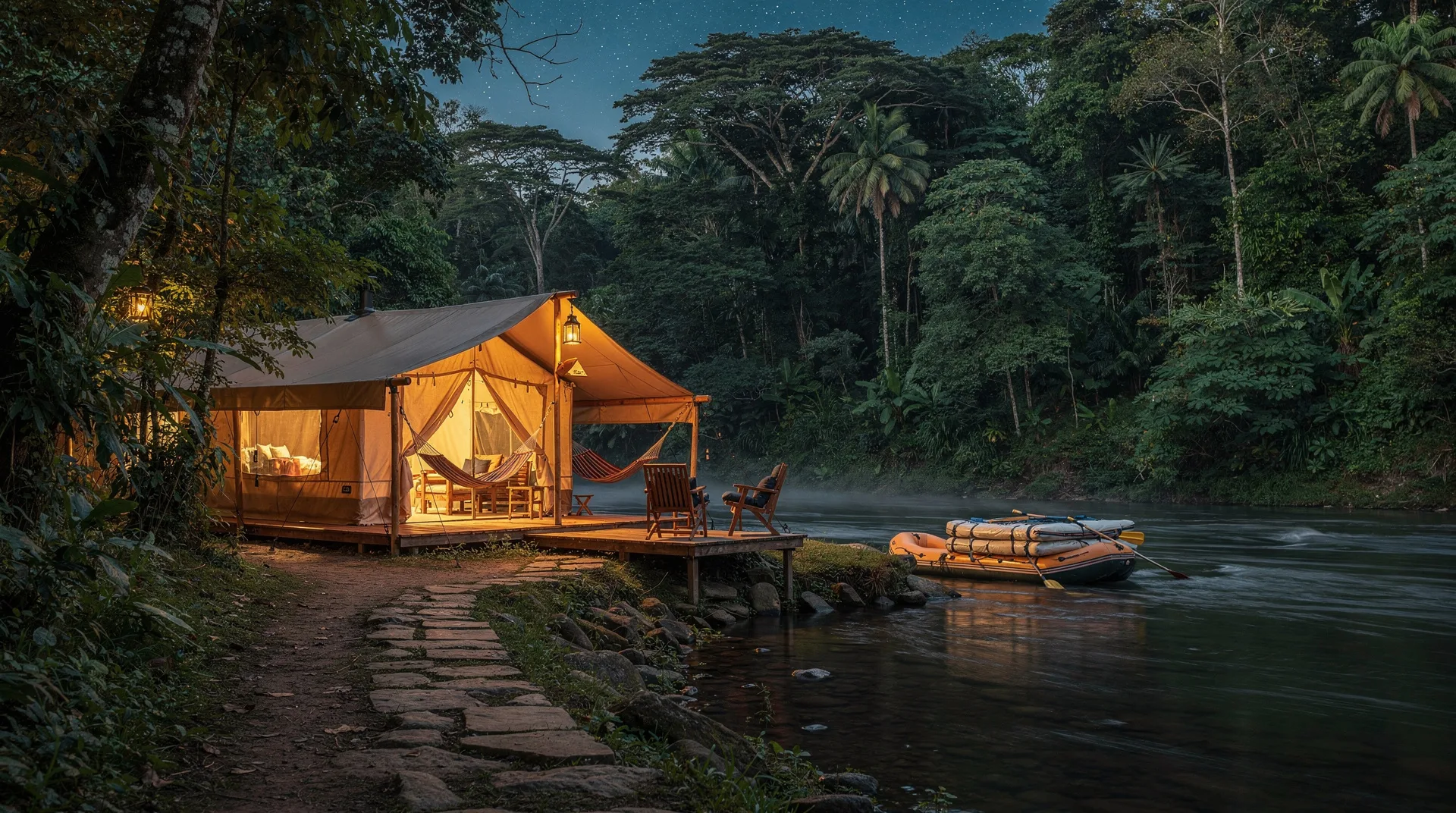
Multi-day Pacuare River expeditions: lodges, logistics, and what to expect
2-day Pacuare expedition with lodge stay?
Yes — Pacuare Lodge and Río Pacuare Lodge both offer overnight stays inside the river canyon, accessible only by raft or helicopter. Sleeping in jungle treehouses or riverside bungalows, waking to waterfall sounds. Costs $400-600 per person for the 2-day expedition.
Why the overnight Pacuare expedition is in a category of its own
The Pacuare River is extraordinary on a single day. But sleeping inside the canyon — waking at 5am to mist rising off the river, howler monkeys in the canopy above your treehouse, birdsong instead of alarm clocks, and the smell of primary forest without any road within hours — is something qualitatively different.
The 2-day Pacuare expedition is not simply a longer rafting trip. It is access to a place that most of the world cannot reach: a roadless jungle canyon in one of the world’s most biodiverse countries, with no power lines, no traffic noise, and no mobile signal. The lodges inside the canyon exist because the only way to get there is by raft or helicopter. That inaccessibility is precisely the point.
This guide covers both main lodges, how the expedition works across two days, pricing, and how to decide whether the investment is right for your trip.
| Pacuare Lodge | Río Pacuare Lodge | |
|---|---|---|
| Price (2D/1N) | $400-550/person | $350-480/person |
| Access | Raft in, helicopter option | Raft in, helicopter option |
| Style | Full-service, treehouse bungalows | Rustic, riverside, community-focused |
| Booking lead time | 3-4 months (dry season) | 2-3 months |
The two main canyon lodges
Pacuare Lodge
Pacuare Lodge is the original and most celebrated overnight option on the river. Built on a cliffside above the river and accessed only by raft, it is consistently rated among the best eco-lodges in Central America — Condé Nast Traveler named it among the top hotels in the world in multiple years.
The physical setting is extraordinary. The lodge sits at the edge of a waterfall-fed cascade, with bungalows perched above the river and a central dining pavilion open to the jungle. Some accommodations are genuine treehouses — elevated platforms within the forest canopy, with open-air showers and hammocks facing directly into the jungle.
The experience includes not just the rafting but also guided nature walks, night hikes, birdwatching with naturalist guides, and pool time in a waterfall pool. Meals are full service — not camping food but genuine restaurant-quality cooking in a dining pavilion 50 meters from a waterfall.
Getting there: You raft in on day one from the Tres Equis put-in (approximately 5-6 hours on the river including stops), navigate the Class III-IV rapids that make the journey an adventure in its own right, and arrive at the lodge from the river side. The helicopter alternative (landing pad available) is used occasionally by guests with mobility limitations or on very short schedules.
Leaving: Day two on the river covers the lower canyon section — still good Class III-IV water including Terminator and Pinball — before the takeout at Siquirres.
Price: $400-550 per person for the 2-day/1-night package including all rafting, meals, accommodation, and guided activities at the lodge. Does not typically include drinks beyond included beverages.
Booking: Through Ríos Tropicales (who have a partnership arrangement with the lodge) or directly through Pacuare Lodge’s website. The lodge is the only accommodation inside the canyon with established infrastructure.
Río Pacuare Lodge (Aventuras Naturas)
Río Pacuare Lodge (operated by Aventuras Naturas) offers a slightly more rustic but equally remarkable overnight experience further up the canyon. The lodge is smaller and less production-quality than Pacuare Lodge but deeply peaceful — fewer guests, more intimate guides, and a similarly roadless, helicopter-access-only setting.
Accommodation is in riverside bungalows with open-air design that lets the jungle sounds in without compromise. The lodge focuses on sustainability — solar power, composting, indigenous community partnerships with the Cabecar people who have lived in the Pacuare canyon for centuries.
Price: $350-480 per person for the 2-day/1-night package.
Booking: Directly through Aventuras Naturas or through La Fortuna-based operators including Desafio.
La Fortuna: rafting Pacuare & shuttle to SJO or Puerto Viejo — from $140The Desafio shuttle package builds the river transit between La Fortuna and San José (or Puerto Viejo) around the rafting experience — this is the most efficient version of the trip if you are moving between the Caribbean coast and Arenal. If the Pacuare is fully booked or you want a lower-commitment alternative, the Sarapiquí River rafting guide and Reventazón River rafting guide cover Costa Rica’s other main whitewater options, both closer to San José.
How the 2-day expedition works
Day one: the upper canyon
Departure: Hotels in San José, Turrialba, or La Fortuna depending on your operator and itinerary. San José pickup is typically 5:30-6am for the 2.5-hour drive to the put-in at Tres Equis.
Morning: Equipment fitting and safety briefing at the put-in (30-45 minutes). First paddle strokes on calm water as you enter the canyon. The canyon walls close in within the first kilometre — the road noise from the put-in highway disappears completely.
On the water (day one): 5-7 hours including rapids, swimming stops in calm pools, wildlife observation pauses in eddies, and a riverside lunch. The upper canyon contains the most technically demanding rapids: Dos Locos, Pipeline, and Terminator are all navigated before the lodge.
Arrival at the lodge: Late afternoon, typically 3-5pm. Guide-provided river briefing as you unclip at the lodge beach. Time to shower (surprisingly hot water, solar-heated), change, and explore the lodge before dinner.
Evening: Dinner at the lodge pavilion. Optional guided night hike (1.5-2 hours) to observe frogs, sleeping birds, and nocturnal mammals. The night sounds inside the canyon — insects, frogs, the river itself — are overwhelming in the best sense. No traffic, no urban light pollution. The Milky Way is visible from the lodge terrace on clear nights.
Day two: the lower canyon
Dawn: 5-6am is when the canyon is most alive. Mist rises off the water. Toucans move through the canopy. A guided birdwatching walk from the lodge is offered by some operators at this hour.
Breakfast: Full service at the lodge.
On the water (day two): 3-4 hours including the lower canyon rapids. Double Drop, Pinball, and several unnamed but engaging features. The lower section is slightly less technical than the upper but still Class III-IV in parts. By the lower canyon, your paddling is noticeably more confident than day one — two days on the same river shows measurable skill development even in beginners.
Takeout at Siquirres: Mid-afternoon. Transport to San José, La Fortuna, or Puerto Viejo depending on your arrangement with the operator.
Cabecar indigenous communities
The Pacuare canyon is traditional territory of the Cabecar people, one of Costa Rica’s 24 recognised indigenous groups. Small communities exist in the canyon without road access. Both main lodges have established relationships with these communities, and some expedition packages include cultural visits — traditional crafts, medicinal plant knowledge, and explanations of the canyon’s cultural history.
These visits are meaningful if handled respectfully. A good operator uses community-consented and community-benefiting protocols rather than uninvited visits. Ask your operator about the nature and terms of any cultural component.
Wildlife inside the canyon
The roadless canyon corridor is exceptional habitat. Without hunting pressure and with intact forest from the river to the ridge, the Pacuare zone supports populations rarely seen in accessible areas:
Mammals: Tapir tracks are regularly found on the lodge beaches (tapirs come to drink at dawn and dusk). Ocelots and jaguars use the corridor. River otters are occasionally seen from rafts. White-faced capuchin, howler, and spider monkey troops use the riparian forest.
Birds: The canyon’s continuous forest allows specialist species absent from fragmented habitat. Sunbittern (one of the most spectacular riverside birds in Central America), harpy eagle (extremely rare, but documented in the canyon), and over 350 species total have been recorded along the Pacuare corridor.
Reptiles: Spectacled caiman in the lower river section. Fer-de-lance snakes in the riverside vegetation — guides point these out without alarm as a normal part of the ecosystem. Green basilisk lizards on every sunny boulder.
Is the expedition worth the price premium?
The 2-day expedition costs $350-550 per person compared to $120-140 for a single-day Pacuare trip. The question is whether that premium (approximately $250-400 more) is justified.
Our honest assessment: for visitors who care about the quality of the experience rather than simply completing an activity, the answer is yes without reservation. The single-day Pacuare is excellent. The 2-day expedition is transformative. The difference is roughly equivalent to eating a good meal at a restaurant versus cooking the same ingredients over a campfire in the location where they were grown — the ingredients are the same, the experience is incomparably different.
For couples on honeymoon or a significant trip, for adventure travellers who have rafted before and want to go deeper, and for anyone willing to spend on experience over objects, the multi-day expedition is one of the best investments you can make in Costa Rica.
If budget is a genuine constraint, the single-day Pacuare is not a compromise version — it is still one of the best river days in the world. But the overnight is better.
Booking logistics and lead time
Pacuare Lodge books up months in advance for dry-season dates (December-April). In high season, availability at the lodge fills by August-September for December-January slots. Book at least 3-4 months ahead for peak season.
Río Pacuare Lodge / Aventuras Naturas has slightly more availability but also fills in peak season. 2-3 months ahead is a reasonable minimum.
Green season (May-November) bookings are more flexible. Late November start to December is an excellent shoulder-season option — water levels still elevated, lodge capacity available, lower prices at nearby hotels before Christmas rates kick in.
Pacuare River rafting (from Turrialba) — from $120The Turrialba-based single-day trip is the baseline for comparison and a good option if the lodge is fully booked.
Frequently asked questions about multi-day Pacuare expeditions
Is the Pacuare Lodge suitable for non-rafters?
Pacuare Lodge is accessible by helicopter for guests who do not raft. Some lodge guests arrive by air, spend 2-3 nights at the lodge enjoying guided hikes and the location without rafting, and depart by raft on the final day. This is an expensive but real option for travel companions who want the lodge experience but cannot or will not raft Class IV.
Are meals included?
Yes, for both main lodges. All meals, non-alcoholic drinks, and guided activities at the lodge are included in the expedition package pricing. Alcoholic drinks are charged separately.
Can I do the expedition as a solo traveller?
Yes. Both lodges accept solo bookings and place solo travellers in small groups (6-10 people per raft, usually 2-3 rafts per expedition day). You will share the lodge with other guests who may or may not be in your raft group. It is a social experience regardless.
What if I need to leave the canyon unexpectedly?
Medical emergencies are handled by helicopter evacuation — both lodges have clearings accessible by helicopter. For non-emergency exits, the only option is to raft downstream (the fastest route out). There is no road access. This is why health and fitness screening is done at booking.
What is the signal situation?
No mobile signal inside the canyon. Both lodges have satellite-based internet that is available for brief essential communication but is not a streaming-quality connection. This is a feature, not a bug — the disconnection is part of the experience.
Can I bring my camera?
Absolutely. A waterproof case or underwater housing for your camera is essential on the river. Bring a separate dry bag (provided or bring your own) for lenses and batteries. The lodge has charging points. GoPro helmet mounts produce the best action footage on rapids.
What to eat and drink on the river expedition
Both main lodges provide full meals, but the quality and style differ:
Pacuare Lodge serves formal sit-down meals in the main pavilion. Breakfast is a full hot spread with eggs, rice, beans, fresh fruit, bread, and coffee. Lunch on the river is a packed meal eaten riverside — typically sandwiches, fresh fruit, and nuts. Dinner at the lodge is the meal where the kitchen truly performs: fresh-caught fish (from sustainable sources), tropical vegetables, and desserts that surprise visitors expecting camp food. Dietary restrictions (vegetarian, vegan, celiac) are accommodated with advance notice.
Río Pacuare Lodge / Aventuras Naturas is more informal. Meals are family-style, served at a communal table, with fresh local ingredients prepared simply. The lodge grows some of its own vegetables and sources from nearby farms. The intimacy of the dining setting — 8-12 guests at one table, sharing the same day’s river experience — creates a communal atmosphere that many visitors cite as a highlight.
On the river: Riverside lunch stops on both day one and day two of the expedition are taken in eddies or on sandy beaches. The guide team typically prepares a light spread. Water is carried by guides and should be supplemented by a personal water bottle. Dehydration on a full river day is a real risk — the combination of physical exertion, sun exposure, and not thinking to drink in an exciting environment leads to headaches by mid-afternoon if you are not consciously hydrating.
Alcohol: Beer and spirits are available at both lodges at additional cost. There is typically a social gathering around the dinner table in the evening where drinks are part of the atmosphere. Alcohol during rafting is strictly prohibited by all legitimate operators.
The pre-expedition preparation that makes the difference
Visitors who prepare for the expedition physically and logistically have a markedly better experience than those who arrive unprepared.
Physical preparation: The rapids themselves do not require exceptional fitness — the guide does most of the navigation work. But two things help significantly: core strength (for maintaining position in the raft through sustained turbulence) and cardiovascular fitness (for the return hike if an emergency takeout is needed). A month of regular swimming, cycling, or rowing before the expedition is genuinely helpful.
Packing for the lodge: The lodge provides linen, towels, and basic toiletries. What you need to bring: 2-3 days of quick-dry clothing (you will be wet for much of each river day), a buff or balaclava for cold early-morning starts, a headlamp (the canyon is very dark once the lodge generator turns off), and a dry bag for anything you want to keep dry on the raft. Both lodges have charging points but capacity is limited — one device at a time.
Mental preparation: The canyon’s enforced disconnection from mobile networks is significant for first-time visitors. A two-day window without social media, email, or news access is something many visitors describe as unexpectedly valuable but initially uncomfortable. If being unreachable for 48 hours creates serious work or personal anxiety, plan the expedition at a time when it is genuinely acceptable to be offline.
Day zero logistics: Arrange the drive to the put-in with your operator in advance, confirm pickup times, and have all equipment organised the night before. Missing the launch window is a significant problem — the river schedule is fixed by tidal and daylight constraints in the lower canyon.
Environmental sustainability at the Pacuare lodges
Both main lodges have made genuine investments in sustainable operations that go beyond the typical greenwashing of eco-lodge marketing:
Pacuare Lodge: Solar power for most energy needs, composting of all organic waste, grey-water treatment systems, and a reforestation program on degraded land adjacent to the lodge. The lodge holds Sustainable Tourism Certification (CST) Level 4 — the highest attainable under Costa Rica’s certification system, awarded to fewer than 5% of accommodation in the country.
Río Pacuare Lodge / Aventuras Naturas: Solar and micro-hydro power combination, zero single-use plastic policy (water is served from filtration units rather than bottles), and a community partnership with the adjacent Cabecar community that includes employment, healthcare support, and educational funding.
Booking at either lodge is a more sustainable choice than most Costa Rica accommodation options. The isolation that makes them remarkable as experiences also makes them logistically challenging to operate sustainably — both lodges have invested significantly to achieve it. For how the expedition costs compare against other adventure activities across the country, see our Costa Rica adventure tour pricing guide.
Fitting the expedition into a wider trip
The canyon overnight works best as a fixed point that the rest of the route bends around. Because the river schedule is set by your operator, book the expedition first and then choose hotels either side of it. The base town for most departures is Turrialba, and the takeout side connects naturally to the Caribbean coast, so Puerto Viejo and Tortuguero are easy follow-ons for a trip that moves from river to sea. If you are heading the other way, La Fortuna and San José are the usual bookends. A good wet-season trip can also pair the expedition with some of the lighter adventure options: the same operators often run canyoneering in Arenal as a contrast to the river.
Two sample routes show how the expedition slots in. The 10 days eco-luxury itinerary treats the lodge night as its centrepiece, while the 12 days adventure itinerary uses it as the first big physical day before heading south. For a shorter trip, the 7 days quick Caribbean itinerary shows how to keep the river and the coast within one week.
For the transfers that frame the trip, our shuttle services overview and rent a car or not guides help you decide between a shared shuttle and driving yourself. A river day also changes what you pack, so check the Costa Rica packing list and think about travel insurance, since there is no road out of the canyon. Timing matters too: the best time to visit Costa Rica explains how the seasons shape river levels and lodge availability.
Finally, the canyon is a wildlife corridor, and a few habits make a difference. Keep your distance from animals on the lodge beaches, never feed anything, and follow your guide’s lead. Our wildlife watching ethics guide and the broader Costa Rica wildlife overview set out what good practice looks like.
Related guides
The full single-day Pacuare experience is covered in our Pacuare River rafting guide. For the 7-10 day adventure circuit that includes the expedition, see extreme adventure routes. The rafting class comparison explains what Class III-IV means in practical terms for a first-timer considering the expedition.