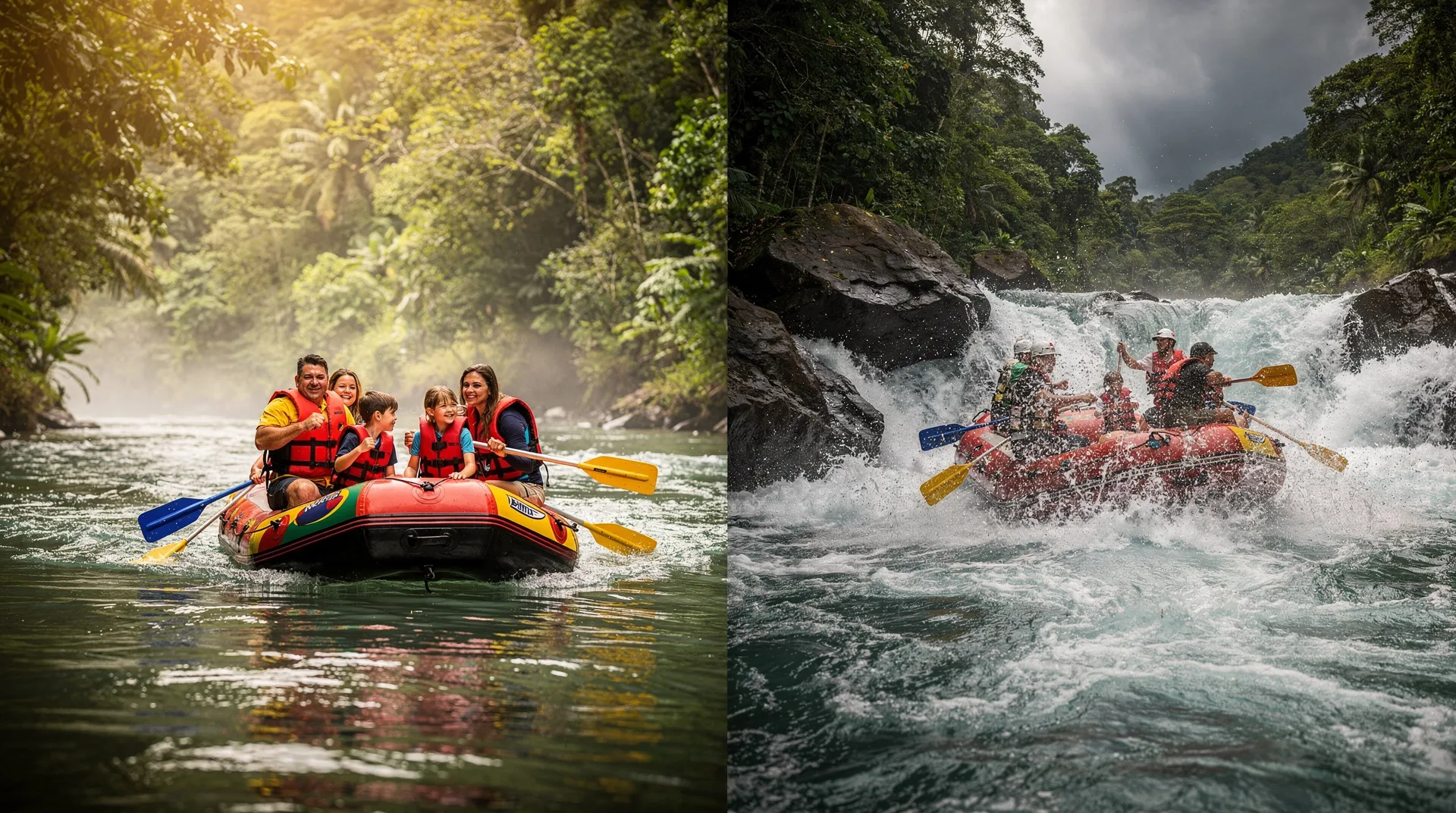
Rafting class comparison: the International Whitewater Scale explained for Costa Rica
What does class III vs IV mean?
The International Whitewater Scale runs from Class I (calm) to Class VI (unrunnable). Class III means regular waves and manoeuvring required; Class IV means powerful, unavoidable features requiring precise paddling. Costa Rica's Sarapiquí is II-IV, the Pacuare is III-IV.
Understanding the International Whitewater Scale before you book
Before booking any rafting trip in Costa Rica, you will encounter a class designation — “Class II-III”, “Class III-IV”, or similar. These numbers come from the International Whitewater Scale (also called the International Scale of River Difficulty), a six-point classification system adopted globally to help paddlers and trip operators communicate river difficulty.
The system is not perfect. A Class III rapid in high water can behave like Class IV; the same rapid at low water might read as Class II. But the classifications are the universal shorthand used by operators, guides, and paddlers worldwide, and understanding them prevents unpleasant surprises.
This guide explains each class in real-world terms, maps them to Costa Rica’s specific rivers, and helps you select the right trip for your experience level and goals.
| Scale | Class I (easy) to Class VI (unrunnable) |
| Costa Rica range commercially offered | Class II to Class IV (occasionally IV-V at flood stage) |
| Minimum age | 8-10 for Class II-III rivers, 12-16+ for Class IV |
| Best rivers by level | Savegre/Sarapiquí upper (II-III), Pacuare (III-IV) |
| Key variable | water level — the same river can shift a full class with rainfall |
The six classes explained
Class I: easy
Flat water to small riffles with no significant obstacles. No maneuvering required. Self-rescue after capsizing is trivial. Examples: the lower sections of many Costa Rican rivers near estuaries, calm lake crossings, and the flat approach sections of most commercial put-ins.
Costa Rica equivalent: The flat water approach on some Sarapiquí entry sections before the first rapids. No commercial touring is marketed as Class I because it would not justify a rafting trip — it is essentially a canoe lake.
Who it suits: Anyone. The minimum for meaningful rafting is Class II.
Class II: beginner
Regular waves and small rapids with easily identified routes. Occasional maneuvering around obstacles. Self-rescue is easy in calm water between features. The experience is engaging and wet without requiring technical skill.
What it feels like: The raft bounces through a series of standing waves that splash over the bow. The guide shouts “forward” and you paddle. The river spins the raft slightly between rapids. You are never in genuine danger of serious consequences.
Costa Rica equivalent: The upper section of the Sarapiquí Class II-III run when water is low, and calm pool sections between rapids on most commercial rivers.
Who it suits: Families with children from age 8, anyone who wants the river experience without adrenaline, and beginners building confidence before attempting Class III.
Class III: intermediate
Moderate, irregular waves with more complex maneuvers required to avoid obstacles. Scouting from the bank may be necessary in unfamiliar water. Swimmers (people who exit the raft) face moderate difficulty and rescue may require assistance. The experience is genuinely exciting and physically engaging.
What it feels like: The raft is pushed and twisted by the current. The guide’s commands matter — “left turn” and “forward hard” are instructions that change the outcome rather than just adding paddle power. You get fully wet. Some rapids require two or three coordinated paddle strokes to hit the correct line. Missing the line means bouncing off a rock, which is startling but usually not dangerous.
Costa Rica equivalent: The main Sarapiquí commercial section, the lower Reventazón downstream section, the Savegre commercial section, and the calmer portions of the Pacuare between its major drops.
Who it suits: First-time rafters on commercial trips with experienced guides, physically fit adults, families with teenagers, and anyone comfortable being splashed and having moderate control of the raft.
Class IV: advanced
Powerful, predictable features demanding precise boat handling in turbulent water. Scouting mandatory on unfamiliar sections. Risk to swimmers is real and self-rescue can be difficult. Strong hydraulics and significant holes are features of Class IV water.
What it feels like: At Class IV, the river asserts itself. Individual rapids last 15-45 seconds of concentrated effort — the guide may shout five commands in rapid succession, and the raft responds imprecisely even with good paddling. The hydraulic at the base of a Class IV drop can recirculate a raft or swimmer, holding them in the same spot rather than washing them downstream. Guides position themselves in eddies below major features for this reason. A swim in Class IV water is not catastrophic with prepared guides and proper technique, but it is more consequential than a Class III swim — expect to be moved quickly through a turbulent section before reaching calm water.
What you see: In a commercial Class IV rapid, the water “stacks up” — the hydraulic creates a visible wave that breaks back on itself (a “hole” or “hydraulic”). The raft typically enters with enough speed to punch through rather than getting caught. The sound is significantly louder than Class III.
Costa Rica equivalent: Pipeline, Terminator, Double Drop, and Dos Locos on the Pacuare. The Sarapiquí Jungle Run’s peak sections at high water. The pre-dam sections of the upper Reventazón (now submerged).
Who it suits: Physically fit adults without significant mobility limitations. Prior rafting experience is helpful but not required on commercial trips with experienced guides. The guide team’s competence becomes the primary safety factor at Class IV.
Class V: expert
Extremely difficult, long, and violent rapids. Scouting essential. Rescue difficult. Significant risk to swimmers even with expert backup. Some Class V features are appropriate for commercial trips with highly experienced guides; others are not.
What it feels like: Sustained violent water without rest between features. Multiple hydraulics in sequence. Swimming in Class V without immediate rescue support is life-threatening. Most Class V rapids are run with lead kayak safety, not just raft guides.
Costa Rica equivalent: The pre-dam El Bajo and El Tucán sections of the Reventazón (now lost to the reservoir). Occasional Pacuare features at extreme flood stage. Some upper Sarapiquí creek-boating sections above the commercial put-in.
Commercial availability in Costa Rica: Essentially none for general tourists. Legitimate operators do not run Class V sections with commercial guests who have no kayaking background.
Who it suits: Experienced paddlers who have completed multiple Class IV+ runs and are comfortable with genuine risk management. Not a tourist activity.
Class VI: unrunnable
The maximum category. Rapids that cannot be run safely even by expert paddlers. Falls into this category include waterfalls above 10 meters with dangerous landing zones, boulder sieves, and hydraulics with no escape route.
Costa Rica equivalent: Certain creek drops in the Talamanca range, some upper Savegre gorge sections, and specific features in the highest-flow periods of all major rivers.
Commercial availability: Zero. Portage only.
How water level changes the class
The most important caveat to the entire scale: water level changes everything.
The Pacuare runs as a Class III-IV river at average dry-season flow. At October flood stage (the peak of the Caribbean rainy season), the same section runs Class IV-V. The hydraulics are bigger, the holes more recirculating, and the swim consequences significantly more serious.
This is why operators’ seasonal adjustments matter. A reputable operator in Costa Rica will:
- Check river gauge readings before every departure
- Modify or cancel trips when flow exceeds safe limits for commercial guests
- Brief guests honestly about conditions rather than minimising what they will encounter
If an operator tells you “the river is always Class III-IV” without referencing current conditions, that is a yellow flag — the correct answer acknowledges variation.
Applying the scale to Costa Rica’s commercial rivers
Arenal: rafting Sarapiqui River day tour Class II-III — from $85| River | Season | Class | Commercial? | Minimum age |
|---|---|---|---|---|
| Savegre | Dry | II-III | Yes | 10 |
| Sarapiquí upper | Dry | II-III | Yes | 8-10 |
| Sarapiquí upper | Wet | III | Yes | 10 |
| Reventazón downstream | Year-round | III | Yes | 10 |
| Sarapiquí Jungle Run | Dry | III-IV | Yes | 12 |
| Sarapiquí Jungle Run | Wet | IV | Yes (experienced guides) | 14 |
| Pacuare | Dry | III-IV | Yes | 12 |
| Pacuare | Peak wet (Oct) | IV-V | Limited; operator discretion | 16+ |
| Upper Reventazón (pre-dam) | Historical | IV-V | No longer exists | — |
The “plus” convention and half-class ratings
You will sometimes see “Class III+” or “solid Class III” in descriptions. These informal designations indicate that the section is at the upper end of Class III — more demanding than a typical III but not consistently a IV. Costa Rica’s Pacuare is often described as “Class III-IV” precisely because some rapids are solid III and others are genuine IV.
Do not let the plus convention mislead you. “Class III+” means you should be comfortable with Class III and aware you will encounter Class IV features. It is a warning to prepare for the harder end of the range, not a guarantee that the worst features will be the IV-level ones.
What “commercial” Class IV actually means
Here is the critical distinction that most booking descriptions do not make explicit: commercial Class IV (what you experience on a guided tourist raft) is different from paddling Class IV in your own kayak or leading your own raft.
On a commercial tour:
- An experienced guide is in the back of the raft reading the river and executing primary steering
- You follow commands rather than making independent navigation decisions
- The operator has pre-scouted every rapid hundreds of times and knows the safe lines
- Safety kayakers may be positioned below key features
- Rescue protocols are practiced
In this context, a fit adult with no prior rafting experience can safely complete a commercial Class IV river. The guide’s skill translates a IV into an accessible experience. Trying to run the same rapid in a rental kayak without guide support is a different proposition entirely.
This is why “I have never rafted before, should I do the Pacuare?” has a more nuanced answer than the class rating alone suggests: with a qualified commercial operator, yes. Without one, no.
Choosing the right class for your group
First-time rafters, families with children 8-12, visitors uncertain about comfort with cold water: Sarapiquí upper section (Class II-III) or Savegre (Class II-III).
First-timers who are physically fit and comfortable with rough water: Sarapiquí Jungle Run (Class III-IV) or Pacuare single day. Most participants describe the Pacuare as within their comfort zone once on the water.
Experienced swimmers and athletes who want maximum intensity: Pacuare in high water (May-October), or the Sarapiquí Jungle Run in wet season when flows are elevated.
Visitors with children under 10: Savegre is the only appropriate option for groups with young children. Most operators will not put children under 10 on the Pacuare.
Rafting Class 3-4 "Jungle Run": Río Sarapiquí — from $95Frequently asked questions about the International Whitewater Scale
Is there a universal standard for Class IV, or does it vary by country?
The International Whitewater Scale is a global standard used by all professional rafting bodies. However, there is inherent subjectivity in classification — a Class IV in New Zealand may feel different from a Class IV in Costa Rica due to water temperature, canyon topography, and individual rapid characteristics. The scale is useful for orientation, not for precise comparison across rivers.
If I have done Class III, am I ready for Class IV?
Generally yes, as a commercial passenger with an experienced guide. The jump from III to IV is significant but manageable in the context of a well-run commercial operation. What matters more than prior experience is physical fitness, comfort with being submerged briefly, and willingness to follow guide commands promptly.
Why do operators use ranges like “Class III-IV” instead of a single number?
Because rivers are not uniform. The Pacuare has sections of Class II flatwater between major rapids and reaches Class IV at its most demanding features. A range reflects the variation on the river rather than making a false average. Always interpret the range as “this is the highest class you will encounter” for safety planning.
How does rainfall affect the class on the day?
A significant rainfall the previous day or overnight can raise a Class III river to Class IV. Responsible operators check gauge data before departure. Do not be surprised if your operator calls you the morning of to discuss conditions — this is a sign of professionalism, not of a disorganised operation.
Are there Class V commercial tours available in Costa Rica?
Not to our knowledge, as of April 2026. Some operators run very high-water Pacuare trips that approach Class V in isolated features, but these are not marketed as Class V and typically run only with guides who have personal Class V river experience. Any operator advertising a “Class V commercial tour” for general tourists warrants very careful vetting.
How guides read a river: the skill behind the classification
Understanding how guides assess rapids in real time adds useful context to the classification system.
When a guide approaches an unfamiliar rapid (even guides who know a river well re-evaluate in changed conditions), they look for:
The tongue: The smooth V-shaped chute of fast, clean water at the top of a rapid that indicates the deepest, clearest path through. Entering the tongue correctly sets up the entire rapid run.
Holes and hydraulics: These are identified by the foamy, aerated water downstream of a submerged obstacle. The water “falls in” on itself, creating recirculation. The guide classifies the hole’s severity by its width, depth, and whether the downstream flow can flush a swimmer out (a “flushing hole”) or tends to hold them (a “keeper hydraulic”). Class III holes are flushing. Class IV holes can be keeper at certain water levels.
Eddy lines: The boundary between downstream-flowing current and the upstream-circulating water behind obstacles. Guides use eddies as rest stops, scouting platforms, and safety positions. Eddy lines in fast water create an abrupt rotational force on the raft — guides who know a river will call “left forward” or “right back” as you cross an eddy line to compensate for the spin.
Reading waves: Standing waves indicate consistent deep water over a submerged feature. Breaking waves (where the top of the wave curls over) indicate shallower water or a more powerful hydraulic below the surface. A series of clean standing waves is the ideal “read” for a straightforward rapid run.
This skill accumulates over thousands of hours on rivers. The guide who has run the same Pacuare section 400 times will see lines that an experienced paddler visiting for the first time cannot perceive. This is why the guide-to-guest relationship in commercial rafting is genuinely the primary safety factor — your paddling contributes, but the guide’s line choice determines the outcome.
River communication: the commands you will hear
Every commercial rafting guide uses a standardised set of commands. Knowing them before you get on the water makes you a more responsive crew member:
“Forward” or “Paddle forward”: Everyone paddles forward together, hard.
“Back paddle”: Everyone paddles backward. Used to slow the raft or back away from an obstacle.
“Left turn” or “Turn left”: Left side of the raft (from the perspective of someone facing forward) paddles backward while the right side paddles forward. This turns the raft left.
“Right turn”: Opposite — right side back paddles, left side forward paddles.
“Hold on” or “Down”: Stop paddling and grab the safety rope along the inside of the raft. Used when impact is imminent.
“High side”: Get your weight to the higher side of the raft immediately — used when the raft is being pushed toward a flip by a hydraulic and counter-weighting might save it.
“Stop”: Straightforward — stop paddling completely.
Practice these commands mentally before your trip. The difference between a crew that responds in two seconds and one that responds in half a second is meaningful in Class IV water.
Understanding “swims”: when people exit the raft
Involuntary exits from the raft — “swims” in paddling terminology — are not failures. They are anticipated events that all commercial guides prepare for. On the Pacuare in dry season, most guided trips do not produce any swims. At high water, swims are more common even in experienced groups.
The correct procedure if you exit the raft:
- Curl into a ball briefly to protect your feet and hands from hitting rocks
- Roll onto your back, feet pointing downstream, arms out for balance
- Do not fight the current — float defensively until you reach calmer water
- Grab the throw bag rope if a guide throws one to you — wrap it around your wrist and let them pull you to an eddy
- If you reach the bank, exit and stay put — the raft will come to you
The defensive position (back, feet downstream) is counterintuitive when you are in fast water — every instinct says to flip onto your front and swim. Guides spend significant time in the briefing making this correct response habitual rather than instinctive.
The first-time commercial rafter: realistic expectations
If you are booking a commercial Costa Rica rafting trip and have never been in a whitewater raft, here is what to realistically expect:
You will be surprised by how cold the water is: Even tropical rivers feel cold when you are suddenly submerged at full speed. The Pacuare runs at 22-24°C — not cold by most measures, but the contrast with air temperature and the sudden immersion creates a visceral shock response.
The noise is bigger than expected: Standing at the edge of a Class III or IV rapid, the sound is significantly more intense than it looks from a distance. This is normal and the guides are calm in it, which helps.
The first rapid feels chaotic: Orienting in moving water while trying to remember four commands and control a paddle simultaneously takes most first-time rafters 2-3 rapids to develop. The learning curve is steep and short.
You will be better at it by the end: Most people report that the last rapid of the day feels dramatically more manageable than the first. This skill development within a single day is one of the genuinely satisfying aspects of commercial rafting.
Matching the class to the rest of your trip
The class you choose also shapes how the rest of your itinerary fits together. A Class III-IV day is tiring, so it works best when the following day is light. Pairing a river day with a relaxed stop such as the hot springs near Arenal gives tired shoulders somewhere to recover, and the La Fortuna area makes a natural base for combining rivers, volcano views and canyoning.
If you are building the trip around the Sarapiquí, the Sarapiquí area sits in the northern lowlands and combines well with wildlife stops. The Pacuare and Reventazón runs usually start from the Turrialba side of the country, so think about transport early; the shuttle services overview and the guide to driving in Costa Rica both help you decide how to reach a put-in.
Wider context for adventure-minded travellers
Rafting is rarely the only adventure on a trip. If you are weighing it against other adrenaline options, the comparison of zip-lining, canyoning and hanging bridges shows how each activity feels. Travellers who want something wetter and more technical than a raft can read about canyoning in Arenal. Anyone keen to stack several activities in one itinerary will find ideas in the 12-day adventure itinerary with Corcovado and the Pacuare.
Packing and safety matter as much as the class. Quick-drying clothes and secure footwear are covered in the packing list, and the general safety guide explains how to think about risk on any outdoor activity. If you are travelling with younger children, the family travel tips will help you decide which river sections are realistic for them.
Related guides
The Pacuare River rafting guide gives the full context for Costa Rica’s premier Class III-IV river. The Sarapiquí River guide covers both sections with operator comparisons. For multi-day adventures using the full spectrum of river experiences, see extreme adventure routes. Full pricing across all rafting options is in how much do adventure tours cost.