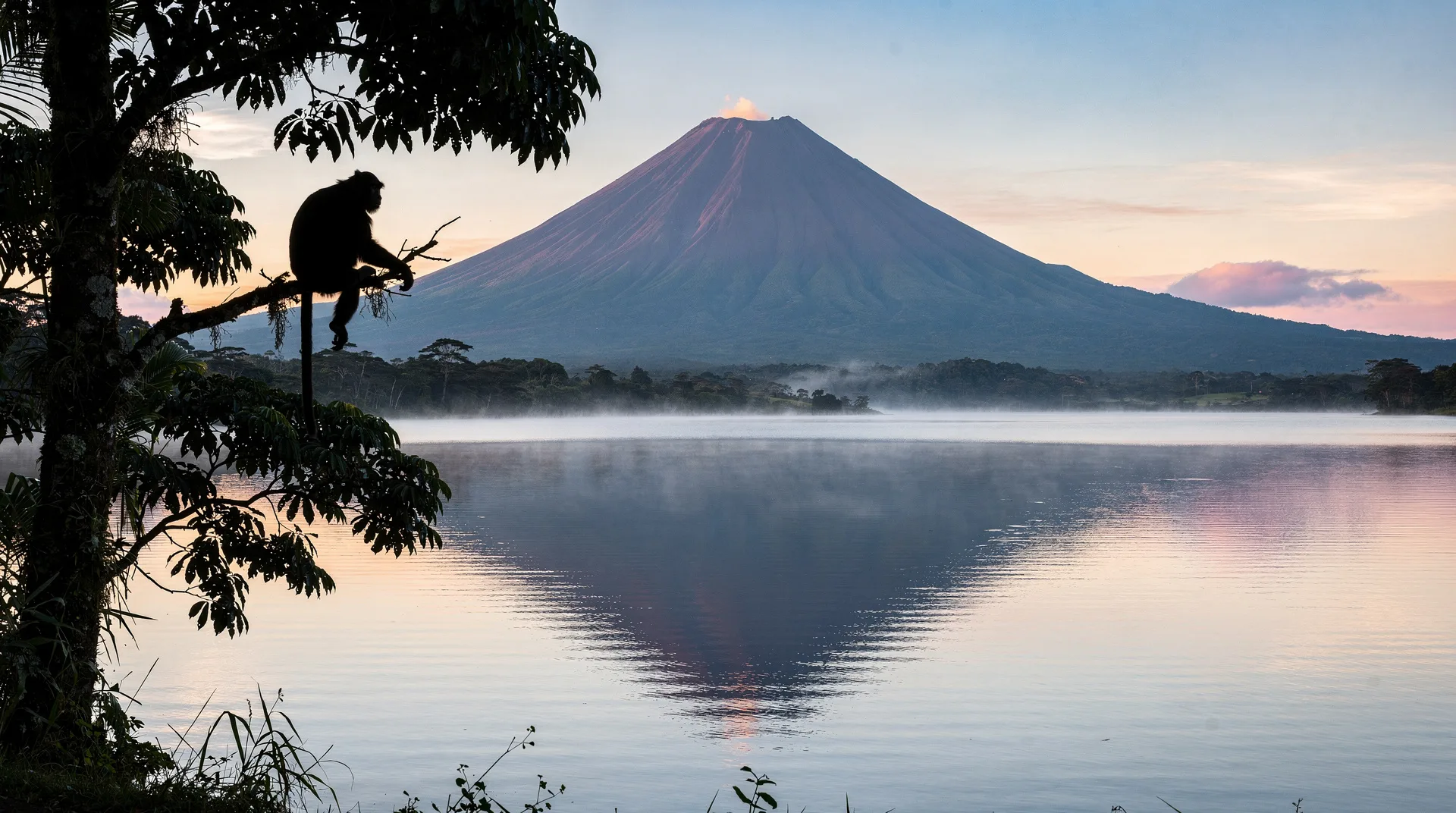
Arenal Volcano National Park: what you can actually do and see in 2026
Can you climb Arenal Volcano?
No. Arenal has been classified as an active volcano since 2010, and all trails leading to the summit or upper cone have been permanently closed. Cerro Chato, the adjacent dormant cone that offered the classic crater lake hike, has also been closed since 2017 for ecological recovery. The park's open trails circle the base and lava fields.
The iconic cone that reshaped Costa Rican tourism
For 42 years — from 1968 to 2010 — Arenal Volcano was in continuous eruption, making it one of the most active volcanoes in the Americas. The eruption began catastrophically on July 29, 1968, when a flank explosion killed 87 people and buried three villages. For the next four decades, Arenal became the defining image of Costa Rica: a perfect conical volcano regularly emitting lava flows, pyroclastic material, and spectacular night-time incandescence that lit up the flanks.
The lava stopped flowing in 2010. Volcanologists now classify Arenal as being in a “resting phase” — still active geologically, still capable of renewed eruptive activity, but currently quiet at the surface. The cloud-wrapped cone that most visitors see today shows no surface lava, though fumaroles and seismic activity continue.
This transition has required La Fortuna’s tourism industry to reframe what the Arenal experience means. The answer, practically, is: the volcano itself is the backdrop, and the surrounding landscape — hot springs, rivers, waterfalls, canopy bridges, cloud forest — is the product. For many visitors, this is entirely sufficient. The cone rising over Lake Arenal on a clear morning remains one of the most spectacular natural panoramas in Central America.
| Entry fee | around $15/person |
| Hours | 8am–4pm daily |
| Can you climb it? | No — summit and Cerro Chato both closed |
| Best time | Early morning for clearest cone views |
| Nearby | Místico bridges, La Fortuna Waterfall, hot springs |
What’s actually open in the park
The national park covers 12,016 hectares around the cone and includes the lava fields of the 1968 eruption and subsequent flows.
Open trails (as of 2026):
Trail 1 — Lava Fields trail (Los Tucanes): A 4km loop through the 1968 lava field. The trail crosses black hardened lava formations with pioneer vegetation — ferns and early-succession forest growing through the cracks. Excellent for reptile and bird photography. Views of the cone from this trail are outstanding on clear mornings.
Trail 2 — Coladas trail (El Volcán): A 1.8km one-way trail entering the base of the cone through primary and secondary forest. This trail was intermittently closed between 2022 and 2024 for re-routing due to erosion — always check SINAC’s current status before visiting.
Trail 3 — Heliconias trail: A short 1.7km interpretive loop near the park entrance through secondary forest. Best for early morning bird watching.
Cerro Chato is closed: The adjacent dormant cone with its famous crater lake was temporarily closed by SINAC in 2017 for ecological recovery after erosion caused by excessive visitor traffic. As of April 2026, it remains closed. Private landowners adjacent to the trail have created unofficial alternative routes — these are not sanctioned by SINAC and any incidents on them are at the visitor’s own risk.
Entry fee: $15 per person. No advance reservation required — pay at the entrance station.
Opening hours: 8am to 4pm daily.
La Fortuna: waterfall, Arenal Volcano and hot springs tour — from $95If the volcano’s behaviour is what draws you, the guide to volcanic activity in Costa Rica explains what “resting phase” means in practice, and how to see Arenal eruptions is worth a read for the history behind the cone you are looking at. Bring a camera on the lava-field trail; the volcano photography tips cover how to handle cloud, haze and shifting morning light. The surrounding town is covered in the La Fortuna destination page, which helps when choosing where to stay.
Místico Arenal Hanging Bridges Park
The most popular activity in the Arenal area is not technically inside the national park — it is at Místico Park, a private reserve adjacent to the park. The hanging bridges are a network of eight suspension bridges and ground-level paths through primary rainforest, totalling 3.5km.
The bridges span river gorges and forest canopy at heights up to 100m, giving birdwatchers and wildlife photographers access to the mid and upper canopy where toucans, trogons, and hundreds of other species are active. Sloths are frequently spotted from the bridges — the elevated perspective makes spotting them in the Cecropia trees much easier than from the ground.
Místico Park operates separately from the national park and offers both self-guided admission tickets and guided naturalist tours. The guided experience adds significant value for wildlife identification — the difference between seeing and understanding what you are seeing.
La Fortuna: Místico Arenal hanging bridges admission ticket — from $26Bridge walks reward patience: move slowly, stop often and listen before you look. If wildlife is the point of your trip, the where to see sloths guide and the wildlife photography tips will help you get more from the canopy. For a wider comparison of canopy options, see zip-lining vs canyoning vs bridges.
La Fortuna Waterfall: worth the hike
Located 5km from La Fortuna town, the Catarata La Fortuna is a 70m cascade that plunges into a blue-green pool in a canyon below. The descent involves 530 steps (one-way, steep, non-negotiable) and takes 15 to 20 minutes down. The climb back up takes 25 to 30 minutes and is genuinely strenuous in the heat.
The pool at the base is swimmable — one of the great rewards in the area. The water is cold (fed by mountain springs), crystal clear, and surrounded by vertical canyon walls draped in mosses and ferns. Entry fee is around $18 per person. The path is maintained and safe.
La Fortuna: Arenal Volcano and waterfall tour with lunch — from $110Hot springs: the essential context
La Fortuna’s hot spring resorts use geothermal water from the same volcanic system beneath Arenal. The springs are located north of town on the road toward Tabacón. Several resorts have built elaborate pool complexes around them.
Tabacón Grand Thermal Resort: The most famous and most expensive. A river of naturally heated water flows through the resort grounds. Multiple pools of different temperatures, excellent landscaping, and day-pass pricing around $80–100. The premium feels justified for the experience.
Baldi Hot Springs: More affordable ($45–55 day pass), larger pools, and a waterslide complex that makes it popular with families. Less atmospheric than Tabacón but wider pool variety.
Eco Termales: Quieter, limited entry numbers, more intimate. Day pass ~$50. No slide facilities. Recommended for couples and travellers wanting a calm soak over a party atmosphere.
Free alternative — Río Chollín: Locals know a spot under a bridge on the Chollín River where geothermally heated water mixes with cold river flow, creating a warm natural pool. It has no facilities, no safety monitoring, and access is slightly complicated — ask locally in La Fortuna. It is genuinely free and genuinely hot, but without the controlled environment of the resorts.
For a deeper comparison of the paid options, read Tabacón vs Baldi vs Eco Termales. The Arenal hot springs overview and the hot springs day pass guide explain how day passes work, and the free hot springs in Arenal page expands on the Río Chollín option above.
Night wildlife tours at Arenal
The rainforest around La Fortuna comes alive after dark. Guided night walks (typically 6pm to 9pm) organised by local operators cover the forest trails in the hotel zones and park perimeter, spotlighting nocturnal species.
Common night tour sightings include: glass frogs (their translucent bellies make their organs visible), red-eyed tree frogs, boa constrictors draped on branches, kinkajous moving through the canopy, sloths (easier to spot at night when they are more active), and sleeping birds that allow remarkably close approach.
La Fortuna: Arenal Volcano rainforest night tour — from $60 La Fortuna: hanging bridges, Arenal Volcano, and falls tour — from $130Night walks pair well with a quiet morning elsewhere, since you will be out late. For more on what comes out after dark, see the nocturnal wildlife guide, and keep the wildlife watching ethics in mind when a guide shines a light on an animal: keep your distance, skip flash and follow your guide’s lead.
Best views of Arenal Volcano
The cone frequently hides behind cloud — this is a practical reality that no tour operator will volunteer until you ask directly. In dry season (December to April), clear mornings are common. In rainy season, the cone can disappear for days at a time. The best views occur in the early morning before cloud builds.
Best viewpoints:
- Lake Arenal, west shore near Nuevo Arenal: the classic postcard angle with the cone reflected in the lake
- Mirador El Silencio (on the road toward El Castillo): slightly elevated, excellent sunrise angle
- Mistico Hanging Bridges Park: the bridges provide elevated canopy-level views toward the cone
- Nayara Springs and other luxury hotels on the south slope: pool views of the cone at sunset (paying guests only)
Getting around La Fortuna
La Fortuna is a town — accommodation, restaurants, and tour operators are concentrated in the town centre. The national park entrance is about 10km west on Route 142. Most activities (Místico, Tabacón, the waterfall) require either a car, a taxi, or an operator pickup.
Taxi: La Fortuna has official red taxis and unofficial “tourist” taxis. The red official taxis have regulated fares; tourist taxis negotiate. Clarify before getting in.
Rental car: Useful for flexibility, particularly for the national park, lake viewpoints, and hot spring visits. 4WD is not required for the main Arenal circuit but is useful for the Monteverde transfer road.
Shuttle transfers: La Fortuna is on most major shuttle routes — Interbus and GrayLine connect it to San José, Monteverde, Tamarindo, and Manuel Antonio.
Whether to drive or not depends on your route; the rent a car or not guide and the notes on driving in Costa Rica lay out the trade-offs, and the shuttle services overview covers the alternative. Weather also shapes the trip, so check the best time to visit Costa Rica before you lock in dates.
Frequently asked questions about Arenal Volcano National Park
Will I see lava?
No. Arenal’s lava flows stopped in 2010. The volcano is in a resting phase. On a clear night, the cone is sometimes visible with steam and gas emissions from the summit fumaroles, but there is no surface lava.
Is the volcano still active?
Yes — Arenal is classified as an active volcano under continuous OVSICORI monitoring. Geologists note ongoing seismic activity and hydrothermal system processes beneath the surface. Renewed eruptive activity is possible in future decades but there is no current indication of impending eruption.
What is the best time of year to see the volcano clearly?
January and February offer the highest probability of clear views. Morning visits are essential regardless of season — cloud cover builds most days by 10am. The cone is visible on roughly 50 to 60% of dry-season mornings and less frequently in rainy season.
How long should I spend in La Fortuna?
Three to four days is the standard. Day 1: hanging bridges and national park trails. Day 2: La Fortuna Waterfall and hot springs. Day 3: canyoning or ATV tour, night walk. Day 4: optional Caño Negro wetlands day trip or transfer to Monteverde.
Is there accommodation inside the national park?
No. All accommodation is in La Fortuna town (10km east), the El Castillo area (south of the park, quieter and closer to the park entrance), or the luxury lodges on the volcano slopes (Nayara, Tabacón Lodge, Arenal Kioro).
What a first-time Arenal day actually costs
Combining the national park entry with the area’s other pillars gives a realistic sense of budget: park entry ($15) plus a hanging bridges visit ($26 self-guided or ~$55-60 guided) plus an evening hot springs pass ($40-110 depending on resort) puts a single full day at roughly $80-190 per person before food and transport. Spreading the same activities over 2-3 days, as most visitors do, softens the daily spend and avoids the fatigue of trying to cram lava fields, bridges, a waterfall hike, and hot springs into one day.
Where to fit Arenal in your itinerary
Arenal is almost always the first or second major stop on a Costa Rica circuit — its central location makes it a practical base before branching to Monteverde (3 hours via lake crossing), Tamarindo (3.5 hours), or San José (3 hours). The 7-day Arenal and Manuel Antonio itinerary gives you four nights in the area. For a volcano comparison, see Arenal vs Poás vs Irazú and the complete best volcanoes guide. The Arenal vs Rincón de la Vieja comparison helps you choose if your itinerary can only fit one northern volcano destination.