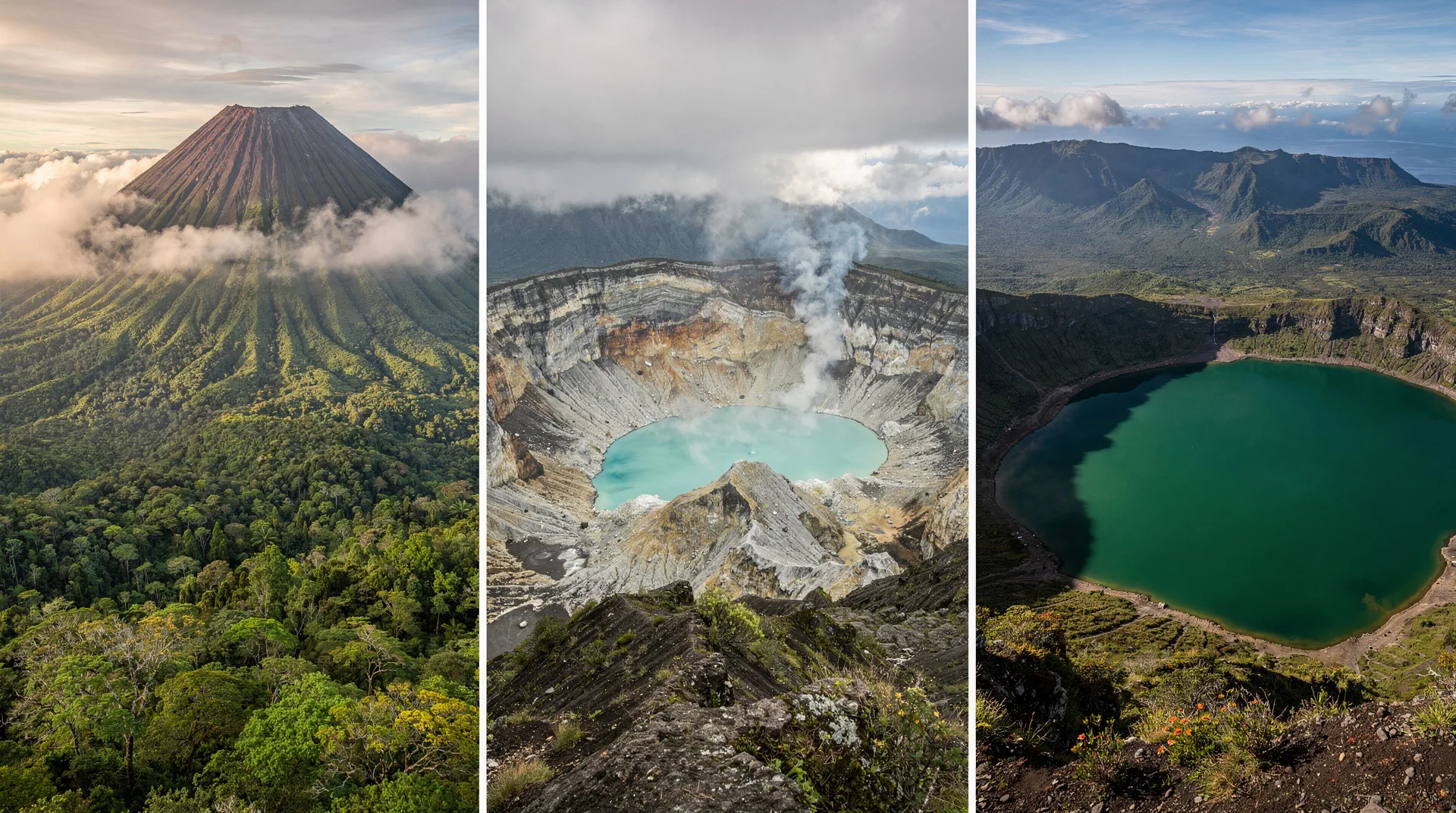
Arenal vs Poás vs Irazú: which volcano is right for you?
Which volcano is best for first-timers?
Arenal for nature, Poás for crater drama, Irazú for views.
Three volcanoes, three completely different experiences
If you have limited time and are trying to decide between Arenal, Poás, and Irazú, know this upfront: all three are excellent, but they are not interchangeable. Each delivers a different kind of experience, suits a different base location, and requires a different level of planning. This guide cuts through the confusion with a direct comparison.
Arenal (1,670 m) is in the northern Caribbean lowlands near La Fortuna. Poás (2,708 m) and Irazú (3,432 m) are both in the Central Valley — Poás to the northwest of San José in Alajuela province, Irazú to the east in Cartago province. If you are based in San José, Poás and Irazú are logical day trips. Arenal requires a 3-hour drive or shuttle to La Fortuna and at least one night there to do it justice.
The short version: first-timers often pick Arenal because the overall destination is richer (hot springs, waterfalls, canopy, wildlife). Travelers short on time and based in San José tend to choose Poás for its dramatic crater or Irazú for the views. Photographers and hikers with a preference for raw landscapes often favour Irazú. Families tend to enjoy Poás for its short walks and the nearby La Paz Waterfall Gardens.
At a glance
| Arenal | Poás | Irazú | |
|---|---|---|---|
| Elevation | 1,670 m | 2,708 m | 3,432 m |
| Drive from San José | 3 hours (overnight needed) | 1.5 hours (day trip) | 1.5 hours (day trip) |
| Reservation required | No | Yes — SINAC, book 4 weeks ahead | No |
| Active crater access | No (resting since 2010) | Yes (viewpoint, gas monitors) | Yes (rim walk) |
| Entry fee | ~$20 | ~$20 | ~$18 |
| Best combined with | Hot springs, waterfalls, wildlife | La Paz Waterfall Gardens, Doka coffee | Orosi Valley, Cartago Basílica |
| Best for | Multi-day nature trip | Crater drama + day trip | Dual-ocean views, photography |
Arenal Volcano — rainforest, hot springs, and the iconic cone
Arenal is the postcard volcano of Costa Rica. Its near-perfect 1,670-metre cone is dramatic even when cloud-covered, and the ecosystem around it — lush rainforest, lake, rivers — gives the destination a richness that Poás and Irazú do not match. The volcano is in a resting phase since its last major eruptive cycle ended in 2010, which means you will not see lava flows, but the landscape and wildlife around it are world-class.
What to do at Arenal
Inside Arenal Volcano National Park, two trails access the lava field and forest. The Coladas trail walks across solidified 1968 lava flows — other-worldly terrain carpeted with pioneer vegetation. Los Tucanes trail passes through transitional forest with good bird and mammal sightings (toucans, coatis, howler monkeys). Neither trail is strenuous. The park is open 8am-4pm; entry is approximately $20.
The hot springs are the other half of the Arenal experience. Tabacón Grand Spa Resort sits directly on a geothermally heated river — its natural-feel pools and jungle setting are genuinely beautiful and worth the $80-100 day pass. Eco Termales is smaller and quieter, with a reservation-only cap that keeps it uncrowded. Baldí has more slides and pools at a lower price point. If budget matters, Río Chollín — a free geothermally heated river under a bridge about 7 km from town — is a legitimate (if basic) alternative, though without safety infrastructure.
La Fortuna: waterfall, Arenal Volcano and hot springs tour — from $95Arenal logistics
- Base: La Fortuna (1-2 nights minimum)
- Drive from San José: 3 hours
- Budget per day: $80-150 (mid-range, including park + hot springs)
- Best combined with: Mistico Hanging Bridges, La Fortuna Waterfall, Tenorio/Río Celeste, lake crossing to Monteverde
Poás Volcano — the most dramatic accessible crater
Poás sits 2,708 metres above sea level in the Cordillera Central. Its main crater — roughly 300 metres wide and 300 metres deep — holds a hyperacidic lake that periodically erupts phreatomagmatic jets of steam and sulfuric acid. After a major eruption in April 2017 forced a prolonged closure, the park reopened with a strict reservation system that limits visitor numbers per time slot.
This caution is warranted. Sulfur dioxide levels at the crater rim can spike without warning, and rangers have authority to evacuate the viewpoint. Air quality monitors are posted at the viewing platform. For most visitors on most days, the experience is safe and extraordinary. The turquoise-green lake, the billowing gas plumes, and the sense of standing on the edge of something genuinely alive make Poás arguably the most viscerally impressive volcano visit in the country.
What to do at Poás
The main crater viewpoint is a 10-minute paved walk from the visitor center. A second trail leads to the extinct Botos Lagoon — a serene, clear-water lake surrounded by dwarf cloud forest. Total time in the park is typically 2-3 hours. There are no strenuous trails.
The surrounding area offers strong complementary activities: La Paz Waterfall Gardens (a world-class attraction with five waterfalls, a butterfly observatory, hummingbird garden, jaguar enclosure, and serpentarium) is 12 km from the park and easily combined. Doka Estate coffee plantation, one of Costa Rica’s oldest haciendas, sits at the base of the volcano on the way up.
Poás Volcano active crater, La Paz Waterfall & birdwatching — from $140 Celeste River from San José — from $135Poás logistics
- Base: San José or Alajuela (day trip)
- Drive from San José: 1.5 hours
- SINAC reservation: Required — book at sinac.go.cr at least 4 weeks ahead for busy dates
- Park hours: 8am-2pm
- Entry fee: Approximately $20
- Best combined with: La Paz Waterfall Gardens, Doka Estate coffee tour
Irazú Volcano — Costa Rica’s highest, with dual-ocean views
Irazú is the highest accessible volcano in Costa Rica at 3,432 metres. It last erupted meaningfully in 1994. Its summit craters — Diego de la Haya holds a greenish sulfuric lake; Playa Hermosa is a dry moonscape — are accessible via a short rim walk from the parking area. The vegetation zone at this altitude is eerie and beautiful: low, windswept plants clinging to grey volcanic soil.
The signature reason to visit Irazú is the dual-coast view. On clear mornings — typically before 8:30am — you can see both the Pacific Ocean to the west and the Caribbean Sea to the east from the crater rim. This is rare anywhere in the world and entirely free once you have paid the park entry fee (~$18). Cloud rolls in from both sides through mid-morning, so timing is critical.
What to do at Irazú
Beyond the craters, the Irazú visit pairs naturally with the Orosi Valley loop — a scenic circuit through the coffee-growing valley east of Cartago that includes the ruins of the 1715 colonial church at Ujarrás and the thermal pools of Orosi town. The Basílica de Nuestra Señora de los Ángeles in Cartago itself — the most important Catholic pilgrimage site in Central America — is 20 km from Irazú and a remarkable stop for those interested in Costa Rican culture.
San José: Irazú Volcano, Cartago city & Orosi Valley tour — from $110Irazú logistics
- Base: San José or Cartago (day trip)
- Drive from San José: 1.5 hours (via Cartago)
- No reservation required — no SINAC advance booking needed
- Park hours: 8am-3:30pm
- Entry fee: Approximately $18
- Best combined with: Cartago Basílica, Orosi Valley, Sanatorio Durán
Head-to-head comparison
| Criterion | Arenal | Poás | Irazú |
|---|---|---|---|
| Elevation | 1,670 m | 2,708 m | 3,432 m |
| Active crater access | No (resting) | Yes (viewpoint) | Yes (rim walk) |
| Reservation required | No | Yes (SINAC) | No |
| Drive from San José | 3 hours | 1.5 hours | 1.5 hours |
| Overnight needed | Yes (1-2 nights) | No | No |
| Complementary activities | Hot springs, waterfalls, wildlife | La Paz, coffee | Orosi, Cartago |
| Cost (park + transport) | $120-180+ | $80-120 | $70-100 |
| Best time to visit | Sunrise or late afternoon | Early morning | Before 8:30am |
| Family-friendly | Very | Very | Moderate |
| Wildlife sightings | Excellent | Moderate | Low |
| Photography value | High | Very high | Very high |
Which volcano to choose for your trip
Choose Arenal if: You have 2+ nights in La Fortuna, want wildlife hiking and hot springs, and are treating the volcano as part of a broader destination rather than a summit-focused experience.
Choose Poás if: You are based in San José with limited days, want maximum crater drama, enjoy combining it with La Paz Waterfall Gardens, and have booked your SINAC entry in advance.
Choose Irazú if: You are based in San José, want the highest elevation with dual-ocean views, and plan to combine it with the cultural circuit through Cartago and Orosi Valley.
Choose all three if: You have 10+ days and are building an itinerary that includes La Fortuna (Arenal), Central Valley (Poás and Irazú as back-to-back days from San José), and want to understand the full volcanic range of the country. Our 10-day Arenal, Monteverde and Manuel Antonio itinerary integrates Arenal into a broader circuit.
The La Paz Waterfall Gardens: Poás’s indispensable companion
If you are visiting Poás, the La Paz Waterfall Gardens complex deserves 2-3 hours on the same day. Set on the slopes of Poás at approximately 1,500 metres elevation, the park contains five distinct waterfalls on the La Paz River, a massive butterfly observatory (the largest in the world under one roof), hummingbird garden, serpentarium, jaguar and puma enclosures, toucan and macaw aviaries, and a trout hatchery.
La Paz is far better than its “tourist attraction” label suggests — the quality of the animal enclosures and garden landscaping is exceptional, and the multiple hanging bridges over the waterfalls produce genuine natural beauty. Entry is approximately $48 for adults (including all exhibits) and the complex is open 8am-5pm. The waterfall trail alone takes 1.5 hours at a comfortable pace.
The combination of Poás (morning, 8am sharp) and La Paz (11am-2pm) produces a full day that covers volcanic crater drama, waterfall scenery, and remarkable wildlife — one of the highest-value single-day itineraries available from San José.
Irazú’s less-visited perspectives: Sanatorio Durán
Two kilometers below the Irazú crater on the descent road sits Sanatorio Durán — a tuberculosis sanatorium built in 1918 and abandoned in 1973. The structure is now an atmospheric ruin open for guided visits. The combination of volcanic landscape, colonial architecture, and the genuinely strange history of the building (including, in later years, a period as a psychiatric hospital and an orphanage) makes for an unusual and memorable stop.
Guided tours of Sanatorio Durán include the history of the building and its patients. The exterior is accessible independently; interior tours require a local guide. Some visitors combine it with the Cartago ruins (the shell of the colonial-era church that has never been completed after a series of earthquakes destroyed early construction attempts) for a full Cartago province historical circuit alongside Irazú.
Practical tips for visiting all three
Getting the most from Poás
Book SINAC entry the moment you know your travel dates — sincas.go.cr is the booking platform. The system opens slots approximately 30 days ahead and popular weekend slots fill within hours. If you miss the online window, arrive at the park gate at 7:30am and hope for cancellations, though this is not reliable during peak season.
Weather at Poás changes quickly. The first 30-minute slot (8:00am entry) has the statistically best chance of clear views. By 9:30am, cloud frequently fills the crater. Check the park’s webcam (accessible through their website) the evening before to assess conditions.
Sulfur dioxide levels at the crater viewpoint are monitored in real time. If your eyes, nose, or throat become irritated during your visit, move away from the crater immediately. Rangers will request evacuation if levels exceed safe limits.
Getting the most from Irazú
The 7am-9am window is critical for dual-ocean views. Drive up early and wait at the gate if needed. Bring binoculars — the ocean views are distant and require magnification for a satisfying experience. Pack a warm jacket (8-12°C at the summit in the morning) and waterproof shoes for muddy paths.
The secondary Playa Hermosa crater (a 10-minute walk from the main Diego de la Haya crater) is quieter and often has better lighting from the northeast. Many photographers prefer it to the main crater viewpoint.
Getting the most from Arenal
Stay a minimum of two nights. The volcano is a backdrop, not a day trip — the hot springs, waterfall, and hanging bridges justify the full stay. Book your Tabacón or Eco Termales slot (especially the latter, which requires reservations) before arrival. Hot springs at sunset, after a national park morning, is the classic La Fortuna day structure.
Consider the lake crossing transfer if your next stop is Monteverde — it is faster than any road option and passes through beautiful lakeside scenery.
Planning around the volcanoes
A volcano visit works best when it fits the rest of your trip rather than dictating it. Start with the base town: La Fortuna for Arenal, and San José for the two Central Valley volcanoes. If you are unsure whether to rent a car for the Central Valley days, our rent a car or not guide and the notes on driving in Costa Rica will help you decide, and shuttle services are a simple alternative for the Arenal leg.
Timing matters as much as transport. Clear crater views depend on the weather, so read about microclimates and compare the dry season with the green season before you lock in dates. Mornings are generally the safer bet at the higher volcanoes, which is why we keep repeating the early start.
If you want more detail on the Arenal side of the trip, the Arenal hot springs overview explains how to choose between the pools, and the Cartago and Orosi Valley page covers the area around Irazú. Understanding why these mountains behave the way they do also helps you read the warnings at the park gates; see understanding Costa Rica’s volcanic activity.
Frequently asked questions about Arenal vs Poás vs Irazú
Can I visit Poás and Irazú on the same day?
Technically possible but not ideal. Both are 1.5 hours from San José in opposite directions — Poás northwest, Irazú east. You would need to start before 6am to do Poás (which requires early morning for clear views) and arrive at Irazú by early afternoon, adding a 2-hour drive between the two. Most travelers are better served splitting them across two days.
Is Arenal still active?
Yes, classified as active. The last major eruptive phase ended in 2010 and the volcano has been in a resting period since. OVSICORI monitors seismic and gas activity continuously. Small phreatic events and gas releases are possible. Summit access is prohibited for this reason.
Do I need advance booking for any of these volcanoes?
Only Poás requires advance booking through the SINAC online reservation system (sinac.go.cr). Arenal and Irazú national parks allow walk-in entry. Poás reservations are essential on weekends and during Costa Rican school holidays — book 4 weeks ahead to be safe.
What’s the temperature at the summits?
Arenal’s base area near La Fortuna is typically 24-32°C. The Poás summit at 2,708 m averages 8-15°C and is often misty. Irazú at 3,432 m is Costa Rica’s coldest national park, averaging 6-12°C with strong winds. Always bring a waterproof layer and fleece for Poás and Irazú regardless of the season.
Are there entrance fees for all three?
Yes. Arenal Volcano National Park charges approximately $20. Poás Volcano National Park charges approximately $20 (included in SINAC reservation). Irazú Volcano National Park charges approximately $18. Most guided tours include park entry in the quoted price — check carefully before booking.
Related guides
For more detail on each individual volcano, see our Arenal Volcano National Park guide, Poás Volcano National Park guide, and Irazú Volcano National Park guide. Planning to photograph these landscapes? Read our volcano photography tips. For the full picture of all six visitable volcanoes, see our best volcanoes in Costa Rica guide.